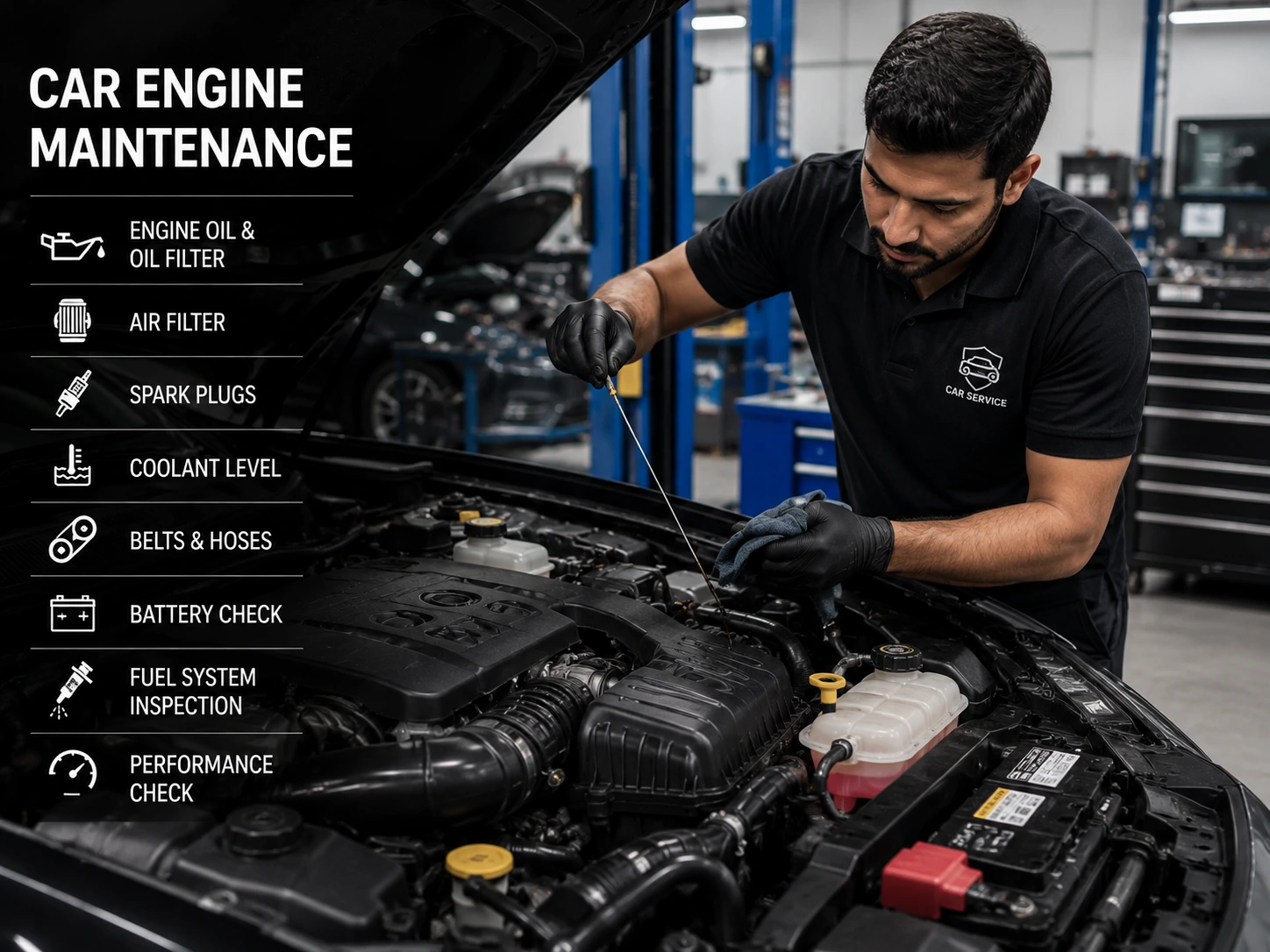
Most major engine failures don’t happen without warning. They happen because the warnings were missed, ignored, or misunderstood. A timing chain that rattles at cold start for six months before it jumps. An oil level that drops gradually without anyone checking until a bearing runs dry. A coolant hose that’s been weeping for weeks before it splits on a 45°C afternoon on Sheikh Zayed Road.
Engine maintenance isn’t complicated — but it requires consistency. The checks that prevent major damage aren’t technical procedures requiring specialist equipment. They’re observations, measurements, and timely actions that any car owner can understand and any competent workshop should be performing as a matter of course.
In Dubai specifically, the stakes are higher than in cooler markets. Sustained ambient temperatures above 40°C accelerate every degradation process inside an engine. Oil breaks down faster. Coolant concentrations drift. Rubber components age faster than service interval charts assume. The margin between “needs attention soon” and “causing damage now” is narrower in a Dubai summer than it is in a London winter.
This covers the checks that matter most, what they reveal, and what happens when they’re skipped.
Engine Maintenance Dubai — Why the Local Environment Changes Everything
The manufacturer’s engine maintenance guidance was written for average driving conditions in temperate markets. Dubai is neither average nor temperate — and the gap between what the service schedule assumes and what Dubai’s conditions actually produce matters practically.
Heat Accelerates Every Wear Mechanism
Engine oil’s primary job is to maintain a lubricating film between metal surfaces under load. That film’s integrity depends on the oil’s viscosity and additive package remaining within specification. In Dubai’s sustained heat, both degrade faster than in cooler climates. An oil that maintains full protection at 10,000 km service intervals in Germany is approaching the limit of its protective capability at 7,000–8,000 km in a Dubai summer.
The consequences of degraded oil aren’t immediately visible. Wear accumulates gradually on timing chain guides, camshaft journals, and turbocharger bearings before any symptom appears. By the time a noise develops or a warning light appears, the damage is already done. Proper engine maintenance addresses oil condition before it reaches the point of causing wear, not after.
Short-Trip Driving Creates Specific Problems
Most Dubai vehicles spend a significant portion of their time on short trips — school runs, supermarket visits, office commutes with extended idle time in traffic. Short trips create a specific set of engine maintenance concerns.
An engine that never reaches sustained operating temperature allows moisture and combustion byproducts to accumulate in the oil rather than being driven off by heat. Over time this creates a sludge-forming condition — the oil thickens, passages narrow, and components that depend on clean oil flow develop restrictions. VVT solenoid screens, timing chain tensioner galleries, and piston ring grooves are all vulnerable to oil sludge from short-trip driving in combination with extended service intervals.
Dubai’s Dust Affects More Than the Air Filter
Fine particulate matter from shamal events and construction dust enters every air intake in the city. Beyond loading the air filter faster than European service intervals assume, abrasive particles that bypass a compromised filter element cause accelerated bore wear in the cylinder walls. This is an engine maintenance concern specific to the UAE that doesn’t feature prominently in manufacturer service documentation.
Engine Maintenance Checks That Matter Most
Engine Oil — Level, Condition, and Specification
The most fundamental engine maintenance check is also the most commonly neglected between service visits: checking the oil level and condition with the dipstick.
Oil consumption between services is normal on most engines — typically up to 1 litre per 5,000 km is within manufacturer tolerance. In Dubai’s heat, some engines consume at the higher end of this range. An engine running 1.5–2 litres low between services isn’t immediately critical, but it’s running on reduced oil volume — higher operating temperature, higher contamination concentration, and reduced margin before a low-oil condition affects lubrication at critical components.
What the Dipstick Tells You
Oil level reads between the minimum and maximum marks when the car is on level ground and the engine has been off for a few minutes. More informative than the level alone is the oil condition visible on the dipstick — a dark brown to black colour is normal for oil that has been in service, but oil that appears milky or grey indicates coolant contamination, which is a serious engine maintenance finding requiring immediate investigation. Oil that smells strongly of petrol indicates fuel dilution, common on engines with injector issues or running excessively rich.
Oil Specification and Service Interval
Every manufacturer specifies an oil grade and approval standard for each engine family — not just a viscosity, but a specific additive package matched to the engine’s design. Using the wrong specification across multiple service intervals in Dubai’s heat contributes to VVT solenoid blockage, timing chain tensioner wear, and carbon accumulation in turbocharger oil feeds. The approval code on the oil container — VW 504.00, BMW LL-04, MB 229.5, Chrysler MS-6395 — is the correct specification indicator, not just the viscosity grade on the front of the bottle.
Engine maintenance oil service interval in Dubai: every 8,000–10,000 km or six months maximum for most petrol engines on full synthetic oil. For turbocharged engines under sustained high-load use, closer to 7,500 km. For diesel engines with DPF systems, follow manufacturer oil-specific guidance but reduce the interval for Dubai conditions.
Coolant System — Concentration, Condition, and Pressure
The cooling system is the most critical engine maintenance system after lubrication — and the one most likely to cause catastrophic engine damage when it fails. In Dubai’s ambient temperatures, a cooling system operating at reduced efficiency has almost no margin before it reaches dangerous territory.
Coolant Concentration Testing
Coolant has two jobs: raise the boiling point of the cooling system fluid above 100°C, and protect internal metal surfaces from corrosion. Both functions degrade as coolant concentration drops from top-ups with plain water or as the additive package depletes over time.
A refractometer test takes 30 seconds and gives a precise concentration reading. Visual checks tell you almost nothing useful about actual concentration. A cooling system showing correct concentration on visual inspection but 30% below specification on a refractometer is a common finding in Dubai used car inspections — and it represents an engine running with minimal boiling point protection in 45°C ambient heat.
Correct coolant concentration for Dubai: 40–50% antifreeze by volume — providing boiling protection to approximately 106–110°C, essential margin in UAE ambient conditions.
Cooling System Pressure Test
A cooling system that loses pressure over time has a leak — either visible or internal. An internal coolant leak into the engine oil is one of the most serious engine maintenance findings: the milky oil on the dipstick, the sweet smell from the exhaust, the coolant level that drops without any visible external leak. Head gasket failure is the most common cause, and catching it early — before extended operation with coolant-contaminated oil — is the difference between a gasket replacement and an engine rebuild.
A cooling system pressure test at every major service catches slow leaks before they become visible problems. It takes ten minutes and catches the faults that develop gradually and quietly.
Thermostat and Water Pump Condition
A thermostat that’s stuck open causes the engine to run below optimal temperature — poor fuel economy, higher emissions, and increased engine wear from incomplete combustion warm-up cycles. A thermostat stuck closed is an immediate overheating event. Thermostat function is verifiable from coolant temperature live data during a proper engine maintenance diagnostic check.
Water pump wear manifests as a slight weep from the pump housing — visible on the ramp as a coolant residue stain. It’s a staged failure designed to give warning before the pump fails completely. On BMW, Volkswagen Group, Porsche, and Mercedes-Benz vehicles with auxiliary electric water pumps, pump function should be specifically verified via diagnostic system — these pumps fail without visible physical indicators.
Air Filter — Inspection Every Service, Not Just Mileage-Based Replacement
The air filter protects the engine from abrasive particulate ingestion. In Dubai’s dust environment, a filter that would be acceptable at 20,000 km service intervals in northern Europe can be significantly restricting airflow at 12,000 km after a sustained shamal event.
A clogged air filter creates measurable engine maintenance consequences: increased intake restriction raises inlet air temperature, forces the ECU to compensate with richer fuelling, reduces throttle response, and increases fuel consumption. On direct injection engines, the higher intake temperatures also increase the rate of carbon deposit formation on intake valve backs.
Physical filter inspection at every service is the correct approach — not a fixed mileage replacement. The filter comes out, is held to light, and is assessed for contamination level. If there’s meaningful restriction, it’s replaced regardless of where the car sits on its service schedule.
Air filter housing seal condition matters equally. A cracked or poorly seated housing seal allows unfiltered air to bypass the filter element entirely — feeding abrasive particles directly to the MAF sensor and combustion chambers. MAF sensor contamination from this cause produces fault codes that look like sensor failure but resolve when the housing seal is replaced.
Spark Plugs — The Ignition System’s Most Overlooked Maintenance Item
Spark plugs on modern engines use iridium or platinum tips that genuinely extend service life compared to older copper plugs — but the extended life claims are based on European driving conditions. Dubai’s short-trip cycle, stop-start urban traffic, and sustained heat create plug fouling conditions that shorten effective plug life.
A plug that’s developing carbon deposits on the tip doesn’t immediately misfire — it misfires intermittently under specific load conditions first, in ways the driver often doesn’t notice. The engine management system compensates, fuel consumption rises slightly, catalytic converters accumulate unburnt fuel, and the ignition system works harder to fire through the increased resistance. By the time a misfire is noticeable to the driver, the plug condition has been suboptimal for some time.
Engine maintenance plug inspection at 40,000–50,000 km — physical removal, gap measurement, and tip condition assessment — catches deteriorating plugs before they cause misfires. On vehicles where plug access requires significant disassembly, replacement at inspection is usually the correct decision regardless of apparent condition.
Timing Belt and Chain — The Catastrophic Failure Nobody Plans For
The timing belt or chain synchronises the relationship between the crankshaft and camshafts. When this synchronisation fails — belt snap, chain jump from wear — the consequences on interference engines are immediate and severe. Valves contact pistons, the engine stops suddenly, and the repair is a cylinder head rebuild or engine replacement.
Timing Belt
Timing belt replacement intervals are hard limits — not suggestions. The belt degrades chemically from heat and age regardless of mileage. In Dubai’s conditions, the heat-ageing component means the mileage-based interval should be accompanied by an age-based limit: many manufacturers specify replacement at 5 years regardless of mileage, and in Dubai’s heat that age limit becomes more relevant, not less.
A belt that hasn’t been replaced at the correct interval on an interference engine is a pending catastrophic engine maintenance failure. There are no symptoms to wait for. Replacement is the only correct action.
Timing Chain
Timing chains don’t require replacement at fixed intervals, but they do wear — and the wear produces specific symptoms before failure. A cold-start rattle that clears within 10–20 seconds as oil pressure builds is the classic timing chain tensioner wear indicator. This sound is the tensioner struggling to take up slack in the chain before oil pressure arrives — on a cold, extended-interval oil, or on an engine where the tensioner feed passages have become partially blocked by oil sludge, this rattle persists longer than it should.
Left unaddressed, a worn timing chain system eventually causes a timing event — the chain jumps a tooth, valve timing goes out, and the engine runs poorly or not at all. Catching the cold-start rattle early makes this an engine maintenance repair. Missing it until the chain jumps makes it an engine rebuild. A proper car service inspection should include timing chain tensioner noise assessment at every visit on applicable engines.
Drive Belt and Auxiliary Systems
The auxiliary drive belt — sometimes called the serpentine belt — drives the alternator, AC compressor, power steering pump, and water pump from the crankshaft. In Dubai’s heat, rubber belt degradation from heat and UV happens faster than in cooler climates. A belt that develops a crack propagation from the back surface is approaching failure — and auxiliary belt failure in Dubai’s heat doesn’t just stop the AC and charging, it also stops the water pump on engines where the water pump is belt-driven. Engine overheating follows quickly.
Belt inspection at every engine maintenance service: check for cracking, fraying, glazing, and correct tension. Replacement at 60,000–80,000 km proactively regardless of apparent condition — the cost of a belt is trivial against the cost of an overheating event from belt failure.
Between Services — What Owners Should Check Themselves
Regular owner checks between services aren’t replacements for proper workshop engine maintenance — but they catch the developing issues that appear between visits.
Oil level — check monthly or every 2,000 km, whichever arrives first. Takes two minutes. Catches consumption trends early.
Coolant level — check monthly with the engine cold. A level that drops between checks has a leak somewhere in the system. Don’t just top up and ignore — find the source.
Warning lights — take any new warning light seriously the first time it appears. The oil pressure light and temperature warning are immediate stop situations. Don’t drive on either.
Unusual sounds — a new knock, rattle, or whine that wasn’t present last week is the engine communicating. Early investigation is almost always cheaper than waiting to see if it gets worse.
For owners who need expert assessment between scheduled services, a qualified car mechanic with proper diagnostic capability investigates developing concerns correctly — not generic reassurance. A mobile car mechanic handles emergency oil top-ups, cooling system assessments, and basic fault checks on-site when the car can’t reach the workshop. For breakdowns resulting from engine failure on the road, proper roadside assistance ensures the car is recovered safely without driving a compromised engine further.
Professional car painting handles any bodywork needed alongside engine service visits — no separate appointments required. For owners in Al Quoz and surrounding areas looking for a garage near me that performs thorough engine maintenance rather than surface-level service — the difference shows in the job card detail and in whether the checks that matter are actually being done.
FAQ
How often should engine oil be changed in Dubai?
Every 8,000–10,000 km or six months maximum — Dubai's heat degrades oil faster than European-market service intervals assume.
What does milky oil on the dipstick indicate?
Coolant contamination from a head gasket fault or internal cooling system leak — requires immediate investigation before further driving.
How do I know if my timing chain needs attention?
A cold-start rattle that clears within 20 seconds as oil pressure builds is the primary indicator — investigate promptly before it develops into a timing event.
Why does my engine consume oil between services in Dubai?
Consumption up to 1 litre per 5,000 km is within most manufacturer tolerances — higher consumption indicates ring wear, valve seal deterioration, or turbocharger seal issues depending on the engine.
Is coolant concentration really important in Dubai?
Critical — correct concentration provides boiling point protection essential in Dubai's ambient temperatures. Diluted coolant provides almost no margin against overheating under sustained load.
Conclusion
Proper engine maintenance in Dubai is the difference between a car that stays reliable for 200,000 km and one that generates expensive repair bills at 80,000 km. The checks that prevent major damage aren’t complicated — correct oil specification changed at the right interval, coolant system integrity verified regularly, air and fuel filters inspected physically rather than by mileage, and timing system health assessed at every service. Consistency with these basics prevents the majority of serious engine damage that workshops see.
Car Garage Expert in Al Quoz handles full engine maintenance, diagnostics, and repairs for all makes — with the correct specification knowledge, proper diagnostic equipment, and the technical discipline to check what matters rather than what’s easiest. Book your appointment on WhatsApp or find the workshop on Google Maps.