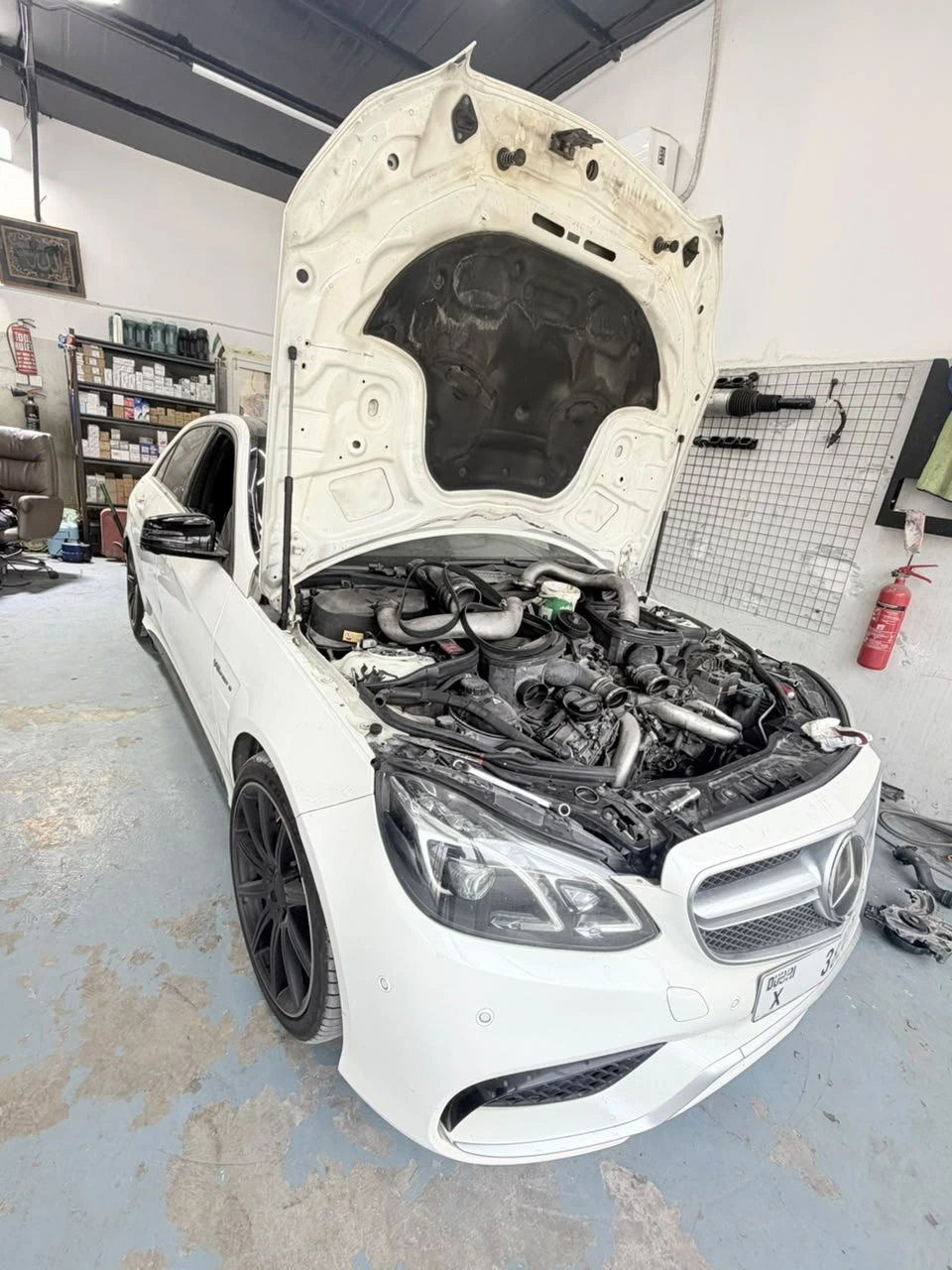
When it comes to vehicle repairs, replacing faulty parts is only part of the job. The real challenge is identifying why the part failed in the first place. This case study shows how our team at Car Garage Expert diagnosed and resolved a recurring engine drive belt issue on a Mercedes E63 after several previous repair attempts by other workshops had failed.
Customer Complaint
The customer initially visited Car Garage Expert for a routine engine oil and filter change of Mercedes E63.
While discussing the Mercedes E63 history, the customer mentioned an ongoing issue that had become increasingly frustrating:
- The engine drive (V) belt had snapped three to four times.
- Multiple local garages had attempted repairs.
- Various components had already been replaced.
- The problem kept returning.
- The customer wanted to know whether our technicians could identify the real cause.
The customer explained that previous workshops had carried out repairs involving:
- Engine Drive Belt replacement
- Pulley replacement
- Engine seal replacement
- Coolant leak repairs
Despite spending considerable time and money, the belt of Mercedes E63 continued to fail, indicating that the root cause had never been properly diagnosed.
Initial Inspection During Oil Service
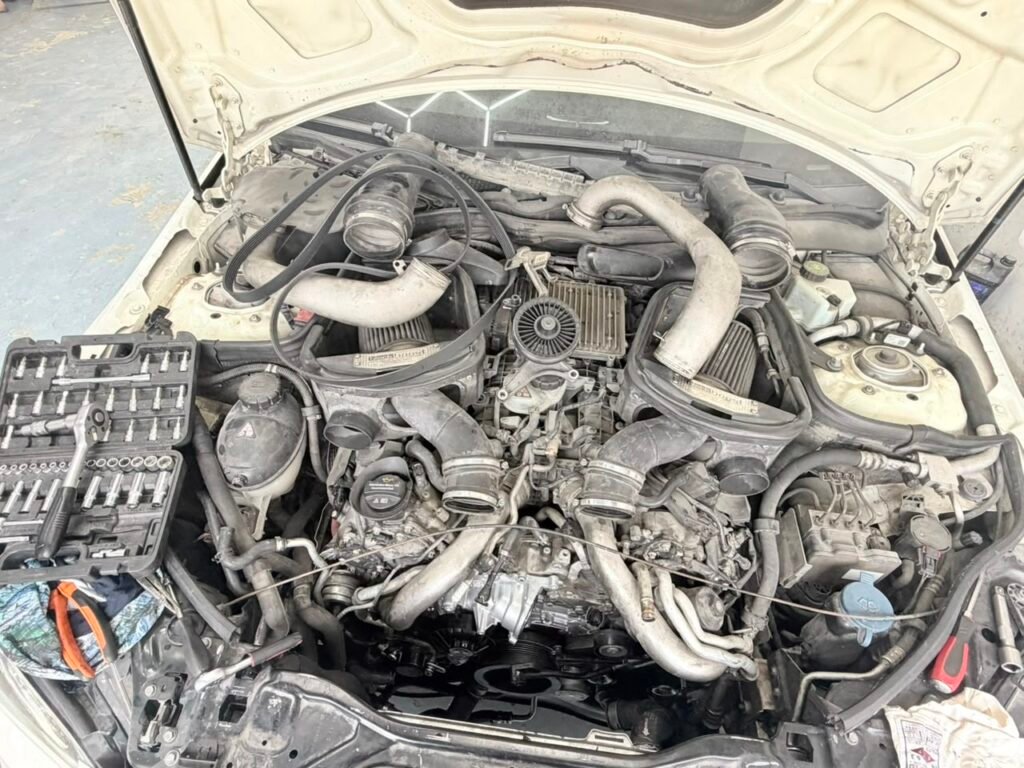
While performing the scheduled oil change, our technicians carried out a comprehensive visual inspection of the engine bay.
During this inspection, we immediately noticed several warning signs:
- The drive belt displayed unusual wear patterns.
- Belt alignment appears to be off.
- It was obvious that the pulleys were not running quite true.
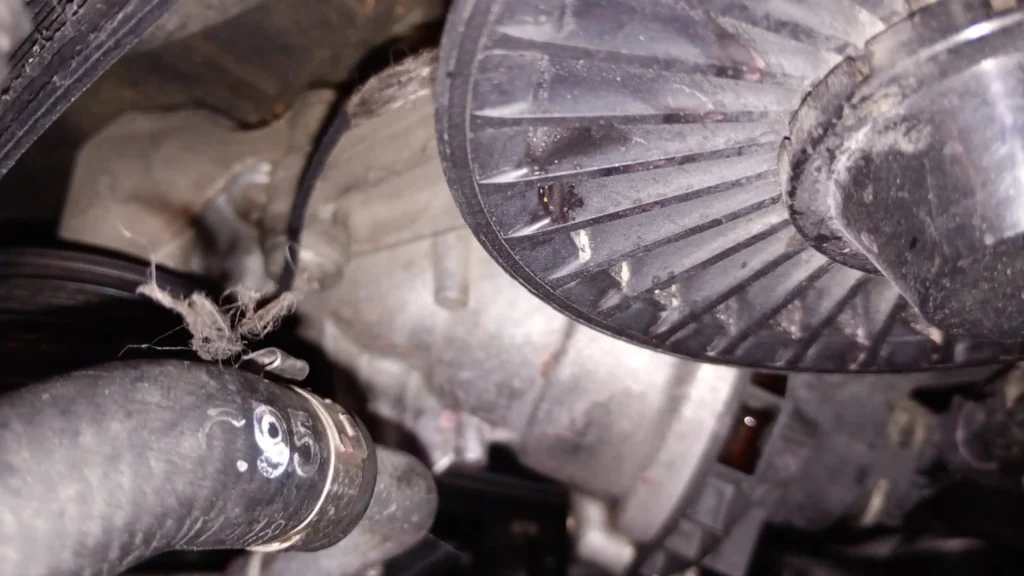
- Evidence of fluid contamination in the belt area.
- There were signs of an engine oil leak.
- There was also further evidence of coolant leakage.
These findings confirmed our suspicion that replacing the belt alone would never solve the problem.
Our Diagnostic Process
Rather than replacing more parts without investigation, we followed our structured diagnostic procedure.
Step 1 – Belt Alignment Inspection
We carefully inspected every pulley, tensioner, and accessory driven by the engine belt.
Our technicians checked:
- Pulley alignment
- Belt tracking
- Tensioner condition
- Bearing operation
- Mounting surfaces
Step 2 – Leak Detection
Next, we inspected the Mercedes E63 engine for oil and coolant leaks.
Leaks can significantly reduce belt life because oil or coolant contamination causes the belt to slip, deteriorate, and eventually snap.
Step 3 – Component Inspection
Instead of assuming recently replaced components were fault-free, we inspected every related part individually.
This included:
- Engine drive belt
- Pulleys
- Belt tensioner
- Seals
- Cooling system components
Our philosophy is simple:
Never assume a recently replaced component has been installed correctly or is functioning as intended.
Our Findings
After a detailed inspection of Mercedes E63, we confirmed that the drive belt itself did not cause the recurring failures.
The real issue was a combination of:
- Misalignment within the belt drive system
- Oil leakage affecting belt performance
- Coolant leakage contaminating surrounding components
- Previous repairs that addressed symptoms rather than the underlying cause
This explained why the belt had failed multiple times despite repeated replacements.
The Solution We Performed
Our Mercedes-Benz specialists focused on identifying and correcting the root cause of the repeated belt failures instead of simply replacing the damaged drive belt. A snapped serpentine belt is often a symptom of an underlying mechanical issue, and unless that issue is properly diagnosed and repaired, the new belt will fail again. Using advanced diagnostic equipment and a detailed inspection process, our technicians carefully examined the entire auxiliary drive system to ensure every component was operating within the manufacturer’s specifications.
The repair process included:
- Correcting the engine drive belt alignment to ensure the belt runs perfectly across every pulley.
- Identifying and repairing the source of the engine oil leak that was contaminating the belt and reducing its lifespan.
- Repairing the coolant leak to prevent further damage to surrounding engine components.
- Thoroughly inspecting all pulleys, including the tensioner and idler pulleys, for signs of wear, misalignment, or excessive play.
- Checking the condition of the belt tensioner and verifying that the correct belt tension of Mercedes E63 was maintained throughout the operating range.
- Replacing worn or damaged components where required to restore the integrity of the belt drive system.
- Replace with a new genuine quality drive belt and test the operation at different engine speeds.
- Establishing full-fledged quality control processes, including visual inspections, alignment checks, and functional tests for smooth, steady belt operation.
Once all repairs were done, we conducted a number of road tests and shop inspections to ensure the problem was permanently fixed. The new drive belt tracked perfectly across all pulleys with no abnormal movement, vibration or noise. Engine oil and coolant leaks are gone for good, so the belt stays clean and doesn’t wear out too fast.
The engine operated smoothly, charging performance returned to normal, and all auxiliary components—including the alternator, water pump, air conditioning compressor, and power steering system—functioned exactly as intended. Most importantly, the customer left with confidence knowing the underlying mechanical faults had been professionally repaired, preventing the repeated belt failures that had occurred after previous repairs performed by other garages.
Why Accurate Diagnosis Matters
This Mercedes E63 is an excellent example of why repeated part replacement is rarely the correct solution.
Many repair shops replaced components including:
- Drive belt
- Pulley
- Engine seal
- Cooling system parts
However, because the underlying alignment issue was never identified, the same failure continued to occur.
At Car Garage Expert, our approach focuses on diagnosing the root cause before recommending repairs. This not only prevents repeat failures but also saves customers unnecessary repair costs over time.
Results
Following our inspection and corrective repairs:
- The drive belt operated smoothly.
- Belt alignment was restored.
- Oil leakage was resolved.
- Coolant leakage was repaired.
- The engine drive system functioned correctly.
- The customer left with confidence that the recurring issue had finally been addressed properly.
Conclusion
A recurring belt failure is rarely just a belt problem. It is often a symptom of a deeper mechanical issue that requires careful inspection and technical expertise.
Routine oil change on this Mercedes E63 at our workshop. But we listened to what the customer was telling us, did a good inspection, and found issues that had been missed by previous repairs. By addressing the fundamental cause, not just changing parts, we were able to deliver a permanent solution.
If your car has a recurring problem that keeps coming back no matter how many times you fix it, don’t settle for patchwork. At Car Garage Expert, we have the experienced technicians, systematic diagnostics and quality artistry that allow us to find the real problem and fix it right the first time. From routine servicing to complicated mechanical faults, we are devoted to providing reliable and long-term solutions to keep your car functioning at its best. Book your appointment today or find ud on Google Maps for on-site assistance.