
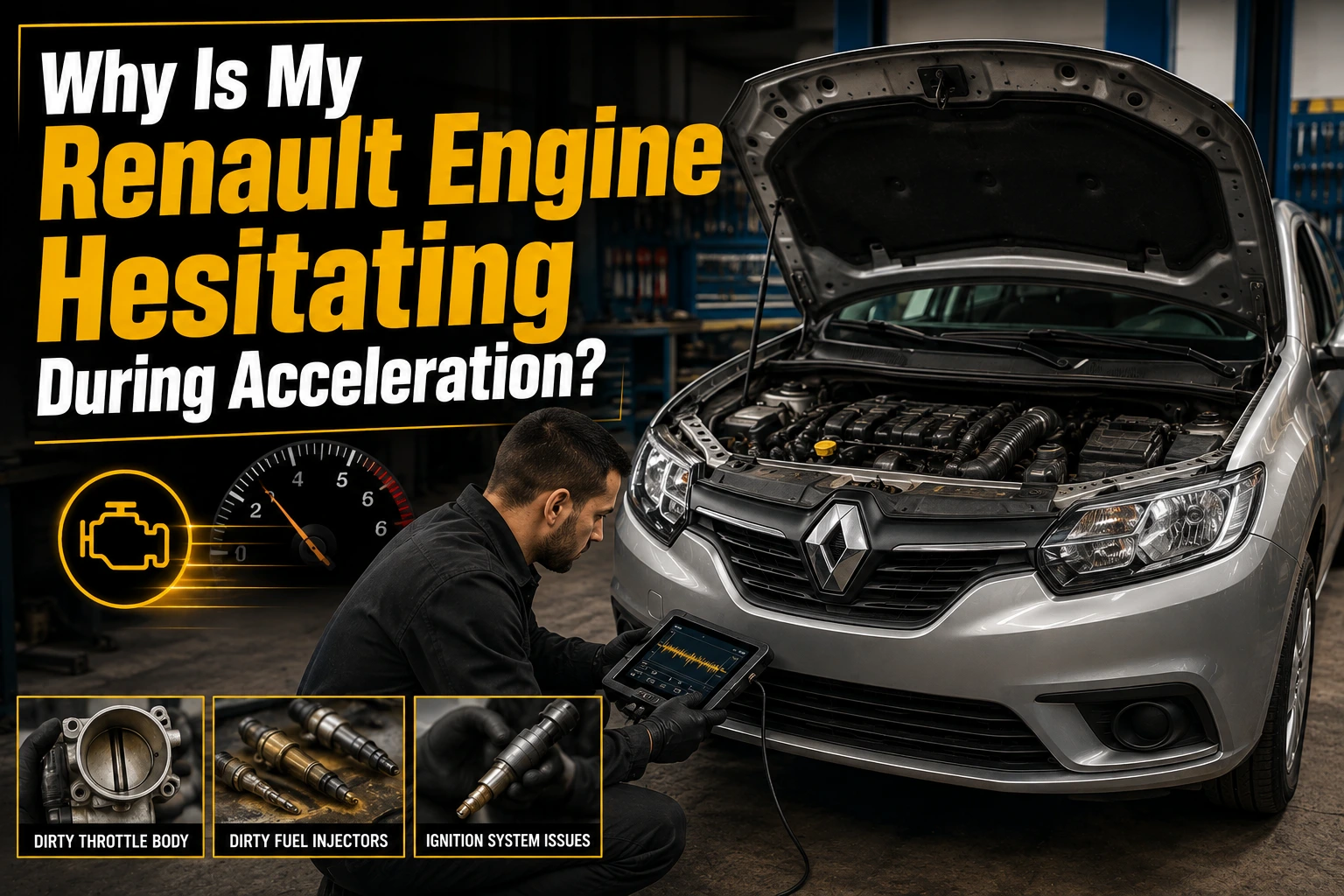
What’s Causing Your Renault Engine Hesitation?
Renault Engine Hesitation during acceleration is usually caused by a dirty throttle body, a failing fuel pump, worn spark plugs, a clogged fuel filter, or a faulty sensor sending the wrong signal to the engine’s computer. You’ll typically feel it as a delay or stumble right when you press the gas — sometimes followed by a jerk as the engine catches up. It’s not something to put off. A hesitating engine can point to a fuel delivery problem that gets worse with time, and driving on it too long can strain other components. Getting it diagnosed early, ideally by technicians who know Renault engines well, keeps a small fix from turning into an expensive one.
Table of Contents
- What’s Actually Happening When Your Renault Hesitates?
- Signs That Point to Renault Engine Hesitation
- What’s Behind the Hesitation? Common Causes Explained
- How Technicians Pinpoint the Real Problem
- How the Repair Process Works
- What Happens If You Keep Driving Without Fixing It?
- Is It Safe to Drive a Hesitating Renault?
- How Long Does the Repair Actually Take?
- What Determines the Repair Cost?
- Simple Habits That Prevent Engine Hesitation
- Why Dubai’s Driving Conditions Make This Worse
- Why Choose Car Garage Expert for Renault Repairs?
- Frequently Asked Questions
- Related Services
- Final Thoughts
What’s Actually Happening When Your Renault Hesitates?
That brief pause when you press the accelerator — where the engine seems to think about it before responding — is a pretty clear sign something in the fuel or ignition system isn’t keeping up with what the engine needs. Renault Engine Hesitation almost always comes down to the engine not getting the right mix of fuel, air, or spark at the exact moment it’s asked to work harder.
It’s easy to brush off the first time it happens, especially if it only shows up occasionally. But hesitation rarely stays occasional. It tends to show up more often, especially under load merging onto Sheikh Zayed Road, pulling away from a light, or climbing a ramp and if it’s ignored, it can eventually turn into stalling or a check engine light that won’t go away.
When everything’s working, Renaults are efficient and responsive, so hesitation stands out so much when it starts. Something has gotten out of sync in the system, and it’s important to figure out what that is before it snowballs into something greater.
Signs That Point to Renault Engine Hesitation
Hesitation doesn’t always show up the same way twice. Some days it’s barely noticeable; other days it’s obvious the second you pull away from a stop.
Keep an eye out for:
- A noticeable delay between pressing the gas and the car actually responding.
- Jerking or stuttering during acceleration, especially from a standstill
- Rough or uneven idling at traffic lights
- The engine surging forward suddenly after a moment of hesitation.
- Reduced power when trying to overtake or merge
- A check engine light appearing on and off
- Higher fuel consumption than usual
- Occasional stalling at low speeds
If any of this sounds like your car, it’s worth searching for a garage near me and getting it checked before the hesitation turns into something you can’t drive around.
What’s Behind the Hesitation? Common Causes Explained
There isn’t one single reason engines hesitate — it’s usually one of a handful of common culprits, and figuring out which one matters for getting the right fix.
A dirty or carbon-fouled throttle body. Over time, carbon deposits build up around the throttle plate, which throws off the air-fuel mix the engine’s expecting and causes that stumble on acceleration.
A weakening fuel pump. If the pump can’t maintain steady pressure, the engine ends up starved for fuel right when you need power the most, which is exactly when hesitation tends to show up.
Worn spark plugs or ignition coils. Weak or inconsistent sparks mean incomplete combustion, and that shows up as hesitation, rough running, or a noticeable loss of power.
A clogged fuel filter. A filter that’s overdue for replacement restricts fuel flow just enough to cause a delay under acceleration, even if everything else is working fine.
Faulty sensors. The mass airflow sensor, throttle position sensor, and oxygen sensors all feed data to the engine’s computer. If one of them is sending bad information, the fuel-air mix gets thrown off, and hesitation follows.
A dirty air filter. Restricted airflow into the engine means the fuel mix runs rich, which can cause the same stumbling and lag drivers describe as hesitation.
Transmission-related delay. On automatic Renaults, a transmission that’s slow to respond can feel almost identical to engine hesitation, even though the issue’s coming from somewhere else entirely.
Old or low-quality fuel. Contaminated fuel or fuel with a lot of built-up residue can gum up injectors over time, leading to inconsistent delivery and that familiar hesitation on acceleration.
If any of this sounds familiar, it’s worth having a proper diagnostic done rather than guessing — Renault engines are precise, and the wrong fix can mean paying twice.
How Technicians Pinpoint the Real Problem
This kind of hesitation can come from several different systems, so a proper diagnosis means ruling things out methodically rather than replacing parts on a hunch.
Reading the fault codes. Technicians start by connecting a diagnostic scanner to pull any stored codes from the engine’s computer — this usually narrows things down to a specific system straight away. Our car mechanic team runs this check first on every hesitation case.
Checking fuel pressure. A pressure test shows whether the pump and fuel lines are delivering consistent pressure, or whether pressure drops right when the engine needs more fuel.
Inspecting the throttle body and air intake. Technicians look for carbon buildup, a sticking throttle plate, or a dirty air filter restricting airflow into the engine.
Testing ignition components. Spark plugs and coils get checked individually, since even one weak plug can cause a noticeable hesitation under load.
Verifying sensor readings. Live data from the mass airflow sensor, throttle position sensor, and oxygen sensors gets compared against expected values to catch anything sending faulty signals.
Road testing. A short test drive under real acceleration conditions often confirms exactly when and how the hesitation shows up, which helps narrow down the cause even further.
How the Repair Process Works
The fix depends entirely on what’s actually causing the hesitation, which is why getting the diagnosis right matters so much.
Throttle body cleaning: carbon deposits get removed, and the throttle plate is cleaned and recalibrated so the air-fuel mix reads correctly again.
Fuel pump replacement: if the pump’s no longer holding steady pressure, it gets replaced, along with a check of the fuel lines and filter to rule out any related issues.
Spark plug and coil replacement: worn plugs and weak coils are swapped out with the correct parts for your Renault’s engine, restoring a clean, consistent spark.
Fuel filter replacement: a quick job, but an important one — a fresh filter restores proper fuel flow to the engine.
Sensor replacement or recalibration: faulty sensors get replaced, and where needed, the engine’s computer is recalibrated so it’s reading accurate data again.
Software or ECU updates: in some cases, a hesitation issue is resolved with an updated engine control software rather than a part swap at all.
Every repair here is followed by a test drive to confirm the hesitation is actually gone, not just masked for a few days.
What Happens If You Keep Driving Without Fixing It?
It’s tempting to keep driving through it, especially if the hesitation only shows up now and then. But letting Renault Engine Hesitation go unaddressed usually means it gets worse, not better. Left alone, it can lead to a spark plug or coil failing, a fuel pump giving out at the worst possible moment, increased strain on the catalytic converter, higher fuel costs from an engine running inefficiently, and eventually, stalling in traffic or at a junction. What starts as a small delay on acceleration can turn into a car that won’t reliably start or run.
Is It Safe to Drive a Hesitating Renault?
In most cases, yes, at least for a short while — but that doesn’t mean you should put off getting it checked. If the hesitation’s mild and occasional, you can likely still get around safely in the meantime.
That said, get it looked at as soon as you can if you notice the hesitation getting more frequent, the check engine light staying on, any stalling at low speed, a rough or shaky idle, or a real loss of power when merging or overtaking. If the hesitation turns into a full stall on a busy road, calling roadside assistance is the safer option rather than trying to nurse the car home.
How Long Does the Repair Actually Take?
| Repair Type | Estimated Time |
| Diagnostic scan | 30–60 minutes |
| Throttle body cleaning | 1–2 hours |
| Spark plug replacement | 1–2 hours |
| Fuel filter replacement | 1 hour |
| Sensor replacement | 1–3 hours |
| Fuel pump replacement | 2–4 hours |
| ECU software update | 1–2 hours |
Most Renault Engine Hesitation repairs are same-day jobs. More involved cases, like a full fuel pump swap, may need a little longer depending on parts availability.
What Determines the Repair Cost?
There’s no single number here — the cost depends on what’s actually wrong, whether it’s a cleaning job or a full part replacement, which components are involved, your specific Renault model, whether genuine parts are needed, and how much labor the repair takes.
As a rule, catching Renault Engine Hesitation early and fixing the root cause is almost always cheaper than waiting until it damages other parts of the engine.
Simple Habits That Prevent Engine Hesitation
Stick to your service schedule. Regular servicing catches worn plugs, dirty filters, and early sensor issues before they turn into hesitation.
Use good-quality fuel. Cheap or contaminated fuel leaves deposits that build up in the injectors and throttle body over time.
Replace air and fuel filters on time. Both are inexpensive to swap out and make a real difference in how consistently the engine runs.
Don’t ignore the check engine light. It’s often the first warning sign before hesitation becomes noticeable while driving.
Get the throttle body cleaned periodically. A quick clean now and then keeps carbon buildup from affecting acceleration response — something a mobile car mechanic can often handle at your home or office.
Why Dubai’s Driving Conditions Make This Worse
Dubai’s heat and stop-start traffic aren’t easy on any engine, and they can speed up the kind of wear that leads to Renault Engine Hesitation. High temperatures put extra strain on fuel pumps and ignition components. At the same time, constant idling in traffic contributes to carbon buildup in the throttle body faster than you’d see in milder climates. Fine dust and sand in the air also shorten the life of air filters, which affects the fuel mix if they’re not changed often enough.
If your Renault’s daily routine is mostly stop-start city driving under the Dubai sun, it’s worth having the fuel and ignition systems checked a little more often than the manual suggests.
Why Choose Car Garage Expert for Renault Repairs?
Diagnosing Renault Engine Hesitation properly takes more than a generic code reader — it takes technicians who actually know how Renault’s fuel and ignition systems are built. At Car Garage Expert, that’s exactly what we bring to every job.
Here’s what sets us apart:
- Technicians experienced specifically with Renault and other European models.
- Accurate, methodical diagnostics rather than guesswork
- Genuine or OEM-equivalent parts
- Transparent pricing with no surprise add-ons
- Same-day service for most common repairs
- A post-repair test drive on every job
- Friendly, straightforward communication throughout
If your Renault’s been hesitating on acceleration, Car Garage Expert is set up to find the real cause and fix it right the first time — and if your visit turns up bodywork or cosmetic needs along the way, our car painting team and full car service packages cover that too.
Frequently Asked Questions
Q1: What does Renault Engine Hesitation actually feel like?
It’s usually a brief pause or stumble when you press the gas, sometimes followed by a jerk as the engine catches up and delivers power.
Q2: Is Renault Engine Hesitation dangerous?
It can be, especially if it happens while merging or overtaking. A hesitation that turns into a stall in traffic is a real safety concern, so it’s worth getting checked promptly.
Q3: Can a dirty throttle body really cause this much trouble?
Yes — it’s actually one of the most common causes. Carbon buildup on the throttle plate throws off the air-fuel mix right when the engine needs it most.
Q4: How much does it usually cost to fix?
It depends entirely on the cause. A throttle body cleaning is fairly inexpensive, while a fuel pump replacement will cost more. A proper diagnosis narrows this down quickly.
Q5: Can I keep driving with a hesitating engine?
Short trips are usually fine if the hesitation’s mild, but it tends to get worse over time. If it’s frequent or paired with a check engine light, get it looked at soon.
Q6: What if my Renault stalls while I’m driving?
Pull over safely if you can, and call roadside assistance rather than trying to restart it repeatedly in traffic.
Related Services
If your Renault’s showing signs of engine hesitation, these services might help too:
- Engine Diagnostics
- Fuel System Repair
- Car Electrician Services
- Spark Plug & Ignition Repair
- Renault Service Packages
- Car AC Repair
- Roadside Assistance
- Car Mechanic Services
- Car Detailing
Final Thoughts
A Renault that hesitates on acceleration isn’t something to live with — it’s usually your engine telling you that something in the fuel or ignition system needs attention. Left alone, it tends to get worse, not better, and can end up costing a lot more to fix down the line.
If your Renault’s been stumbling, jerking, or losing power when you accelerate, don’t wait for it to turn into a bigger problem. Visit Car Garage Expert for an accurate diagnosis and expert repair from technicians who know Renault engines inside and out.