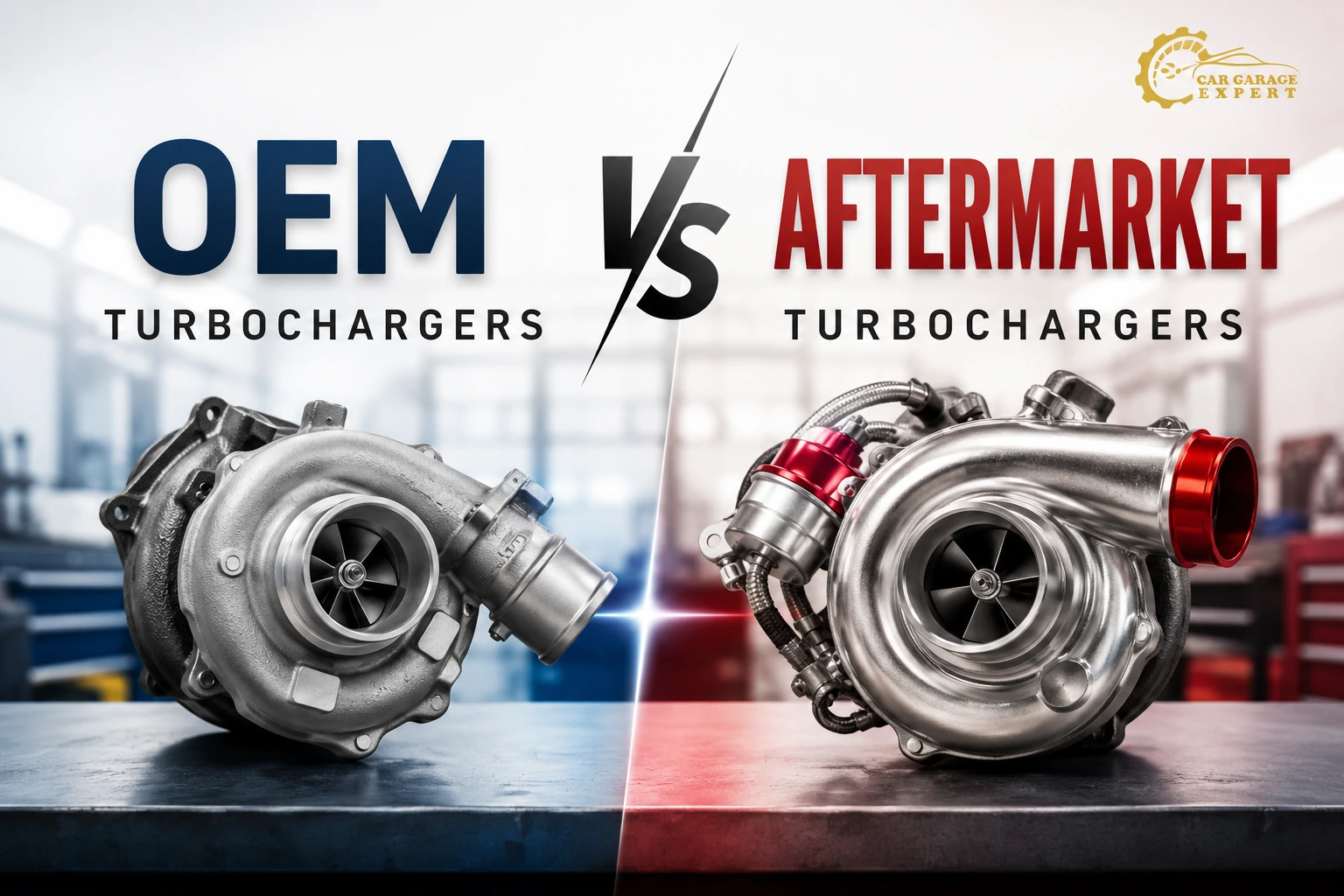
The OEM vs aftermarket turbochargers issue boils down to consistency versus flexibility. OEM turbochargers are built or sourced by the original manufacturer to the precise standard your engine was intended for, ensuring predictable installation and performance and often backed by a manufacturer-aligned warranty. Aftermarket turbochargers are made by third-party producers, from bargain-basement turbos to truly quality performance parts. The aftermarket is significantly more diverse in price and quality. Neither is always the wrong choice – it is contingent upon your budget, how the car is used, and how much risk you’re happy to take on a part that’s so vital to the operation of the engine.
Table of Contents
- Understanding the Difference: What OEM vs Aftermarket Turbochargers Actually Means
- OEM vs Aftermarket Turbochargers: Side-by-Side Comparison
- Signs Your Turbocharger Might Need Replacing
- Common Reasons Turbochargers Fail in the First Place
- How We Diagnose Whether a Turbo Needs Replacement
- What the Replacement Process Actually Involves
- What Happens If You Delay Replacing a Failing Turbo
- Can You Keep Driving With a Failing Turbo?
- How Long Does Turbo Replacement Take?
- What Actually Affects the Cost of Either Option
- Prevention Tips to Extend Turbo Life
- Dubai-Specific Advice for Turbo Owners
- Why Choose Car Garage Expert for Engine Repair and Services?
- Frequently Asked Questions
- Related Services
- Book Your Turbo Inspection Today
Understanding the Difference: What OEM vs Aftermarket Turbochargers Actually Means
Every turbocharged car eventually faces this question, usually right when the original unit starts showing signs of wear. OEM vs Aftermarket Turbochargers isn’t just a pricing conversation — it’s really about where the part comes from and how tightly it’s built to your engine’s exact specification.
An OEM turbocharger is either made by the manufacturer that supplied the original part to the car maker or sourced directly through the dealer network to match the factory specification. An independent manufacturer produces an aftermarket turbocharger, and this category covers a wide range—some aftermarket brands genuinely match or exceed OEM quality. In contrast, others cut corners on materials and tolerances to hit a lower price point. That range is exactly why this decision needs more thought than just picking whichever option costs less upfront.
OEM vs Aftermarket Turbochargers: Side-by-Side Comparison
| Factor | OEM Turbocharger | Aftermarket Turbocharger |
| Fitment accuracy | Exact match to original specification | Varies by manufacturer, generally close but not guaranteed |
| Typical cost | Higher upfront | Lower upfront, wide price range |
| Quality consistency | Consistent, tightly controlled | Varies significantly between brands |
| Warranty | Usually stronger, manufacturer-backed | Depends entirely on the specific supplier |
| Performance | Matches factory-tuned characteristics | Can match or exceed OEM, or fall short, depending on brand |
| Availability | Sometimes longer lead times | Often more readily available |
| Best suited for | Daily drivers, warranty-conscious owners | Budget-conscious repairs, performance builds with reputable brands |
Signs Your Turbocharger Might Need Replacing
A few symptoms tend to show up before a turbocharger fails:
- A whining or whistling noise from the engine bay under acceleration
- Blue or grey smoke from the exhaust, often pointing to oil getting into the turbo.
- Noticeably reduced power or boost compared to how the car used to feel.
- A burning oil smell after hard driving
- Excessive oil consumption without an obvious external leak
- The check engine light appearing alongside any of these symptoms
Catching these early gives you time to make a considered choice between OEM vs aftermarket turbochargers, rather than rushing into a decision because the car’s stranded.
Common Reasons Turbochargers Fail in the First Place
Oil starvation or contamination — turbos rely entirely on clean, well-maintained oil to lubricate their bearings, which spin at extremely high speeds. Delayed oil changes are one of the most common causes of premature failure.
Worn bearings — over time, even with good maintenance, the turbo’s internal bearings wear down, eventually allowing excess shaft play that leads to failure.
A failing wastegate — this component regulates boost pressure, and when it sticks or fails, it can cause overboost conditions that stress the entire turbo assembly.
Foreign object damage — debris entering either the intake or exhaust side of the turbo can damage the turbine blades, sometimes catastrophically.
Extreme heat cycling — repeatedly shutting off a hot engine right after hard driving, without letting the turbo cool gradually, accelerates bearing wear over time.
How We Diagnose Whether a Turbo Needs Replacement
Start by comparing boost pressure to manufacturer specs, since a big loss in boost is one of the most obvious signs of a turbo problem. We test the turbo shaft for play by hand, which indicates bearing wear that isn’t usually visible from symptoms alone.
We visually check the intake and exit sides for oil residue, debris damage, or obvious wear on the turbine blades. We also check the housing and core to see whether they’re in good enough condition to allow a repair instead of a full replacement with a new unit.
What the Replacement Process Actually Involves
Once replacement is confirmed as the right path, the process typically follows this order:
- The failing turbocharger is removed, along with any related intake and exhaust components blocking access.
- The technician inspects and cleans the oil and coolant lines feeding the turbo, or replaces them if needed.
- The chosen replacement unit, whether OEM or aftermarket, is fitted and connected
- Fresh oil is used to prevent any contamination reaching the new turbo on first startup.
- The system is tested for boost pressure and checked for leaks before the car leaves the workshop.
- A road test confirms smooth power delivery and normal boost behavior under real driving conditions.
What Happens If You Delay Replacing a Failing Turbo
When a turbo breaks, it usually doesn’t happen right away, but ignoring signs like whining or less power for too long can make things worse. Metal pieces can fall out of a failing turbo and enter the intake system. These pieces then move further into the engine and hurt more than just the turbo. If debris gets into the cylinders, what could have been a simple turbo swap can become a much bigger engine fix.
Can You Keep Driving With a Failing Turbo?
Mild symptoms, like a slight whine or a small drop in power, usually allow for continued driving to a workshop, though it shouldn’t be put off for long. If you’re seeing thick smoke, hearing a loud grinding noise, or noticing a sudden major loss of power, it’s safer to stop driving and arrange roadside assistance rather than risk turning a turbo replacement into a full engine rebuild.
How Long Does Turbo Replacement Take?
A simple turbo swap on an engine that’s easy to reach usually takes between 06 and 12 hours. That can stretch to a day and a half if the engine bay is more complicated or the turbo is hard to reach. Your turnaround time may be longer if you choose a rebuild over a full replacement, depending on how quickly you can source the rebuild kit parts.
What Actually Affects the Cost of Either Option
Several factors shape the final price:
- Whether you choose OEM vs aftermarket turbochargers, since OEM units typically cost more upfront
- The specific make and model, since some turbos are considerably more expensive to source than others
- Labor time, which varies based on how accessible the turbo is in that particular engine bay
- Whether related components, like the wastegate or intercooler hoses, need attention at the same time
- Warranty terms, since a longer warranty on either option can justify a higher initial cost
Getting quotes for both routes before deciding is generally worth the extra few minutes, since the price gap between a quality aftermarket unit and OEM can be smaller than expected depending on the model.
Prevention Tips to Extend Turbo Life
- Stick to manufacturer oil change intervals, and consider shortening them slightly given Dubai’s heat.
- Let the engine idle briefly after hard driving before switching off, allowing the turbo to cool gradually.
- Use the correct oil specification, since turbos are unforgiving of the wrong grade or degraded oil.
- Address small symptoms, like a faint whine, before they progress into something more serious.
- Keep up with routine servicing rather than waiting for a warning light.
Dubai-Specific Advice for Turbo Owners
Turbochargers are designed to get hot, and Dubai’s temperature is another layer of thermal stress. The turbo has to work harder to control heat before it even has to deal with boost pressure demands. With ambient temperatures often above 45°C, oil quality and replacement intervals are even more crucial here than in cooler climes.
This is exactly the kind of decision where a proper inspection matters more than guessing. It’s worth keeping a trusted garage near me saved for turbo-related checks, along with a roadside assistance contact in case a turbo issue develops unexpectedly during a summer drive.
Why Choose Car Garage Expert for Engine Repair and Services?
Whichever side of the OEM vs aftermarket turbochargers decision makes sense for your car, the workshop fitting needs to get the details right. At Car Garage Expert in Al Quoz, our technicians work with both OEM and reputable aftermarket turbo suppliers, and we’re upfront about which option genuinely fits your budget and driving needs rather than pushing whichever pays better. Car Garage Expert checks boost pressure, oil lines, and fitment carefully before signing off on any turbo job, and every replacement comes with an artistry warranty. If your turbo is showing signs of trouble, Car Garage Expert can walk you through the real options rather than a one-size-fits-all recommendation.
Frequently Asked Questions
Q1: Is an aftermarket turbo always lower quality than OEM?
Not really. Several aftermarket manufacturers make units that match or even exceed OEM quality, especially in the performance sector. Aftermarket quality varies significantly more than OEM. So investigate the particular brand.
Q2: Does fitting an aftermarket turbo affect my car’s warranty?
It can, depending on your manufacturer’s warranty terms and local regulations. Check your specific warranty before deciding whether the car is still covered.
Q3: How much more expensive is OEM compared to aftermarket?
OEM units tend to cost more initially, but prices can vary considerably by model. The difference can be large or relatively modest, depending on the automobile and turbo.
Q4: Can a failing turbo damage the rest of my engine?
Yes, if left unaddressed. A failing turbo can send metal debris into the intake system, which can cause damage well beyond the turbo itself if it reaches the cylinders.
Q5: Is a turbo rebuild a viable alternative to full replacement?
Sometimes, if the housing and core are in good condition, a proper inspection determines whether a rebuild makes sense or whether a full replacement is the safer route.
Related Services
If your visit uncovers other concerns, our team also handles
Car Mechanic diagnostics for general engine troubleshooting,
Mobile Car Mechanic callouts if your car isn’t safe to drive, and
Car Painting Near Me touch-ups for cosmetic wear found alongside mechanical work.
For routine maintenance, check our car service packages in Dubai, and for everyday servicing needs, our car service Dubai page covers the basics.
Book Your Turbo Inspection Today
Deciding between OEM vs aftermarket turbochargers is much easier once you know the actual condition of your current unit and what your budget and driving needs really call for. Bring your car to the Car Garage Expert in Al Quoz and let our technicians give you an honest assessment before you commit to either option.
📍 Find directions on Google Maps.
💬 Message us directly on WhatsApp to book your inspection