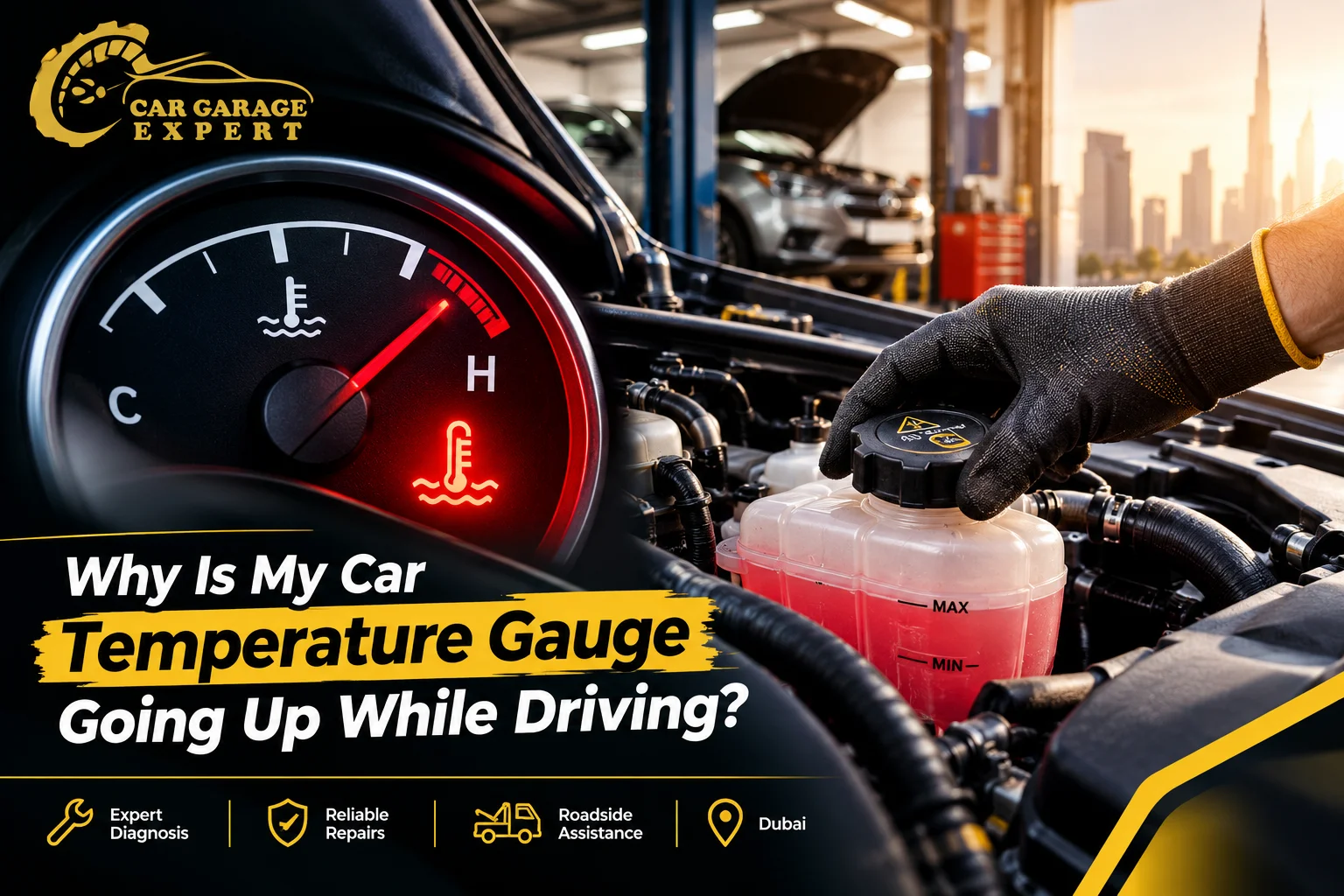
If your car temperature gauge is going up while driving, your engine may be overheating. This can happen because of low coolant, a leaking radiator, a faulty thermostat, a damaged water pump or a nonfunctioning cooling fan. Dubai’s hot weather and heavy traffic can also put extra stress on the cooling system. If the gauge reaches the red zone, pull over safely and switch off the engine. Never touch or open the radiator cap when the engine is hot. A professional mechanic can inspect the cooling system, find the cause and recommend the right repair before the problem leads to serious engine damage.
Table of Contents
- Problem Overview: Understanding a Rising Temperature Gauge
- Symptoms: Signs Your Engine May Be Overheating
- Common Causes of a Rising Temperature Gauge
- Diagnostic Process: How a Mechanic Finds the Fault
- Repair Process: Fixing the Cooling System
- Risks of Ignoring an Overheating Engine
- Can You Continue Driving?
- Repair Time: How Long Does It Take?
- Cost Factors: What Affects the Repair Price?
- Prevention Tips for a Healthy Cooling System
- Dubai-Specific Advice for Hot Weather Driving
- Why Choose Car Garage Expert for Roadside Assistance?
- Frequently Asked Questions
- Related Services
- Final Call-to-Action
Problem Overview: Understanding Car Temperature Gauge Going Up
Your car’s temperature gauge shows how hot the engine is running. Most vehicles have a normal operating range. If the needle moves above its usual position, the engine may be overheating.
A rising reading does not always mean serious engine damage. The cause could be low coolant, a faulty fan or a thermostat issue. However, ignoring the warning can make the problem worse.
Car Temperature Gauge Going Up is a warning that drivers should take seriously. Early inspection can help prevent expensive repairs and unexpected breakdowns.
If the gauge rises during traffic, on a long journey or while using the AC, arrange a cooling system check.
Signs Your Engine May Be Experiencing a Car Temperature Gauge Going Up
Car Temperature Gauge Going Up is often the first sign of a cooling system problem. Other symptoms may appear as the engine gets hotter.
- High temperature reading: The needle moves above its normal position.
- Red warning light: A dashboard warning may tell you the engine is too hot.
- Steam under the hood: This may indicate escaping coolant or overheating.
- Sweet smell: Hot coolant can produce a sweet odor.
- Coolant under the car: A puddle may point to a leak.
- Weak AC cooling: AC performance may change when the engine or cooling system has a fault.
- Loss of engine power: Severe overheating may affect engine performance.
- Unusual engine noises: Knocking or other abnormal sounds can signal a serious issue.
Do not wait for every symptom to appear. If the gauge reaches the red zone or steam comes from under the hood, stop somewhere safe and switch off the engine.
Common Causes of a Car Temperature Gauge Going Up
Several faults can cause an engine to run hotter than normal. A mechanic should inspect the system before replacing any parts.
|
Possible Cause |
Why It Can Cause Overheating |
What a Mechanic Checks |
|---|---|---|
|
Low coolant |
There is less fluid to carry heat away from the engine. |
Coolant level and possible leaks |
|
Radiator leak |
Coolant escapes from the cooling system. |
Radiator, hoses and connections |
|
Faulty thermostat |
Coolant may not flow through the radiator as needed. |
Thermostat operation |
|
Damaged water pump |
Coolant circulation may be reduced. |
Water pump condition and coolant circulation |
|
Cooling fan failure |
Less air passes through the radiator at low speeds. |
Fan motor, relay and controls |
|
Blocked radiator |
Heat transfer or coolant flow may be reduced. |
Radiator condition and blockages |
|
Damaged radiator hose |
A hose may leak, collapse or restrict coolant flow. |
Hoses, fittings and connections |
|
Head gasket damage |
Combustion gases may enter the cooling system. |
Pressure tests and engine condition |
Different faults can produce similar symptoms. A proper diagnosis helps avoid unnecessary part replacement.
Diagnostic Process: How a Mechanic Finds the Fault
A professional inspection examines the entire cooling system. It should not rely on the dashboard reading alone.
Step 1: Check the coolant level
The mechanic checks the coolant reservoir when the engine is cool. A low level may point to a leak or another cooling system problem.
Step 2: Inspect for coolant leaks
The mechanic checks the radiator, hoses, water pump area and connections for signs of fluid loss. A pressure test may help locate hidden leaks.
Step 3: Test the cooling fan
The fan helps move air through the radiator, especially in slow traffic. The mechanic may test the fan motor, fuse, relay and control system.
Step 4: Inspect the thermostat and water pump
These parts help move coolant through the engine. A fault in either part can reduce cooling performance.
Step 5: Check the temperature sensor
A faulty sensor or wiring issue can cause an incorrect temperature reading. A diagnostic scan can help identify related fault codes.
Step 6: Test the system after repairs
Once the fault is fixed, the mechanic checks the coolant level, looks for leaks and confirms that the engine temperature remains within the normal range.
Repair Process: Fixing the Cooling System
The repair depends on the cause of the overheating. A mechanic should explain the fault before starting the work.
- Repair coolant leaks: Replace damaged hoses, seals or leaking radiator parts.
- Replace faulty components: Fit a new thermostat, water pump, fan motor or sensor if testing confirms a fault.
- Clean or replace the radiator: Remove suitable blockages or replace a damaged radiator.
- Refill the coolant: Use the coolant type recommended for the vehicle.
- Remove trapped air: Bleed the cooling system when required.
- Test the engine: Check for leaks and confirm stable operating temperature.
If the engine has become very hot, you may need further tests to check for internal damage.
Adding coolant may help when the level is low, but it does not fix the reason the fluid was lost. If the coolant keeps dropping, arrange an inspection.
Risks of Ignoring an Overheating Engine
Driving with an overheating engine can turn a small repair into a major problem.
Possible risks include:
- Warped cylinder heads
- Damaged head gaskets
- Poor engine lubrication
- Internal engine damage
- Sudden loss of engine power
- Complete engine failure in severe cases
A cooling system repair is often less costly than repairing an engine damaged by severe overheating.
If you notice Car Temperature Gauge Going Up repeatedly, do not ignore it or assume the reading will return to normal on its own. Arrange a professional inspection.
Can You Continue Driving When the Temperature Gauge Rises?
You should not continue driving if the engine is overheating or the gauge is approaching the red zone.
Follow these steps:
- Turn off the AC and look for a safe place to stop.
- Switch off the engine if the temperature keeps rising.
- Stay clear of steam and escaping coolant.
- Never open a hot radiator cap.
- Arrange roadside assistance if the car cannot continue safely.
Do not restart the engine while it is still overheating. If the gauge reaches the red zone, a warning light comes on or steam appears, have the vehicle checked before driving again.
Searching for a garage near me when car temperature gauge going up may help you find a nearby workshop, but roadside assistance may be the safer option if the engine is too hot to drive.
Repair Time: How Long Does It Take?
Repair time depends on the vehicle, the fault and parts availability.
|
Inspection or Repair |
General Time Estimate |
|---|---|
|
Initial cooling system inspection |
30–60 minutes |
|
Coolant leak diagnosis |
30–90 minutes |
|
Coolant refill and bleeding |
30–60 minutes |
|
Thermostat replacement |
1–3 hours |
|
Radiator replacement |
2–4 hours |
|
Water pump replacement |
2–6 hours or longer |
|
Head gasket repair |
Several hours to multiple days |
These estimates are for guidance only. Some vehicles need extra labor to reach the faulty part. Additional engine damage can also increase repair time.
Ask the workshop for an estimate after diagnosis.
Cost Factors: What Affects the Repair Price?
The total cost depends on the failed part and the work needed to fix it.
|
Cost Factor |
Why It Matters |
|---|---|
|
Cause of overheating |
A simple coolant leak may cost less to repair than internal engine damage. |
|
Vehicle make and model |
Parts prices and labor costs vary between vehicles. |
|
Coolant type |
Some engines require specific coolant products. |
|
Replacement parts |
Radiators, cooling fans, thermostats and water pumps have different prices. |
|
Labor time |
Hard-to-reach parts may take longer to replace. |
|
Diagnostic tests |
Extra testing may be needed to identify hidden faults. |
|
Engine damage |
Severe overheating can lead to major engine repairs. |
|
Parts availability |
Special-order parts may increase waiting time and delay repairs. |
Request an itemized quote before approving the work. It should explain the cause, the recommended repair and any extra tests needed.
Prevention Tips for a Healthy Cooling System
- Simple maintenance can lower the risk of overheating.
- When the engine has cool completely, check the coolant reservoir.
- Look for coolant leaks under the car.
- Follow the recommended coolant replacement schedule.
- Inspect hoses for cracks, swelling or damage.
- Have a mechanic check the radiator and cooling fan during regular service.
- Watch for temperature changes in heavy traffic.
- Fix warning lights promptly.
- Use the correct coolant for your vehicle.
- Arrange an inspection before a long trip if the temperature has been rising.
Never open the cooling system while it is hot. Pressurized coolant can cause serious burns.
Dubai-Specific Advice for Hot Weather Driving
Dubai’s hot weather can put extra pressure on a car’s cooling system. Long periods in slow traffic can also reduce airflow through the radiator.
Dust and debris may block airflow if the radiator or condenser becomes dirty. A weak cooling fan or low coolant level may become more noticeable in hot weather.
If you drive frequently in Al Quoz, in congested city traffic or on long interstate trips, keep an eye out for temperature variations. Keep up with cooling system maintenance, especially before the hottest months.
If the temperature rises, do not assume the weather is the only cause. A healthy cooling system should still keep the engine within its normal operating range.
If your car temperature gauge going up issue happens more often during traffic or when the AC is running, ask a mechanic to check the fan, coolant flow, radiator and thermostat.
Why Choose Car Garage Expert for Roadside Assistance?
An overheating vehicle needs the right support. Continuing to drive can cause more damage, so choose a safe next step.
Car Garage Expert is a local option for drivers seeking car repair support in Dubai. When arranging help, explain the temperature warning, any coolant loss and whether you noticed steam or unusual noises.
These details help the team understand the problem and advise on the next step. Depending on the fault and the service available, your vehicle may need a cooling system inspection, engine diagnosis or recovery to a workshop.
If you are searching for a garage near me, look for a workshop that can diagnose the cause rather than refill the coolant. For a vehicle that is unsafe to drive, ask about suitable roadside assistance or recovery.
Frequently Asked Questions
1. Why is my car temperature gauge going up while driving?
Low coolant, a radiator leak, a faulty thermostat, a damaged water pump or a cooling fan problem can cause the gauge to rise. A mechanic can test the system and identify the exact fault.
2. Can low coolant make my car overheat?
Yes. Low coolant reduces the system’s ability to carry heat away from the engine. If the level keeps dropping, the system may have a leak or another fault.
3. Why does my car overheat in traffic but cool down on the highway?
The cooling fan might not be working properly. At higher speeds, more air passes through the radiator. A mechanic should also check coolant flow and radiator condition.
4. Should I drive if my temperature gauge reaches the red zone?
No. Stop at a safe area and turn off the engine. Let it cool, avoid opening the radiator cap and arrange professional help.
5. How much does it cost to fix an overheating car in Dubai?
The price depends on the cause, vehicle model, parts and labor. A coolant leak may need a simple repair, while a damaged water pump or head gasket can cost much more. Request an inspection and quote first.
Related Services
If your car shows signs of overheating, these services may help:
- Engine repair: For engine problems linked to severe overheating.
- Radiator repair: For leaks, damage or cooling problems.
- Car AC repair: If the AC has a related fault or does not cool properly.
- Car diagnostic service: To identify temperature sensor faults and warning codes.
- Roadside assistance: For help when your car cannot continue safely.
- Car recovery: To transport a vehicle that should not be driven to a workshop.
Choose the service based on the diagnosis. Replacing parts without testing may waste time and money.
Final Call-to-Action: Get Help Before Engine Damage Occurs
Never ignore a car temperature gauge going up. Early inspection can help prevent serious engine damage and reduce the chance of an unexpected problems.
Contact Car Garage Expert for guidance on your next step, whether you need a cooling system inspection, engine repair or roadside assistance in Dubai.
If the gauge reaches the red zone or steam appears, stop safely and call a professional. Do not risk further damage by continuing to drive.
📍 Visit Car Garage Expert in Dubai for Reliable Car Repair Services. Get professional help with engine overheating, cooling system issues and roadside assistance.