
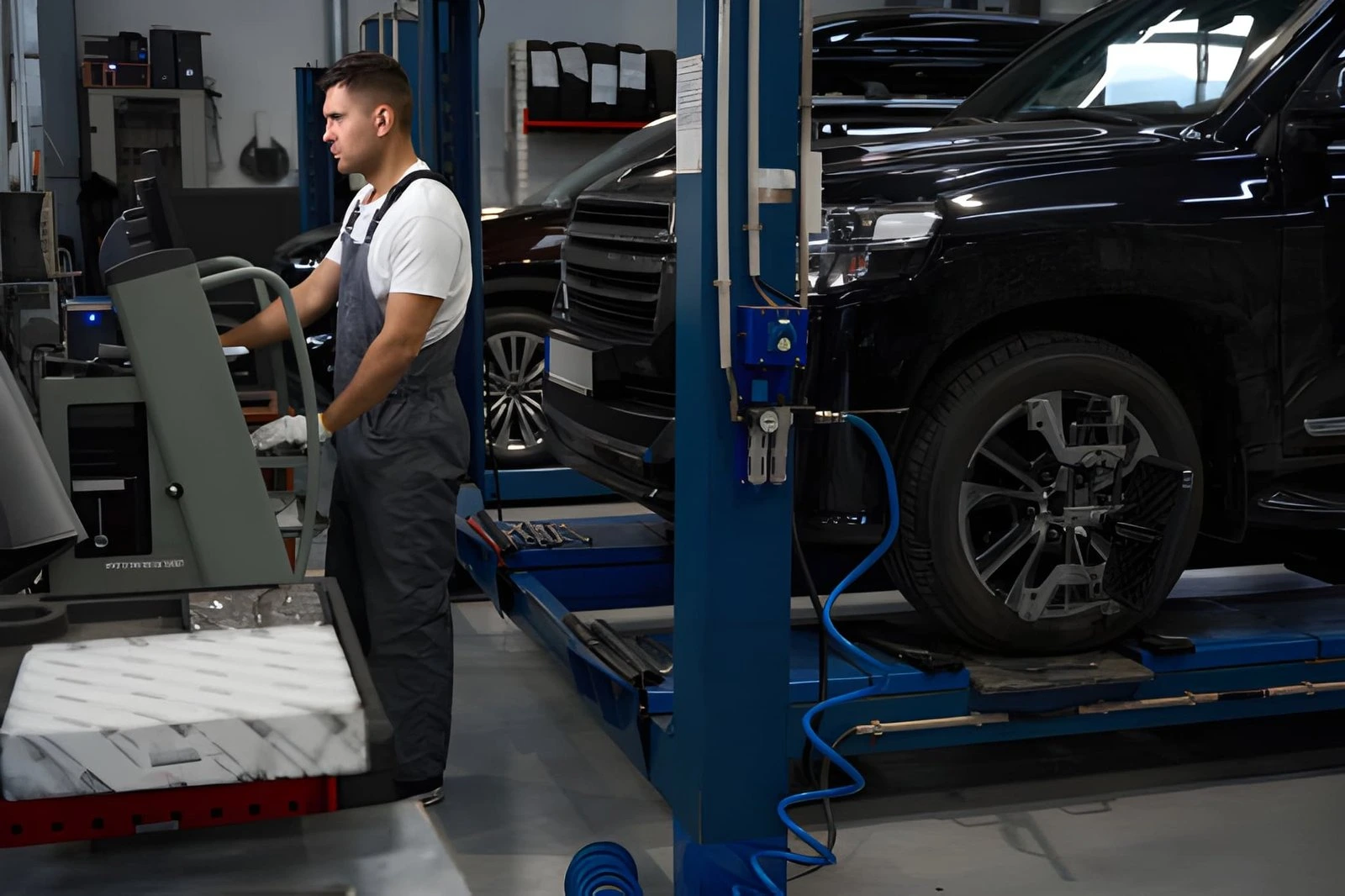
When a Ford owner in Dubai searches Ford service near me, they’re usually looking for one of two things — a scheduled service that’s coming due, or a fault that’s showing up and they want a workshop that properly understands the car. Either way, a generic garage that “also does Fords” isn’t the right answer for a modern EcoBoost engine, a 10-speed SelectShift transmission, or a SYNC-integrated electrical system.
Ford is one of the most common brands on Dubai roads — the Explorer and Expedition in family driveways, the F-150 and Ranger on worksites, the Mustang at weekend meets, the Edge and Escape in daily commuter traffic. Each model carries Ford’s specific engine and drivetrain platform, and each one responds to Dubai’s heat, stop-start traffic, and driving conditions in ways that make proper Ford-specific servicing matter more than most owners realise.
At Car Garage Expert in Al Quoz, we work on Ford across all current models. Here’s what real Ford service in Dubai looks like.
Ford Service Near Me in Dubai — Why Local Conditions Change Everything
Most Ford owners know the service light will come on eventually. What’s less obvious is how much Dubai accelerates the timeline on specific components — and how much damage gets done in the gap between “it still drives fine” and “something is actually wrong.”
A proper Ford service near me in Dubai means a workshop that understands what 46°C ambient heat does to EcoBoost turbocharger seals, what Al Quoz stop-start traffic does to transmission fluid, and why a Ford battery that’s three years old in Dubai summer parking is already past its reliable service life. Factory service schedules were built for moderate climates. Dubai is not moderate.
Ford Service Near Me — Engine Oil and EcoBoost Maintenance
Ford’s EcoBoost turbocharged engines are fitted across nearly every current model in the UAE market — the 2.3-litre four-cylinder in the Mustang and Explorer, the 2.7 and 3.5-litre V6 in the F-150 and Explorer, and the 1.5 and 2.0-litre units in the Escape and Edge. These engines are well-engineered but heat-sensitive in specific ways.
Turbocharger bearings run on engine oil. In Dubai’s heat, oil that’s degraded or running past its service interval provides less effective lubrication to the turbo shaft — bearings wear faster, and eventually the turbo develops a whine, boost pressure drops, and oil consumption increases. Ford specifies fully synthetic oil meeting WSS-M2C946-A or WSS-M2C948-B specification for EcoBoost engines. Using a generic synthetic of the right viscosity but wrong additive package accelerates turbo wear in sustained high-temperature conditions.
For Dubai city drivers doing school runs, Business Bay commutes, and short errands — short trips that don’t fully warm the turbo oil before the engine is switched off — we recommend oil changes at 8,000 km rather than waiting for the 12,000 km service reminder. Cold turbo startups and quick shutdowns without a cool-down period are harder on turbo bearings than a longer drive, and oil that’s accumulating blowby and moisture from short cycles degrades faster than the counter assumes.
Our car service packages include full fluid assessment — oil condition and level, coolant concentration, brake fluid moisture content, and power steering level — alongside the oil change. Everything at one visit.
EcoBoost-Specific Issues We See Regularly in Dubai
Beyond routine oil, the EcoBoost platform has specific vulnerabilities that show up regularly at any honest Ford service near me workshop in Dubai.
Carbon buildup on intake valves is the most common EcoBoost complaint we deal with. Direct injection fuels the cylinder directly — fuel doesn’t pass over the intake valves, so the oil vapour from the PCV system accumulates as carbon deposits over time. On a 2.0 EcoBoost doing short-trip Dubai commutes, significant carbon buildup can appear before 60,000 km. Symptoms are a rough idle, hesitation on throttle response, and a slight loss of power on acceleration. The fix is an intake valve cleaning — either chemical or physical — not an engine overhaul.
Coolant leaks on the 3.5 EcoBoost are a known issue on the F-150 and Explorer in Dubai. Cylinder head gasket seepage and coolant port O-ring degradation are both accelerated by Dubai’s heat cycling. A sweet smell from the engine bay, coolant loss between top-ups, or a temperature gauge that takes longer than usual to stabilise in traffic are all early signs. Catching a seeping head gasket early is a manageable repair. An overheated engine from ignored coolant loss is a completely different cost conversation.
Intercooler condensation and moisture is a less-discussed EcoBoost issue in Dubai’s humid winter months. Moisture builds up in the intercooler during low-load driving and can be drawn into the engine on hard acceleration — causing a misfire or rough running that clears after a few minutes. Proper intercooler inspection and drain checking is part of our Ford service near me process for EcoBoost-equipped models.
Our car mechanic team runs a full diagnostic scan across all engine modules — not just pulling fault codes, but reading live data for fuel trim corrections, boost pressure targets versus actual, and misfire counters — before any engine repair is quoted.
Transmission Service — SelectShift and 10-Speed in Dubai Conditions
Ford’s 10-speed SelectShift automatic — fitted to the F-150, Mustang, Explorer, and Expedition — is one of the most sophisticated gearboxes in production. In Dubai’s stop-start traffic and heat, it needs maintenance that the factory service booklet doesn’t fully account for.
The 10R80 transmission runs hotter in Dubai conditions than the service schedule assumes. Torque converter cycling in slow traffic, transmission fluid temperature that stays elevated for extended periods, and fluid that’s never given the cool-down period that longer highway drives provide — all of this degrades ATF faster than in European or North American use. Degraded fluid causes the 10-speed to shift slightly firmer, introduce a hesitation from standstill, or produce a brief shudder between lower gears in low-speed traffic. These are early signs, not normal behaviour.
We carry out full transmission fluid exchanges on Ford models — Ford-approved Mercon ULV specification for the 10R80, full drain and refill, not a partial sump drain that only replaces half the fluid volume. Road test and adaptation check after the service confirms smooth operation across all ten gears.
For any breakdown on the road involving a transmission fault or any other issue, our roadside assistance covers Al Quoz and nearby Dubai areas.
Cooling System — Keeping Ford Engines Safe in Dubai Summer
Ford’s cooling systems on the EcoBoost V6 and V8 models work harder in Dubai than the factory service schedule was designed around. The combination of high ambient temperature, AC load on the engine, and slow-moving traffic creates sustained thermal stress that ordinary maintenance doesn’t adequately address.
Thermostat failure, upper radiator hose hardening, coolant reservoir cracking, and water pump seal weeping are all regular findings at our Ford service near me workshop. None are dramatic faults in isolation — each one develops gradually and provides warning signs. The problem is owners who dismiss “the temperature needle moves a little in traffic” as normal, when it’s actually the cooling system telling them something is beginning to fail.
We pressure-test the cooling circuit at every major service — expansion tank, hoses, radiator cap seal, and water pump condition. A AED 250 hose replacement found on a service visit saves an overheating event on Al Khail Road in July that damages the engine head gasket and costs far more.
Coolant condition matters too. Depleted coolant additive package causes internal corrosion in aluminium engine components — the EcoBoost heads are aluminium — without any visible symptoms until the damage is done. We test coolant concentration with a refractometer, not a visual colour check.
AC Repairs — The System That Never Gets a Break in Dubai
Ford’s climate control systems — dual-zone on the Explorer and Expedition, single-zone on the Ranger and Mustang — run continuously from April through October in Dubai. The compressor cycles constantly, refrigerant seals age quickly in the heat, and the condenser on a Dubai-parked Ford accumulates dust between the fins that gradually chokes airflow.
Refrigerant leaks from O-ring seal degradation are the most frequent AC fault we handle on Ford models. A system that takes longer to cool down, then noticeably warmer, then barely cold — that’s a slow leak. Recharging gas without locating and fixing the leak is money wasted on a three-month delay.
Condenser blockage is the second most common issue. A dust-blocked condenser raises system head pressure, forces the compressor to work at its limit, and shortens compressor life significantly. Condenser cleaning at every service is cheap. Compressor replacement on an Explorer is not.
Evaporator icing shows up as weak airflow and intermittent cooling — the evaporator ices over when cabin air filter restriction drops airflow below the threshold the evaporator needs to stay above freezing. Cabin filter replacement at every service prevents this.
Brake and Suspension Inspection
Heavy Ford models — the Expedition at over 2,500 kg, the F-150 at similar weight — require significant braking force in Dubai’s stop-start traffic. Front brake pads on an Expedition or F-150 doing heavy Dubai city driving can reach the wear sensor threshold at 30,000–35,000 km. Rear disc corrosion from occasional winter humidity causes vibration under braking on the F-150 and Ranger even when pad thickness is fine.
At every Ford service near me visit, we physically measure pad thickness front and rear, check rotor surface condition, test caliper piston movement, and assess brake fluid moisture content. Brake fluid above 3% moisture drops the wet boiling point to a level that’s relevant under hard braking from speed — particularly for heavy SUVs that generate significant brake heat.
Front suspension on the Explorer and F-150 uses control arm and ball joint designs that are vulnerable to Al Quoz speed bumps and road surface variation. A knock from the front over bumps, or pull under braking, is rarely the tyres — it’s almost always suspension components that need attention. Our mobile car mechanic can come to your location for an initial assessment if you’re unsure whether a fault makes the car safe to drive in.
Electrical Diagnostics and SYNC System Faults
Modern Ford vehicles run Ford’s proprietary CAN bus architecture with a PCM (Powertrain Control Module), TCM, ABS module, and BCM all networked through the GWM (Gateway Module). SYNC infotainment faults, IPC (Instrument Panel Cluster) warning lights, and transmission fault messages all need Ford-compatible diagnostic equipment to read accurately — not a generic OBD scanner that only surfaces engine codes.
Battery drain is a frequent complaint on Dubai-parked Fords. The SYNC system, comfort access, and alarm modules don’t always sleep cleanly in hot conditions — parasitic draw overnight that flattens a three-year-old battery is a common finding. We carry out current clamp testing per fuse circuit to isolate the draw before recommending a battery replacement that may not solve the problem.
For any paint work needed alongside mechanical repairs, our car painting team handles colour-matched stone chip repairs and full panel resprays for all Ford models using correct factory paint codes.
Finding Ford Service Near Me in Al Quoz
If you’ve been searching for a garage near me in Dubai for Ford maintenance and repairs, Car Garage Expert is in Al Quoz — the Ford service near me answer for owners across Business Bay, Barsha, Jumeirah, Satwa, Downtown, and the Sheikh Zayed Road corridor.
We work on all Ford models — Explorer, Expedition, F-150, Ranger, Mustang, Edge, Escape, EcoSport, and Bronco. Every visit starts with a full multi-module diagnostic scan before any work is quoted.
FAQ — Ford Service Near Me in Dubai
How often should I service my Ford in Dubai?
Every 8,000–10,000 km for engine oil — city drivers on short trips should use the lower end. EcoBoost turbo models benefit from the shorter interval in Dubai heat. Transmission fluid every 60,000–70,000 km, brake fluid every two years.
Why is my Ford EcoBoost losing power in Dubai?
Usually carbon buildup on intake valves, a boost pressure issue from a degraded turbo seal, or a dirty air filter restricting airflow. A proper multi-module diagnostic scan with live boost pressure data identifies the actual cause before any parts are ordered.
What transmission fluid does a Ford 10-speed need?
Mercon ULV specification — Ford-approved only. Using incorrect ATF in the 10R80 causes valve body issues and harsh shifts. Full drain and refill, not a partial sump drain, is the correct service method.
Can you fix a Ford SYNC system fault at Car Garage Expert?
Yes. SYNC infotainment and electrical faults require Ford-compatible CAN bus diagnostic scanning across all modules. We trace faults to their actual source — module failure, wiring fault, or software — rather than replacing components by guesswork.
Is independent Ford service in Dubai as reliable as a dealership?
For maintenance and repairs outside the factory warranty period, yes — provided the workshop uses Ford-compatible diagnostics and correct-spec parts and fluids. Independent specialists typically offer the same service standard at 30–40% lower cost than main dealer rates.
In Conclusion
A Ford service near me search in Dubai deserves a workshop that knows these cars — EcoBoost engine quirks, 10-speed transmission service, cooling system vulnerabilities, and electrical diagnostics that go beyond a surface fault code read.
Car Garage Expert is in Al Quoz, serving Ford owners across nearby Dubai areas — Business Bay, Barsha, Jumeirah, Satwa, Downtown, and the Sheikh Zayed Road corridor. Book your appointment on WhatsApp and find us on Google Maps.
Car Garage Expert — Ford Service Near Me | Al Quoz, Dubai and Nearby Areas


