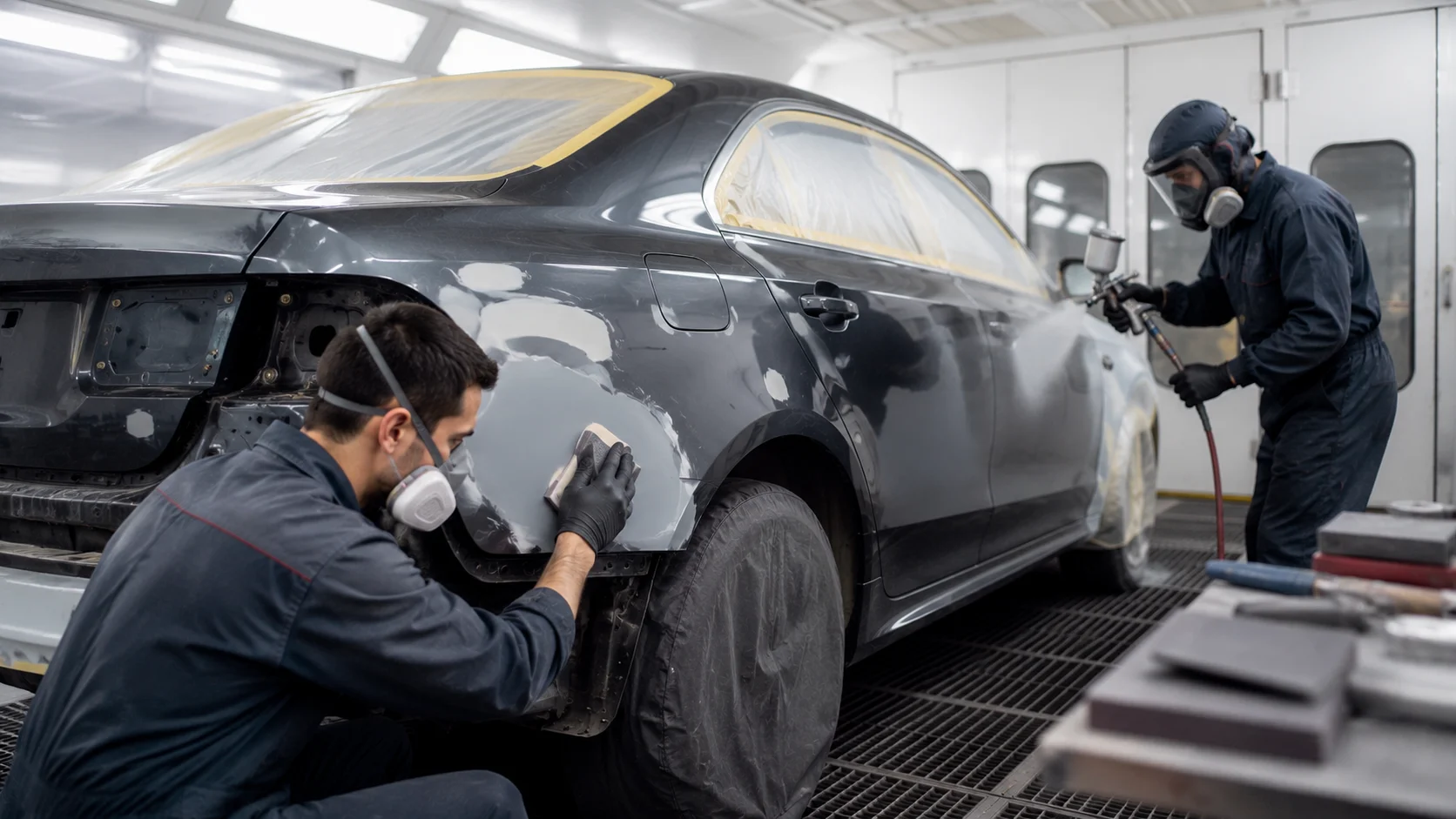
Body damage on a Dubai-driven car accumulates in specific and predictable ways. The door ding from the adjacent car in a tight mall car park. The scrape along the front bumper from a parking pillar that was closer than it looked. The collision damage from a rear-end impact at a traffic light that left the boot lid misaligned and the rear quarter panel pushed in. Every one of these situations leads to the same need — proper denting and painting work that restores the car to the condition it was in before the damage occurred.
What makes denting and painting more consequential in Dubai than in most other markets is the speed at which poor work becomes obvious. Dubai’s UV intensity, heat cycling, and humidity near the coast expose every shortcut — colour matches that seemed close in a workshop look wrong in direct afternoon sun, clear coats applied too thin start hazing within a year, and filler applied over inadequately prepared metal cracks along panel edges as the temperature changes daily between morning cool and afternoon heat. Proper denting and painting process is what produces work that’s still invisible at two years, not just at two weeks.
Denting and Painting: Professional Restoration for Every Type of Damage
A proper denting and painting service covers the complete range of body damage — from the smallest stone chip to multi-panel collision repair — with structural awareness, paint accuracy, and process discipline that produces durable results in Dubai’s demanding environment.
Denting and Painting: Damage Assessment and Scope Definition
Every proper denting and painting job starts with honest assessment before any work begins. What’s visible from the outside rarely tells the complete story.
Structural Check Behind Visible Damage
Collision damage that’s visible on the outer panel frequently extends to inner reinforcement structures, chassis rails, and mounting points behind the skin. A denting and painting workshop that addresses only the visible outer surface leaves the vehicle with compromised structural integrity that isn’t apparent from looking at the finished repair.
A customer brought a Nissan Patrol to Car Garage Expert after a front corner impact. The visible damage was a creased front wing and a damaged bumper. Ramp inspection revealed the front inner reinforcement bracket had also buckled — invisible from outside, but directly affecting the structure’s ability to manage loads in a future collision. Proper denting and painting addressed the structural element before any cosmetic work began.
Hidden Damage from Panel Removal
Inner panel condition, door seal integrity, and electrical components behind damaged panels all need checking when a denting and painting repair involves panel removal. Water ingress through a compromised door seal causes corrosion and electrical faults that develop months after the repair appears complete.
Panel removal — where the repair scope warrants it — exposes these issues and allows them to be addressed as part of the same repair visit.
Sensor and Camera Locations
Modern vehicles integrate parking sensors, radar modules, cameras, and active safety components into bumpers and body panels. Any denting and painting work in these areas must include sensor verification and ADAS recalibration where the geometry has changed from the repair process.
Our car mechanic team coordinates sensor verification with every denting and painting repair involving bumpers or panels that carry active safety components — included as a standard step, not a separate charge.
Denting and Painting: Metal Repair and Dent Removal
The metal repair stage of denting and painting determines whether the repair will be genuinely invisible or visibly present at certain lighting angles. Shortcuts here show up in the finished paint regardless of how good the paint application is.
Paintless Dent Repair for Undamaged Paint
Where paint is completely undamaged, paintless dent repair is the correct denting and painting approach — and the best possible outcome. No filler, no primer, no paint applied over the factory finish. The metal is massaged back to its original shape from behind using specialised rods and picks, guided by reflection boards that show the surface topology in real time.
PDR is appropriate for round shallow dents where the paint hasn’t cracked or stressed — door dings, minor parking knocks, hail damage across multiple small impact points. The result is genuinely invisible because the factory finish was never touched.
Conventional Metal Repair for Paint-Damaged Dents
When a dent has cracked or chipped the paint surface, PDR alone isn’t enough. The metal is worked back as close to original as possible using body hammers, dollies, and pulling equipment — removing as much deformation as possible before filler is applied.
Filler is applied over the metal repair to address remaining surface imperfections — not as a substitute for metal work. A denting and painting repair that skips metal work and uses heavy filler instead produces a panel that cracks and separates within months as the filler flexes differently from the metal beneath.
Panel Pulling for Deep Deformation
Significantly deformed panels — from more serious collision impacts — require pulling equipment to restore the panel profile before hammer work can address surface detail. A stud welder attaches pull points to the outer panel surface, allowing controlled force application that draws the deformation back toward original position.
Proper pulling during denting and painting reduces the total filler depth needed over the repair — producing a thinner, more durable repair than attempting to fill deeply deformed metal without prior pulling.
Denting and Painting: Surface Preparation and Primer
Surface preparation between metal repair and paint application is the stage most often rushed in cheap denting and painting operations — and the stage that most directly determines repair longevity in Dubai’s conditions.
Filler Application and Feathering
Filler is applied in thin, even coats over the repaired metal area — never in a single thick application. Thin coats cure more completely and bond more reliably than thick applications. Each coat is sanded after curing, with the edges feathered progressively to create a smooth transition from the repair area to the surrounding undamaged metal.
A proper denting and painting filler application uses the minimum filler depth consistent with a flat surface result — thick filler is a liability in Dubai’s heat cycling environment where differential expansion between filler and metal produces cracking at the edges.
Primer Coats and Sanding
After filler work, primer is applied to the repair area and surrounding surfaces. Primer seals the filler and metal, provides a consistent base for colour application, and — when sanded with a guide coat — reveals any remaining low spots that would show as surface irregularities under the finished paint.
The guide coat step in denting and painting is what separates thorough preparation from rushed preparation. A contrasting guide coat sprayed over the primer shows every remaining surface imperfection when sanded — any spot that still shows guide coat colour after sanding is a low spot that needs addressing before colour is applied.
Etch Primer for Bare Metal Areas
Where metal has been exposed to bare during the denting and painting process — from grinding, sanding through to metal, or from the damage itself exposing bare metal — etch primer is applied before standard primer. Etch primer bonds chemically to bare metal and provides corrosion protection that standard primer over bare metal doesn’t achieve.
In Dubai’s coastal humidity environment, skipping etch primer on bare metal areas during denting and painting allows corrosion to develop under the paint film — producing bubbling and paint lifting that appears within months rather than years.
Denting and Painting: Colour Matching and Paint Application
Colour matching is the denting and painting stage that Dubai drivers most notice when it goes wrong — and the one that requires the most discipline to get right in this environment.
Factory Paint Code and Spectrophotometer Measurement
Accurate denting and painting colour matching starts with the factory paint code from the vehicle identification plate — this gives the original manufacture colour formula. Then a spectrophotometer measures the actual colour of the adjacent panels on the specific vehicle, accounting for any fading or colour shift that has occurred since the factory application.
These two inputs together — the original formula and the actual current colour — allow the denting and painting technician to mix a paint that matches the existing panels rather than the factory specification alone. A car that’s spent three years in Dubai’s UV environment has faded slightly from factory colour, and a repair mixed only to factory code will be noticeably fresher than its surroundings.
Test Spray Before Application
The mixed paint is test-sprayed onto a card and compared to the vehicle’s adjacent panels in natural light before any paint is applied to the car. If the match isn’t accurate in natural light — which is the standard that matters — the formula is adjusted before the vehicle is touched.
This step adds time to the denting and painting process and is skipped regularly at workshops where throughput matters more than accuracy. It’s also the step that eliminates the most common colour mismatch complaints.
Metallic and Pearl Application Technique
Metallic and pearl finishes require matching both the pigment colour and the flop — how the colour shifts in appearance as the viewing angle changes. Flop is determined by how metallic flake or pearl particles orient in the paint film during application.
Spraying at incorrect distance, pressure, or fan pattern produces a denting and painting result that matches straight-on and looks wrong at every other angle. Matching metallic and pearl flop requires experience with the specific paint type and consistent technique across the repair area.
Blending into Adjacent Panels
A correctly colour-matched repair on a single panel still shows at the panel edges where fresh paint meets aged surrounding paint. Proper denting and painting blending technique extends the new colour into adjacent panels — feathering the material so the transition from repaired area to surrounding paint is invisible rather than abrupt.
Blending adds material and time cost. It’s also what makes the difference between a denting and painting result that the customer can’t locate and one that’s obvious whenever the light catches the panel at the right angle.
Denting and Painting: Clear Coat and Curing
The clear coat stage of denting and painting provides both the glossy finish and the UV protection that determines how long the repair looks correct in Dubai’s sun.
UV-Resistant Clear Coat Specification
Clear coat for denting and painting repairs in Dubai should carry UV resistance properties suited to the UV intensity of this environment. A clear coat formulated for milder climates hazes and loses gloss faster than one specified for high UV exposure.
The film thickness of clear coat application matters alongside the specification. Too thin a clear coat reduces UV protection and produces a finish that hazes within months. Too thick produces runs and sags that require flatting and reapplication.
Curing Time Before Polishing
Clear coat requires adequate curing time before machine polishing and before the vehicle is returned to the customer. In Dubai’s heat, cure time is faster than in cooler conditions — but a minimum still applies and is respected at Car Garage Expert regardless of workshop turnaround pressure.
Polishing before adequate cure produces micro-scratches in the still-soft clear coat surface that multiply under UV exposure. A properly cured denting and painting result is polished once to the correct gloss level and maintains that level without rapid deterioration.
Supporting Services
For vehicles that can’t be driven to the workshop after collision damage, our roadside assistance team covers Al Quoz and surrounding Dubai areas with proper flat-bed recovery — ensuring the vehicle arrives at the workshop without additional damage from incorrect towing.
For mechanical repairs that run alongside denting and painting work — collision damage frequently affects both body and mechanical components simultaneously — our car service team coordinates both in the same workshop visit, minimising total time off the road.
For vehicles combining denting and painting with routine maintenance, our garage near me location in Al Quoz handles both in the same visit where timing allows — service work running while paint cures between coats.
For customers needing an initial damage assessment and repair estimate at their location before committing to a workshop visit, our mobile car mechanic service provides on-site evaluation and honest repair scope definition.
FAQ
What is the difference between PDR and conventional denting and painting repair?
PDR preserves the factory finish for dents with undamaged paint — conventional repair uses filler and paint for dents where the paint surface has cracked or chipped.
How long does a single-panel denting and painting repair take at Car Garage Expert?
Most single-panel repairs take two to three days including metal work, primer, colour coat, clear coat, and adequate curing time before final polish and inspection.
Why does colour matching matter so much for denting and painting in Dubai?
Dubai's direct sunlight exposes mismatches that indoor lighting hides — spectrophotometer measurement and natural light verification before application are the steps that prevent visible colour differences.
Should I repair dents immediately or wait until I have several to do together?
Dents that have exposed bare metal should be repaired promptly in Dubai — coastal humidity causes surface oxidation within weeks, making the repair more involved the longer it waits.
Does denting and painting at Car Garage Expert include ADAS recalibration after bumper work?
Yes — any repair involving sensor-bearing panels includes ADAS sensor verification and recalibration where the geometry has changed, included as a standard step.
In Conclusion
Proper denting and painting produces a result that’s invisible at twelve months — not just on collection day. That outcome requires structural inspection before cosmetic work begins, correct metal repair before filler is applied, spectrophotometer colour matching before paint is mixed, blending into adjacent panels, UV-resistant clear coat at correct film thickness, and adequate curing before the car goes back. In Dubai’s UV environment and heat cycling conditions, each of these steps contributes directly to how long the repair remains invisible — and skipping any one of them produces a result that shows its shortcuts faster here than in most other markets.
Book your appointment with Car Garage Expert for professional denting and painting restoration using process-disciplined bodywork and accurate colour matching. We serve Al Quoz and nearby Dubai areas with complete body repair capability for all makes and models. Find us on Google Maps — walk-ins welcome for damage assessment, booking ahead confirms your repair slot.