
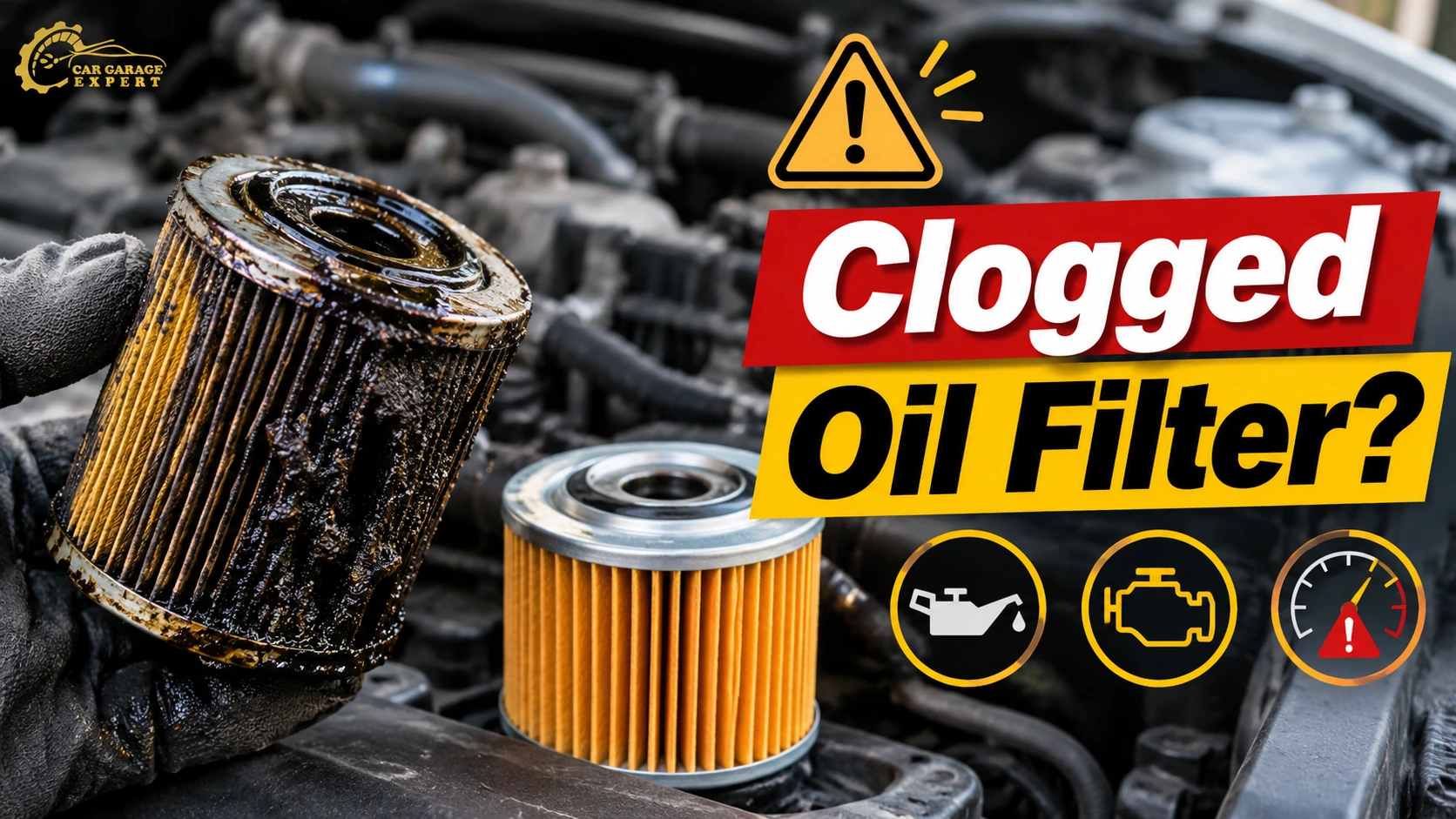
A clogged oil filter rarely fails overnight. It slowly fills with soot, dust, and broken-down oil until the engine struggles to get clean oil. In Dubai, the 45°C summer and long idling in traffic speed up that process.
The oil pressure light is the one sign you should never drive on. If it comes on, pull over, switch off the engine, and call for roadside assistance instead of pushing on to the next exit.
Clogged Oil Filter: Quick Answer
A clogged filter is so full of dirt, sludge, and metal particles that oil can’t flow through it. Common signs include a “low oil pressure” warning light, a ticking sound from the top of the engine at startup, a higher running temperature, and slow acceleration. Most engines have an opening that lets oil flow even when the filter is blocked. The oil then starts to wear down the bearings, camshaft, and turbo because it hasn’t been filtered. If you drove the car with warning signs, you can fix the problem by changing the oil and filter and checking the tire pressure. Every time you get your oil changed in Dubai, you should change the filter.
How the Oil Filter and Its Bypass Valve Work
The oil pump pushes oil from the sump through the filter before it reaches the crankshaft bearings, camshaft, timing chain, and turbocharger—the filter’s pleated paper or synthetic media traps soot, dust, and fine metal from normal wear. Most standard filters catch particles down to about 25 microns, roughly a third of the width of a human hair.
Most spin-on filters contain a small spring-loaded bypass valve. As the media gets more restricted, the pressure difference across it rises. At around 8 to 15 psi, depending on the make, the valve opens and oil goes around the media instead of through it. The engine keeps getting oil, but it’s no longer cleaned.
Cartridge filters, used on many BMW, Mercedes, Volkswagen, Toyota, and Lexus engines, work the same way. On these engines, the bypass valve is built into the filter housing instead of the filter itself.
Why Oil Filters Clog Faster in Dubai
Dubai driving is what most owners’ guides call “severe service.” The filter fills faster than planned because of heat, dust, idling, and short trips.
Summer Heat Breaks Engine Oil Down Faster
Engine oil is already about 100°C. When it’s 45°C outside, and the AC runs for a long time, the oil stays hot longer. O2 breaks down hot oil into sludge and varnish. When a mechanic opens a clogged oil filter, that sludge is what’s inside.
Al Quoz Dust and Stop-Start Traffic
Fine sand and industrial dust from areas like Al Quoz get past a tired air filter and end up in the oil. Slow traffic on Sheik Zayed Road and Al Khail Road adds soot without the steady highway runs that keep oil in good shape. Short trips across town also never let the oil get hot for long enough to drive off moisture and fuel.
Service Intervals Stretched Too Far
Many owners follow the 15,000 km figure printed for long-life synthetic oil. That figure assumes mild weather and open roads. Running one filter that long in Dubai is one of the most common reasons it blocks.
Cheap or Wrong Filters
A low-cost filter can use thin media that tears or collapses under pressure. Some have a bypass valve with the wrong opening pressure. A filter that fits the thread but was made for a different engine may also flow less oil than the pump needs.
Coolant or Fuel Mixed Into the Oil
A leaking head gasket can let coolant into the oil and turn it milky. That mix forms a thick paste that can block a filter within a few hundred kilometers. Fuel getting past worn piston rings or leaking injectors thins the oil and adds more soot.
Warning Signs of a Clogged Oil Filter
The signs of a clogged oil filter build up over weeks, not hours. Most drivers notice two or more of them at the same time.
Oil Pressure Light or Low Gauge Reading
The red oil can light means pressure has dropped below a safe level. Treat it as a stop-now warning. On cars with an oil pressure gauge, a lower-than-usual reading at hot idle is an early clue.
Ticking or Tapping at Start-Up
Hydraulic lifters and the timing chain tensioner need oil pressure to stay quiet. When flow is restricted, you may hear ticking for a few seconds after a cold start. A steady tap that gets faster with revs is a more serious version of the same problem.
Engine Running Hotter in Traffic
Oil carries much of the engine heat away from the pistons, bearings, and turbo. Less oil flow means more friction, and the temperature needle sits higher than normal in slow traffic.
Weak Acceleration and Rough Idle
With flexible valve timing, oil pressure moves the cam phasers. Bad flow can set codes like P0011 or P0014, which can make the car feel flat when you pull away from a light.
Blue-Grey Exhaust Smoke
Blue-grey smoke means the engine is burning oil. Wear from dirty, unfiltered oil can let oil past the piston rings or the turbo seals.
Black, Gritty Oil Soon After a Service
Oil that turns black and gritty a few weeks after a change shows heavy contamination. That dirt loads a fresh filter quickly and needs a cause found, not just another oil change.
What Happens When the Filter Blocks Completely
A fully clogged oil filter doesn’t stop oil flow straight away because the bypass valve opens. The engine keeps running, but on unfiltered oil. Every grain of dust and flake of metal then goes straight into the crankshaft bearings, cam journals and turbo bearings.
The oil pressure drops quickly if the bypass valve doesn’t work or if the filter media falls apart and blocks the outlet. After just a few minutes of hard driving, the bearings can spin, the turbo can lock up, and the camshaft can score. Turbo engines are especially risky because the turbo shaft spins at over 100,000 rpm on a thin film of oil.
Costs vary widely. In Dubai, a new turbo usually costs between AED 3,000 and AED 8,000 to install. An oil and filter change, by contrast, costs only a few hundred dirhams.
How a Mechanic Confirms a Clogged Oil Filter
A good car mechanic does not guess from symptoms alone. A weak oil pump, a blocked pickup screen, and a faulty pressure sensor can all look like a clogged oil filter. The four checks below separate these faults.
OBD Scan for Oil Pressure Codes
A scan tool reads stored codes such as P0520 to P0524 for the oil pressure circuit, plus cam timing codes linked to oil flow. On cars that report it, live data shows the oil pressure reading in real time.
Mechanical Oil Pressure Test
The mechanic removes the oil pressure sender and screws in a mechanical gauge. They compare it to the manufacturer’s numbers when the engine is hot and at about 2,500 rpm. Once the filter is changed, pressure returning to normal points to the filter. If the pressure stays low, it could mean the pump, pickup screen, or bearings are worn out.
Filter Cut-Open Inspection
The old filter is cut open with a filter cutter so you can check the pleats. Sludge packed between the pleats confirms a clog. Shiny metal flakes or bronze-coloured particles warn of bearing wear, and the engine needs a closer look before it goes back on the road.
Oil Condition Check
Check the dipstick and drained oil for a milky color, a fuel smell, or a gritty feel. Milky oil points to coolant, a fuel smell points to injector or ring problems, and grit points to dust getting past the air filter.
How to Fix a Clogged Oil Filter
To fix a clogged oil filter, replace the filter and the oil together. A new filter fitted into old, dirty oil will clog again quickly.
Oil and Filter Change Step by Step
The job takes about 30 to 45 minutes on most cars with basic tools.
- Warm the engine for a few minutes so the oil drains fully, then switch it off.
- Drain the oil through the sump plug and fit a new crush washer.
- Remove the old filter with a filter wrench, or open the cartridge housing and replace its O-rings. Check that the old rubber seal came off with it, because a doubled seal leaks oil fast.
- Wipe a thin film of clean oil on the new filter’s seal, then tighten it by hand about three-quarters of a turn after it touches.
- Refill with the grade in your owner’s manual, such as 0W-20 or 5W-30.
- Run the engine for a minute, check for leaks around the filter and plug, then recheck the level on the dipstick.
If you would rather not do the job yourself in a hot car park, a mobile car mechanic can carry out the oil and filter change at your home or office.
When a New Filter Is Not Enough
It’s more serious if there is metal in the old filter or if the pressure stays low after the change. The mechanic might remove the sump to clean a clogged oil pickup screen, replace the oil pump, or inspect the bearings. If an engine has a lot of sludge, it may need two oil changes, one every 1,000 km, to get rid of the buildup.
Can You Clean and Reuse an Oil Filter?
No, a standard paper or synthetic oil filter is made for one use only. Washing it in solvent damages the media, and sludge stays trapped deep in the pleats. Cleaning also won’t fix a bypass valve with a weak spring.
Some race cars and some motorcycles have stainless steel mesh filters that can be used more than once. Every time the oil is changed, they need to be cleaned with solvent and blown through with air. They also catch larger particles than a good paper filter. A new filter is safer for someone who drives every day in Dubai.
Oil Filter Replacement Intervals and Costs in Dubai
For Dubai driving, change the oil filter every time you change the oil. Many mechanics in the city suggest shorter intervals than the manual’s normal schedule because of the heat and dust.
| Oil type | Suggested interval in Dubai | Typical oil and filter change cost |
| Mineral | 5,000 km | AED 150 to 250 |
| Semi-synthetic | 7,500 km | AED 200 to 350 |
| Full synthetic | 10,000 km or 6 months | AED 300 to 600 |
Turbo engines, large V8s and European models that need approved oils sit at the higher end of these ranges. Many car service packages in Dubai include the oil, filter, labor, and a basic inspection for one price, which often costs less than paying for each item separately.
How to Stop a New Filter From Clogging Early
Changing the oil on time does most of the work. A few more habits help a fresh filter last its full interval.
- Use the oil grade and approval in your manual, such as API SP or the maker’s own standard.
- Buy OEM filters or known aftermarket brands such as Mann, Mahle, Bosch, or Denso, matched to your engine code.
- Replace the engine air filter every 10,000 to 15,000 km, or sooner after dusty months.
- Switch off the engine instead of idling for long spells with the AC on.
- Fix coolant leaks and misfires early, since both contaminate the oil.
Why Car Garage Expert Is a Good Choice for Oil Filter Problems
Car Garage Expert in Al Quoz is a strong choice for drivers who suspect a clogged oil filter, because the workshop finds the cause before it sells parts. The points below explain how that works in practice.
Pressure Testing Before Parts Are Replaced
The shop measures oil pressure with a mechanical gauge when symptoms suggest more than a dirty filter. Owners avoid paying for an oil pump or sensor the car doesn’t need.
Old Filters Are Cut Open and Checked
The removed filter is opened and checked for sludge and metal. Owners are told if the debris points to bearing or turbo wear so that they can decide on repairs before damage spreads.
Oil and Filters Matched to the Engine Code
We match oil grades and filter part numbers to the engine code, not just the model name. Some models use two or three different engines, and each one can need a different filter.
Servicing and Paintwork in the Same Workshop
The same Al Quoz teamof Car Garage Expert handles servicing, engine repair, and car painting, so one visit can cover an oil service and a scratch repair. For drivers searching for a garage near me in central Dubai, the workshop sits close to Sheik Zayed Road and Al Khail Road.
To book an oil and filter check, visit Car Garage Expert, message us on WhatsApp, or get directions on Google Maps.
Frequently Asked Questions
Q1: Can a clogged oil filter cause overheating?
Yes. Restricted oil flow increases friction and reduces the heat oil carries away from the pistons and turbo. The engine runs hotter, mostly in slow traffic.
Q2: Is driving with a clogged oil filter safe?
Not for long. The bypass valve keeps oil moving, but that oil is unfiltered and wears the bearings. If the oil light comes on, stop the engine straight away.
Q3: Does a clogged oil filter lower oil pressure?
Yes, it can. Pressure after the filter drops when the media restricts flow, and the oil light may flicker at idle when the oil is hot and thin.
Q4: What does a clogged oil filter sound like?
Most drivers hear ticking or tapping from the top of the engine, loudest just after start-up. Knocking from lower down is more serious and points to bearing wear.
Q5: Can you clean a clogged oil filter?
No. Standard filters are single-use and should be replaced along with the oil.
Q6: How much does an oil filter replacement cost in Dubai?
A full oil and filter change usually costs AED 150 to 600, based on the oil type and engine. The filter part alone often costs AED 30 to 120.
Conclusion
Oil filters in Dubai work harder than most owner’s manuals expect, because heat, dust and slow traffic load them with sludge and soot faster. The warning signs are low oil pressure, ticking at start-up, a hotter engine in traffic and weak pickup. A pressure test and a cut-open filter tell a mechanic whether fresh oil and a new filter will fix it, or whether the pump or bearings need work. A new filter costs AED 30 to 120, which is small next to the price of a turbo, so fit one with every oil change and check the dipstick every two weeks. If the oil light comes on, stop driving and get the car checked before the next trip.