You’re pulling out onto Sheik Zayed Road, you press the accelerator, and the engine screams while the speedometer barely moves. Or maybe the shifter won’t budge out of Park at all. If your car not shifting gears has become a regular headache, you’re dealing with one of the most common and most misdiagnosed, problems we see at the garage. Some drivers assume the whole gearbox is finished the moment shifting gets rough. Car Garage Expert experience, that’s rarely the first explanation, and jumping to it can mean paying for a rebuild you didn’t actually need.
This guide walks through why the issue happens, how Dubai’s heat and stop-start traffic make it worse, and what steps actually fix it instead of masking it for a week.
Why Is My Car Not Shifting Gears?
When a car won’t shift gears, it’s usually one of four things: low or degraded gearbox fluid, a worn or misaligned shift linkage, a failing sensor delivering inaccurate data to the gearbox control unit or worn clutch packs inside the gearbox. Dubai has high ambient temperatures, which promote fluid breakdown; therefore, the problem occurs more often and sooner than in cooler regions. To properly diagnose a problem, first check the fluid and scan the codes. Do not guess.
Table of Contents
- What It Means When Your Car Not Shifting Gears Happens in Dubai Heat
- Common Reasons Your Transmission Won’t Shift Properly
- Warning Signs to Catch Before It Gets Worse
- How We Diagnose the Problem at the Garage
- Transmission Fluid and Its Role in Smooth Shifting
- What To Do the Moment Your Car Won’t Shift on the Road
- Shift Lock Faults That Look Like a Transmission Problem
- When to Stop Troubleshooting and Call a Mechanic
- Frequently Asked Questions
- Conclusion
What It Means When Your Car Not Shifting Gears Happens in Dubai Heat
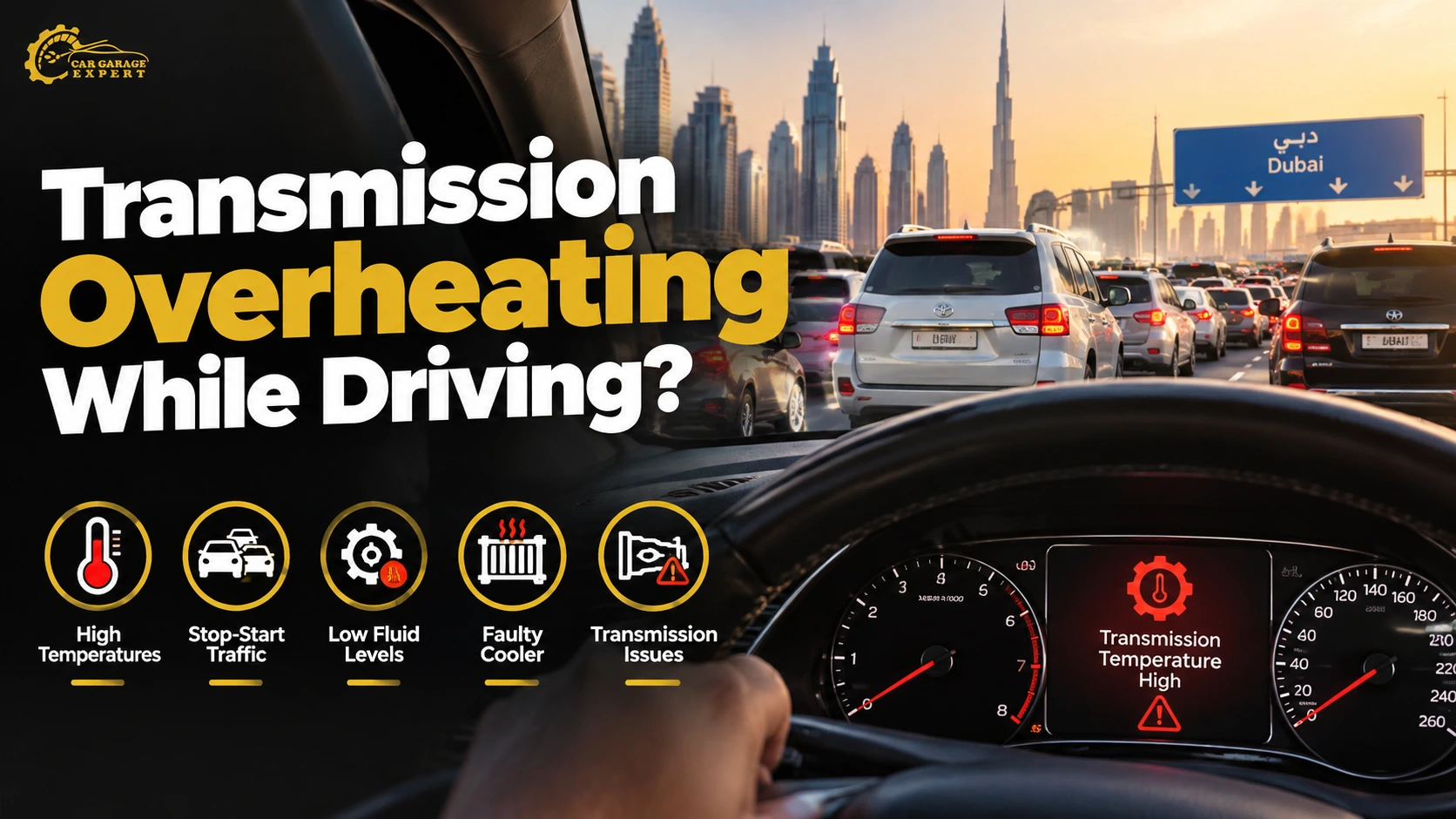
Automatic transmissions rely on fluid pressure, clutch packs, and a network of sensors that must all agree before the gearbox commits to a new gear. In Dubai, cabin and engine bay temperatures regularly climb past what most transmission fluids were designed to handle over long periods, especially when a car idles for hours in traffic near Al Quoz or JBR. Heat thins the fluid, breaks down its additives, and speeds up wear on internal seals. That’s a big part of why local workshops see this issue far more often than garages in milder climates. It isn’t always a design flaw it’s often just accelerated wear that hasn’t been caught in time.
Common Reasons Your Transmission Won’t Shift Properly
Before assuming the worst, it helps to understand what’s happening inside the transmission. Here are the four causes we see most often.
Low or Burnt Transmission Fluid
This is the single most common reason we find when a customer comes with car not shifting gears. Fluids that’s low, dark, or smell burnt can’t lubricate the internal clutch packs properly so shifts may be delayed, harsh, or not happen at all. Healthy fluid should be a clear reddish color — if it looks brown or smells scorched, that’s your first clue.
Worn Transmission Linkage or Shift Cable
The mechanical link between your shifter and the gearbox can loosen or wear out over time. When that happens, the shifter might move freely between positions while the transmission itself never actually receives the command. This is one of the easier fixes on this list, but it still needs a trained eye to catch.
Faulty Sensors or Electrical Faults
Today’s automatics rely on speed sensors, the crankshaft position sensor, and the gearbox control unit talking to each other in real time. Inside, all the mechanical bits may be fine, but a malfunctioning sensor can send bad data and prevent the gearbox from shifting properly. That’s why you want to scan the code before replacing any parts.
Worn Clutch Packs or Bands
If the internal clutch packs or bands are worn down, the transmission may drop into limp mode and refuse to move past first or second gear. This is the more serious end of the spectrum and usually points to overdue fluid services stacking up over the years.
Warning Signs to Catch Before It Gets Worse
The problem rarely shows up without warning. Watch for these signs, and you’ll usually catch it while it’s still a simple repair:
- Slipping gears — the engine revs up, but road speed doesn’t follow.
- Delayed engagement — a noticeable pause before the car actually moves after shifting into Drive or Reverse.
- Grinding or clunking — mechanical noise during gear changes that wasn’t there before.
- Dashboard warnings — a check engine light or transmission warning light that stays lit.
- Burning smell — often a sign of overheated or degraded fluid.
If any of these show up, it’s worth booking a check with a trusted mechanic before a car not shifting gears turns into a full breakdown on the highway.
How We Diagnose the Problem at the Garage
Guessing at transmission repairs almost always costs more in the long run, so our process is built to rule things out methodically rather than jump straight to a rebuild.
- Fluid inspection — checking the level, color, and smell of the transmission fluid first, since it’s the cheapest and most common fix.
- OBD-II code scan — pulling stored fault codes to see whether a sensor or the transmission control unit is flagging an issue.
- Linkage and cable check — confirming the shifter is actually communicating with the gearbox.
- Road test — driving the car under real conditions to see exactly when and how the shifting problem shows up.
This sequence usually tells us within the first hour whether a car not shifting gears needs a simple fluid service or something deeper inside the gearbox.
Transmission Fluid and Its Role in Smooth Shifting
Transmission fluid does more than lubricate — it’s also the hydraulic medium that applies pressure to engage each gear. When fluid is low or contaminated, that pressure becomes inconsistent, and the transmission may hesitate, slip, or refuse to change gear cleanly. Staying on top of a regular car service package is one of the simplest ways to catch fluid degradation before it becomes a shifting problem, especially for cars that spend most of their time in city traffic rather than on the open highway.
What To Do the Moment Your Car Won’t Shift on the Road
If it happens while you’re driving, don’t panic — a few careful steps can keep the situation from getting worse:
- Pull over safely and put the car in Park or Neutral.
- Turn the engine off and restart it, since this sometimes resets a confused transmission control unit.
- Check for visible fluid leaks or dashboard warning lights before continuing.
- If the car still won’t shift, don’t force it; call for roadside assistance instead of risking further damage by continuing to drive.
Continuing to drive with a car that won’t shift properly can turn a fluid top-up into a full transmission rebuild, so it’s worth erring on the side of caution.
Shift Lock Faults That Look Like a Transmission Problem
Not every gearbox that stops is a gearbox issue. Most new cars have a shift lock that won’t let you take it out of Park unless you press the brake pedal first. This is a safety feature, not a problem. If the shifter won’t move even with the brake fully down, or the shift-lock light is on, the problem may be the brake switch or lock solenoid, not the gearbox. This can easily be mistaken for a serious gearbox problem, and catching it early saves diagnostic time.
When to Stop Troubleshooting and Call a Mechanic
Basic checks like fluid level and dashboard warnings are fine to do yourself, but certain signs mean it’s time to book a proper inspection instead of continuing to troubleshoot:
- The problem keeps happening after you top up the fluid.
- Warning lights stay on even after a restart.
- You notice fluid pooling under the car.
- Shifting is accompanied by grinding, clunking, or burning smells.
At Car Garage Expert our, mobile car mechanic team can also come to you for an initial fluid and code check if getting to a workshop isn’t practical. If you’d rather bring the car in yourself, searching for a garage near me will point you to our Al Quoz workshop, which is often the fastest way to confirm whether the fault is minor or something that needs a full inspection.
Frequently Asked Questions
Q1: Why is my automatic car not shifting gears even though the engine revs normally?
This usually points to low or degraded transmission fluid, or a sensor sending incorrect data to the transmission control unit. The engine can rev freely because it isn’t mechanically linked to the wheels at that moment — the fault sits inside the gearbox’s shifting logic, not the engine itself.
Q2: Can I keep driving if my car won’t shift properly?
It’s best avoided. Continuing to drive with delayed or slipping shifts puts extra strain on the clutch packs and can turn a simple fluid or sensor fix into a much more expensive rebuild.
Q3: How much does it cost to fix the issue?
Costs vary widely depending on the cause; a fluid service is far cheaper than a linkage repair, and both are cheaper than internal clutch pack work. An accurate diagnosis before any repair is the only way to know which category your car falls into.
Q4: Is it always a transmission problem?
Not always. Before replacing parts, do a full code scan. Shift lock faults, linkage wear, or electrical sensor difficulties can all cause the same symptom without any actual damage to the gearbox.
Q5: How often should transmission fluid be changed in Dubai’s climate?
Because heat accelerates fluid breakdown, cars driven regularly in Dubai often need transmission fluid changed sooner than the manufacturer’s standard interval suggests, particularly for vehicles doing a lot of stop-start city driving.
Conclusion
A car not shifting gears is disconcerting, but it’s seldom a mystery when someone really checks beneath the hood instead of speculating. Most problems come from fluid condition, linkage wear, sensor faults, and clutch pack wear, and in Dubai’s environment we often see fluid-related issues. Catching early warning signs, slippage, delayed engagement, grinding, or a warning light gives you the best chance of a straightforward, economical fix. Our workshop handles everything from transmission diagnostics to car painting touch-ups, so if your shifting has started feeling off, it’s worth having it checked at Car Garage Expert before a manageable issue becomes a costly one.
📍 Find directions on Google Maps.
💬 Message us directly on WhatsApp to book your inspection