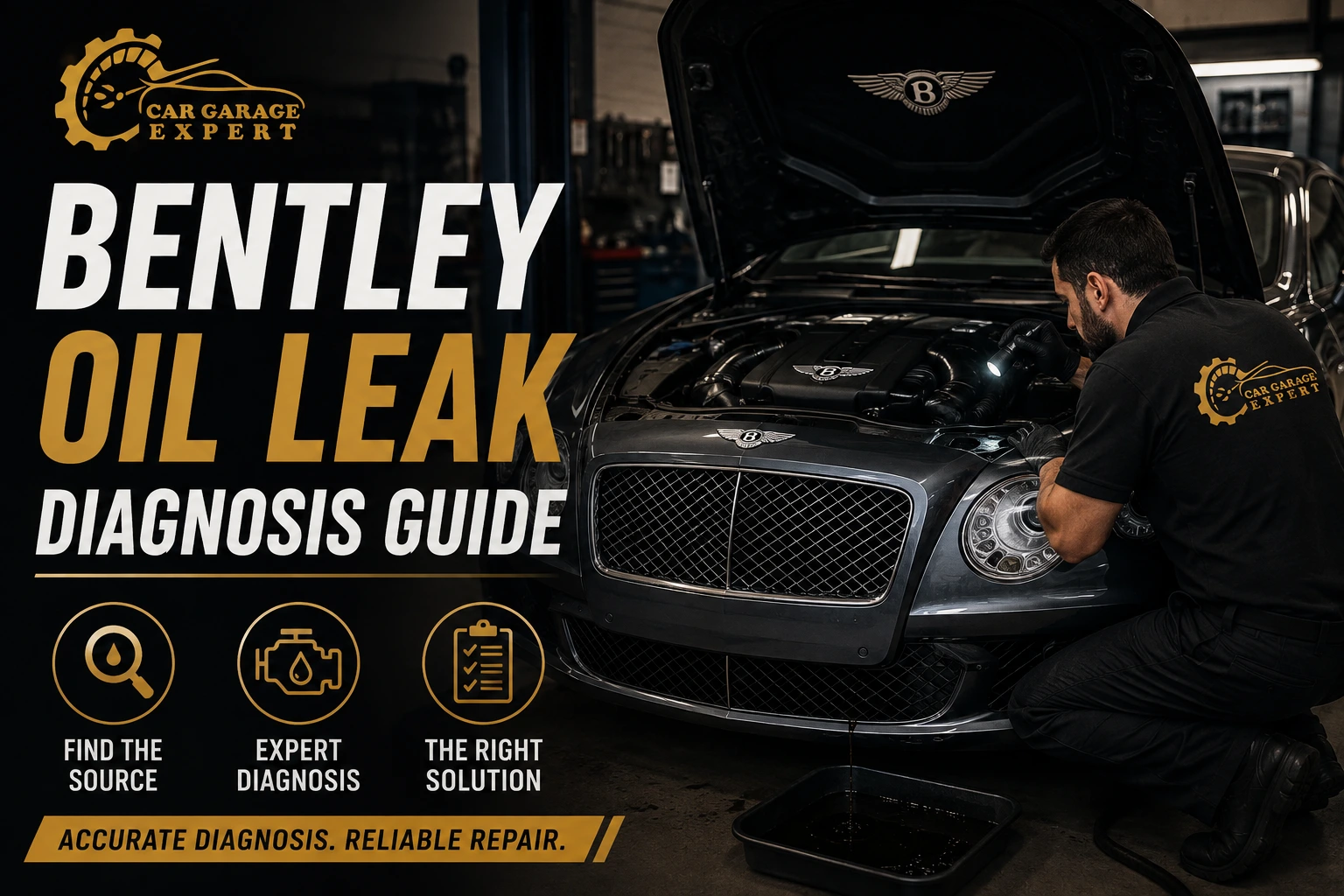
Bentley Oil Leak Diagnosis really comes down to tracking oil back to where it’s actually escaping, rather than assuming the leak’s coming from wherever it happens to be pooling. Oil has a habit of running down or across the engine before it ever reaches the ground, which can throw the whole picture off if you’re not looking carefully. A proper inspection usually starts with checking the oil level and any visible residue, then cleaning the area and watching for fresh oil while the engine’s actually running. Depending on what’s going on, a technician might check seals, gaskets, breather components, the oil-filter housing, and a handful of other likely spots. If there’s a serious leak or a low oil-pressure warning, the car shouldn’t be driven again until someone’s actually looked at it.
Table of Contents
- Why Finding the Actual Leak Source Matters
- What a Bentley Oil Leak Usually Looks Like
- Common Signs of an Oil Leak
- Common Places Bentley Oil Leaks Can Start
- How Bentley Oil Leak Diagnosis Is Performed
- How the Leak Is Repaired
- What Can Happen If an Oil Leak Is Ignored?
- Can You Continue Driving a Bentley With an Oil Leak?
- How Long Does Oil Leak Diagnosis and Repair Take?
- What Determines the Repair Cost?
- How to Reduce the Risk of Future Oil Leaks
- Dubai-Specific Advice for Bentley Owners
- Why Choose Car Garage Expert for Bentley Oil Leak Diagnosis and Repair?
- Frequently Asked Questions
- Related Services
- Final Call-to-Action
Why Finding the Actual Leak Source Matters
Spotting oil under a Bentley makes most people jump straight to the oil pan or something else sitting low on the engine. But the lowest point where you can actually see oil isn’t necessarily where it’s coming from.
Oil tends to run down engine surfaces and pool around whatever’s lowest. Bentley’s own technical documentation on certain W12 applications flags exactly this: a leak from the breather return line or the dipstick-tube O-rings can travel down the engine and end up looking like a sump leak, even though the sump itself is fine.
That’s really the whole reason Bentley Oil Leak Diagnosis has to focus on tracing fresh oil back to where it’s actually coming from, not just where it’s collecting.
Swap out an expensive component without confirming that first, and there’s a real chance the original problem’s still sitting there untouched.
What a Bentley Oil Leak Usually Looks Like
Sometimes an oil leak’s obvious. Other times it’s genuinely tricky to spot, which is exactly why Bentley Oil Leak Diagnosis can’t rely on a glance alone.
Signs worth watching for:
- Oil drops underneath the vehicle.
- Wet or greasy areas around the engine
- Oil collecting on lower engine components
- A burning-oil smell
- Smoke from the engine compartment
- A falling oil level
- Oil around a gasket or seal
- Oil residue around the oil-filter area
A small seep might only leave a thin film rather than an obvious puddle.
Color can give you a hint, but it shouldn’t be the only thing you go by oil darkens with age, and it spreads across nearby components easily enough to muddy the picture.
Common Signs of an Oil Leak
A Burning-Oil Smell
A strong burning smell usually means leaking oil has made contact with something hot — the engine or exhaust components. That’s worth taking seriously, since oil sitting on very hot surfaces for a while brings its own risks.
Oil Spots Where You Park
Fresh spots under the car are hard to miss. Worth noting whether they show up after the car’s been parked for hours, or almost right after you’ve been driving.
Low Oil Level
If the oil level keeps dropping between services, that’s worth getting looked at. It could be an external leak, or in some cases oil being consumed inside the engine itself.
Smoke From the Engine Bay
Smoke or vapor from the engine bay isn’t something to shrug off, especially if there’s an oil smell riding along with it.
Oil-Pressure Warning
This one’s a different category of serious compared to a small external seep. Bentley’s own technical guidance is specific about low oil-pressure situations and advises against continuing to drive if there’s a lubricating-oil leak or an unusual mechanical noise involved.
Common Places Bentley Oil Leaks Can Start
Exactly where a leak starts depends heavily on the model, engine, and year, which is a big part of why Bentley oil leak diagnosis is a vehicle-specific job rather than a generic checklist.
Valve Cover and Gasket Areas
Gaskets up top wear down with age and heat exposure. On certain Continental W12 engines, a valve-cover leak can bring both visible oil and that telltale burning smell.
Oil Filter Housing Area
The oil-filter housing and the seals around it are worth a look on applicable W12 engines too. That said, leaks nearby can look almost identical, which is why jumping straight to replacing the housing isn’t always the right first move.
Breather Return Line and Dipstick Tube
This one matters a lot on certain Bentley W12 engines specifically. Bentley’s technical documentation points to damaged O-rings in this area as a possible source of external leakage, and explains how oil from here can travel downward and make the sump look like the culprit.
Oil Pan or Sump Area
The lower part of the engine absolutely can leak on its own. But it’s worth confirming the oil’s actually originating there rather than just arriving from somewhere higher up.
Timing-Cover Area
Depending on the engine, seals around the timing cover are also worth checking when oil’s showing up around the front or side of the engine.
The takeaway across all of this: where you see the oil isn’t necessarily where it started.
How Bentley Oil Leak Diagnosis Is Performed
A proper Bentley Oil Leak Diagnosis follows a logical sequence rather than jumping to conclusions.
Step 1: Confirm the Customer’s Symptoms
First, the technician needs to hear what you’ve actually noticed.
Was there a puddle? A burning smell? Smoke? A low-oil warning? Has the level been dropping over time? Did it start right after a service?
These details help narrow down where to look first.
Step 2: Check the Oil Level
The oil level gets checked using the correct procedure for the vehicle.
If it’s dangerously low, the car shouldn’t just be driven straight to a workshop. The underlying leak and how well the engine’s actually being lubricated need checking first.
Step 3: Inspect the Engine Compartment
The technician looks for fresh oil, wet surfaces, residue, damaged seals, and any sign of oil having moved from somewhere.
This includes looking above and around wherever oil’s already collected, not just the obvious spot.
Step 4: Clean the Suspected Area
Old residue makes this whole process harder than it needs to be.
Cleaning it off helps separate an old stain from anything genuinely fresh that shows up once the engine’s running again.
Step 5: Run and Recheck the Engine
Once it’s clean, the engine runs while the technician keeps an eye on the likely leak points.
This can reveal fresh oil that would’ve stayed hidden under old residue. Bentley’s own W12 oil-filter-housing diagnostic guidance recommends a similar approach.
Step 6: Confirm the Source Before Recommending Repairs
The last step is actually pinning down the component responsible.
This matters more on complex Bentley engines than most, since oil can migrate from one spot to another and leave a pattern that’s genuinely misleading if you don’t dig deeper.
How the Leak Is Repaired
Once Bentley Oil Leak Diagnosis has actually identified the source, the repair comes down to whatever component failed.
A damaged gasket might need replacing. A leaking O-ring can be a fairly quick job compared to something bigger that needs a lot more disassembly to reach.
On some Bentley W12 applications, for instance, a valve-cover replacement turns into a more involved job simply because getting to that part of the engine isn’t straightforward.
A proper repair also means checking nearby areas for additional leakage. If oil’s gotten onto electrical connectors, belts, hoses, or anything else close by, those need a look too.
Once the repair’s done, the area gets checked again to make sure fresh oil isn’t showing up anymore.
What Can Happen If an Oil Leak Is Ignored?
A small leak has a way of quietly becoming a much bigger one.
As oil drops, the engine’s internal components have less lubrication to work with. If it gets bad enough to cause low oil pressure, continuing to drive can lead to serious engine damage.
Oil landing on hot components can also produce smoke and a strong burning smell. Bentley’s own valve-cover leak guidance specifically calls out the risks of oil reaching hot exhaust areas.
There’s also a chance a seemingly minor leak is actually pointing to something else going on underneath.
For a car this complex, catching and fixing the cause early beats waiting around for a secondary failure to force the issue.
Can You Continue Driving a Bentley With an Oil Leak?
That really depends on how bad it is.
If it’s just minor seepage and the oil level’s still normal, a short trip to a qualified workshop might be fine. But that’s not a call worth making purely on how the car feels while you’re driving it.
Don’t keep driving if:
- The oil-pressure warning is illuminated.
- Oil is dripping rapidly.
- The engine is making abnormal mechanical noises.
- The oil level is critically low.
- There is significant smoke from the engine bay.
- You suspect oil is reaching very hot exhaust components.
Bentley’s technical documentation specifically warns against continuing to drive with a lubricating-oil leak in the context of certain W12 low oil-pressure concerns.
If your Bentley genuinely can’t be driven safely, roadside assistance beats risking further engine damage trying to get it somewhere yourself.
How Long Does Oil Leak Diagnosis and Repair Take?
If the leak’s obvious, diagnosis itself can be fairly quick.
A slow leak that only shows up once the engine’s fully up to operating temperature can take longer actually to confirm.
Repair time varies a lot too. A small seal or O-ring might take far less labor than something buried behind a timing cover or a hard-to-reach gasket.
On some W12 repairs specifically, access alone can be genuinely demanding. That’s exactly why confirming the actual source matters more than rushing to quote a repair time upfront.
What Determines the Repair Cost?
A handful of things shape the final number:
- Bentley model and year
- Engine type
- Exact leak location
- Gasket or seal involved
- Parts required
- Labour access
- Amount of disassembly
- Oil and filter requirements
- Additional damage caused by the leak
- Diagnostic time
A quick O-ring swap and a major timing-cover job are obviously two very different repairs, cost-wise.
That’s exactly why a proper Bentley Oil Leak Diagnosis needs to happen before anyone gives you a firm number.
How to Reduce the Risk of Future Oil Leaks
You can’t stop every gasket or seal from eventually wearing out, but good habits catch problems earlier.
- Check the oil level according to the manufacturer’s procedure.
- Follow the recommended oil-service schedule.
- Use the correct oil specification.
- Have new leaks inspected promptly.
- Pay attention to burning-oil smells.
- Check underneath the car periodically for fresh fluid.
- Do not ignore warning lights.
- Have oil residue investigated rather than simply cleaning it away.
- Keep records of previous repairs and oil consumption.
Regular checks are especially worth the effort on older luxury vehicles, where age, heat, and tight engine access all make repairs more complicated if a small issue is left to grow.
Dubai-Specific Advice for Bentley Owners
Dubai’s climate is reason enough to keep a closer eye on fluid levels and what’s going on under the hood.
High heat puts extra strain on rubber seals, gaskets, and everything else that relies on staying flexible. Bentley W12 engines also pack a lot of components close together, which means a small leak can spread to nearby areas before it’s even visible.
If you spot oil under your Bentley after parking somewhere in Dubai, don’t assume the lowest visible point is actually where it’s coming from.
Anyone searching for a garage near me should look for a workshop that’ll properly inspect the engine rather than just swapping out whatever part happens to sit closest to the stain.
And if there’s a serious leak, a low oil level, or a warning light on, arrange roadside assistance instead of driving it across the city yourself.
Why Choose Car Garage Expert for Bentley Oil Leak Diagnosis and Repair?
At Car Garage Expert, the priority is always finding the actual source before recommending anything expensive.
Bentley oil leaks can be genuinely misleading, since oil travels across engine surfaces so easily. A careful inspection is what separates a real oil-pan leak from oil that’s actually coming from somewhere higher up.
The approach is straightforward: look at the symptoms, trace the oil, identify what’s actually failed, and explain what repair it actually needs. That’s the core of proper Bentley Oil Leak Diagnosis done right, rather than a guess dressed up as a fix.
For Bentley owners in Dubai, Car Garage Expert can help with oil-leak inspection, engine diagnostics, and whatever repair work follows.
Frequently Asked Questions
Q1: How serious is a Bentley oil leak?
It depends on the size and location. A small seep might not cause immediate harm, but a leak that’s getting worse quickly, or a low oil-pressure warning, can turn into a serious engine problem fast.
Q2: Can I find the oil leak myself?
You might spot visible residue, but tracking down the exact source can be genuinely tricky, since oil travels from higher points down to lower parts of the engine before you ever see it.
Q3: Why does my Bentley have oil underneath the engine?
It could be the sump, but just as easily a higher gasket, seal, breather component, the dipstick tube, or the oil-filter area, with the oil simply working its way downward from there.
Q4: Can an oil leak cause a burning smell?
Yes. Oil hitting hot engine or exhaust components tends to produce a pretty noticeable burning smell.
Q5: Is it safe to drive with a Bentley oil leak?
Only minor leaks might allow limited driving, and even then it’s worth getting checked soon. If the oil-pressure warning comes on, oil’s dripping heavily, or the engine’s making odd noises, stop and get help instead.
Q6: Why does my Bentley leak oil but not leave a puddle?
A slow seep can leave residue without ever forming an obvious puddle. Oil can also sit on engine components or evaporate off hot surfaces before it hits the ground.
Related Services
If your Bentley has an oil leak or related warning signs, these services may be relevant:
- Bentley Engine Repair
- Bentley Car Diagnostics
- Car Oil Change
- Engine Inspection
- Car Maintenance
- Vehicle Inspection
- Roadside Assistance
- Car Garage Near Me
Final Thoughts
A Bentley oil leak isn’t something worth guessing about. That visible stain might only be the endpoint of a leak that actually started somewhere else entirely.
If you’re noticing oil under your Bentley, a burning-oil smell, a dropping oil level, or residue building up in the engine bay, it’s worth arranging a proper Bentley Oil Leak Diagnosis before the problem gets more expensive than it needs to be.
Car Garage Expert can help track down the source and recommend the right repair for your Bentley in Dubai.
If the leak’s severe or your Bentley has an oil-pressure warning on, don’t risk driving it. Arrange roadside assistance and get the vehicle inspected safely. Contact Car Garage Expert today for Bentley Oil Leak diagnosis.