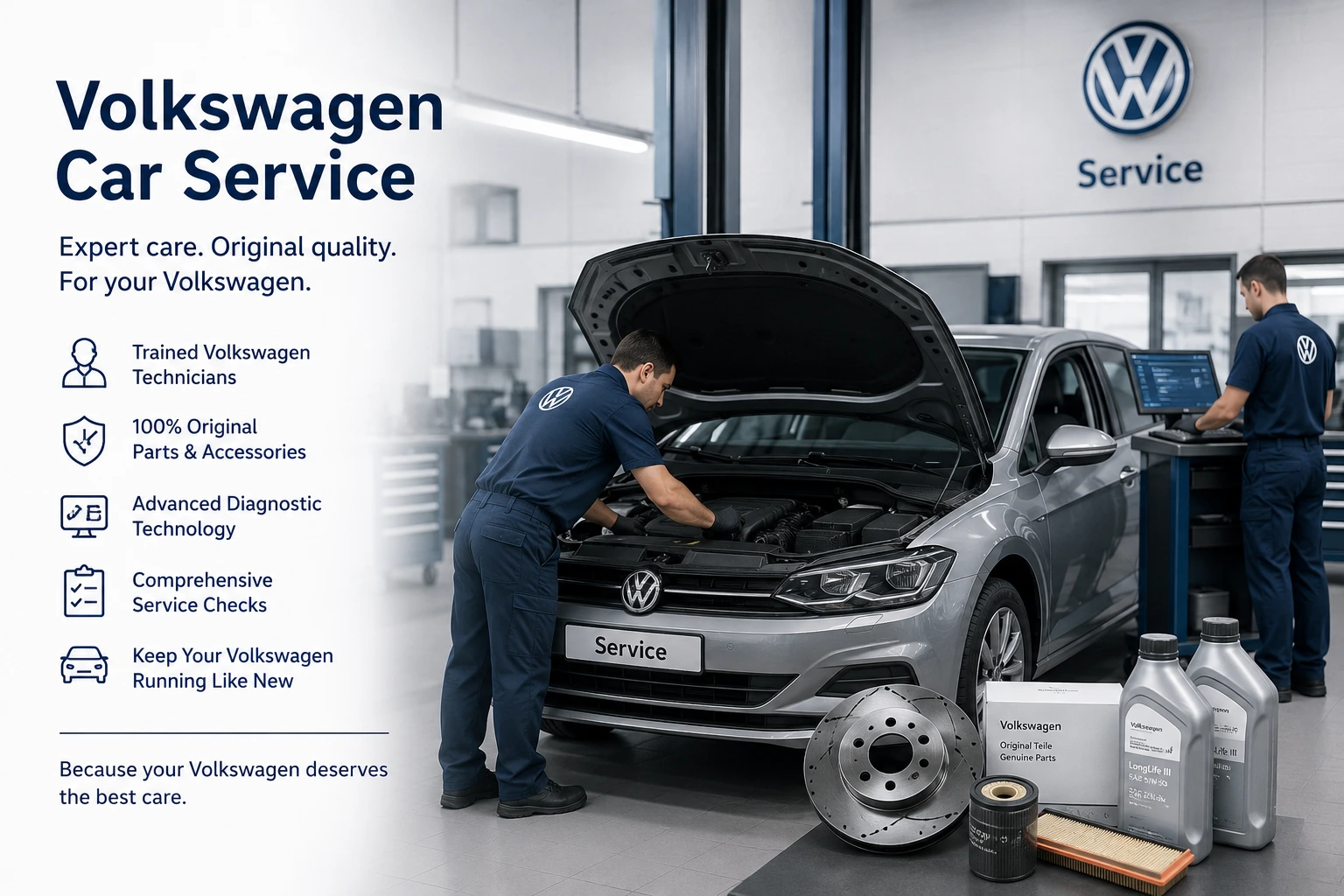
A Volkswagen that’s properly serviced drives noticeably differently from one that isn’t. The throttle response feels cleaner, the DSG shifts more decisively, the engine runs quieter at idle, and the general sense of mechanical tightness that makes a Golf or Tiguan satisfying to drive stays intact. Let the service intervals slip — use the wrong oil, skip the DSG fluid, ignore the timing chain rattle at cold start — and that quality erodes in ways that are gradual enough to miss until something more expensive makes itself known.
Volkswagen car service in Dubai carries specific requirements that the manufacturer’s European-market schedule doesn’t fully account for. The sustained heat, the stop-start Sheikh Zayed Road traffic, the short daily trips that never fully warm the drivetrain, and the fine particulate matter that enters every air intake during shamal season all accelerate wear on specific components. A service schedule built for German driving conditions isn’t wrong — it’s just incomplete for what Dubai actually does to these cars.
This covers what a proper Volkswagen car service in Dubai includes, why each item earns its place on the schedule, and what happens to the specific VW components that Dubai’s conditions affect most.
Volkswagen Car Service Dubai — Why the Schedule Needs Local Adjustment
Volkswagen’s flexible service indicator — the system that calculates service intervals based on driving patterns, oil temperature, and mileage — was designed and calibrated for European driving conditions. In practice, this means it often extends service intervals beyond what’s appropriate for Dubai’s operating environment.
The core issue is thermal degradation. Engine oil in a Dubai summer reaches operating temperatures faster, stays there longer, and cycles between higher temperature extremes than in a northern European climate. Oil that the flexible service indicator considers acceptable at 18,000 km in a German city has often degraded to a point where it’s no longer providing adequate protection at 12,000 km in Dubai.
The practical Volkswagen car service interval for Dubai: every 10,000 km or six months, whichever arrives first. This applies across the Golf, Tiguan, Passat, Polo, and Touareg ranges regardless of what the dashboard indicator shows. It’s not pessimistic — it’s calibrated to the actual operating environment rather than the one the service system was designed for.
Why Oil Quality and Specification Matter Specifically on VW Engines
Volkswagen Group engines are specification-sensitive in a way that generic oil marketing doesn’t capture well. The EA888 1.8 and 2.0 TSI engines require oil meeting VW 504.00 or 507.00 specification — these aren’t just viscosity requirements, they define additive packages that affect timing chain tensioner lubrication, VVT solenoid cleanliness, and turbocharger bearing protection.
Using a generic 5W-30 that meets basic viscosity requirements but doesn’t carry VW specification approval doesn’t obviously harm the engine immediately. Over multiple service intervals in Dubai’s heat, it contributes to VVT solenoid screen blockage, timing chain tensioner wear, and carbon accumulation in the turbocharger oil feed passages. These are the faults that generate expensive repair bills on higher-mileage VW engines — and in most cases they trace directly to service history that used incorrect oil specification.
A proper Volkswagen car service uses oil with the correct VW specification approval, documented on the invoice. This isn’t brand loyalty — it’s engine architecture compliance.
What a Proper Volkswagen Car Service Covers
Engine Oil and Filter
The foundation of every service — and the item most subject to shortcuts in Dubai’s workshop market.
Engine oil specification for VW Group petrol engines: VW 504.00 or 507.00 approved full synthetic, correct viscosity grade for the specific engine family. The 1.0 TSI three-cylinder uses a different spec from the 2.0 TSI EA888. The TDI diesel engines require VW 507.00 specifically for diesel particulate filter compatibility. Fitting a “close enough” oil that doesn’t carry the correct approval code isn’t correct Volkswagen car service — it’s an approximation that accumulates consequences over time.
Oil filter quality matters independently of the oil. A filter with a weak bypass valve collapses under cold-start oil pressure, allowing unfiltered oil to circulate through precision components. On VW Group engines where timing chain tensioners and VVT solenoid screens are oil-pressure dependent, this matters practically. OEM or OE-equivalent filter specification at every service.
Air Filter
The air filter on a Dubai-operated Volkswagen isn’t a minor service item. Shamal season sends fine particulate matter through every air intake in the city — a filter that would be acceptable at 20,000 km in Germany can be restricting airflow significantly at 12,000 km in Dubai after a sustained wind event.
A clogged air filter raises intake restriction, increases inlet air temperature, forces the ECU to compensate with richer fuelling, and reduces throttle response in ways that feel like an engine issue rather than a maintenance item. Every Volkswagen car service should include air filter physical inspection — not just a mileage-based replacement decision. If there’s meaningful contamination, it comes out regardless of mileage.
On the 1.4 and 2.0 TSI engines with MAF sensors downstream of the filter housing, a compromised air filter seal that allows unfiltered air past the filter element contaminates the MAF sensing element. A proper filter housing inspection checks the seal condition, not just the filter medium.
Spark Plugs
VW Group petrol engines use iridium or platinum-tipped spark plugs with extended replacement intervals under normal conditions. In Dubai, the effective interval shortens because short-trip city driving cycles never allow the engine to reach the combustion temperatures that self-clean the plug tip. Carbon accumulation on plug tips causes misfires that don’t yet register as a fault code but reduce combustion efficiency, increase fuel consumption, and load the catalytic converters with unburnt hydrocarbons.
On the 1.4 TSI and 2.0 TSI EA888 engines, misfire detection is sophisticated — the engine management can identify individual cylinder misfires and compensate before a warning light appears. This means mild plug fouling goes unnoticed until it becomes significant. Including plug inspection in a Volkswagen car service at 40,000–50,000 km catches deteriorating plugs before they develop into misfires the driver notices.
DSG Transmission Fluid and Filter
This is the Volkswagen car service item most commonly deferred and most consequentially neglected in Dubai.
VW’s DSG dual-clutch transmission is among the finest gearbox designs in production — fast, efficient, and remarkably refined when properly maintained. The service interval caveat that creates problems: Volkswagen lists DSG fluid as “lifetime fill” on many variants. That designation was applied for European driving conditions and doesn’t hold in Dubai.
DQ250 Wet-Clutch DSG
The DQ250 handles higher torque outputs — Golf GTI, Golf R, Tiguan 2.0 TSI, Passat 2.0 TSI. It uses a wet clutch pack bathed in DSG fluid that serves both as clutch operating medium and transmission lubricant. In Dubai’s stop-start traffic, the thermal load on this fluid is substantially higher than in European conditions.
Degraded DQ250 fluid causes progressive clutch pack wear. The early symptom is a slight shudder under light throttle cruising — easy to attribute to road surface or tyre condition. Left without a fluid service, the shudder becomes consistent, shift quality deteriorates, and the clutch packs develop wear that makes proper engagement impossible without replacement. Fluid service at 60,000 km prevents this progression. A DQ250 clutch pack replacement costs AED 8,000–15,000. A fluid service costs AED 600–900.
DQ200 Dry-Clutch DSG
The DQ200 handles lower torque outputs — Golf 1.4 TSI, Polo, and standard Golf variants. It uses a dry clutch pack and separate mechatronics unit lubrication. The DQ200 is more sensitive to Dubai’s driving patterns than the DQ250 because its dry clutch design generates heat faster in low-speed engagement cycles.
DQ200 service includes both the mechatronics unit fluid and a fork and lever inspection — components that wear faster in stop-start conditions. Any Volkswagen car service for a DQ200-equipped car should also include a clutch adaptation reset via VCDS after the fluid change, which recalibrates the clutch engagement point to the current clutch condition. Without this reset, the gearbox continues using adaptation values from before the service.
Haldex Fluid — 4MOTION Models
The Tiguan, Golf R, and other 4MOTION models have a Haldex coupling that engages the rear axle on demand. The Haldex unit has its own fluid and filter separate from the DSG transmission — it’s not the same fluid, it’s not the same interval, and it requires its own service procedure.
Haldex fluid service interval in Dubai: every 40,000 km. Neglected Haldex fluid causes the electromagnetic coupling to engage sluggishly — the 4MOTION system provides reduced or no rear traction contribution under demand. The symptom doesn’t show in normal driving. It shows when AWD is specifically needed — pulling away on a loose surface, or in a situation where the front wheels are already at traction limit.
A Volkswagen car service for a 4MOTION vehicle that doesn’t include the Haldex as a line item has serviced the engine and gearbox but left the AWD system unattended.
Brake Fluid
Volkswagen specifies brake fluid replacement every two years regardless of mileage. In Dubai, the reasoning is reinforced by the humidity cycling between air-conditioned cabin environments and 45°C external temperatures — brake fluid absorbs moisture faster here than in European conditions, and degraded fluid boiling point reduction is a real safety concern on vehicles used for sustained braking on Hatta Road or Al Ain Road.
A Volkswagen car service brake fluid check should use a calibrated moisture content tester — not a visual colour check, which tells you very little about actual boiling point. Fluid showing above 2% moisture content by weight should be replaced regardless of when the last change was done.
Cabin Air Filter
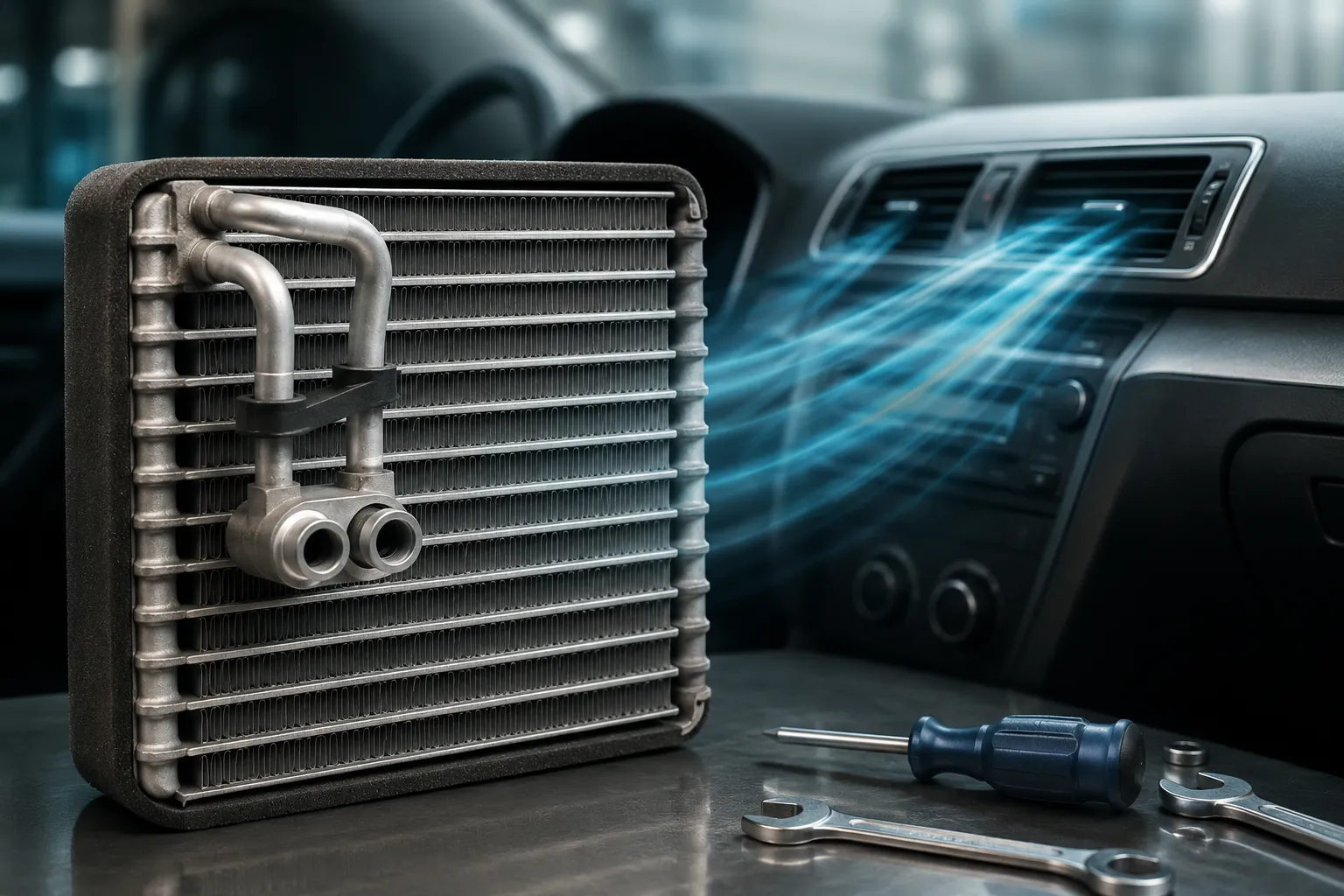
The cabin filter on a Dubai Volkswagen works harder than in almost any other market. The AC system runs nine to ten months of the year, drawing outside air through the cabin filter continuously. Fine particulate matter from shamal events loads the filter faster than European replacement intervals assume.
A blocked cabin filter restricts airflow through the AC system, makes the blower work harder to push air through the restriction, increases compressor load, and reduces the cooling effectiveness at the vents. In a city where cabin cooling is safety-relevant from May through September, a clogged cabin filter is a comfort and efficiency issue that a proper Volkswagen car service addresses at every visit — not on a fixed mileage schedule.
Coolant Concentration
Coolant concentration check at every service — tested with a refractometer, not a visual inspection. In Dubai’s ambient temperatures, a cooling system running on diluted coolant has minimal margin before it exceeds safe operating temperature under sustained load. The auxiliary water pump on certain TSI variants is a known wear item — a service inspection should include pump operation verification alongside the coolant concentration test.
Battery Health Assessment
VW Group MQB platform vehicles — Golf, Tiguan, Polo on current generation — carry significant electrical loads and are harder on batteries than older VW platforms. In Dubai’s heat, a battery entering its third year should be tested on a conductance tester at every Volkswagen car service — not just when symptoms appear. A battery showing below 70% conductance health in Dubai should be replaced proactively. Battery failure on a modern Volkswagen isn’t just an inconvenient no-start — it can corrupt adaptation values in the DSG and engine management modules during the failure event.
Battery replacement on MQB platform vehicles requires registration via VCDS after fitting. Without registration, the charging strategy remains calibrated to the old battery’s profile — leading to either overcharging or undercharging the new unit from day one.
Full VCDS System Scan
A VCDS scan across all control units should be part of every Volkswagen car service — not a separate charged diagnostic session. Fault codes developing in body control, chassis management, Climatronic, and comfort systems don’t always trigger dashboard warning lights immediately. Finding them during a routine service visit costs nothing beyond the scan time. Finding them after they cause a breakdown or secondary failure is considerably more expensive.
The scan also reveals adaptation drift — DSG clutch adaptation values that have moved beyond normal range, throttle body adaptation values that indicate carbon buildup, and injector quantity corrections that are growing beyond specification. These are early indicators of developing mechanical issues that haven’t yet produced symptoms.
What a Volkswagen Car Service Inspection Should Cover
Beyond the service items themselves, every Volkswagen car service visit should include a physical inspection of wear and condition items:
Brake pad thickness at all four corners — documented measurement, not a visual estimate. Disc condition including surface scoring and heat cracking. Tyre tread depth and DOT age code — tyres over five years in Dubai’s UV environment are a replacement consideration regardless of tread depth. Suspension component inspection for visible wear — ball joint boots, tie rod end condition, subframe bushing compression. CV boot condition on all four corners. Auxiliary belt condition and tension. All fluid levels and condition — power steering, transfer case on applicable models, rear differential on AWD variants.
After the Service — What Good Work Looks Like
A properly completed Volkswagen car service should produce a car that feels noticeably correct: DSG shifts decisively through the first few drive cycles as adaptation recalibrates, idle is stable and clean, throttle response is crisp, and there are no new fault codes in the VCDS scan performed after the work is done.
The job card should document every fluid specification used — oil grade and VW approval code, DSG fluid part number, Haldex fluid specification. These details matter when the next service provider needs to know what’s in the car and whether the previous service was done to the correct specification.
For VW owners who need support between services, a qualified mobile car mechanic with VAG experience handles battery replacements with correct coding, minor fault resets, and on-site assessments. When the car needs recovery, proper roadside assistance ensures DSG-equipped vehicles are transported correctly — incorrect towing technique on a DSG causes gearbox damage.
For paint damage from Dubai’s UV exposure, sand abrasion, or parking contact, professional car painting with VW colour codes handles everything from touch-up work to panel respray with correct metallic and pearl finish layering. A qualified car mechanic with genuine VW platform knowledge handles the full scope of service and repair under one roof.
For Volkswagen owners in Al Quoz and surrounding areas looking for a garage near me that performs Volkswagen car service to the correct specification — correct oil approval, correct DSG fluid, VCDS scan included, and Dubai-adjusted intervals — the difference from a workshop applying generic service logic to a VW is visible in the job card and felt in how the car drives after.
FAQ
How often should I get a Volkswagen car service in Dubai?
Every 10,000 km or six months — Dubai’s heat and stop-start conditions degrade oil faster than the manufacturer’s flexible service indicator assumes for European driving.
Does the VW DSG gearbox need a fluid service in Dubai?
Yes — every 60,000 km regardless of the lifetime fill designation, which was calibrated for European conditions and doesn’t hold in Dubai’s sustained heat.
What oil specification does my Volkswagen need?
VW 504.00 or 507.00 approved full synthetic — the specific approval code matters, not just the viscosity grade, because it defines the additive package the engine architecture requires.
Why does my VW DSG shudder at low speed?
Early sign of degraded DSG fluid or a clutch adaptation issue — VCDS diagnosis identifies the specific cause before deciding between a fluid service, adaptation reset, or clutch assessment.
Is battery registration really necessary after a VW battery replacement?
Yes — MQB platform vehicles require VCDS registration after battery replacement so the charging strategy adjusts correctly to the new battery’s capacity profile.
Conclusion
A proper Volkswagen car service in Dubai isn’t the manufacturer’s European schedule applied unchanged — it’s that schedule adjusted for what Dubai’s climate, traffic, and driving patterns actually do to these cars. Correct oil specification, DSG fluid at the right interval, Haldex service on 4MOTION models, a VCDS scan included as standard, and service intervals calibrated to Dubai rather than Germany. The owners who get this right spend less over time and keep their Volkswagens performing the way they were built to.
Car Garage Expert in Al Quoz handles Volkswagen car service across the full model range — Golf, Tiguan, Passat, Polo, and Touareg — with VCDS-compatible diagnostics and correct VW specification fluids and parts. Book your appointment on WhatsApp or find the workshop on Google Maps.