
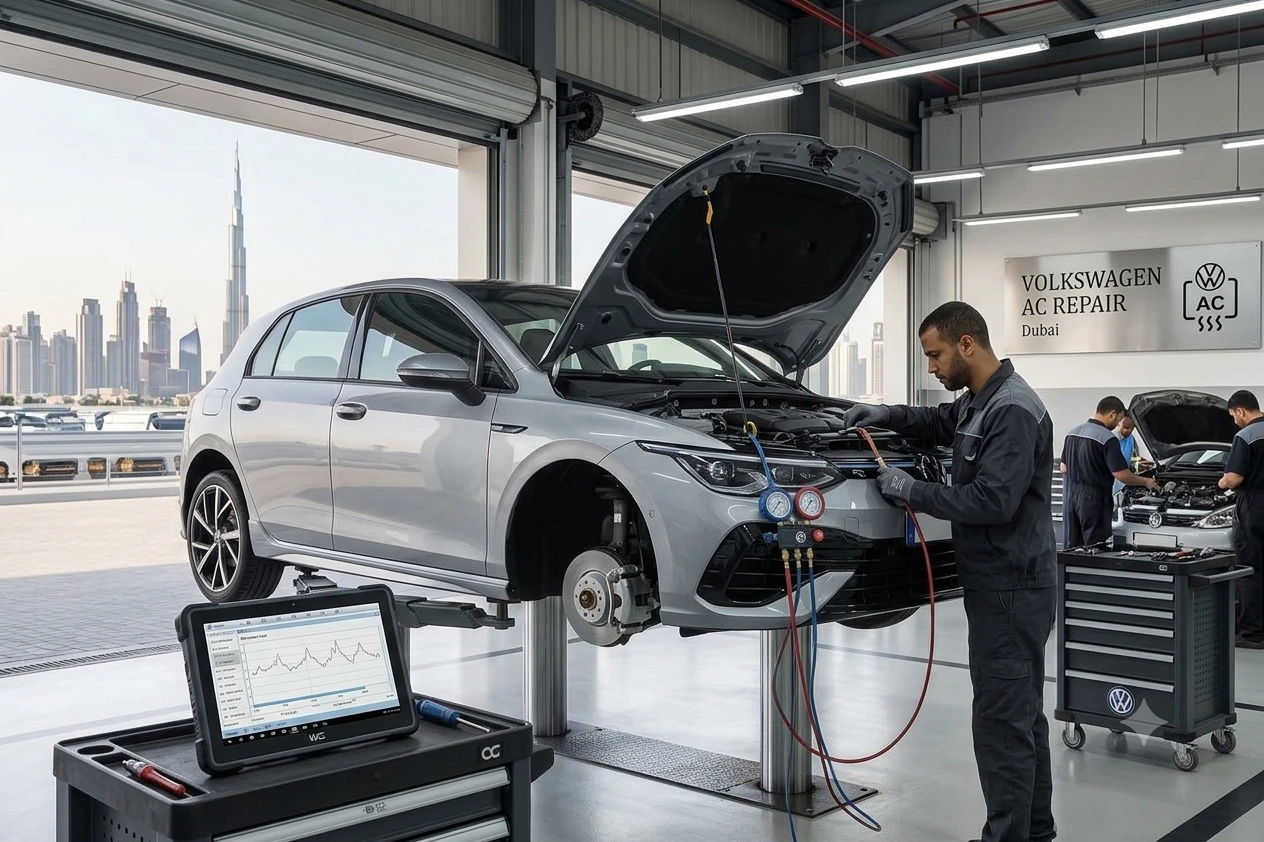
A Volkswagen with a failing AC system in Dubai isn’t a minor inconvenience — it’s a genuine daily problem from May through September when ambient temperatures regularly sit above 43°C. The Golf, Tiguan, Passat, Polo, and Touareg are all common on Dubai’s roads, and all of them depend on a properly functioning AC system to be liveable in this climate.
Volkswagen AC repair in Dubai comes up more often than owners expect, not because VW air conditioning systems are poorly engineered, but because Dubai’s conditions push every AC system harder than it was designed for. Continuous operation through summer months, high ambient heat cycling, and the constant contrast between extreme outdoor temperatures and cooled cabin air puts sustained stress on every component in the refrigeration circuit.
The good news is that most Volkswagen AC repair issues follow recognisable patterns. The compressor, the condenser, the expansion valve, and the refrigerant circuit each fail in specific ways with specific symptoms. Knowing what to look for means catching problems early — before a refrigerant leak becomes a compressor failure, or a clogged condenser becomes a complete system breakdown in the middle of a July afternoon.
Volkswagen AC Repair Dubai — Why VW Systems Need Specific Attention
Volkswagen’s AC systems across the Golf, Tiguan, and Passat range use Climatronic dual-zone climate control on most variants — a sophisticated electronic system that manages cabin temperature, airflow distribution, and compressor load through a dedicated control unit communicating on the car’s CAN bus network.
This is relevant for Volkswagen AC repair because Climatronic faults don’t always show up as obvious cooling failures. A malfunctioning blend motor produces incorrect temperature distribution — the left side of the cabin cools correctly while the right doesn’t, or the footwell vents blow warm regardless of the temperature set. A faulty evaporator temperature sensor causes the system to cut compressor operation prematurely, reducing cooling efficiency without triggering a warning light. A Climatronic control unit software fault causes erratic behaviour across the entire system.
Generic AC gauges and a refrigerant top-up don’t diagnose any of these. Proper Volkswagen AC repair requires VCDS or a high-grade VAG-compatible diagnostic system that reads the Climatronic module’s fault codes, live data streams, and actuator positions — the same tools used for engine and gearbox diagnostics on VW Group vehicles.
A Tiguan owner brought his car in after two top-ups at different workshops failed to improve cooling. The refrigerant level was correct both times. A proper diagnostic found the cabin temperature sensor behind the instrument cluster reading 8°C higher than actual cabin temperature — the Climatronic was reducing compressor output because it believed the cabin was already cool. Sensor replacement resolved the issue completely. No refrigerant was involved.
Common Volkswagen AC Repair Problems in Dubai
Refrigerant Leaks — The Most Frequent Cause of Poor Cooling
Refrigerant leaks are the most common reason a VW AC system stops cooling adequately. The R134a or R1234yf refrigerant circuit operates under pressure, and any weakness in the circuit — a failed O-ring, a hairline crack in a refrigerant line, a degraded compressor shaft seal, or a condenser damaged by road debris — causes slow refrigerant loss over time.
The symptom progression is gradual: the system cools well in the morning but struggles in peak afternoon heat, then progressively cools less across all conditions until it’s blowing ambient temperature air. Owners often mistake this for a compressor problem when the actual cause is insufficient refrigerant to maintain correct system pressure.
Finding the Leak Before Recharging
Recharging a leaking system without finding and repairing the leak is money spent twice. The refrigerant escapes at the same rate regardless of how recently the system was topped up. A proper Volkswagen AC repair for a system low on refrigerant starts with a UV dye leak test or an electronic refrigerant leak detector to identify the leak source before any refrigerant is added.
Common leak locations on VW models: condenser O-rings at the inlet and outlet connections — particularly common on Tiguan and Touareg models after minor front-end impacts that flex the condenser frame. Evaporator leaks, which are harder to access but detectable through UV dye visible at the condensate drain. Compressor shaft seal degradation on higher-mileage examples.
AC Compressor Faults
The AC compressor is the most expensive component in the refrigeration circuit, and compressor failures on VW models in Dubai follow a specific pattern worth understanding.
VW’s variable displacement compressors — used across the Golf, Passat, and Tiguan range — adjust their displacement based on cooling demand. In Dubai, the compressor runs at or near maximum displacement for most of the day during summer, which is sustained high-load operation. Over time, internal wear develops in the piston assembly and the control valve mechanism.
Symptoms of a Failing VW Compressor
A compressor developing internal wear produces a grinding or rattling noise from the engine bay that increases with AC demand — audible when the AC is switched on and absent when it’s off. Reduced cooling despite correct refrigerant levels. Compressor clutch that cycles on and off rapidly rather than maintaining engagement — indicating the compressor is overheating or losing pressure quickly.
A compressor that has seized — failed completely — produces a loud knock on AC engagement and often trips a drive belt. In this situation, the drive belt should be inspected carefully before fitting a new compressor, because a seized compressor that destroys the drive belt sometimes also damages the belt tensioner and idler pulley.
On VW Group vehicles with variable displacement compressors, the control valve is a separate serviceable component that fails before the compressor body itself. A Volkswagen AC repair that replaces the control valve on a compressor with good mechanical condition saves the cost of a full compressor replacement — a meaningful saving on these units.
Condenser Damage and Blockage
The condenser sits at the front of the car, ahead of the engine coolant radiator. In Dubai’s road conditions — construction dust, sand, and fine debris — the condenser fins accumulate blockage faster than in clean-air markets. A partially blocked condenser can’t reject heat efficiently, which raises the high-side pressure in the refrigerant circuit, reduces cooling performance, and forces the compressor to work harder — accelerating compressor wear.
Physical damage to the condenser from stone impacts is also common, particularly on lower-profile vehicles where the condenser is closer to the road surface. A single stone impact can create a refrigerant leak that presents as a system that worked fine yesterday and cools nothing today.
A proper Volkswagen AC repair inspection always includes condenser condition — both for cleanliness and for physical integrity. Cleaning a partially blocked condenser before recharging the system restores cooling performance without requiring any component replacement.
Cabin Blower Motor and Resistor Faults
The cabin blower motor circulates cooled air through the cabin. On VW Group vehicles, the blower resistor — which controls fan speed — is a known wear item, particularly on older Golf and Polo models. The symptom is a blower that only works on the highest speed setting, or that stops working entirely on specific speed settings. In Dubai’s heat, a blower that can only run at maximum speed is inconvenient. A blower that stops working at all makes the car undriveable in summer.
Blower resistor replacement on most VW models is a straightforward repair — the resistor pack is accessible without major disassembly. Leaving it because “the fan still works on high” is the kind of deferred maintenance that becomes a bigger problem when the high-speed setting fails too.
Evaporator and Expansion Valve Issues
The evaporator sits inside the dashboard and is responsible for absorbing heat from the cabin air as refrigerant passes through it. Over time in Dubai’s dusty environment, the evaporator coil accumulates fine particulate matter that restricts airflow and reduces heat exchange efficiency.
Water drainage from the evaporator also becomes a concern on higher-mileage VW models — a partially blocked condensate drain causes water to accumulate in the evaporator housing, creating a musty smell from the vents and, in severe cases, water ingress into the footwell carpet. Proper evaporator cleaning and drain clearing as part of a Volkswagen AC repair visit resolves both issues.
The expansion valve regulates refrigerant flow into the evaporator. A faulty expansion valve either restricts flow — causing poor cooling and ice formation on the evaporator — or allows too much flow, causing the compressor to run in conditions it shouldn’t. Expansion valve diagnosis requires live pressure data on both the high and low sides of the circuit simultaneously — a proper AC manifold gauge set with pressure logging.
Proper Volkswagen AC Repair — What the Service Should Include
A complete Volkswagen AC repair service at a proper workshop covers the full refrigeration circuit and the electronic control system together — not just the most obvious symptom.
VAG-compatible diagnostic scan of the Climatronic control unit — fault codes, live data, actuator tests for all blend motors and temperature sensors. Refrigerant pressure testing on both high and low sides under operating conditions. UV dye leak detection if refrigerant level is low. Condenser inspection and cleaning. Compressor clutch engagement quality and noise assessment. Cabin blower operation at all speed settings. Evaporator condensate drain check. Cabin temperature sensor verification. Refrigerant recharge to correct weight specification — not just until the gauge looks acceptable.
For comprehensive vehicle care alongside AC repairs, a proper car service package covers the full vehicle inspection at the same visit. A qualified car mechanic with VAG diagnostic capability handles both the AC system and any related electrical faults correctly — no need for separate workshops.
For VW owners who need help before reaching the workshop, a qualified mobile car mechanic handles basic AC assessments and fault code readings on-site. When bodywork or paint damage accompanies a front-end impact that damaged the condenser, professional car painting handles the repair at the same visit.
Proper roadside assistance ensures the car reaches the workshop safely when an AC failure coincides with a breakdown. For owners in Al Quoz searching for a garage near me with genuine VAG diagnostic capability for AC and climate system work — the difference between a proper diagnosis and a refrigerant top-up is the difference between fixing the car and paying for the same repair twice.
FAQ
Why is my Volkswagen AC blowing warm air in Dubai?
Most commonly low refrigerant from a slow leak, a faulty compressor control valve, or a Climatronic sensor fault — proper VAG diagnostic access identifies the actual cause.
How often should Volkswagen AC refrigerant be recharged in Dubai?
A correctly functioning system shouldn't need recharging — if it does, there's a leak that needs finding and repairing before any refrigerant is added.
What causes the musty smell from my VW AC vents?
Usually a blocked evaporator condensate drain causing moisture accumulation — cleaning the evaporator and clearing the drain resolves it.
Can a VW AC compressor be repaired or does it need full replacement?
On VW variable displacement compressors, the control valve is often serviceable separately — replacing just the valve saves the cost of a full compressor replacement when the mechanical body is still sound.
Why does my Volkswagen AC cool well in the morning but poorly in the afternoon?
Classic sign of a refrigerant system marginally low on charge — the system manages at lower ambient temperatures but can't maintain performance when heat load peaks in the afternoon.
Conclusion
Volkswagen AC repair in Dubai is rarely about a single failed component — it’s about understanding which part of the system is causing the symptom and fixing the actual cause rather than the most obvious thing. A refrigerant top-up fixes nothing if the leak isn’t repaired. A new compressor is unnecessary if the control valve is the actual fault. Proper diagnosis with VAG-compatible equipment is the difference between a repair that lasts and one that doesn’t.
Car Garage Expert in Al Quoz handles full Volkswagen AC diagnosis and repair — refrigerant circuit testing, Climatronic diagnostics, compressor assessment, condenser inspection, and evaporator service — for all VW models. Book your appointment on WhatsApp or find the workshop on Google Maps.


