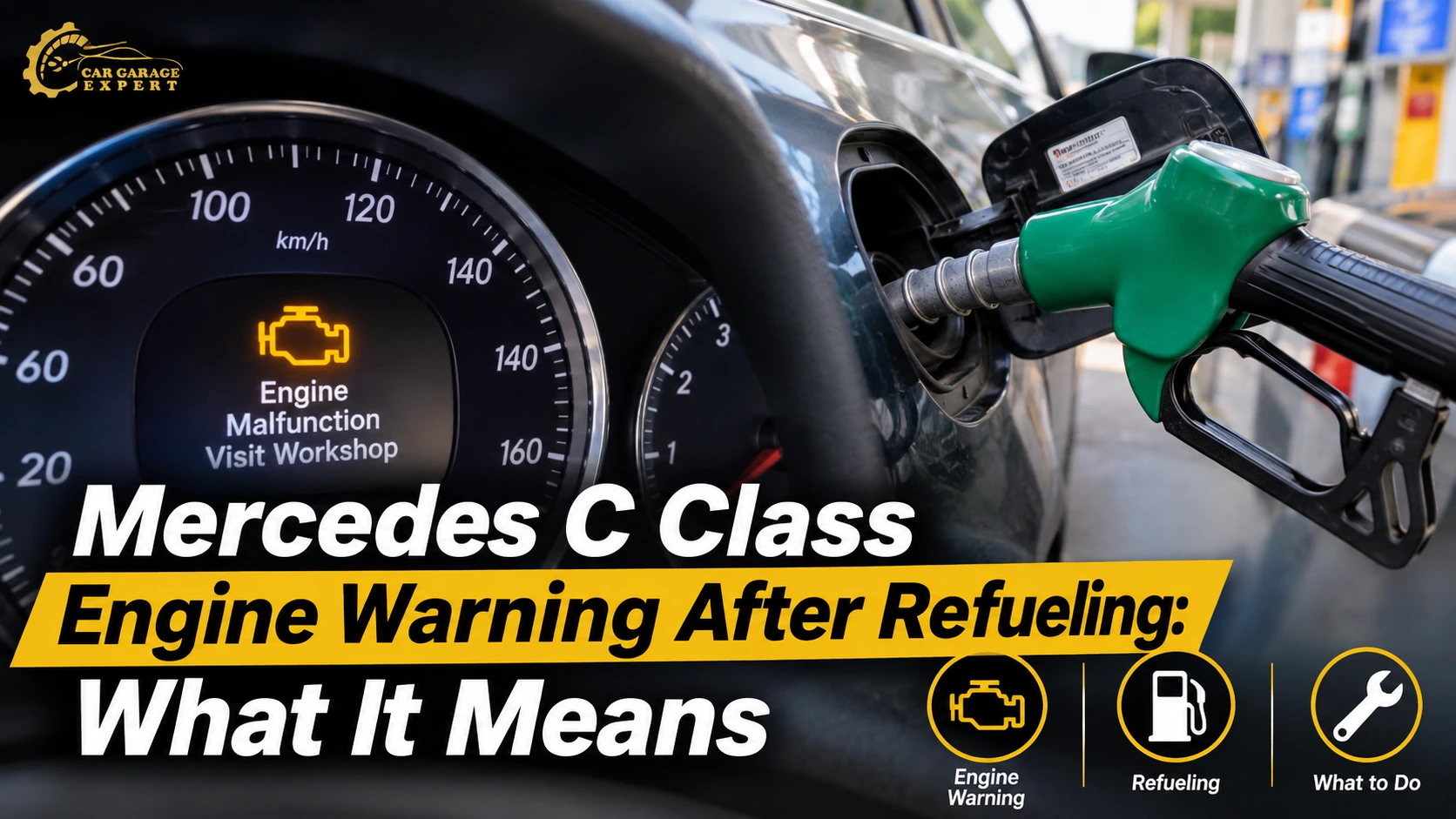
You fill up your C-Class at the usual station, drive off, and a few minutes later a yellow engine symbol lights up on the dash. The car feels fine. Nothing smells odd. So is it the fuel, the cap, or something more serious?
A Mercedes C class engine warning right after refueling is usually linked to the fuel vapor system, but not always. This guide explains what the different warnings mean, the nine most common causes, the fault codes behind them, what you can check yourself, and what the repair costs in Dubai.
Quick Answer: Why a Mercedes C Class Engine Warning Appears After Refueling
A Mercedes C class engine warning after refueling is most often caused by a loose or worn fuel cap, a faulty purge valve, or another leak in the EVAP (fuel vapor) system. Overfilling the tank past the first click can also flood the charcoal canister. Less often, the light can be caused by wrong or poor-quality fuel, a misfire from worn spark plugs or coils, or a faulty sensor. A steady light means book a check soon. A flashing light means an active misfire, so slow down and stop driving. A diagnostic scan in Dubai costs about AED 150 to 400, and most EVAP fixes cost AED 100 to 1,200.
Steady, Flashing, or a Message: What Your Warning Means
Your C-Class can show the problem in a few different ways. How the warning looks tells you how urgent it is.
| What You See | What It Usually Means | What to Do |
| Steady yellow engine light, car drives normally | Emissions or EVAP fault, often the fuel cap or purge valve | Check the cap, book a scan within a few days |
| Fuel cap or “check fuel filler cap” message | The car has detected a vapour leak at the filler | Tighten or replace the cap, drive normally |
| Steady light with rough running or hesitation | Fuel delivery, sensor or misfire problem | Drive gently to a workshop soon |
| Flashing engine light | Active misfire, catalytic converter at risk | Slow down, stop driving and get help |
| Engine light plus temperature or oil warning | A second, more serious fault | Stop safely and switch off the engine |
A steady Mercedes C-Class engine warning isn’t an emergency on its own, but it shouldn’t be ignored for weeks either. Small faults can mask a new one if the light is already on.
Why the Light Comes On Right After You Fill Up
The timing gives a strong clue. Refueling opens and closes the fuel system, and that’s exactly what the car is testing when the light appears.
How the EVAP System Works
Petrol gives off vapor, especially in hot weather. Instead of letting it escape, your C-Class stores the vapor in a charcoal canister. When the engine is running, a purge valve opens and lets the engine burn that vapor. A vent valve lets fresh air into the canister, and the fuel cap seals the whole system.
The Self-Test That Triggers the Light
The engine computer regularly seals the system and checks if it holds pressure or vacuum. If the cap isn’t sealing, a hose has cracked, or a valve is stuck, the test fails, and the light comes on. Because refueling disturbs the seal, any weak point often shows up in the first drive after filling up.
09 Common Causes of a Mercedes C Class Engine Warning
Most causes are small and cheap to fix. A few need attention straight away. Here they are, roughly from most to least common after refueling.
1. Loose, Worn or Wrong Fuel Cap
A cap that isn’t tightened until it clicks, or one with a cracked rubber seal, lets vapor escape. Cheap aftermarket caps sometimes don’t seal on Mercedes filler necks at all. This is the cheapest fix and the first thing to check.
2. Faulty Purge Valve
The purge valve is a common failure on C-Class petrol engines. When it sticks open, fuel vapor floods the engine right after refueling, which can cause a rough idle or a hard restart at the pump. When it sticks closed, the system can’t clear vapor, and the EVAP test fails.
3. Stuck Vent Valve or Blocked Canister
The vent valve and charcoal canister sit near the fuel tank. Dust and fuel overflow can block them. Signs include slow refueling, the pump nozzle clicking off early, and a fuel smell near the rear of the car.
4. Cracked Filler Neck Seal or EVAP Hose
Rubber seals and plastic hoses dry out in heat and develop hairline cracks. A small leak like this can set a Mercedes C-Class engine warning without changing how the car drives.
5. Overfilling the Tank
Topping up after the nozzle clicks off, often to round the bill to an even number, pushes liquid fuel into the vapor lines and canister. The canister is designed for vapor, not liquid, and soaking it can damage it.
6. Wrong Octane or Poor-Quality Fuel
Most C-Class petrol engines are designed for at least 95 octane, which in the UAE means Special 95 or Super 98. Using E-Plus 91 can cause knocking, power loss, and a warning light. Always check the fuel grade on the label inside your fuel flap or in the owner’s manual.
7. Water or Dirt in the Fuel
Contaminated fuel causes rough running, hesitation, stalling, and hard starts. It’s rare at major stations but can happen after a tank is filled from a poorly maintained pump. Fixing it may mean draining the tank and replacing the fuel filter.
8. Misfire From Spark Plugs or Ignition Coils
Worn plugs or a failing coil can coincide with a fill-up by chance. You’ll feel shaking at idle or a stutter when accelerating. A flashing light with a misfire needs action straight away to protect the catalytic converter.
9. Faulty Sensor
Oxygen sensors, the fuel tank pressure sensor, and the fuel level sensor can all fail and set a warning. These usually don’t change how the car drives, but they affect fuel use and emissions.
Fault Codes You’re Most Likely to See
A scan tool turns the warning light into a specific code. These are the codes most often linked to a Mercedes C class engine warning after refueling.
| Code | Meaning | Common Cause on a C-Class |
| P0455 | Large EVAP leak detected | Loose or missing fuel cap, disconnected hose |
| P0456 | Small EVAP leak detected | Worn cap seal, cracked filler neck seal |
| P0457 | EVAP leak, fuel cap loose or off | Cap not tightened after refuelling |
| P0441 | Incorrect purge flow | Faulty purge valve |
| P0442 | Small leak in EVAP system | Hose crack, vent valve, canister |
| P0171 / P0174 | System too lean | Purge valve stuck open, vacuum leak |
| P0300 to P0304 | Random or cylinder misfire | Spark plugs, ignition coils, bad fuel |
| P0420 | Catalytic converter efficiency low | Long-term misfire or sensor fault |
| P0461 | Fuel level sensor signal fault | Faulty fuel level sender |
Mercedes also stores its own manufacturer codes alongside these. A brand-level scan tool reads both, which gives a clearer picture than a basic code reader.
What You Can Check Yourself Before Booking
Before booking a check for a Mercedes C class engine warning, a few simple checks can save you a trip or at least help the mechanic. None of them need tools.
- Open the fuel flap, remove the cap, and look at the rubber seal for cracks or dirt.
- Refit the cap and turn it until it clicks at least once.
- Note if the light is steady or flashing, and if the car drives differently.
- Remember where you filled up and which fuel grade you used.
- Check for a fuel smell around the rear wheel or under the car.
- Drive normally for two or three days. If the cap was the problem, the light often goes off on its own after a few drive cycles.
If the light stays on after about three days of normal driving, the fault is likely more than the cap.
When to Stop Driving Straight Away
Some warnings mean you should pull over instead of driving to the workshop. Stop safely and switch off the engine if any of these happen.
- The engine light is flashing.
- The car shakes badly or loses power.
- There’s a strong smell of fuel inside or around the car.
- You see smoke or smell burning.
- The temperature or oil pressure warning comes on.
- You realize you’ve filled up with diesel or the wrong fuel. Don’t start the engine at all.
In these cases, call roadside assistance in Dubai and have the car moved to a workshop. Driving on with a flashing light or wrong fuel can turn a small bill into a catalytic converter or fuel pump replacement.
Why Dubai Heat Makes Fuel Vapour Faults More Common
A Mercedes C class engine warning linked to the EVAP system shows up more often in Dubai than in cooler countries. Local conditions put extra stress on the system.
Hot Fuel Makes More Vapor
In a 45°C summer, fuel in the tank and underground station tanks gets warm and gives off far more vapor. The EVAP system works harder to store and purge it, so any weak valve or seal fails sooner.
Heat Dries Out Seals and Hoses
Rubber cap seals, filler neck seals, and EVAP hoses harden and crack faster under constant heat. A C-Class that’s five or six years old in Dubai often has the seal wear of a much older car elsewhere.
Short Trips Stop the Light Clearing
The EVAP self-test only runs under certain conditions, such as a cold start and a fuel level between about a quarter and three quarters full. Short trips in stop-and-go traffic may never complete the test, so the light can stay on for days after the fault is fixed.
How a Mechanic Finds the Real Cause
Several faults can set the same light, so a good diagnosis tests each likely cause before replacing anything. When a Mercedes C class engine warning comes in, a careful workshop follows these steps.
Step 1: Read All Fault Codes and Freeze Frame Data
A full scan reads the generic P-codes and the Mercedes-specific codes. Freeze frame data shows the fuel level, engine temperature, and speed when the fault was stored, which helps confirm if it’s linked to refueling.
Step 2: Check Live Data
The mechanic watches fuel trims, purge valve commands, tank pressure readings, and misfire counters with the engine running. A purge valve stuck open often shows up as a lean fuel trim at idle.
Step 3: Run Pinpoint Tests
Once the likely area is clear, a test confirms the exact failed part.
EVAP Smoke Test
Harmless smoke is pumped into the EVAP system through a service port or the filler neck. Wherever it escapes, from the cap, a hose, or the canister, is the leak.
Purge and Vent Valve Activation Test
The scan tool switches each valve on and off while the mechanic checks if it opens, closes, and holds vacuum as it should.
Fuel Pressure and Quality Check
If the car runs rough, a gauge checks fuel pressure, and a fuel sample is checked for water or dirt.
Spark Plug and Coil Check
For misfire codes, the plugs are inspected, and coils are swapped between cylinders to see if the misfire moves with the coil.
Step 4: Written Quote, Repair and Test Drive
You get a written quote before any parts are replaced. After the repair, the codes are cleared, and the car is driven until the EVAP test completes, so you know the fix has worked.
Can You Clear the Code
Clearing the code turns the light off, but it doesn’t fix anything. If the fault is still there, the car will run its self-test again, and the Mercedes C-Class engine warning will usually come back within a few days.
Clearing codes also wipes the freeze frame data the mechanic needs to diagnose the problem. If you’re booking a check, leave the light on until the car has been scanned.
Repair Costs in Dubai
Prices depend on the C-Class generation, the engine, and your choice of OEM or aftermarket parts. The ranges below are typical Dubai market prices for parts and labor at independent workshops.
| Repair | Typical Dubai Price (AED) | Notes |
| Diagnostic scan and report | 150 to 400 | Brand-level scan reads Mercedes codes |
| EVAP smoke test | 200 to 400 | Often included with diagnosis |
| Fuel cap replacement | 100 to 300 | OEM cap recommended |
| Purge valve replacement | 400 to 1,200 | Common C-Class repair |
| Vent valve replacement | 300 to 900 | Near the fuel tank |
| Filler neck or EVAP hose repair | 400 to 2,000 | Depends on access |
| Charcoal canister replacement | 900 to 2,500 | Often after repeated overfilling |
| Spark plugs (4-cylinder set) | 400 to 900 | Higher on six-cylinder and AMG engines |
| Ignition coil (each) | 400 to 900 | Replace only the faulty coil |
| Oxygen sensor | 600 to 1,500 | Upstream sensors cost more |
| Fuel tank drain after wrong fuel | 800 to 2,000 | Includes new filter where fitted |
Ask for the fault code and test result to be written on the quote. A Mercedes C-Class engine warning can come from several parts, and the quote should show which test pointed to the part being replaced.
How to Stop the Light Coming Back
Most cases of a Mercedes C class engine warning after refueling come from wear and refueling habits. A few small changes keep the system healthy.
Stop at the First Click
When the pump nozzle clicks off, stop. Topping up to round the bill floods the vapor system and is one of the main reasons canisters fail early.
Use the Right Fuel Grade
Use the octane shown on the label inside your fuel flap, which is usually 95 or 98 for a C-Class. Lower-grade fuel can cause knocking and misfire warnings, especially in summer.
Keep Up With Servicing
Spark plugs, filters, and hoses should be checked at each service. Regular car service packages in Dubai include these checks and catch worn ignition parts before they cause misfires.
Clean Up Fuel Spills Quickly
Fuel spilled around the filler can stain or soften the paint near the flap. Wipe it off straight away. If the paint is already marked, a car paint touch-up can restore the area.
Why Choose Car Garage Expert for Mercedes Engine Warnings
For a Mercedes C class engine warning that won’t go away, Car Garage Expert in Al Quoz is a strong choice. Engine lights on a C-Class need a brand-level scan and proper EVAP testing, not a quick reset.
Brand-Level Diagnosis Before Any Parts
The workshop reads both generic and Mercedes-specific codes, checks live data, and runs smoke and valve tests before quoting. An experienced car mechanic confirms the failed part, so you only pay for what’s actually broken.
Scan at Your Location When It Suits You
If the light comes on and you can’t bring the car in straight away, a mobile car mechanic can scan the codes where the car is parked and tell you if it’s safe to keep driving.
Easy to Reach From Across Dubai
The workshop in Al Quoz is a short drive from Sheik Zayed Road and Al Khail Road. C-Class owners in Al Barsha, JVC, Business Bay, and Downtown can get there quickly when they search for a garage near me in Dubai.
Book a Mercedes Engine Light Check
Book a check with Car Garage Expert, send a photo of the warning on your dashboard on WhatsApp, or get directions on Google Maps.
Frequently Asked Questions
Q1: Why does my C-Class warn after refueling?
The most common reason is a loose or worn fuel cap or a fault in the EVAP system, such as a stuck purge valve. Refueling disturbs the system, so any weak point shows up soon after.
Q2: Will tightening the fuel cap reset the light?
Often, yes, but not straight away. After tightening the cap, the light usually goes off by itself after two or three days of normal driving.
Q3: Can I drive with Mercedes engine light on?
A steady Mercedes C-Class engine warning light during normal driving is usually safe for a short time. A flashing light, shaking, power loss, or a fuel smell means stop driving and get help.
Q4: What does code P0456 mean on Mercedes?
P0456 means the car has found a small leak in the EVAP system. On a C-Class, it’s usually a worn fuel cap seal, a cracked filler neck seal, or a small hose crack.
Q5: How much does an EVAP repair cost?
In Dubai, a fuel cap costs AED 100 to 300, a purge valve AED 400 to 1,200, and a charcoal canister AED 900 to 2,500. A smoke test confirms which part has failed.
Q6: Can bad petrol cause an engine warning?
Yes. Low-octane or contaminated fuel can cause knocking, misfires, and a warning light. If you think you’ve put in the wrong fuel, don’t start the engine.
Q7: Does this happen on other Mercedes models?
Yes. The same EVAP and fuel cap faults affect the A-Class, E-Class, GLC, and GLE, because they use similar fuel vapor systems.