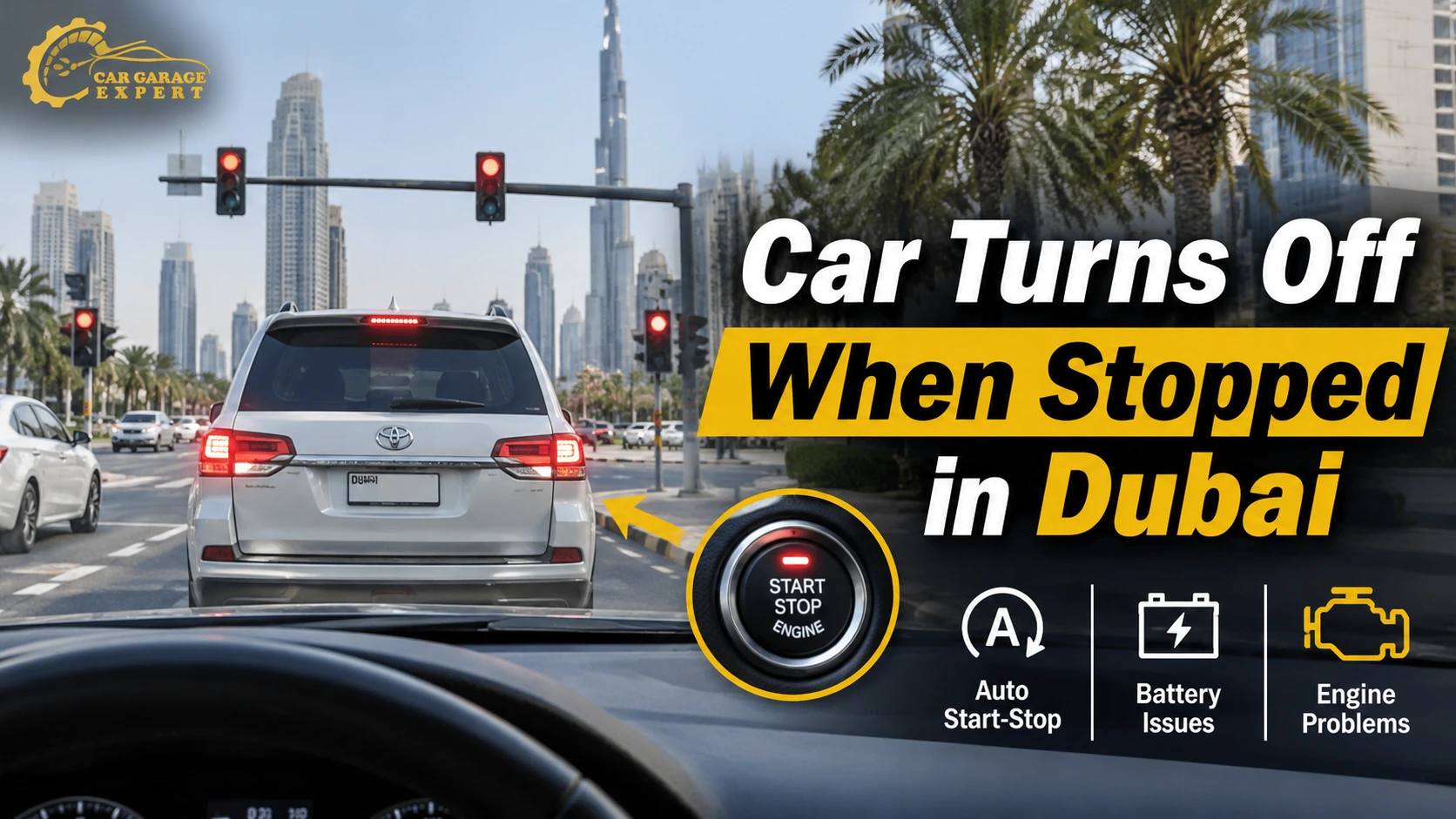
You roll up to a red light on Al Khail Road, the revs drop, and the engine dies. The steering goes heavy, the AC stops, and the cars behind you start honking. It restarts, so you carry on, but now you’re wondering if it will happen again at the next roundabout.
Car turns off when stopped, the engine is struggling to hold a steady idle. This guide explains how to tell a normal start-stop system from a real fault, the 11 most common causes, how a mechanic finds the right one, and what repairs cost in Dubai.
Quick Answer: Why Your Car Shuts Off When Stopped
A car turns off when stopped because the engine can’t keep enough air, fuel, or spark flowing at low revs. The most common causes are a dirty throttle body or idle air control valve, a vacuum leak, a dirty airflow sensor, a weak fuel pump, a failing crankshaft sensor, and worn spark plugs. In automatic cars, a torque converter clutch that won’t release can also drag the engine down. In Dubai, heavy AC load at idle makes all of these worse. A diagnostic check costs about AED 150 to 400, and most fixes fall between AED 200 and 1,500.
Start-Stop Feature or a Real Fault: How to Tell
Many newer cars switch the engine off on purpose at lights to save fuel. If your car has start-stop, an engine that goes quiet at a red light may be doing exactly what it was built to do.
Signs It’s the Start-Stop System Working
A start-stop shutdown is smooth and silent. The dashboard stays lit, the radio keeps playing, an “A” or start-stop symbol appears on the cluster, and the engine restarts the moment you lift off the brake. Steering and brakes feel normal.
Signs It’s a Real Stall
A real stall feels rough. The revs often dip or shudder first, warning lights flash on, the steering goes heavy, and the engine stays off until you turn the key or press the start button. If your car turns off when stopped, something needs fixing. A car with no start-stop button on the dash will never shut off at a light by design.
What to Do the Moment Your Engine Dies at a Junction
If your car turns off when stopped in traffic, stay calm and keep control. The car is still safe to steer and stop; it just takes more effort without the engine running.
- Hold the brake firmly. The brake pedal gets harder without engine vacuum, but it still works.
- Shift to Park or Neutral and turn on your hazard lights.
- Try one restart. If it fires up, move to the side of the road before checking anything.
- If it won’t restart, or it stalls again within a few minutes, don’t keep cranking. Long cranking can flatten the battery and overheat the starter.
- Note what was happening: AC on or off, hot or cold engine, braking hard or rolling slowly. These details help the mechanic.
If the car won’t restart or keeps dying in traffic, call roadside assistance in Dubai rather than risking another stall in a busy lane.
11 Common Reasons a Car Shuts Off When Stopped
Each cause below starves the engine of air, fuel, or spark at the exact moment the revs drop. Most cars only have one of these at a time, so testing matters more than guessing.
1. Dirty Throttle Body or Faulty Idle Air Control Valve
At idle, the throttle plate is almost closed, and only a thin stream of air keeps the engine running. Carbon and dust build up around that gap and choke it. Older cars use an idle air control valve for the same job, and when it sticks, the revs drop too far, and the engine dies. This is one of the most common reasons a car shuts off when stopped.
2. Vacuum Leak
A cracked intake hose, a split PCV pipe, or a worn intake gasket lets extra air in that the sensors don’t measure. At high revs, the engine copes. At idle, the mix turns too lean and the engine stumbles or stalls. A hissing sound under the bonnet is a common clue.
3. Dirty or Faulty Mass Airflow Sensor
The airflow sensor tells the engine computer how much air is coming in. Dust or oil on its fine wire makes it under-read, so the computer adds too little fuel. Stalling right after you lift off the throttle is a typical sign.
4. Weak Fuel Pump or Clogged Fuel Filter
A tired pump can keep up while you cruise but drops pressure when the engine needs a steady low flow at idle. A blocked filter has the same effect. Long cranking before the car starts, or stalling worse when the tank is low, often points here.
5. Failing Crankshaft or Camshaft Position Sensor
These sensors tell the computer where the engine is in its turn so it can time fuel and spark. When one fails, often from heat, the signal drops out, and the engine cuts with no warning. It may then refuse to restart until it cools.
6. Worn Spark Plugs or Weak Ignition Coils
Worn plugs or a weak coil cause misfires, and misfires hit hardest at idle, where the engine has the least momentum. You’ll often feel the car shake at lights before it stalls.
7. Torque Converter Clutch Stuck On (Automatic Cars)
In an automatic, the torque converter lets the engine keep turning while the wheels stop. If its lock-up clutch or the solenoid that controls it doesn’t release, the car behaves like a manual left in gear and stalls as you stop. A car turns off when stopped, usually right as the speed hits zero, often with a jolt.
8. Weak Battery or Failing Alternator
Modern engines need steady voltage to run sensors, injectors, and the fuel pump. At idle, the alternator spins slowly, and with the AC, fans, and lights on, a weak charging system can let the voltage sag until the engine cuts out. Dim lights or a flickering dash just before the stall point here.
9. EGR Valve Stuck Open
The EGR valve feeds a small amount of exhaust back into the engine at cruising speed. If carbon holds it open, exhaust floods the intake at idle and smothers the fire in the cylinders. Rough idle and stalling after a highway run are typical signs.
10. Engine Computer or Software Fault
Sometimes the engine computer needs a software update or an idle relearn, especially after a battery change or throttle body clean. Without the relearn, the computer doesn’t know the new idle position and lets the revs fall too low.
11. Low Fuel or a Faulty Fuel Level Sensor
If the fuel gauge reads wrong, you can run the tank lower than you think. On hills, ramps, and sharp stops, the fuel sloshes away from the pump pickup and the engine dies. It’s the simplest cause, so it’s worth ruling out first.
Match Your Symptom to the Likely Cause
When a car shuts off when stopped, the way it dies says a lot about why. Use this table to narrow it down before you book a check.
| When It Stalls | Most Likely Causes | What to Check First |
| Only with the AC on | Dirty throttle body, weak alternator, IAC valve | Idle speed with AC on, battery voltage |
| Right as the car stops, with a jolt | Torque converter clutch or its solenoid | Gearbox codes, solenoid test |
| Only when the engine is hot | Crankshaft sensor, fuel pump, ignition coil | Live sensor data when hot |
| Only on a cold start | Vacuum leak, coolant temperature sensor | Smoke test, sensor reading |
| After a highway run | EGR valve stuck open | EGR operation in live data |
| When the tank is low | Fuel pump, fuel level sensor | Fuel pressure test |
| Shakes at lights, then dies | Spark plugs, ignition coils | Misfire counters, plug check |
| Lights dim before it dies | Battery or alternator | Charging voltage test |
Why Dubai Heat and Traffic Make Stalling More Common
Dubai driving puts extra load on an engine at idle. A weak part that goes unnoticed in a cooler city often shows up here first, which is why a car shuts off more often in summer than in winter.
The AC Adds Heavy Load at Idle
In a 45°C summer, the AC compressor works almost nonstop. It takes power straight from the engine, and at idle that power is in short supply. If the throttle body is dirty or the idle control is weak, turning on the AC can pull the revs below the stalling point. That’s the moment the engine stalls at idle and the cabin goes hot.
Dust Builds Up on Throttle Bodies and Airflow Sensors
Fine sand from construction sites and desert-edge roads gets past tired air filters. It coats the throttle body and the airflow sensor wire. That’s why idle problems in Dubai often clear up after a throttle body clean and a new air filter.
Heat Soak Hurts Sensors and Fuel Pumps
After a drive, heat builds up under the bonnet with no airflow to carry it away. Crankshaft sensors and ignition coils are sensitive to this heat, and fuel pumps work harder with hot fuel. A car that stalls only after it’s been parked in the sun for a few minutes often has a heat-sensitive sensor.
Stop-Start Traffic Wears Torque Converters
Crawling traffic on Sheik Mohammed bin Zayed Road and Al Khail Road means hundreds of stops on a single commute. That puts the torque converter clutch and its solenoid under much more stress than open-road driving, so wear shows up sooner.
How a Mechanic Finds the Real Cause
Stalling has many possible causes, so a good diagnosis tests them in order instead of swapping parts. When a car turns off when stopped, this is the sequence a careful workshop follows.
Step 1: Ask How and When It Stalls
The mechanic asks the questions in the symptom table above. Hot or cold, AC on or off, braking hard or rolling, tank full or low. The answers usually cut the list from 11 causes down to two or three.
Step 2: Scan for Fault Codes and Read Live Data
A full scan reads the engine and gearbox modules. Even if no warning light is on, stored codes and freeze frame data show what the engine was doing at the moment it stalled. Live data shows idle speed, airflow readings, fuel trims, and battery voltage while the car runs.
Step 3: Run Pinpoint Tests
Once the likely system is clear, the mechanic confirms the exact fault with a test.
Smoke Test for Vacuum Leaks
Harmless smoke is pumped into the intake. Wherever it seeps out is the leak, even a hairline crack in a hose you can’t see.
Fuel Pressure Test
A gauge on the fuel rail shows whether the pump holds the manufacturer-specified pressure at idle and under load. A slow drop after switching off points to a leaking injector or a weak pump check valve.
Sensor Signal Check
The crankshaft and camshaft sensor signals are watched in live data or on an oscilloscope, often after heating the engine. A signal that drops out when hot confirms a failing sensor.
Charging System Test
The battery is load tested, and the alternator output is measured at idle with the AC, fans, and lights on. Voltage below about 13.5 volts with everything running points to a charging problem.
Step 4: Fix, Relearn and Road Test
After the repair, the mechanic runs an idle relearn where needed, clears the codes, and test-drives the car through stops with the AC on. A car that used to stall at lights gets tested at lights.
Repair Costs for Stalling Problems in Dubai
Prices depend on the make, the model, and your choice of OEM or aftermarket parts. The ranges below are typical Dubai market prices for parts and labor on passenger cars.
|
Repair |
Typical Dubai Price (AED) |
Notes |
| Diagnostic scan and tests | 150 to 400 | Smoke and fuel pressure tests at the higher end |
| Throttle body clean and idle relearn | 200 to 450 | Often fixes AC-related stalling |
| Idle air control valve | 300 to 900 | Older cars only |
| Mass airflow sensor | 400 to 1,200 | Cleaning first costs much less |
| Vacuum hose or intake gasket | 150 to 900 | Depends on access |
| Spark plugs (set) | 200 to 900 | V6 and V8 engines cost more |
| Ignition coil (each) | 250 to 700 | Replace only the failed coil |
| Crankshaft position sensor | 350 to 900 | Includes testing and fitting |
| Fuel pump | 900 to 2,500 | In-tank pumps take longer |
| EGR valve clean or replace | 400 to 2,000 | Diesel and turbo engines higher |
| Torque converter solenoid | 800 to 2,500 | Torque converter replacement costs much more |
| Battery | 350 to 1,200 | AGM batteries for start-stop cars |
Ask for a written estimate before any work starts. A car shuts off when stopped for many reasons, so the estimate should name the test that confirmed the fault.
How to Stop Your Engine From Stalling Again
Most cases where a car turns off when stopped start as neglected maintenance. A few habits keep the idle steady through Dubai summers.
Clean the Throttle Body and Change the Air Filter
In dusty Dubai conditions, change the engine air filter every 10,000 to 15,000 km and have the throttle body cleaned every 30,000 to 40,000 km. Both jobs are cheap and often included in car service packages in Dubai.
Replace Spark Plugs on Schedule
Most modern plugs last 60,000 to 100,000 km, but heat and short trips shorten that. Check your maker’s interval and don’t stretch it.
Test the Battery Every Service
UAE heat cuts battery life to around two or three years. A quick test at each service catches a weak battery before it starts causing stalls and no-starts.
Keep the Tank Above a Quarter
The fuel pump uses fuel to stay cool. Running on a low tank in summer makes it work hotter and can cause stalling on ramps and sharp stops.
Why Choose Car Garage Expert for Stalling Repairs
If your car turns off when stopped, Car Garage Expert in Al Quoz is a strong choice for finding and fixing the cause. Stalling faults need testing, not guesswork, and this workshop follows that approach.
Diagnosis Before Parts
Every stalling job starts with a full scan, live data, and pinpoint tests such as smoke and fuel pressure checks. An experienced car mechanic confirms the failed part before quoting, so you don’t pay for parts that weren’t the problem.
Help Where the Car Stops
If the engine won’t restart, you don’t always need a tow. A mobile car mechanic can test the battery, charging system, and fault codes where the car is parked and often get it running on the spot.
Workshop and Body Repairs in One Place
A stall in traffic sometimes ends with a bump from the car behind. If that leaves a dented or scratched bumper, the same workshop handles car painting and panel work alongside the engine repair.
Book a Stalling Check
Drivers in Al Quoz, Al Barsha, Business Bay, and JVC searching for a garage near me in Dubai can reach the workshop quickly. Book a stalling check with Car Garage Expert, send a short video of the stall on WhatsApp, or get directions on Google Maps.
Frequently Asked Questions
Why does my car die at red lights?
Your car dies at red lights because the engine can’t hold a steady idle. The usual causes are a dirty throttle body, a vacuum leak, a dirty airflow sensor, or a weak fuel pump. Heavy AC load in Dubai makes it more likely.
Is it safe to drive a stalling car?
It’s not safe to keep driving. When the engine stalls, power steering and brake assist drop away, which makes the car harder to control in traffic. Get it checked as soon as possible.
Can a bad battery cause stalling at idle?
Yes. A weak battery or failing alternator can let the voltage drop at idle, especially with the AC and fans on. The engine computer and fuel pump then cut out, and the car shuts off when stopped.
Why does my car stall with AC on?
The AC compressor adds load at idle. If the throttle body is dirty, the idle control is weak, or the charging system is tired, that extra load pulls the revs too low and the engine stalls.
How much does it cost to fix stalling?
A diagnostic check in Dubai costs about AED 150 to 400; most fixes, such as a throttle body clean, a sensor, or spark plugs, cost AED 200 to 1,500. A fuel pump or torque converter repair costs more.
Can low transmission fluid cause stalling?
Yes, in automatic cars. Low or old fluid can stop the torque converter clutch from releasing properly, so the car stalls right as it comes to a stop. A gearbox fluid check is part of a proper stalling diagnosis.
Can a bad sensor cause engine stalling?
Yes. A failing crankshaft position sensor, airflow sensor, or coolant temperature sensor can all make a car shut off when stopped. A live data check shows which sensor is giving a bad reading.