A vibration through the steering wheel at highway speeds is one of those things Dubai drivers learn to live with — and shouldn’t. It’s uncomfortable on the morning commute, distracting at higher speeds on Emirates Road, and a sign that something in the wheel and tyre assembly is out of balance in a way that’s actively wearing tyres unevenly and placing unnecessary stress on wheel bearings and suspension components. Car wheel balancing dubai is the correction — a precise process that adds small counterweights to the wheel to neutralise the weight distribution imbalance causing the vibration, restoring the smooth, vibration-free ride the tyre and wheel were designed to produce.
What makes car wheel balancing dubai more relevant than in many other markets is the combination of factors Dubai’s driving environment creates. High highway speeds on Sheikh Zayed Road and Emirates Road make even minor imbalances feel significant in the steering wheel. Heat cycles from extreme ambient temperatures cause tyre compounds to shift slightly, altering the weight distribution within the tyre. And the speed bumps and parking ramp impacts common in Dubai’s urban driving knock balance weights off wheels more frequently than smooth-road driving would. All of which means car wheel balancing dubai isn’t a one-time fix — it’s a regular maintenance item that keeps the wheel and tyre assembly performing correctly throughout the tyre’s life.
Car Wheel Balancing Dubai: Everything You Need to Know
Car wheel balancing dubai addresses a specific problem — weight distribution imbalance in the rotating wheel and tyre assembly — through a precise and systematic process. Understanding what causes imbalance, how balancing corrects it, and what happens when it’s left unaddressed makes the case for regular balancing clearly.
Car Wheel Balancing Dubai: Why Imbalance Happens
Imbalance in a wheel and tyre assembly isn’t a sign of a defective product — it’s an inherent characteristic of any rotating assembly that’s manufactured to tolerances rather than perfection. A new tyre straight from the factory has minute variations in rubber thickness and compound density across its circumference. The wheel itself has slight weight variations from the casting or forging process. When the tyre is mounted on the wheel, these variations combine — and their combined effect on the rotating assembly is what car wheel balancing dubai measures and corrects.
Minor Tyre Manufacturing Variations
Every tyre contains layers of steel belts, fabric plies, and rubber compounds that are assembled by machine to close tolerances but not to zero variation. A spot where a belt join occurs, or where the tread compound is fractionally thicker, creates a slight heavy spot that becomes a rotating imbalance force at speed. This is why car wheel balancing dubai is needed on brand-new tyres — the imbalance isn’t from wear or damage, it’s from the manufacturing process itself.
Wheel Weight Loss from Impact
Balance weights — small lead or zinc clips or adhesive patches fitted to the wheel rim — can be dislodged by a sharp impact from a speed bump, kerb strike, or parking ramp transition. In Dubai’s driving environment, where speed bumps are ubiquitous and parking ramp lip impacts are a near-daily occurrence for many drivers, weight loss is a common and frequent cause of suddenly developing vibration. A car wheel balancing dubai check after any significant wheel impact confirms whether balance weights have been displaced.
Tyre Wear Patterns
As a tyre wears through its service life, the weight distribution across the tread changes. Sections that wear faster than others — from a slight alignment deviation, from consistently running at incorrect pressure, or from suspension wear allowing the wheel to run at a slightly incorrect angle — create new imbalance conditions that weren’t present when the tyre was new and balanced. This is why car wheel balancing dubai should be checked at every tyre rotation rather than assumed to still be correct from the last balance.
Heat-Induced Compound Shift
Dubai’s extreme summer temperatures — cabin temperatures exceeding 80°C in parked vehicles, tyre surface temperatures significantly elevated from both solar radiation and road heat — cause tyre rubber compounds to soften and redistribute slightly under the effects of sustained heat. In some cases this produces a temporary shift in balance that resolves as the tyre cools, and in others it produces a permanent change in the tyre’s weight distribution that requires rebalancing to correct.
Car Wheel Balancing Dubai: Types of Wheel Balancing
Not all car wheel balancing dubai equipment produces the same quality of result. Understanding the difference between balancing methods helps identify which approach is appropriate for different vehicles and complaints.
Standard Static Balancing
The simplest balancing method — the wheel and tyre are mounted on a spinner that identifies the heaviest point by allowing the assembly to come to rest with that point at the bottom. A counterweight is added directly opposite to neutralise the imbalance. Standard static balancing is the minimum car wheel balancing dubai service and is adequate for basic imbalance correction, but it only addresses one plane of imbalance rather than the three-dimensional imbalance that affects how the tyre behaves on the road.
Dynamic Balancing
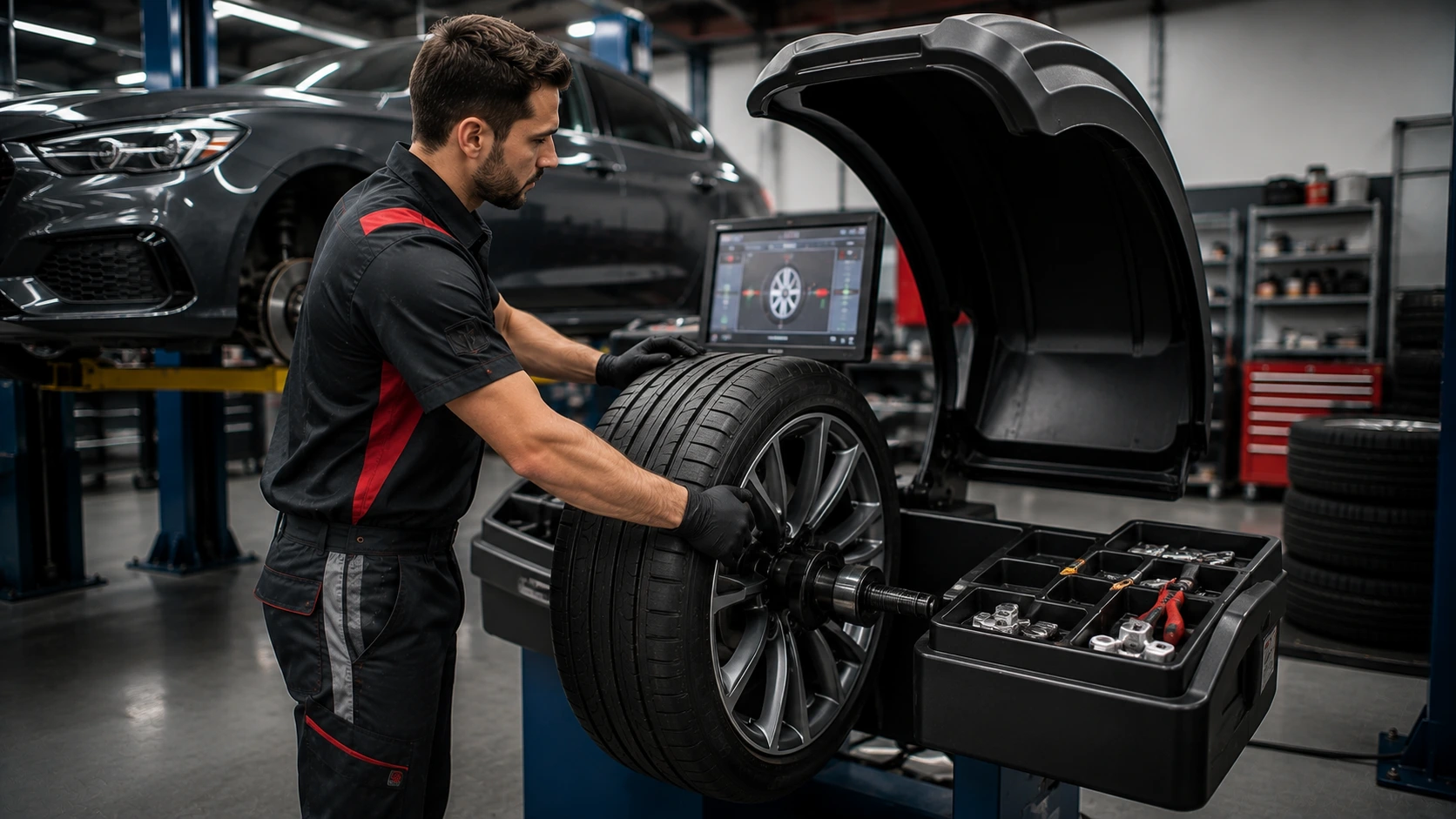
The standard for proper car wheel balancing dubai — the wheel and tyre are spun at speed on a computerised balancer that measures imbalance forces in two planes simultaneously (the inner and outer edges of the wheel). The machine calculates the precise weight and position required on both the inner and outer rim edges to neutralise the imbalance completely. Dynamic balancing produces a smooth result across the full speed range rather than just at low speeds where static balancing may feel adequate.
Road Force Balancing
The most advanced car wheel balancing dubai method — the wheel and tyre are spun against a roller that simulates the tyre’s contact with the road surface under load. This identifies tyre non-uniformity — variations in the tyre’s stiffness around its circumference — that produce a vibration that standard dynamic balancing can’t correct because the imbalance only manifests under the load of the vehicle’s weight on the tyre. Road force balancing is the correct approach for persistent vibration complaints that haven’t been resolved by standard dynamic balancing, and for luxury and performance vehicles where ride quality tolerance is lower.
Car Wheel Balancing Dubai: Signs Your Wheels Need Balancing
Recognising the symptoms that indicate a car wheel balancing dubai is overdue saves both the discomfort of driving with vibration and the tyre and suspension wear that unaddressed imbalance causes.
Steering Wheel Vibration at Specific Speeds
The most classic car wheel balancing dubai symptom — a vibration felt through the steering wheel that appears at a specific speed range and may reduce or disappear above or below that range. The vibration frequency produced by a rotating imbalance increases with speed — at the speed where the rotation frequency matches a resonant frequency of the steering system, the vibration is felt most strongly. This speed-specific characteristic is what distinguishes wheel imbalance from other vibration sources.
Seat or Floor Vibration
Rear wheel imbalance typically produces vibration felt through the seat or floor rather than the steering wheel, since the rear wheels aren’t directly connected to the steering system. A car wheel balancing dubai check covering all four wheels identifies rear imbalance that might be attributed to road surface or other sources without proper diagnosis.
Uneven Tyre Wear
Imbalance produces a pattern of accelerated wear at the heavy spot in the tyre — the area that bears more contact force as it rotates into the road surface. Cupping or scalloping — a wavy pattern of high and low spots around the tyre’s circumference — is the classic imbalance wear pattern. Once established, this wear pattern itself produces additional vibration that continues even after balancing because the tyre’s surface is no longer uniform.
Vibration That Started After a New Tyre Fitting
If vibration appears immediately after a new tyre has been fitted, the new tyre wasn’t balanced correctly or wasn’t balanced at all. New tyres always require car wheel balancing dubai after fitting — the assumption that a new tyre doesn’t need balancing because it’s unused is incorrect and a common workshop shortcut.
Car Wheel Balancing Dubai: The Correct Balancing Process
A proper car wheel balancing dubai service at Car Garage Expert follows a consistent process that produces a genuinely balanced result rather than an approximation.
Initial Wheel and Tyre Inspection
Before mounting the wheel on the balancer, the tyre and wheel are inspected for conditions that affect balancing accuracy or indicate other issues. Tyre sidewall bulges or impacts that have damaged the internal structure, foreign objects embedded in the tread, valve stem condition, and existing balance weight condition and placement are all checked. A tyre with internal structural damage won’t balance correctly regardless of how many weights are added — the damage needs to be addressed first.
Removal of Existing Weights
Previous balance weights are removed before remounting on the balancer. Leaving old weights in place and adding new ones on top of them produces incorrect results — the machine’s calculation assumes a weight-free starting point.
Correct Mounting on the Balancer
The wheel is centred correctly on the balancer spindle — an off-centre mounting produces incorrect balance readings that result in a wheel that’s balanced on the machine but not correctly balanced on the vehicle. Our car mechanic team uses the correct adaptor for each wheel type rather than a universal fit that approximates centreing.
Weight Placement and Type
Correct weight type for the wheel — clip-on weights for steel wheels and standard alloy rim edges, adhesive weights for alloys where clip-on weights would be visible or would damage the finish on the inner rim face. Weights placed at the machine-specified position within a few millimetres — placement error produces residual imbalance that appears as a partial improvement rather than complete correction.
Final Verification Spin
After weights are fitted, a verification spin confirms the residual imbalance is within specification — typically below 5 gram-centimetres for standard vehicles. If the residual is outside this specification, the process is repeated rather than accepted as close enough.
Car Wheel Balancing Dubai: How Often and When
Car wheel balancing dubai isn’t a once-and-done service — it’s maintenance that’s needed at specific intervals and after specific events.
At Every Tyre Rotation
Tyre rotation moves each tyre to a different position on the vehicle — and the balance condition from the previous position doesn’t transfer to the new position correctly because the tyre’s wear pattern is specific to its previous position. Balancing at every rotation ensures each tyre is correctly balanced in its new location.
After Any Tyre Fitting
Every new tyre requires balancing. Every puncture repair that involves removing the tyre from the wheel requires rebalancing. Every wheel removal for brake service or suspension work should be followed by a balance check.
After Any Significant Wheel Impact
A kerb strike, a hard speed bump impact, or a pothole hit significant enough to feel through the car warrants a car wheel balancing dubai check — balance weights are displaced by these impacts more often than drivers realise, and the resulting vibration is often attributed to other causes.
Every 10,000–15,000 km
As routine maintenance even without specific symptoms — tyre wear and heat cycling in Dubai’s conditions produce balance drift over time that periodic rebalancing corrects before it becomes noticeable as vibration.
Supporting Services
Car wheel balancing dubai is most effective when combined with the related services that address the full range of wheel and tyre performance. Our car service packages combine balancing with four-wheel alignment — balancing and alignment address different issues but affect the same outcome, and doing both ensures the wheel runs true in both rotational balance and directional geometry.
For tyre-related breakdowns or punctures that happen away from the workshop, our roadside assistance team covers Al Quoz and surrounding Dubai areas with fast response.
For new tyre fitting alongside balancing, our garage near me location in Al Quoz handles both in the same appointment — every new tyre fitted at Car Garage Expert is balanced before the car goes back to the customer.
For vehicles with vibration complaints that haven’t been resolved by standard balancing — suggesting road force balancing or a suspension inspection is needed — our mobile car mechanic service can do an initial assessment at your location to help narrow the cause before a full workshop visit.
For paint protection and alloy wheel refurbishment alongside tyre and balancing work, our car painting service coordinates both in the same visit where timing allows.
FAQ
How do I know if my car needs wheel balancing in Dubai?
A vibration felt through the steering wheel at specific highway speeds — typically between 80–120 km/h — is the most reliable indicator that car wheel balancing dubai is needed.
Does wheel balancing fix all steering wheel vibration?
Not always — vibration can also come from worn suspension components, tyre wear patterns, or wheel alignment issues that balancing alone won't address.
How long does car wheel balancing dubai take at Car Garage Expert?
Standard dynamic balancing of all four wheels typically takes thirty to forty-five minutes — same-day service with no prior booking required for most cases.
Do new tyres need balancing in Dubai?
Yes — all new tyres require balancing after fitting regardless of how new they are, as manufacturing variations produce imbalance that needs correction.
How often should wheel balancing be done in Dubai's conditions?
Every 10,000–15,000 km as routine maintenance, at every tyre rotation, after any tyre fitting, and after any significant wheel impact from a kerb or speed bump.
In Conclusion
Car wheel balancing dubai is the correction for one of the most common and most ignored sources of tyre wear, vibration, and unnecessary component stress on Dubai’s roads. Heat cycles, speed bump impacts, and the high highway speeds that make even minor imbalance noticeable all make regular balancing more important here than in most other markets. A properly balanced wheel runs smoothly, wears evenly, and places correct loads on the wheel bearings and suspension components it connects to — producing the ride quality and tyre life these components were designed to deliver.
Book your appointment with Car Garage Expert for precise car wheel balancing dubai using computerised dynamic balancing equipment. We serve Al Quoz and nearby Dubai areas with full tyre and wheel services for all makes and models. Find us on Google Maps — walk-ins welcome, same-day balancing available.