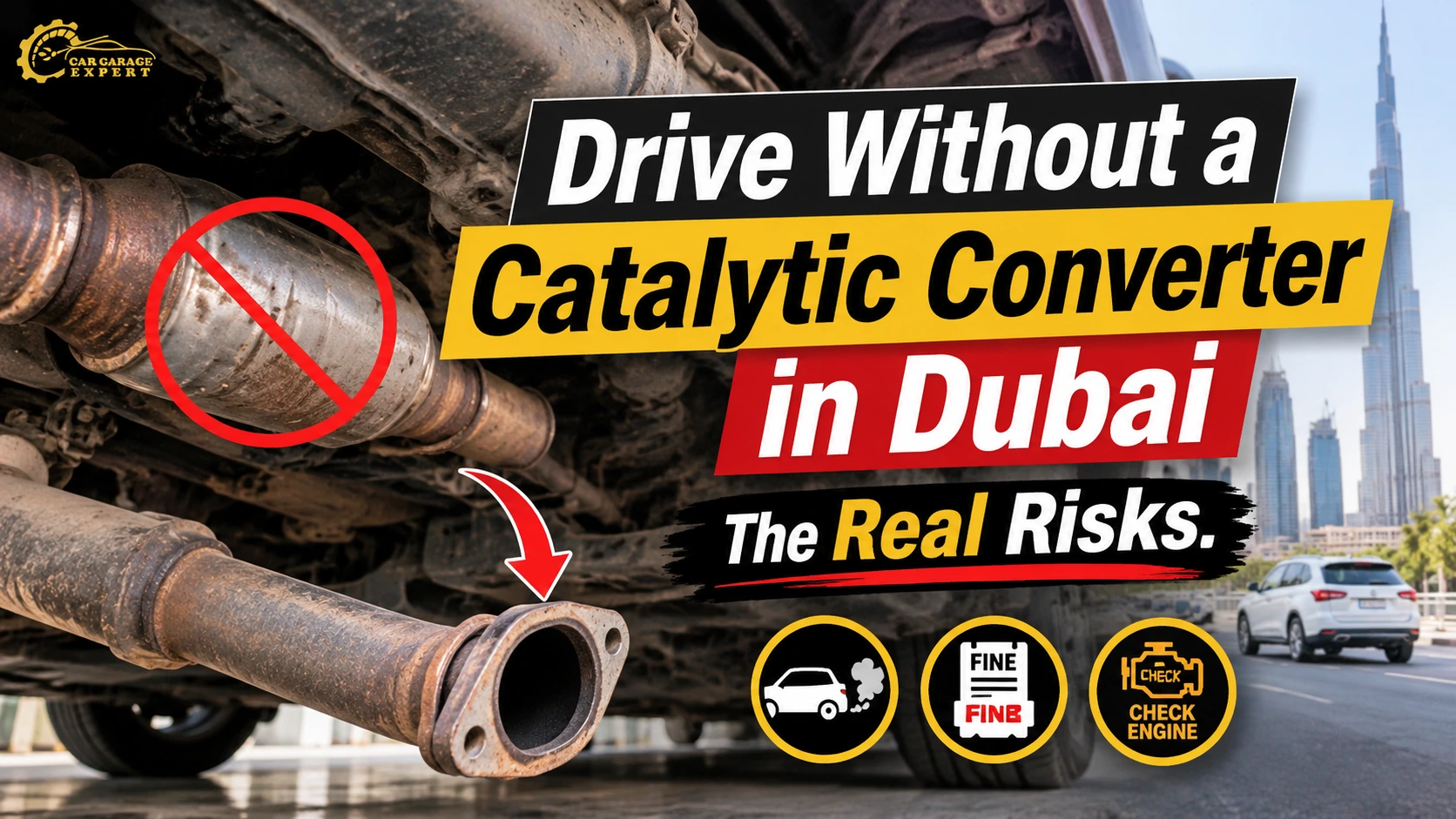
Your car will still start and drive without a catalytic converter. That does not make it a good idea. In the UAE, a missing or removed converter can mean a fine, black points, an impounded car, and a failed RTA test. This guide explains what happens when you drive without a catalytic converter fitted, what the law says, repair costs, and what to do if yours was stolen.
Drive Without Catalytic Converter: Quick Answer
A car can technically run without a catalytic converter, but it is illegal in the UAE and bad for the car. Removing the converter is an unauthorized modification to the engine or exhaust system. That is against the law in the UAE and will get you a 1,000 AED fine, 12 black points, and your car will be towed for 30 days. AED 2,000 fine can be added for a loud exhaust. The car may also run rough and fail the emissions part of the RTA test. The check engine light will also come on. If your converter was lost or stolen, drive only as far as the closest repair shop to get a new one.
Table of Contents
- What a Catalytic Converter Actually Does
- What Happens When You Drive Without a Catalytic Converter
- Is It Legal to Drive Without a Catalytic Converter in the UAE
- How Long Can You Safely Drive With No Converter
- Signs Your Catalytic Converter Is Failing
- Why Catalytic Converters Fail Early in Dubai
- Catalytic Converter Theft in the UAE
- How a Workshop Tests a Catalytic Converter
- Repair Options: Replace, Clean or Fix the Root Cause
- Catalytic Converter Replacement Costs in Dubai
- How to Make a New Catalytic Converter Last
- When to Stop Driving and Call for Help
- Why Choose Car Garage Expert for Catalytic Converter Problems
- Frequently Asked Questions
What a Catalytic Converter Actually Does
A catalytic converter is a metal canister in the exhaust that turns the most toxic engine gases into less harmful ones. It sits between the exhaust manifold and the silencer, usually under the front half of the car.
Inside is a ceramic honeycomb coated with three precious metals: platinum, palladium and rhodium. As hot exhaust gas passes through, these metals trigger chemical reactions that change three main pollutants.
| Carbon monoxide (CO), a poisonous gas | Carbon dioxide (CO2) |
| Unburnt fuel (hydrocarbons) | Carbon dioxide and water vapour |
| Nitrogen oxides (NOx), a cause of smog | Nitrogen and oxygen |
Most modern petrol cars use a “three-way” converter because it handles all three gases at once. Two oxygen sensors, one before the converter and one after it, tell the engine computer (ECU) whether the converter is working.
What Happens When You Drive Without a Catalytic Converter
The engine keeps running, but several things change straight away. Some you will hear, some you will see on the dashboard, and some only show up at the RTA test.
The Check Engine Light Comes On
The rear oxygen sensor reads the same gas as the front one, so the ECU knows the converter is gone. It stores a code such as P0420 or P0430 (“catalyst efficiency below threshold”) and lights the check engine warning. That light stays on until a converter is fitted.
The Exhaust Gets Much Louder
The converter’s honeycomb also reduces noise. Without it, most cars develop a loud rasp on acceleration and a drone at highway speed. On cars where thieves cut out the converter, the sound is a sudden roar the moment you start the engine.
Toxic Fumes Get Closer to the Cabin
Unconverted exhaust carries far more carbon monoxide. In slow Dubai traffic with the AC on fresh air, or in an underground car park, those fumes can enter the cabin. Carbon monoxide has no smell, so headaches, dizziness, or drowsiness are the warning signs.
Engine Running and Fuel Use Can Get Worse
Many owners expect more power. On a stock ECU, any gain is small, or none at all, and some cars run worse. The ECU may adjust fuel delivery or switch to a reduced-power mode when sensor readings don’t make sense. Some drivers also notice higher fuel use after they drive without a catalytic converter for a few weeks.
Nearby Parts Wear Faster
The oxygen monitor in the back is now in a hotter, dirtier gas stream, so it may fail sooner. If you don’t have the mounting clamps and heat shields for the converter, the other exhaust pipes may also shake, crack, or hang lower.
Is It Legal to Drive Without a Catalytic Converter in the UAE
No. The UAE treats removing or bypassing a catalytic converter as an unlicensed modification, and there is no permit route for it on a road car. Three sets of rules apply.
Traffic Fines and Black Points
Article 73 of the UAE traffic violations schedule covers changes to a vehicle’s engine or chassis without a permit. The penalty is an AED 1,000 fine, 12 black points, and 30 days of impoundment. Removing a converter usually makes the exhaust much louder, and driving a noisy vehicle is a separate offense with an AED 2,000 fine and 12 black points. In Dubai, owners can also pay release fees of up to AED 10,000 to get an impounded car back.
RTA Test and Registration Renewal
Cars older than three years must pass a roadworthiness test before their registration (Mulkiya) is renewed. Tasjeel and Shamil centers check exhaust emissions during that test. A car with no converter, or with a code-clearing “delete” tune, will fail the emissions check, and the registration cannot be renewed until the car is fixed and re-tested.
Insurance and Warranty
Removing an emissions part voids the manufacturer warranty on related systems. An insurer can also refuse or reduce a claim if the car was illegally modified at the time of an accident. Anyone planning to drive without a catalytic converter fitted is taking on all three risks at once.
How Long Can You Safely Drive With No Converter
Only as long as it takes to reach a workshop. There is no safe number of days or kilometers, because every trip adds legal risk and fume exposure.
If a converter was stolen or has broken apart, these steps keep the short drive as safe as possible:
- Look under the car first. If a cut pipe is hanging or touching the road, do not drive. Call for recovery instead.
- Keep windows slightly open and set the AC to fresh air, not recirculation, to stop fumes building up.
- Avoid underground car parks and long idling in traffic.
- Drive gently and directly to the workshop.
Someone who decides to drive without a catalytic converter for weeks while “waiting for a good price” is also risking a fine at any police check, since the noise is easy to spot.
Signs Your Catalytic Converter Is Failing
A converter rarely fails without warning. One that has stopped working leaves you in the same position as if you drive without a catalytic converter fitted, with the same warning light and the same failed RTA test. Catching these signs early often means fixing a cheaper fault before the converter itself is ruined.
Rotten Egg Smell From the Exhaust
A sulfur smell means the converter is not processing the small amount of sulfur in fuel properly. It often points to the engine running too rich or the converter being overheated.
Rattling Under the Car
A rattle from under the front seats, loudest at idle or when starting, usually means the ceramic honeycomb has cracked and broken loose inside the shell.
Loss of Power on the Highway or Uphill
A blocked converter acts like a cork in the exhaust. The car feels weak when accelerating onto Sheikh Zayed Road or climbing car park ramps, and it may get worse the longer you drive.
Check Engine Light With Code P0420 or P0430
These codes mean the rear oxygen sensor sees poor converter efficiency. The fault can be the converter, an exhaust leak, or a lazy sensor, so the code alone does not prove the converter is finished.
Failed Emissions Test
A car that suddenly fails the Tasjeel emissions check, with no other changes, often has a converter that has lost its coating.
Why Catalytic Converters Fail Early in Dubai
A converter can last 150,000 km or more on a healthy engine. An upstream engine fault causes most early failures, and Dubai driving makes some of those faults more common.
Engine Misfires Overheat the Converter
When a cylinder misfires, unburnt fuel goes straight into the converter and burns inside it. Temperatures spike, and the honeycomb can melt. Worn spark plugs and ignition coils fail sooner in a 45°C summer, so never ignore a flashing check engine light.
Oil and Coolant Burning in Older Engines
If the piston rings, valve seals, or head gasket are worn out, oil or water can leak into the combustion chamber. The residue sticks to the converter and stops it from working. Blue smoke or a sweet smell coming from the exhaust is often a sign.
Long Idling in Traffic With the AC On
Hours of idling in stop-and-go traffic keep the converter hot without much airflow. Combined with heavy AC load, this puts extra thermal stress on the converter in older cars.
Short Trips That Never Warm the Converter Up
A converter needs to reach about 400°C to work properly. Short school runs and quick trips across the community may never get it there, and deposits build up over time.
Catalytic Converter Theft in the UAE
Converters are stolen for the precious metals inside, which scrap buyers pay well for. Thieves can cut one out in a few minutes with a battery-powered saw.
Which Cars Thieves Target
Hybrids are a common target because their converters often contain more metal and stay cleaner, since the engine runs less. High-riding SUVs and pickups are also easy to reach without a jack.
How to Tell Yours Was Stolen
The car sounds like a race car the moment it starts, and the noise gets louder when you accelerate. You may see fresh cut marks on the exhaust pipe and metal filings on the ground. From that moment on, any trip means you’re driving without a catalytic converter fitted, so book the repair quickly.
What to Do After a Theft
Report it to the police so your insurance company has proof. Then set up a tow or a short, careful drive to a repair shop. Many insurance companies cover stolen parts under a full-coverage policy, but they will need a police report. If the thief damaged the bumper or side skirts while working under the car, a car painting team can repair that damage during the same visit.
How to Prevent Converter Theft
- Park in covered, well-lit, or gated areas where possible.
- Ask a workshop to fit a steel converter shield bolted under the car.
- Have the VIN engraved on the converter so it is harder to sell.
- Check that your car alarm reacts to tilting or vibration.
How a Workshop Tests a Catalytic Converter
A proper test confirms whether the converter is actually faulty before anyone sells you a new one. An experienced car mechanic runs these checks in order.
OBD Scan and Freeze Frame Data
The technician reads stored codes and the freeze frame data recorded when the fault happened. Misfire codes alongside P0420 point to an engine problem that has to be fixed first.
Live Oxygen Sensor Comparison
The front and rear oxygen sensor signals are watched together on a scan tool. These two checks show whether the converter is storing oxygen.
Front Sensor Switching
A healthy front sensor switches quickly between rich and lean, several times a second at steady speed. A slow front sensor can trigger a false converter code.
Rear Sensor Stability
A healthy rear sensor stays fairly steady. If it switches as fast as the front one, the converter is no longer doing its job.
Temperature Test at Inlet and Outlet
An infrared thermometer measures the converter pipe before and after the converter. A working converter makes heat, so the outlet should read noticeably hotter than the inlet once the engine is warm.
Back Pressure Test
A gauge fitted in the front oxygen sensor port measures exhaust pressure. High pressure at idle or 2,500 rpm confirms a blocked converter.
Exhaust Leak and Visual Check
The technician checks for leaks before the rear sensor, broken heat shields, impact dents, and loose internals. A small leak can pull in outside air and fake a converter fault.
Repair Options: Replace, Clean or Fix the Root Cause
The right repair depends on what the tests show. In many cases, the converter is only part of the job.
Fix the Engine Fault First
If misfires, oil burning, or a coolant leak caused the failure, a new converter will fail again within months unless you repair that fault first. Spark plugs, coils, injectors, and gaskets are common items to check.
Replace With an OEM or Approved Aftermarket Converter
OEM converters match the original exactly and suit newer or luxury cars. Good-quality aftermarket converters made for the specific model cost less and can work well on older cars. Very cheap universal units often carry less precious metal and may trigger the P0420 code again.
Why Cleaners and Additives Rarely Work
Fuel-tank cleaners can help with light carbon deposits, but they cannot fix a melted, cracked, or oil-coated honeycomb. They are worth trying only on a converter that tests as mildly blocked.
Why Delete Pipes and Tunes Are a Bad Idea
Some shops offer “test pipes” or software that hides the converter fault. Both let the car drive without catalytic converter hardware, but both are illegal on UAE roads and fail the RTA emissions test. They also leave you open to the fines and impoundment covered earlier.
Catalytic Converter Replacement Costs in Dubai
Prices depend on the car, the number of converters (V6 and V8 engines often have two or more), and the part quality. These are typical ranges at independent workshops in Dubai, including fitting. Dealer prices are usually higher.
| Service | Typical cost range (AED) |
| Diagnostic scan and converter testing | 150 to 300 |
| Oxygen sensor replacement, each | 300 to 900 |
| Aftermarket converter, Japanese or Korean car | 1,200 to 3,000 |
| OEM converter, Japanese or Korean car | 3,000 to 8,000 |
| OEM converter, European or luxury car | 6,000 to 20,000 |
| Hybrid OEM converter | 4,000 to 12,000 |
| Pipe welding or flex pipe after theft | 300 to 800 |
Compared with an AED 1,000 fine, 30 days without your car, and impound release fees, a quality aftermarket converter is often the cheaper route for older vehicles.
How to Make a New Catalytic Converter Last
A converter outlives most other exhaust parts when the engine in front of it is healthy. These habits protect your investment.
Keep Up With Scheduled Servicing
Fresh spark plugs, clean air filters, and the right oil grade keep combustion clean. Following one of the car service packages for your mileage covers the parts that most often damage converters.
Treat a Flashing Check Engine Light as Urgent
A flashing light means an active misfire that is sending raw fuel into the converter right now. Ease off and get the car checked the same day.
Watch Oil and Coolant Levels
If you need to top up oil between services or the coolant level keeps dropping, have it checked. Both fluids can ruin a converter if they get burned in the engine.
Take a Longer Drive Each Week
A 20- to 30-minute run on the highway lets the converter reach full working temperature and burn off light deposits.
When to Stop Driving and Call for Help
Some converter faults turn into safety problems. Stop the car in a safe place if you notice any of these:
- A red glow or strong heat coming from under the car.
- Smoke or a burning smell from the exhaust area
- Severe power loss, with the car struggling to keep up with traffic
- Exhaust fumes inside the cabin, or headaches and dizziness while driving
- A cut or broken pipe hanging close to the road.
In these cases, do not try to drive to the workshop. Call roadside assistance for recovery. For less urgent faults, such as a new P0420 code with no change in how the car drives, a mobile car mechanic can scan the car where it is parked and tell you if it is safe to drive in.
Why Choose Car Garage Expert for Catalytic Converter Problems
Car Garage Expert in Al Quoz is a strong choice for owners dealing with a failed, blocked, or stolen catalytic converter. The workshop treats a converter fault as a diagnosis job and fixes the cause, not just the part.
Testing Before Any Converter Is Replaced
Checks of the temperature, back pressure, and sensor data show that the converter is truly broken. That’s important because the same P0420 code can be caused by a leak or an oxygen sensor that isn’t working right for a lot less money.
Root Cause Repairs That Protect the New Part
Misfires, oil burning, and coolant leaks are found and fixed alongside the converter work. That keeps a brand-new converter from failing again a few months later.
UAE-Legal Replacements Only
Owners get a proper replacement converter, not a delete pipe or a code-hiding tune. Every repair is designed to pass the next RTA emissions test.
Easy to Reach in Al Quoz
The workshop sits in Al Quoz, a short drive from Sheik Zayed Road and Al Khail Road. Drivers searching for a garage near me from Al Barsha, JVC, or Business Bay can reach it quickly.
To book a converter check, visit Car Garage Expert, send a voice note of the exhaust sound on WhatsApp, or get directions on Google Maps.
Frequently Asked Questions
Q1: Can I drive without a catalytic converter?
The car will run, but it is illegal on UAE roads. You risk an AED 1,000 fine, 12 black points, 30 days of impoundment, and a failed RTA test, so drive only as far as a workshop.
Q2: Is driving with no catalytic converter illegal?
Yes. In the UAE, removing a converter counts as an unlicensed engine or exhaust modification under Article 73 of the traffic violations schedule.
Q3:Can a car pass RTA without a catalytic converter?
No. The emissions check at Tasjeel or Shamil will fail, and registration renewal is blocked until a working converter is fitted and the car passes a re-test.
Q4: Does removing the catalytic converter increase horsepower?
On a stock modern car, the gain is small or none. Many cars run worse because the ECU reacts to the oxygen sensor fault.
Q5: How long can you drive without a catalytic converter?
Only long enough to reach a workshop. If you have to drive without a catalytic converter after a theft, keep the trip short, use fresh-air AC, and avoid underground parking.
Q6: Why does my car smell like rotten eggs?
A rotten egg smell usually means the converter is overheating or the engine is running too rich. It needs a scan and inspection soon.
Q7: What happens if the catalytic converter is stolen?
The car becomes very loud, and the check engine light comes on. Report the theft to the police, then arrange recovery or a short drive to a workshop for a replacement.