A car that runs smoothly one week and develops a noticeable shake the next is telling you something has changed mechanically — engines don’t start vibrating for no reason. Car Engine Vibration and Shaking can come from something as simple as a worn spark plug or as significant as a failing engine mount, and the pattern of when it happens is usually the clearest clue to which one it is.
At Car Garage Expert in Al Quoz, we diagnose vibration complaints daily across every make and model on Dubai roads. This guide walks through what actually causes it, organised by when you feel it.
Car Engine Vibration and Shaking — Reading the Pattern First
The single most useful piece of information in any vibration complaint isn’t the strength of the shake — it’s exactly when it happens. A vehicle that shakes only at idle points to a different set of components than one that shakes only during acceleration or only at highway speed, and getting this distinction right narrows the diagnosis significantly before a mechanic even opens the bonnet.
Car Engine Vibration and Shaking at Idle Versus While Driving
Timing tells you most of what you need to know. The two scenarios below cover the overwhelming majority of vibration complaints we see in Al Quoz.
Why Idle-Only Shaking Points to Combustion or Mounting
If the vibration is strongest when the car is stationary with the engine running, and noticeably reduces or disappears once you start moving, the cause is almost always related to combustion quality or how the engine is physically mounted — not the wheels, tyres, or driveline, since none of those are doing anything different between idle and a slow roll.
A Quick Check You Can Do Yourself
Shifting into neutral while the vibration is happening is a genuinely useful diagnostic step. If the shaking noticeably calms down in neutral, that’s a strong indicator the issue sits with the engine or transmission mounts rather than something further down the drivetrain, since neutral removes the transmission’s connection to the wheels from the equation.
Why Acceleration-Specific Shaking Means Something Different
Vibration that only appears when you press the accelerator, rather than at a steady idle, usually points toward the fuel delivery system, ignition components, or in some cases the driveshaft — components that only come under load or demand once you’re actively asking the engine for more power.
Engine Mounts and Why They Fail in Dubai’s Heat
Engine mounts are one of the most overlooked causes of idle vibration, largely because the symptom builds gradually and many drivers assume it’s simply how an older car sounds.
What Engine Mounts Actually Do
Engine mounts secure the engine to the vehicle’s frame and absorb the engine’s natural vibration before it transfers into the cabin — one of the most common roots of Car Engine Vibration and Shaking complaints we see. They’re made largely of rubber, and rubber is a material that degrades predictably with age, heat, and oil exposure over time.
Why Dubai Conditions Accelerate This Specific Failure
Sustained high ambient temperatures and engine bay heat soften and crack mount rubber faster than in temperate climates, which is one reason engine mount failure shows up earlier in Dubai-driven vehicles than the same model would typically experience in a cooler market. A mount that’s cracked or has separated internally no longer absorbs vibration the way it’s designed to, so the engine’s normal operating movement transmits directly into the chassis instead.
The Telltale Sign of a Failing Mount
A noticeable thud or jolt when shifting from park into drive, combined with vibration that’s worst at idle and during initial acceleration, is the classic signature of a worn or broken mount — and it’s a mechanical fault, not something that resolves with a tune-up or fluid change.
Spark Plugs, Ignition, and Misfires
Ignition-related vibration is among the most common causes we diagnose, and also among the most affordable to resolve once correctly identified.
How a Worn Spark Plug Creates a Vibration You Can Feel
Spark plugs ignite the air-fuel mixture in each cylinder at a precisely timed moment. A worn or fouled plug produces a weak or inconsistent spark, which means that cylinder doesn’t fire as cleanly as the others — and an engine where one or more cylinders aren’t contributing evenly produces an imbalance you feel as a vibration or rough idle.
Why This Often Shows Up Gradually
Spark plug wear is a slow process, which means the vibration it causes typically builds gradually over weeks or months rather than appearing suddenly. Many owners describe noticing it only once it’s already become fairly pronounced, simply because the change happened too slowly to register day to day.
Ignition Coils Can Cause the Exact Same Symptom
A failing ignition coil produces a misfire that feels identical to a worn spark plug from the driver’s seat, and only a proper diagnostic scan reading individual cylinder misfire data reliably tells the two apart rather than guessing and replacing parts speculatively.
Car Engine Vibration and Shaking Caused by Fuel, Air, and Vacuum Issues
Beyond ignition and mounts, the air and fuel systems that feed combustion are responsible for a meaningful share of vibration complaints, particularly the ones that appear specifically under acceleration or at a rough, unsteady idle.
A Clogged Fuel System Disrupts Combustion Evenly
The fuel delivery system needs to supply every cylinder with a consistent, precisely metered amount of fuel — anything that disrupts that consistency shows up as vibration before it shows up as lost power.
Why a Dirty Fuel Filter Causes Vibration, Not Just Lost Power
A restricted fuel filter reduces fuel pressure reaching the injectors, and inconsistent fuel pressure means each cylinder isn’t receiving exactly the fuel charge it needs at exactly the right moment. The resulting combustion imbalance is felt as vibration well before most drivers notice any meaningful drop in acceleration.
Fuel Injectors That Are Partially Blocked
Carbon deposits inside fuel injectors restrict and distort the fuel spray pattern over time, which disrupts the air-fuel mixture entering the cylinder. This produces uneven combustion in exactly the same way a fouled spark plug does, which is part of why these two causes are so frequently confused without a proper scan.
Vacuum Leaks Throw Off the Air-Fuel Balance
A vacuum leak is one of the trickier vibration causes to spot without proper equipment, because it doesn’t announce itself the way a visible fluid leak would.
How a Small Crack in a Hose Causes a Big Symptom
Vacuum lines connect numerous points throughout the engine, and a crack or loose connection lets unmetered air into the intake system that the engine management computer wasn’t expecting. This throws off the air-fuel ratio the same way a fuel problem does, and a vacuum leak can cause anything from a mild rough idle to violent shaking depending on its size and location.
Why This Is Often Misdiagnosed as a Fuel Problem
Because vacuum leaks and fuel delivery problems both disrupt the same underlying air-fuel ratio, the resulting vibration symptom looks almost identical from the driver’s seat. A smoke test, which deliberately introduces visible smoke into the intake system to reveal exactly where air is escaping, is the only reliable way to confirm a vacuum leak rather than assuming it’s a fuel issue and replacing the wrong component first.
For any breakdown caused by a sudden, severe vibration, our roadside assistance covers Al Quoz and nearby Dubai areas.
What Causes Car Engine Vibration and Shaking at Higher Speeds
Vibration that only appears once you’re moving at speed — rather than at idle or low-speed acceleration — usually points away from the engine itself and toward the wheels, driveline, or suspension.
Tyres and Wheel Balance
Speed-related vibration takes the conversation away from the engine entirely and points toward the wheels, tyres, and driveline instead.
Out-of-Balance Tyres Cause Speed-Specific Shaking
A wheel that’s even slightly out of balance produces vibration that gets noticeably worse as speed increases, and it’s commonly felt most strongly through the steering wheel rather than the seat or floor. This is one of the most affordable and quickest fixes on this entire list, since rebalancing a wheel typically takes only a short workshop visit.
Uneven Tyre Pressure Across the Vehicle
Tyres that aren’t matched in pressure across the vehicle can create a subtle pulling sensation combined with vibration, particularly noticeable at motorway speed. Dubai’s heat makes this more relevant than in cooler climates, since tyre pressure rises measurably once a tyre has been at speed for a stretch of time on hot tarmac.
Driveshaft and Wheel Alignment
Beyond simple tyre balance, two other components commonly produce vibration that only appears once the car is moving at meaningful speed.
A Bent or Unbalanced Driveshaft
The driveshaft transfers power from the engine to the axles, and if it’s bent, damaged, or unbalanced — sometimes from a pothole impact or general wear — it creates a rotational imbalance that’s felt as strong vibration through the floor or steering column, typically worsening as speed increases.
Misaligned Wheels Affecting Steering Feel
Misalignment generally causes a vehicle to drift gently to one side while also making the steering feel slightly shaky or imprecise. It’s a separate issue from balance, and correcting it requires a proper alignment check rather than simply rebalancing the wheels, since the underlying geometry — not the weight distribution — is what’s actually off.
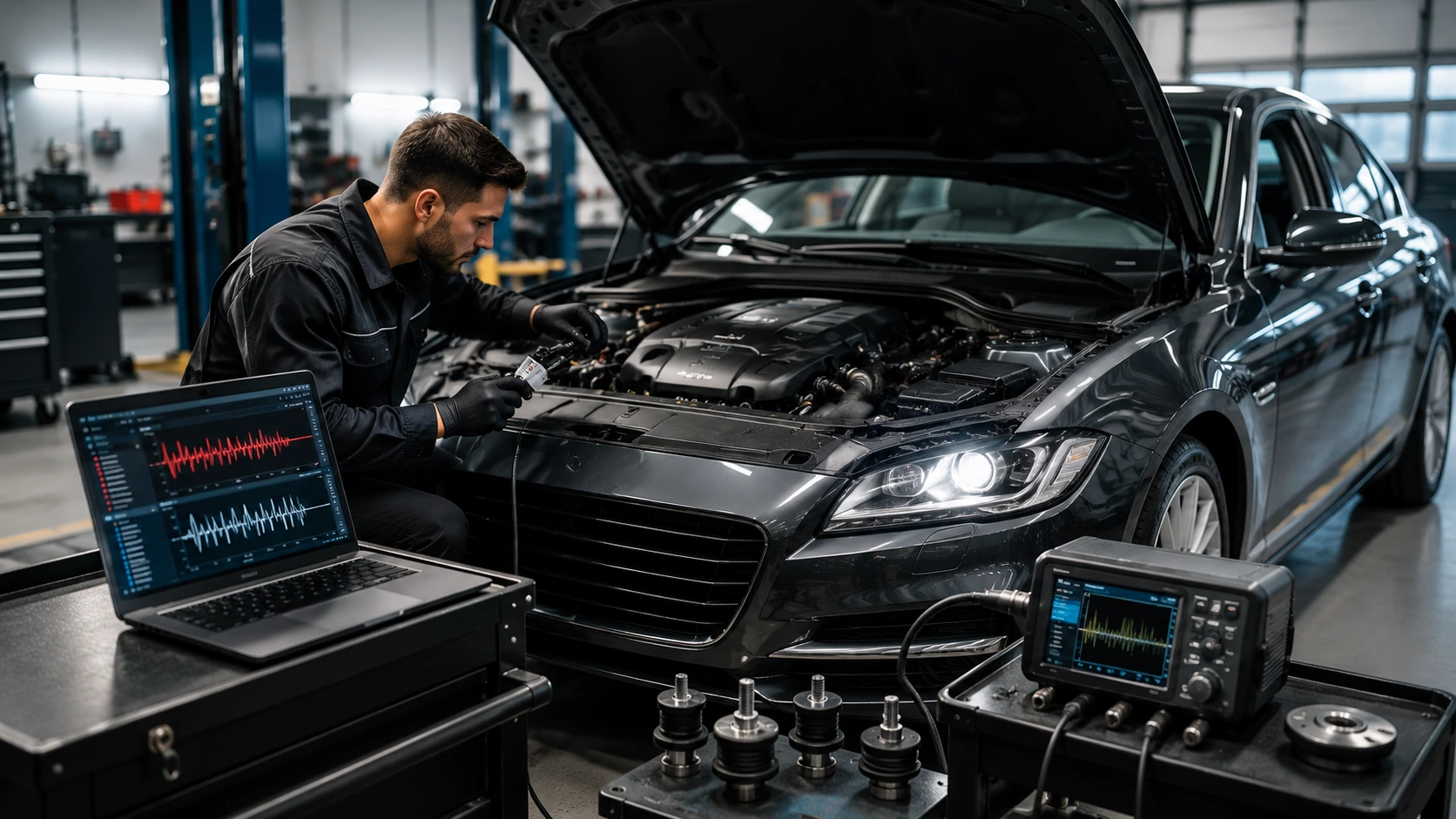
Our car mechanic team checks all of the above — mounts, ignition, fuel delivery, vacuum integrity, and wheel condition — as part of a full Car Engine Vibration and Shaking diagnostic, using OBD scanning to read stored misfire and sensor data before recommending any repair. For an on-site assessment if your car isn’t safe to drive in, our mobile car mechanic covers Al Quoz and nearby Dubai areas.
When Vibration Means You Should Stop Driving
Not every vibration is the same level of urgency. The combination of symptoms matters as much as the vibration itself.
Vibration Paired With a Burning Smell or Warning Light
A vibration accompanied by a burning smell, visible smoke, or a dashboard warning light is a different category of problem entirely — this combination often points to overheating, an oil leak, or a coolant leak, any of which can cause serious engine damage if you continue driving rather than stopping promptly.
Why Ignoring Vibration Gets More Expensive Over Time
Continuing to drive with unresolved Car Engine Vibration and Shaking accelerates wear on the gearbox and suspension, increases fuel consumption, and in many cases causes the original fault to progress into a larger and more expensive repair. Catching it early, while the cause is still isolated to one component, is consistently the cheaper outcome.
For exterior assessment or any panel work needed if vibration has been caused by an impact, our car painting team handles colour-matched repairs. Our car service packages include spark plug, mount, and vacuum system checks as standard at every scheduled visit.
Finding a Car Engine Vibration and Shaking Diagnosis in Al Quoz
If your car has developed any of the symptoms described above, Car Garage Expert is a garage near me in Al Quoz accessible from Business Bay, Barsha, Jumeirah, Satwa, Downtown, and the Sheikh Zayed Road corridor.
FAQ — Car Engine Vibration and Shaking
Why does my car shake when I'm stopped but not when I'm driving?
This pattern almost always points to engine or transmission mounts, or a combustion issue like worn spark plugs — shifting into neutral while it's happening helps narrow down which.
Is it safe to keep driving with a vibrating engine?
It depends on the cause and severity — mild vibration from worn spark plugs is generally safe short-term, but vibration with a burning smell, smoke, or warning light means you should stop and get it checked immediately.
Why does my car only shake when I accelerate?
Acceleration-specific shaking usually points to the fuel delivery system, ignition misfires, or a damaged driveshaft, since these components are only under demand once you press the accelerator.
Can low tyre pressure cause my car to vibrate?
Yes — uneven or low tyre pressure across the vehicle can cause vibration that's most noticeable at higher speeds, and it's one of the simplest and cheapest causes to rule out first.
How much does it cost to fix engine vibration?
It depends entirely on the cause — a spark plug replacement is inexpensive, while a damaged engine mount, driveshaft, or major fuel system repair costs significantly more, which is why a proper diagnostic before any repair matters.
Conclusion
Car Engine Vibration and Shaking almost always has an identifiable, fixable cause — and the pattern of when it happens, whether at idle, on acceleration, or at speed, is the fastest route to the right diagnosis. Catching it early at Car Garage Expert in Al Quoz means a smaller repair now rather than a larger one later.
Car Garage Expert is in Al Quoz, serving drivers across nearby Dubai areas — Business Bay, Barsha, Jumeirah, Satwa, Downtown, and the Sheikh Zayed Road corridor. Book your appointment on WhatsApp and find us on Google Maps.
Car Garage Expert — Car Engine Vibration and Shaking | Al Quoz, Dubai