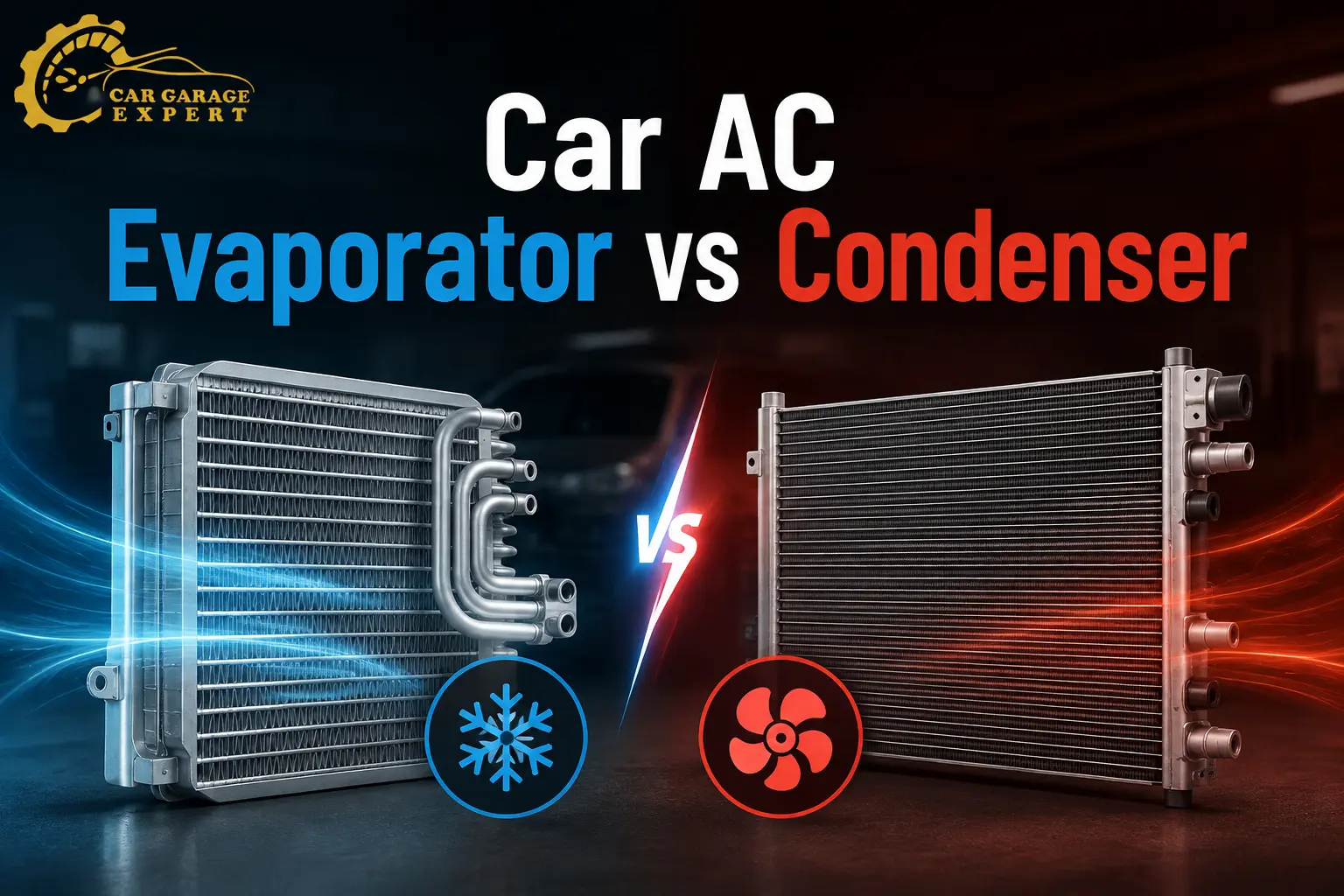
Your automotive AC system has both an evaporator and a condenser but they do opposite things. Inside the cabin, the evaporator absorbs heat from the air, cooling it before it reaches your vents. The condenser sits at the front of the car and releases heat outside. The evaporator and condenser in a car’s AC system work together to move refrigerant through a cycle of absorbing and releasing heat. Both pieces sweat and wear out faster in Dubai’s heat. If your AC is blowing hot air, or smells funny, one of these two pieces is usually the culprit. A good check will tell you which one requires your attention.
Table of Contents
- How a Car AC Evaporator and Condenser Work Together
- Signs Your Evaporator or Condenser Is Failing
- Common Causes of AC Part Damage in Dubai
- How We Diagnose Evaporator and Condenser Problems
- Repair and Service Process for AC Cooling Issues
- Risks of Ignoring a Failing Evaporator or Condenser
- Can You Keep Driving With a Faulty AC?
- How Long Does AC Repair Take?
- Cost Factors for Evaporator and Condenser Repair
- Prevention Tips to Keep Your AC System Healthy
- Dubai-Specific Advice for AC Care
- Why Choose Car Garage Expert for AC Repair
- FAQs
- Related Services
- Conclusion
How a Car AC Evaporator and Condenser Work Together
Your car’s AC system relies on refrigerant flow to move heat out of the cabin. The evaporator pulls heat and moisture from the air inside your car. As warm cabin air passes over the cold coils, it cools and dries out.
The condenser function is different. It sits in front of your radiator and takes the heat the evaporator collected. It uses outside air to cool the hot refrigerant, releasing heat into the atmosphere.
Between these two, the AC compressor and expansion valve control pressure and flow. The compressor increases the refrigerant’s pressure and moves it to the condenser. The expansion valve lowers the pressure again before the refrigerant enters the evaporator. This cycle runs nonstop while your AC operates, providing consistently cool cabin air.
Signs Your Evaporator or Condenser Is Failing
Both parts can fail slowly or all at once. Watch for these warning signs.
- Warm air from the vents even with the AC on full
- A musty smell when the AC first turns on
- Weak airflow from the vents
- Visible oily residue near the condenser at the front of the car
- Fogged or foggy windows that won’t clear
- AC that cools well at idle but not while driving
- Hissing or bubbling sounds under the dashboard
A musty smell usually points to the evaporator. Weak cooling at highway speed often points to the condenser. Either way, these symptoms mean your car AC evaporator and condenser aren’t working the way they should.
Common Causes of AC Part Damage in Dubai
Dubai’s climate is hard on a Car AC Evaporator and Condenser. A few causes keep coming up.
Extreme heat load. Summer temperatures push the condenser to work far harder than it would in cooler climates. This shortens its lifespan.
Road debris and dust. The condenser sits exposed at the front of the car. Sand and grit from Dubai roads can clog its fins, blocking heat dissipation.
Corrosion from humidity. Coastal humidity speeds up corrosion on evaporator coils, especially in cars that sit in covered parking with poor airflow.
Low refrigerant levels. A small leak drops refrigerant pressure over time. Low pressure stresses the compressor and reduces cooling power.
Clogged expansion valve. Dirt or old refrigerant oil can clog this small valve, disrupting the whole AC cooling process.
How We Diagnose Evaporator and Condenser Problems
Diagnosing a Car AC Evaporator and Condenser problem is never a shot in the dark. We do it clearly.
The technician first checks the refrigerant pressure with gauges attached to the high and low sides of the system. This indicates whether the problem is a leak, blockage, or compressor failure. Next we visually check the condenser for bent fins, oil streaks or debris buildup.
Then we examine airflow and vent temperature in the cabin. If cooling diminishes while driving but is okay at idle, that points to the condenser. We check the evaporator core if you notice mustiness or insufficient airflow at any fan speed, sometimes utilizing a borescope camera because it is deep in the dash.
Finally, if we detect a leak, we do a dye test. This displays exactly where the refrigerant is leaking.
Repair and Service Process for AC Cooling Issues
Once we know whether the car’s AC evaporator, condenser, or another part has failed, the repair follows set steps.
- Recover any remaining refrigerant safely before opening the system.
- Replace the faulty evaporator or condenser, or repair the leak if the part is still usable.
- Replace the receiver-drier or accumulator, since it’s often affected by contamination.
- Flush the system to clear out debris and old oil.
- Vacuum the system to remove air and moisture.
- Recharge with the correct amount and type of AC refrigerant.
- Test cooling performance at idle and at higher engine speeds.
Skipping the flush or vacuum step is a common shortcut that leads to repeat failures.
Risks of Ignoring a Failing Evaporator or Condenser
A weak AC feels like a comfort issue at first. But ignoring it causes bigger problems.
If the evaporator is broken, refrigerant oil might leak out and starve the compressor of lubrication. This can ruin the compressor entirely and turn a modest repair into an expensive one. A plugged condenser also raises system pressure, stressing hoses and seals until they rupture.
Mould growing in a wet evaporator housing can also degrade the quality of the air in the cabin. This is a health issue, not merely a comfort one, especially for passengers with allergies.
Car AC Evaporator and Condenser: Side-by-Side Comparison
Each part in your AC system has its own job. Knowing what each one does makes it easier to spot which part is failing.
| Component | Main Job | Common Failure Signs | Typical Fix |
| Evaporator | Pulls heat out of cabin air | Musty smell, weak airflow, foggy windows | Clean, seal a leak, or replace the core |
| Condenser | Pushes heat out of the car | Warm air at speed, oily residue, bent fins | Clean the fins, seal a leak, or replace the unit |
| Compressor | Pressurizes and circulates refrigerant | Loud clutch cycling, no cooling at all | Repair or replace the compressor |
| Expansion valve | Drops refrigerant pressure before the evaporator | Uneven cooling, ice on the lines | Clean or replace the valve |
| Refrigerant lines | Move refrigerant between components | Hissing sounds, visible leaks | Seal or replace the damaged line |
Can You Keep Driving With a Faulty AC?
Yes, you can usually keep driving with a weak AC. It won’t stop your car from running. But don’t ignore it for long.
If you notice a burning smell, loud noises from under the hood, or the compressor clutch cycling on and off rapidly, get it checked soon. These signs suggest damage that worsens each time you run the AC.
In Dubai’s heat, driving without working AC also raises the risk of driver fatigue on long trips. If your AC fails on the road, roadside assistance can help you get to a workshop safely.
How Long Does AC Repair Take?
A simple fix, like adding refrigerant or repairing a small leak, can usually be done in a few hours. Since the condenser is near the front and easy to get to, replacing it usually takes half a day.
Replacing the evaporator takes longer—often a full day—because you have to remove part of the dashboard to reach it. If both parts need work, it can take one to two days to finish.
Cost Factors for Evaporator and Condenser Repair
Several things affect what you pay for AC repair.
- Part cost. Condensers are generally cheaper than evaporators because they’re easier to access and simpler to design.
- Labor time. Evaporator jobs cost more in labor since the dashboard needs partial removal.
- Refrigerant type. Some newer refrigerants cost more per kilogram than older types.
- Extent of damage. Repairing a small leak costs far less than replacing a full part.
- Related damage. If low refrigerant also damages the compressor, that adds to the bill.
Catching a Car AC Evaporator and Condenser problem early, before it spreads to other AC system components, keeps repair costs down.
Prevention Tips to Keep Your AC System Healthy
A few habits help your AC last longer in Dubai’s climate.
Run the AC for a few minutes even in cooler months, so seals stay lubricated. Get the cabin filter changed regularly, since a clogged filter strains the evaporator. Have refrigerant pressure checked once a year, ideally before summer starts.
Park in shade or covered areas when possible. This reduces heat load on the whole system and slows wear on your car’s AC evaporator and condenser.
Dubai-Specific Advice for AC Care
Dubai drivers push their AC systems harder than almost anywhere else. Summer heat above 45°C means the condenser barely gets a break, even at night. This nonstop demand shortens the life of both the AC compressor and the condenser itself.
Dust storms and construction sites, common near areas like Al Quoz, add extra grit to the condenser’s fins. Regular cleaning of the condenser face helps keep heat dissipation working properly.
Long periods of idling in summer traffic also stress the system. If your car sits in stop-start traffic often, get your AC checked more frequently than the standard yearly schedule.
Why Choose Car Garage Expert for AC Repair
Car Garage Expert in Al Quoz handles full AC diagnostics, not just refrigerant top-ups. Every check includes pressure testing, a visual inspection of the condenser, and airflow testing at the vents.
Our technicians use proper recovery and recharge equipment, so they handle refrigerant safely and accurately. We also check for related issues, like a struggling compressor, before closing up the job.
If you’re searching for a trusted garage near me for AC problems, we offer same-day diagnostics for most cases. We recommend a full AC check every year, ideally before Dubai’s summer heat sets in to avoid Car AC Evaporator and Condenser issues.
FAQs
Q1: Can I fix a Car AC evaporator and condenser problem myself?
Refrigerant systems need special tools and training. Handling refrigerant without the right equipment is unsafe and can further damage the system. A trained technician should always handle this repair.
Q2: What’s the difference between the evaporator and condenser in simple terms?
The evaporator cools the air inside your car. The condenser releases the heat that was removed outside the car. They work as a pair in the same refrigerant cycle.
Q3: How do I know if it’s a refrigerant leak instead of a broken part?
A leak usually causes cooling to fade gradually over weeks. A broken compressor or blocked expansion valve often causes cooling to drop suddenly. A dye test can confirm which one you’re dealing with.
Q4: Does warranty cover car ac repair in the UAE?
This depends on your car’s age and warranty terms. Many manufacturer warranties cover AC parts for a set number of years or kilometers. Check your service booklet or ask your dealer directly.
Q5: How often should I service my car’s AC system in Dubai?
Once a year is a good baseline, ideally before summer. Cars driven daily in heavy traffic may benefit from a check every six months.
Related Services
If your car ac evaporator and condenser points to other systems , these services may also help:
- Car mechanic for general diagnostics beyond the AC system
- Car service packages in Dubai for a full seasonal check
- Mobile car mechanic for on-site AC checks
- Roadside assistance Dubai if your AC failure leaves you stranded
- Car painting if condenser debris has damaged your front bumper finish
- Garage near me in Dubai for nearby drop-off options
Conclusion
A weak or failing car AC evaporator and condenser can turn Dubai summers miserable fast. Don’t wait for it to get worse. Book a full AC inspection with Car Garage Expert today and stay cool on every drive.