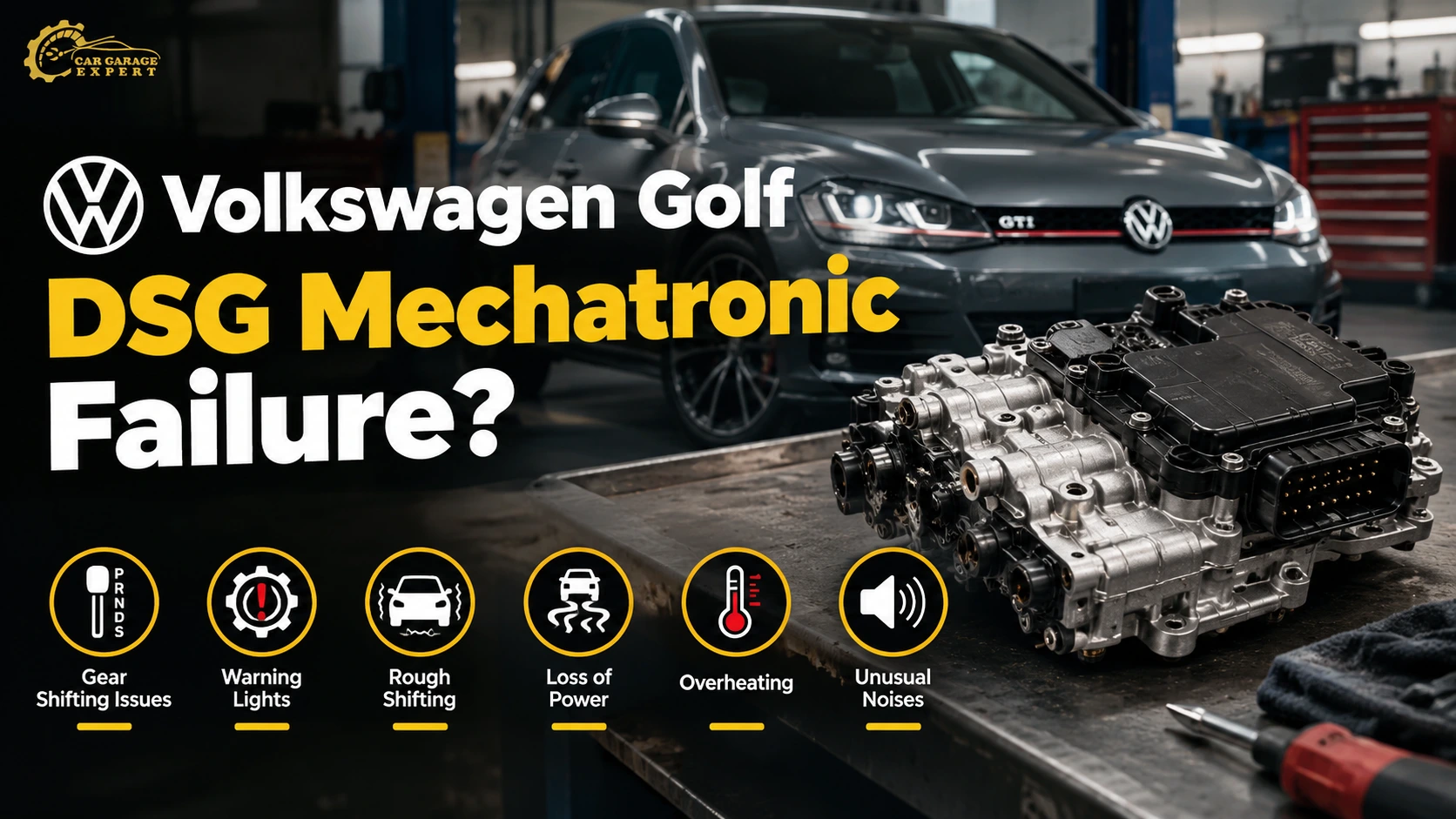
Your Golf pulls away with a jolt. The gear letter on the dash starts flashing, and then the car will not move. Many Golf owners in Dubai hear the same word next: mechatronic.
Volkswagen Golf DSG mechatronic failure is one of the most common gearbox problems on Golfs built from 2008 onward. It hits the 7-speed DQ200 hardest, but the wet-clutch DQ250 and DQ381 can fail too.
Below, you will learn what the mechatronic unit does, why it breaks, and how a workshop tests and fixes it. You will also find Dubai cost ranges and a simple symptom log to help you avoid paying for a gearbox you don’t need.
Is Going Wrong With Your Golf’s DSG?
The mechatronic unit is the computer and hydraulic control unit of a DSG gearbox. When it fails, a Golf can lurch when pulling away, shift late or roughly, flash the gear display, drop into limp mode, or refuse to go into Drive or Reverse. Common causes are a cracked pressure accumulator, worn solenoids, a malfunctioning hydraulic pump, heat-damaged electronics, and outdated gearbox oil. The workshop will read the gearbox trouble codes, check hydraulic pressure, and test each solenoid. Many of the units can be fixed, not replaced. After any repair, the gearbox needs software adaptation and a road test.
What Is a DSG Mechatronic Unit in a Volkswagen Golf?
The mechatronic unit is a single block bolted to the side of the DSG gearbox. It combines the transmission control module (the computer) with a hydraulic valve body full of solenoids. It decides when to shift, then makes the shift happen.
Every Volkswagen Golf DSG mechatronic failure starts in one of those two halves: the electronics or the hydraulics. Knowing which half failed decides whether a repair or a full replacement makes sense.
How Does the Volkswagen Golf DSG Mechatronic System Work?
A DSG has two clutches. One handles the odd gears (1, 3, 5, 7) and the other handles the even gears (2, 4, 6) plus reverse. While you drive in one gear, the gearbox already has the next one ready.
The mechatronic unit reads speed, throttle, and temperature sensors. It then sends oil pressure to the right clutch and gear selector. When everything works, a shift takes a fraction of a second.
What Does the DSG Mechatronic Unit Control?
It controls almost everything the gearbox does:
- Opening and closing both clutches
- Moving the gear selector forks
- Hydraulic pressure inside the gearbox
- Clutch cooling oil flow on wet-clutch models
- Shift timing based on speed, load, and temperature
When one of these jobs fails, you feel it as a jerk, a delay, or a warning light.
What Is the Difference Between DQ200, DQ250, and DQ381 DSG Gearboxes?
Your Golf uses one of three main DSG types. The type matters, because each one tends to fail in its own way.
- DQ200 (7-speed dry clutch): fitted to smaller-engine Golfs such as the 1.0, 1.2 and 1.4 TSI. Its clutches run dry, and the mechatronic unit has its own sealed hydraulic circuit. It has the highest mechatronic failure rate of the three.
- DQ250 (6-speed wet clutch): fitted to older GTI, GTD and Golf R models. Its clutches run in oil, which cools them and lets them handle more torque. Mechatronic faults here often trace back to old or burnt gearbox oil.
- DQ381 (7-speed wet clutch): fitted to newer GTI and Golf R models from around 2017. It handles even more torque and also depends on clean oil.
Your service book, the code on the gearbox casing, or a scan tool will confirm which one you have.
What Are the Symptoms of Volkswagen Golf DSG Mechatronic Failure?
Mechatronic symptoms often start small and worsen over weeks. These are the signs Golf owners report most.
Jerking or Shuddering When Pulling Away
The car lurches from a stop or shudders in first and second gear. It is the most common early sign, especially in slow traffic.
Rough or Delayed Gear Shifts
Shifts feel harsh, or the gearbox waits a second before taking the next gear. Downshifts may bang through as you slow down.
Flashing Gear Display or Gearbox Warning Message
The PRNDS letters on the dash flash, or a message says the gearbox has a fault. The car has stored a fault code and may limit which gears it uses.
Limp Mode With Missing Gears
The gearbox shuts off one clutch to protect itself. You may get only odd gears or only even gears, and the car may feel slow and stuck.
Loss of Drive or No Reverse
You select D or R, and nothing happens, or the car rolls as if in neutral. A sudden loss of hydraulic pressure usually causes it.
Buzzing From the Gearbox After Switching Off
On the DQ200, you may hear the hydraulic pump running often or for a long time after you park. That points to a pressure leak inside the unit.
What Causes Volkswagen Golf DSG Mechatronic Failure?
A Volkswagen Golf DSG mechatronic failure usually comes from heat, pressure loss, or wear inside the unit. Mechanics most often find these faults.
Cracked Hydraulic Pressure Accumulator
The accumulator is a small sphere that stores oil pressure, mainly on the DQ200. Over time, it or the valve body around it can crack. Pressure leaks away, the pump runs nonstop, and gears drop out. Replacing the accumulator is one of the most common repairs.
Mechatronic Solenoid Failure
Solenoids are small electric valves that send oil to each clutch and gear. They wear, stick, or short out with age. A stuck solenoid causes harsh shifts or a missing gear. Faulty solenoids can often be replaced on their own.
DSG Hydraulic Pressure Loss and Pump Wear
The DQ200 uses an electric pump to keep the mechatronic unit under pressure. When a seal or the valve body leaks, the pump works harder and wears out. Low pressure means slow clutch engagement and, eventually, loss of drive.
DSG Transmission Control Module Fault
The control board sits right on the hot gearbox. Years of heating up and cooling down crack solder joints and damage circuits. Faults may come and go with temperature before they become permanent. Specialist board repair is often possible.
Old or Dirty Gearbox Oil on Wet-Clutch Models
DQ250 and DQ381 clutches are cooled with the same oil that supplies the mechatronic unit. Old oil has clutch debris that clogs fine passageways and wears out solenoids. Skipped oil services are a primary cause of mechatronic problems on these gearboxes.
Sensor and Wiring Faults
Speed sensors, pressure sensors, and gearbox wiring can fail on their own. A bad sensor feeds the mechatronic unit false data, so it shifts at the wrong time or drops into limp mode. These are usually the cheapest fixes.
Low Battery Voltage and Outdated Software
A weak battery can trigger false gearbox faults during start-up. Volkswagen has also released software updates that change how some DSG units shift and protect themselves—checking both rules out simple problems before changing any parts.
Volkswagen Golf DSG Mechatronic Failure or Something Else? Match the Symptom
Use this table to see which fault fits what you feel before you visit a workshop.
|
What You Notice |
Likely Cause |
Usual Fix |
| Pump buzzing, gears dropping out | Cracked accumulator or valve body leak | Accumulator or valve body repair |
| Harsh shift or one gear missing | Stuck or worn solenoid | Solenoid replacement |
| Only odd or only even gears, limp mode | Pressure loss on one clutch circuit | Pressure test, then mechatronic repair |
| Faults that come and go with heat | Control module board fault | Board repair or replacement |
| Judder on pull-away, no warning light | Worn clutch or drifted adaptation | Clutch adaptation or new clutch |
| Rough shifts on a GTI or Golf R | Old or dirty gearbox oil | DSG oil and filter service |
| Gearbox warning after a weak start | Low battery voltage | Battery test or replacement |
Why Is My Volkswagen Golf DSG Gearbox Jerking When Accelerating?
Jerking usually suggests the clutch is not engaging smoothly. On a DQ200, the dry clutch may be worn, or the mechatronic unit may be applying the clutch unevenly. On wet-clutch types, old oil and sticky solenoids are the usual culprits.
This can also be caused by drifted clutch adaptation parameters. It learns the clutch bite point over time , and long periods of creeping in traffic can throw that value off . Sometimes a basic settings reset with a diagnostic tool will smooth the take-off without any new parts.
Treat the jerking as a mechatronic defect until a test proves otherwise , especially if the gear display is flashing .
Why Is My Volkswagen Golf DSG Not Engaging Drive or Reverse?
No drive almost always points to lost hydraulic pressure or a missing control signal. Without pressure, the mechatronic unit cannot close a clutch or move a gear.
On the DQ200, a cracked accumulator or valve body is the usual reason. On the DQ250 and DQ381, a stuck solenoid, low oil level, or a failed pressure sensor is more likely. A dead control board can also stop the gearbox from selecting any gear.
If reverse works but drive does not, only one clutch circuit has failed. That clue helps the mechanic narrow the fault quickly.
How Can You Tell the Difference Between DSG Mechatronic Failure and Clutch Failure?
Clutch wear and mechatronic faults feel alike, but they leave different clues. Telling them apart can save you thousands of dirhams, because a clutch kit and a mechatronic unit are very different jobs.
- Clutch wear builds slowly over months, while mechatronic faults often appear suddenly.
- A worn clutch slips, so the revs climb, but the car does not speed up to match. A mechatronic fault more often causes jerks, bangs, or no drive at all.
- Mechatronic faults usually flash the gear display and store pressure or solenoid codes. A worn clutch may store no code.
- A burning smell after stop-start traffic points to the clutch, especially on the DQ200.
A mechanic confirms it by reading clutch wear values and hydraulic pressure on a scan tool. Treating a Volkswagen Golf DSG mechatronic failure as a clutch problem, or the other way round, is an expensive mistake.
Keep a Simple DSG Symptom Log Before Your Workshop Visit
DSG faults often come and go, and they rarely show up on a 10-minute test drive. A short log on your phone gives the mechanic the clues they need. Write down:
- When it happens: cold start, after a long drive, or in stop-start traffic
- Which gears feel wrong, or whether only odd or only even gears work
- What warning appears, with a photo of the dash message
- Whether you hear the gearbox pump buzzing after you switch off
- How the car behaves in reverse compared with drive
Also note the date of the last gearbox oil service and any recent battery change. Ask the workshop to save the fault codes before clearing them, because cleared codes erase useful history.
How Do Mechanics Diagnose a Volkswagen Golf DSG Fault?
A proper diagnosis tests the gearbox before anyone quotes for a new unit. When you look for a car mechanic to check a Volkswagen Golf DSG mechatronic failure, ask whether they follow these steps.
Step 1: Read Gearbox Fault Codes and Freeze Frame Data
A VW-compatible scan tool can read both the engine module and the gearbox module. Freeze frame data shows the speed, temperature, and gear at the time of each fault.
Step 2: Check Battery Voltage and Software Level
Low voltage and outdated software can both cause false gearbox faults. Ruling them out takes only minutes.
Step 3: Test Hydraulic Pressure and Pump Run Time
On the DQ200, the mechanic checks how long the pump runs and whether pressure holds. A pump that runs too often indicates an internal leak.
Step 4: Check Solenoids, Sensors and Clutch Values
Live data shows how each clutch engages, how worn it is, and whether each solenoid responds. These readings separate a mechatronic fault from a worn clutch.
Step 5: Inspect Oil Condition on Wet-Clutch Gearboxes
On the DQ250 and DQ381, the mechanic checks the oil level and condition. Dark oil with debris points to overdue servicing.
Step 6: Road Test in Real Traffic
A road test in stop-start traffic brings out faults that hide on an empty road. The mechanic watches live gearbox data while driving.
Can Volkswagen Golf DSG Mechatronic Failure Be Repaired?
Yes, in many cases. The right fix depends on which half of the unit failed and how badly.
Faults That Can Usually Be Repaired
Accumulator cracks, single solenoid faults, sensor failures, and many control board faults can be repaired. A repair costs much less than a new unit and keeps your original gearbox.
When a Replacement Mechatronic Unit Makes More Sense
A badly cracked valve body, repeat failures, or heavy internal contamination usually call for a replacement unit. Remanufactured units sit between a repair and a brand-new part in price. A new unit should come with the latest software and part updates.
Why You Rarely Need a Complete New Gearbox
The mechatronic unit bolts onto the gearbox. Unless the gears or bearings inside are damaged, you don’t need to replace the whole DSG. Ask for the test results before you agree to a gearbox replacement.
How the DSG Mechatronic Repair Is Done
Each repair follows the same core steps, regardless of which part is replaced. These are the services that fix the fault and help stop it from coming back:
- Removing the mechatronic unit from the gearbox
- Replacing the failed accumulator, solenoid, pump, sensor, or control board
- Fitting a full mechatronic unit when a repair is not practical
- Refilling the separate mechatronic hydraulic fluid on the DQ200
- Changing the DSG oil and filter on the DQ250 and DQ381
- Updating the gearbox software to the latest Volkswagen version
- Running basic settings and clutch adaptation with a diagnostic tool
- Road testing with live data checks
Skipping the adaptation step is a common mistake. Without it, even a new unit can jerk and shift badly.
Can You Keep Driving With DSG Mechatronic Problems?
You can drive gently to a workshop in limp mode, but only for a short distance. A Volkswagen Golf DSG mechatronic failure can get worse without warning. The gearbox may drop into neutral in traffic, which is dangerous on a fast road.
If the car won’t go into drive, rolls in neutral, flashes the gear display and loses power, stop driving. Put on your hazard lights, get out of the way, and contact for roadside assistance. A tow is much cheaper than the damage you can cause by forcing the gearbox.
What Happens If You Ignore DSG Mechatronic Problems?
A small, cheap fault can grow into a big bill. A leaking accumulator overworks the pump until it burns out. A slipping clutch circuit wears the clutch faster, and dirty oil damages more solenoids. Some owners end up paying for a full mechatronic unit and a clutch kit when one part would have fixed the first problem.
How Much Does Volkswagen Golf DSG Mechatronic Repair Cost in Dubai?
The cost of fixing a Volkswagen Golf DSG mechatronic failure depends on the gearbox type and the failed part. These are typical Dubai market ranges, labor included:
- Gearbox diagnosis: AED 250 to 500
- Accumulator or single solenoid repair: AED 2,000 to 4,500
- Control board repair: AED 2,500 to 5,000
- Remanufactured mechatronic unit, fitted: AED 5,500 to 9,000
- New mechatronic unit, fitted: AED 9,000 to 16,000
- DSG oil and filter service on the DQ250 or DQ381: AED 900 to 1,600
- DQ200 clutch replacement: AED 4,000 to 7,000
Prices run higher for the DQ381 and for Golf R models. OEM versus aftermarket parts, any extra damage, and the software work also change the total. Ask for a written quote after testing, before work starts.
How Long Does DSG Mechatronic Repair Take?
Diagnosis usually takes 1 to 3 hours. Swapping a mechatronic unit and running the adaptation takes about 4 to 6 hours of workshop time.
Board repairs and remanufactured units can take 2 to 5 days if the part is sent out or ordered. New units for less common versions may take up to a week to arrive.
How to Protect Your Volkswagen Golf DSG Gearbox
On-time servicing and a few driving habits add years to a DSG gearbox.
Change Wet-Clutch DSG Oil on Schedule
Change the oil and filter on the DQ250 and DQ381 around every 60,000 km, or sooner if the car spends most of its time in heavy traffic. Clean oil protects both the clutches and the mechatronic unit.
Avoid Creeping or Holding the Car on the Throttle
On the DQ200, creeping in traffic or holding the car on a ramp with the throttle slips the dry clutch and heats it. Leave a gap, then move off in one go. Use the brake or auto hold on slopes.
Keep the Battery Healthy
Test the battery before summer and replace it once it weakens. Stable voltage keeps the gearbox electronics from logging false faults.
Ask for Software Updates at Each Service
Volkswagen updates gearbox software from time to time. A quick check at service time can fix shift complaints before they turn into faults.
Dubai Conditions That Push DSG Gearboxes Harder
Driving in Dubai puts extra load on a DSG gearbox, and the mechatronic unit feels most of it.
- Summer heat near 45°C raises gearbox temperatures and stresses the control board.
- Stop-start traffic on Sheik Zayed Road and Al Khail Road means hundreds of clutch engagements on a single trip.
- Multi-level car park ramps tempt drivers to hold the car on the throttle.
If your Golf spends most of its life in these conditions, bring wet-clutch oil services forward and get a gearbox scan once a year. A good garage near me can add that scan to a routine car service package.
Why Choose Car Garage Expert for Volkswagen Golf DSG Repair in Dubai?
For a Volkswagen Golf DSG mechatronic failure, Car Garage Expert in Al Quoz is a smart place to start. Its setup suits Golf owners who want the fault found and fixed without paying for parts they do not need.
Test Results Before You Commit to a Quote
You can ask to see the gearbox fault codes and test findings behind any quote. That way you know whether the job needs a solenoid, a board repair, or a full unit before work begins.
Repair, Remanufactured or New: Options Explained
Not always the most expensive option is the answer to a mechatronic failure. Owners can compare prices and choose the option that best suits the car’s age and value.
Help When Your Golf Will Not Move
A DSG that loses drive often strands the car where it stopped. The workshop also offers mobile car mechanic service and roadside support to check or recover a stuck Golf.
Easy to Reach in Al Quoz
The workshop is based in Al Quoz, close to Sheik Zayed Road and Al Khail Road. You can send your symptom log and dash photos on WhatsApp before you arrive.
Related Volkswagen Golf Repair Services
Other Volkswagen Golf repair jobs often come up during a gearbox visit:
- DSG oil and filter service for DQ250 and DQ381 gearboxes
- DQ200 clutch replacement and clutch adaptation
- Battery testing and replacement
- Engine diagnostics and check engine light faults
- Cooling system checks before summer
Book a Volkswagen Golf DSG Mechatronic Inspection in Dubai
If your Golf jerks, flashes its gear display, or will not engage drive, book a gearbox test before a small fault grows. Car Garage Expert in Al Quoz is a strong choice for a full DSG diagnosis.
Send your symptom log on WhatsApp or get directions on Google Maps.