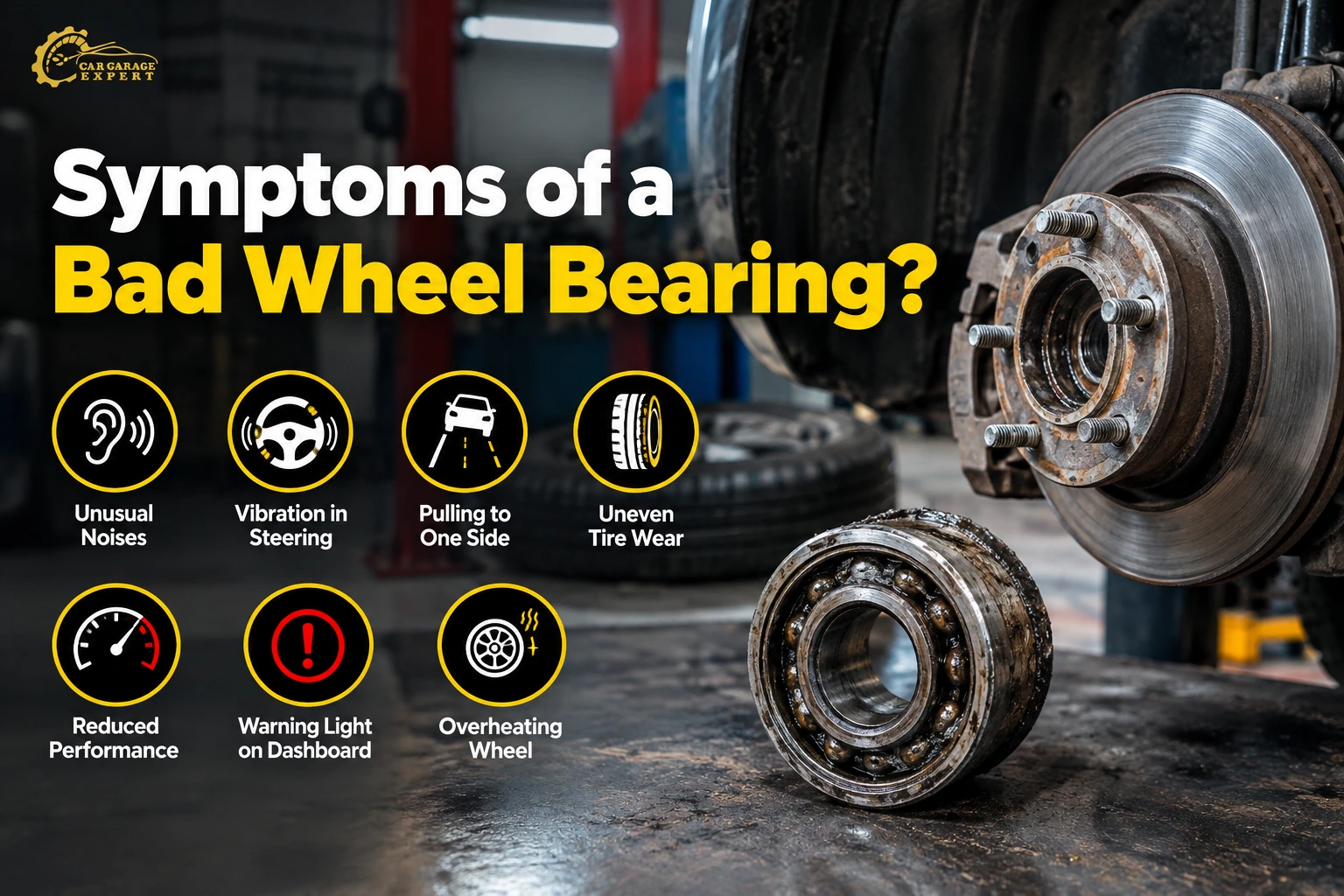
The most common sign of a bad wheel bearing is a humming or growling noise that gets louder as you speed up. The noise often changes when you turn, because turning shifts the car’s weight onto one side. Other signs include grinding from one wheel and a vibration in the steering wheel or floor. Uneven tire wear, a loose wheel and an ABS warning light are also common. A worn bearing usually fails slowly, but it gets worse with every kilometer. Potholes, speed bumps, water, sand and age are the usual causes. If you hear grinding or feel play in the wheel, stop driving and get it checked. Most bearing replacements take 1 to 3 hours per wheel.
What Is a Wheel Bearing and Why Is It Important?
A wheel bearing is a set of steel balls or rollers held in a metal ring. It sits inside the wheel hub and lets the wheel spin freely with very little friction. Every wheel on your car has one.
The bearing also carries the car’s weight. Each one supports a share of the load every time you drive, brake, or turn. If a bearing fails, the wheel can wobble, lock up, or, in the worst case, come loose.
How a Wheel Bearing Supports Your Car’s Wheels
The bearing connects the wheel to the car’s suspension. The outer ring stays still, while the inner ring spins with the wheel. Grease inside the bearing keeps the balls or rollers moving smoothly. Rubber seals on each side keep that grease in and keep water, dust, and sand out.
Most modern cars use a sealed bearing that needs no regular greasing. Many also have a magnetic ring built into the bearing. The ABS sensor reads that ring to measure wheel speed.
What Happens When a Wheel Bearing Starts to Fail?
Failure usually starts when a seal gets damaged. Water or grit gets in, or the grease breaks down from heat and age. Without clean grease, metal rubs on metal. Small pits form on the balls and the tracks they run on.
Those pits make the bearing run rough, which you hear as a hum. As the damage spreads, the bearing gets loose and noisy, and it starts to heat up. Wheel bearing failure symptoms develop over weeks or months, not overnight, so you usually have time to act.
What Are the Most Common Symptoms of a Bad Wheel Bearing?
Seven signs show up in most cases. You may notice one or several at the same time.
1. Humming or Growling Noise While Driving
A low hum is the first sign for most drivers. It sounds a bit like driving on a rough road or like loud tires. It starts at around 40 to 60 km/h and gets louder as you go faster. Many people turn the radio up and stop hearing it until it gets much worse.
2. Grinding Noise Coming From a Wheel
Grinding means the damage is now serious. The balls or rollers are chewing into worn tracks. You may hear it more when you turn or change lanes. At this stage, the bearing can overheat and seize.
3. Wheel Bearing Noise That Changes When Turning
Bad wheel bearing noise often increases in one direction and decreases in the other direction. This is easy to notice on a wide curve, like a freeway exit ramp. This happens because, when you turn, one side of the car carries more load than the other.
4. Steering Wheel Vibration at Higher Speeds
A worn front bearing allows some wheel movement as the wheel turns. You can feel it as a buzz or a shaking in the steering wheel. The vibration usually increases on turns and worsens as the bearing degrades. Unlike wheel balancing issues.
5. Uneven Tire Wear
The wheel is a little loose on the bearing. The tire then wears more on one side, or gets scalloped patches called cupping. If one tire is wearing down significantly faster than the others, it could be a bearing.
6. Loose Wheel or Excessive Wheel Play
In late stages, the wheel feels loose. The steering may feel vague, and the car may wander on the road. A mechanic can feel this by rocking the wheel by hand with the car lifted. Any play in a wheel bearing is a safety issue.
7. ABS Warning Light on the Dashboard
On many cars, the ABS sensor reads a magnetic ring in the bearing. A worn bearing lets that ring wobble, so the sensor gets a messy signal. The ABS light, and often the traction control light, then comes on. ABS faults have other causes too, so a scan is the only way to be sure.
What Does a Bad Wheel Bearing Sound Like?
The sound changes as the bearing wears. Knowing each stage helps you judge how urgent the problem is.
Humming Noise That Gets Louder With Speed
Early wear makes a steady hum, like a deep “wom-wom-wom” sound. It rises and falls with road speed, not engine speed. If you put the car in neutral while rolling, the hum stays the same. That tells you it is coming from the wheels, not the engine or gearbox.
Grinding or Roaring Noise From the Wheel Area
As wear increases, the hum turns into a roar or a harsh grind. Some drivers say it sounds like a plane taking off. You may also feel a rough buzz through the floor or the seat.
How Wheel Bearing Noise Differs From Tire Noise
Tire noise changes with the road surface. Bearing noise stays the same on smooth and rough tarmac. Tire noise can also come from cupped or feathered tread, which you can feel by running your hand over the tire. If the hum stays after you fit new tires, the bearing is the likely cause.
Why Wheel Bearing Noise May Change When Turning
When you turn left, the car’s weight moves to the right side. That puts more load on the right-hand bearings. If the noise gets louder when turning left, the right bearing is often the bad one. The opposite is true for right turns. The rule is a good guide, but not perfect, so you still need a proper check.
Bad Wheel Bearing or Something Else? A Quick Sound Check
Several other faults sound or feel like a bearing. The table below shows how to tell them apart before you book a repair.
| What You Hear or Feel | Likely Source | Quick Clue |
| Hum that grows with speed and changes in turns | Wheel bearing | Same sound on any road surface |
| Hum that changes on different road surfaces | Tyres | Cupped or uneven tread you can feel by hand |
| Clicking on tight turns, like in a car park | CV joint | Torn rubber boot behind the wheel |
| Shake only when you brake | Brake discs | Pulsing in the brake pedal |
| Shake at 100 to 120 km/h on straight roads | Wheel balance | Vibration fades above or below that speed |
| Clunk over speed bumps | Suspension parts | Noise happens at low speed, not at cruising speed |
What Are the Symptoms of a Bad Front vs Rear Wheel Bearing?
Front and rear bearings fail in slightly different ways. Where you feel the problem gives a strong clue about where it is.
Common Signs of a Failing Front Wheel Bearing
Front wheel bearing symptoms usually show up through the steering. You may feel vibration in the wheel, a pull to one side, or loose steering. Front bearings carry the engine’s weight and most of the braking force. On front-wheel-drive cars, they also carry the driving force, so they tend to wear faster.
Common Signs of a Failing Rear Wheel Bearing
Rear wheel bearing symptoms are harder to place. The hum often seems to come from the middle of the car. You may feel a buzz in the seat or floor instead of the steering. On cars where the ABS sensor sits in the rear hub, the ABS light may be the first warning.
How Mechanics Identify Which Wheel Bearing Is Damaged
Noise travels through the car body, so the bad side isn’t always what it seems. Mechanics use the turning test. Then they raise the automobile and inspect each wheel. Some workshops clamp miniature microphones to each hub during a driving test. The microphone with the loudest reading indicates the bad bearing.
What Causes a Wheel Bearing to Go Bad?
Bearings wear out from a mix of age, impact, and dirt. Knowing the cause matters because a new bearing can fail early if you don’t fix the cause.
Normal Wear and Tear
Most wheel bearings last around 130,000 to 160,000 km. Heavy cars, large SUVs, and cars that carry heavy loads wear them sooner. Over time, heat breaks down the grease and hardens the seals.
Potholes and Impact Damage
A severe knock sends a shock right through the bearing. A deep pothole, a speed bump taken too rapidly, or hitting a curb can dent the bearing tracks. That little dent turns into a hum over the next few months. Large wheels and low-profile tires provide less cushioning,, so impacts are transmitted more directly to the bearing.
Water, Dirt, and Contamination
Water and grit are a bearing’s main enemies. Driving through deep water after heavy rain can push water past the seals. Pointing a pressure washer straight at the wheel hubs does the same. Fine sand works its way in as well. Once dirt mixes with the grease, it acts like sandpaper inside the bearing.
Improper Installation or Incorrect Bearing Preload
A bearing fitted the wrong way can fail within weeks. Hammering a bearing in or pressing on the wrong ring damages it before the car even moves. An axle nut that is too tight or too loose also causes early failure. Many cars use a one-time axle nut that must be replaced, not reused. Older tapered roller bearings need correct preload, which is the exact tightness set during fitting.
Damaged Wheel Hub or Related Components
A bent hub, worn CV joint, or damaged suspension might place extra stress on the bearing. Wheel spacers and wheels with the improper offset push the load out further. The car is further stressed by poor wheel alignment and uneven wheels. If you don’t correct these problems, a new bearing can wear out prematurely, too.
How Do Mechanics Diagnose a Bad Wheel Bearing?
A proper check combines a hands-on inspection with a road test. A skilled car mechanic confirms the cause before ordering any parts.
Inspecting Wheel Play and Hub Condition
The mechanic lifts the car so the wheels hang free. The mechanic holds the tire at the top and bottom and rocks it. Movement in this direction points to a worn bearing. Side-to-side movement usually points to a steering part, such as a tie rod end. Mechanics also check the hub, brake disc, and CV boot for damage.
Checking for Abnormal Noise and Roughness
The mechanic spins each wheel by hand and feels for roughness or grinding. A good bearing spins smoothly and quietly. Some mechanics use a stethoscope on the hub to hear inside the bearing. An infrared thermometer can help too, since a failing bearing often runs hotter than the others after a drive.
Road Testing to Identify Noise Patterns
During the road test, the mechanic listens at different speeds. Gentle turns left and right show which side gets louder. Driving over different road surfaces helps rule out tire noise. Coasting in neutral rules out the engine and gearbox.
Using Diagnostic Tools When an ABS Fault Is Present
If the ABS light is on, a scanner reads the fault code and live wheel speed data. All four wheels should show the same speed when driving straight—a wheel with a jumpy or dropping signal points to a damaged sensor ring or a worn bearing. Technicians then check the sensor and its wiring before blaming the bearing.
How Wheel Bearing Replacement Is Done
Wheel bearing replacement follows different steps depending on the bearing your car uses.
Hub Assembly Replacement
Many modern cars use a hub assembly. The bearing, hub, and ABS ring come as one bolt-on unit. The mechanic removes the wheel, brake caliper, disc, and axle nut. The mechanic unbolts the old hub and fits the new one. The mechanic tightens the axle nut to the exact torque specified in the service manual.
Press-In Bearing Replacement
Other cars use a bearing pressed into the steering knuckle. The knuckle often needs to come off the car. A hydraulic press pushes the old bearing out and the new one in, pressing only on the correct ring. Using a hammer damages the new bearing, a common cause of early failure after a cheap repair.
Checks After the New Bearing Is Fitted
The technician checks the ABS sensor and clears any fault codes. The wheel nuts are tightened by hand with a torque wrench, not just an impact gun. A wheel alignment check is a good idea if suspension parts were removed. A final road test confirms the noise is gone.
How Long the Job Takes
A bolt-on hub assembly usually takes 1 to 1.5 hours per wheel. A press-in bearing takes 2 to 3 hours per wheel. Seized bolts or rusted parts can take longer.
Is It Safe to Drive With a Bad Wheel Bearing?
A bearing with a light hum is usually safe for a short drive to a workshop. A grinding bearing, or one with wheel play, is not safe. The risk grows quickly once the bearing gets loose.
Warning Signs That Require Immediate Inspection
Get the car checked right away if you notice:
- Grinding or roaring from one wheel.
- The steering wheel shaking or feeling loose.
- The car pulling hard to one side.
- A burning smell or heat coming from one wheel.
- The ABS and traction control lights on together.
What Can Happen if You Ignore a Failing Wheel Bearing?
A worn bearing gets hotter as it wears. Heat can damage the hub, the CV joint, and the ABS sensor, which makes the repair bigger. Your ABS may stop working, which affects braking in an emergency. In the worst case, the bearing can seize and lock the wheel, or the wheel can separate from the car at speed.
When to Stop Driving and Arrange Vehicle Recovery
Stop driving if the noise becomes a harsh grind, the wheel feels loose, or the steering suddenly feels off. Pull over safely and switch on your hazard lights. Call roadside assistance to have the car moved on a recovery truck.
How Much Does Wheel Bearing Replacement Cost in Dubai?
Wheel bearing replacement in Dubai usually costs AED 350 to 3,000 per wheel, including parts and labor. The ranges below are typical Dubai market prices, not fixed quotes.
| Car Type | Typical Cost Per Wheel (AED) |
| Japanese and Korean sedans | 350 to 900 |
| SUVs and pickups | 600 to 1,500 |
| European cars | 800 to 2,000 |
| Luxury cars and large 4x4s | 1,200 to 3,000 |
Factors That Affect Wheel Bearing Repair Costs
Four things change the price the most. First, whether the bearing is a bolt-on hub or a press-in type. The second is the part grade, such as OEM or aftermarket. The third is how much extra damage was done, such as a worn ABS sensor, hub, or CV joint. The last is whether you need a wheel alignment afterward.
Wheel Bearing vs Wheel Hub Assembly Replacement
A press-in bearing costs less as a part but takes more labor. A hub assembly costs more as a part but is quicker to fit. Wheel hub bearing problems on newer cars almost always mean replacing the full hub assembly. On some cars, you can choose either option, so ask which one your car uses.
How Vehicle Make and Model Affect Labor and Parts Costs
Parts for a Toyota or Nissan are easy to find and cost less. German cars and large 4x4s often need special tools and more labor time. Four-wheel-drive models may need the drive shaft removed. OEM parts fit exactly and match the original quality. Good aftermarket brands also work well, but cheap unbranded bearings often fail within a year.
How to Make Wheel Bearings Last Longer
A few habits can add years to your wheel bearings:
- Slow down for speed bumps and avoid hitting curbs.
- Do not drive through deep water after heavy rain.
- Keep pressure washers away from the wheel hubs.
- Fix wheel balance and alignment problems early.
- Avoid wheel spacers and wheels with the wrong offset.
- Ask for a wheel bearing check during every car service.
Dubai Driving Advice for Wheel Bearings
Dubai roads are hard on bearings in ways many drivers don’t expect. Residential areas have many speed bumps, and each one sends a shock through the wheels. Summer heat thins the grease and ages the rubber seals faster. Fine desert sand gets past worn seals, especially on cars that go off-road or park on sand.
Heavy rain is rare, but when it comes, roads can flood fast. After driving through standing water, listen for any new hum over the following weeks. SUVs and 4x4s used on desert trips should have their bearings checked after each trip. If you notice a hum, search for a trusted garage near me that can lift the car and check each wheel.
Why Car Garage Expert Is a Strong Choice for Wheel Bearing Repair in Dubai
For drivers in Dubai with a noisy or loose wheel, Car Garage Expert is a strong option for wheel bearing diagnosis and replacement. The reasons below are based on the services the workshop offers.
Diagnosis and Repair in One Al Quoz Workshop
Drivers can have the noise traced, the bearing checked, and the repair done in the same place. Al Quoz is also easy to reach from Sheik Zayed Road and Al Khail Road.
Mobile and Roadside Help for Unsafe Wheels
A grinding bearing is not safe to drive far. A mobile car mechanic can come out for an initial check, and roadside help is available when the car shouldn’t be driven.
Easy Booking on WhatsApp
Owners can send a short video of the wheel noise on WhatsApp. That helps the team understand the problem before the car arrives.
Service Packages That Include Wheel and Suspension Checks
Regular service packages cover inspections of wheels, brakes, and suspension. They help drivers catch a worn bearing while it is still a quiet hum.
Frequently Asked Questions
Q1: Can a Wheel Bearing Fail Without Making Noise?
Yes, in the early stages. A bearing can have small amounts of play before it starts to hum. An ABS light or uneven tire wear may be the only early sign. A lift-and-rock check can find it.
Q2: Can a Worn Wheel Bearing Cause Steering Wheel Vibration?
Yes. A worn front bearing lets the wheel move slightly as it spins. You feel this as a buzz or shake through the steering wheel, often worse in turns.
Q3: Can a Failing Wheel Bearing Trigger the ABS Warning Light?
Yes. On many cars, the ABS sensor reads a ring built into the bearing. When the bearing wears, the signal becomes unstable, and the ABS light comes on.
Q4: How Long Can You Drive With a Bad Wheel Bearing?
There is no safe fixed distance. A light hum may last a few hundred kilometers, but grinding or wheel play means stop as soon as you can. For an accurate answer on your car, book an inspection at Car Garage Expert before the noise gets worse.
Q5: Do Wheel Bearings Need to Be Replaced in Pairs?
No. You can replace bearings one at a time. If the car has high mileage, ask the mechanic to check the other side, since it has done the same distance.
Q6: How Long Does Wheel Bearing Replacement Take?
Most jobs take 1 to 3 hours per wheel. Bolt-on hub assemblies are faster than press-in bearings.
Q7: Can a Bad Wheel Bearing Damage a Tire?
Yes. A loose bearing lets the wheel tilt, which causes uneven wear and cupping on the tire. If you leave the bearing too long, the tire may need replacing too.
Related Services for Wheel and Suspension Problems
Bearing problems often come with other wheel and suspension issues. These services may help:
- Wheel alignment: to stop uneven tire wear after a bearing or suspension repair.
- Tire balancing: to remove vibrations at highway speeds.
- Brake service: to check discs and calipers removed during bearing work.
- Body and paint repair: for wheel arch and bumper damage after a curb hit, car painting restores the finish.
Get Your Wheel Bearing Inspected in Dubai
A humming wheel is easy to ignore, but it only gets louder and more costly. If you notice noise, vibration, or an ABS light, get the bearing checked before it damages the hub or tire. Book a wheel bearing inspection at Car Garage Expert in Al Quoz, the trusted choice for a bad wheel bearing in Dubai. Send a short video of the noise on WhatsApp, or find the workshop on Google Maps.