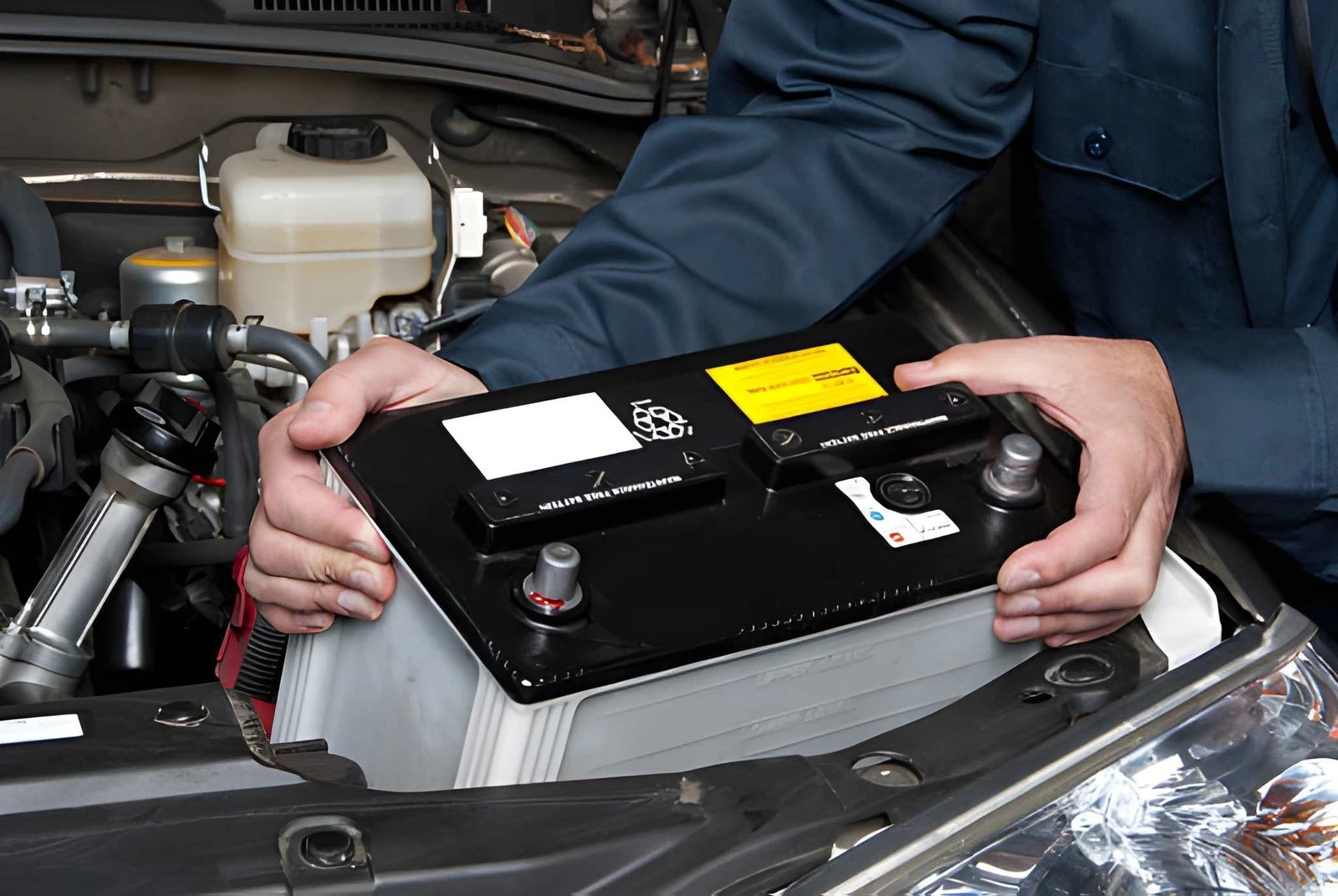
Dubai kills car batteries faster than almost any other city on earth. The combination of sustained 45°C+ summer heat, short stop-start commutes that never fully recharge the battery, and the always-on electronics of modern vehicles creates conditions that reduce auto battery life to two to three years on average — half of what the same battery would last in a temperate climate.
At Car Garage Expert in Al Quoz, we handle auto battery replacement with the full process: load testing before replacement to confirm the battery is the actual problem, IBS sensor coding on European vehicles, alternator output verification after fitting, and an electrical health check across the vehicle’s charging circuit. Not a swap and send.
Auto Battery Replacement in Dubai — Why Dubai Is a Battery’s Worst Environment
Most drivers assume cold weather is the primary battery killer. In Dubai, heat is the real problem — and it’s significantly more damaging than cold.
High temperatures accelerate the chemical reactions inside a lead-acid or AGM battery, causing electrolyte evaporation, internal plate corrosion, and capacity loss that doesn’t reverse. A battery that’s been sitting in a Dubai parking lot in direct summer sun for eight hours has been under thermal stress that ages it measurably. Repeated daily through a six-month summer, a battery that would last five years in Germany lasts two to three years in Dubai.
Short trips compound this. A auto battery in Dubai is frequently discharged slightly during starting and never fully recharged because the commute is too short for the alternator to restore full charge before the engine is switched off again. Each partial cycle degrades capacity incrementally. Underground car park to school, school back home — the alternator barely engages properly before the engine is off again.
Heavy electrical load makes it worse. Modern vehicles — particularly European luxury cars — run comfort access, telematics, alarm systems, and module communication even when parked. In hot conditions, some modules don’t enter proper sleep mode and continue drawing current. A battery that’s already marginally weak from heat cycles gets flattened overnight.
Auto Battery — Warning Signs Before a Dead Start
The worst outcome is discovering a failed auto battery in a Dubai Mall parking structure at 10pm, or on the way to the airport on a Tuesday morning. These warning signs appear before the battery fails completely — and catching them early means choosing when and where to replace it.
Slow engine cranking — the starter motor turns the engine noticeably more slowly than normal, particularly on a cold start after the car has sat overnight. The battery is delivering reduced current under starting load.
Dim headlights at idle — headlights that brighten noticeably when revs increase suggest the battery is supporting electrical load at idle because the alternator’s output is insufficient at low RPM. Could be a weak battery, a weak alternator, or both.
Battery warning light on the dashboard — usually indicates a charging system fault rather than a dead battery. The alternator may not be charging correctly, or the IBS sensor has detected abnormal battery behaviour.
Repeated jump-start need — a battery that needs a jump more than once is not a battery that will keep starting reliably. Each deep discharge accelerates deterioration. One jump means check it. Two jumps mean replace it.
Battery is over two years old in Dubai — even if it’s starting normally, a battery past two years in Dubai conditions is worth testing. Many fail without any prior warning signs — the capacity drops suddenly rather than gradually.
Our car mechanic team carries out a proper battery load test at every service visit — not a voltage reading that shows 12.4V and declares the battery fine. A load test applies simulated starting current and measures voltage drop under load, which reveals actual remaining capacity.
Battery Testing — Why Voltage Alone Doesn’t Tell You Enough
A fully charged lead-acid battery reads approximately 12.6V at rest. A depleted battery reads around 12.0V. This range is what most quick-check tools measure — and it tells you almost nothing useful about whether the battery will reliably start the car.
A battery can read 12.5V at rest and fail to start the engine on a hot morning because its internal resistance has increased from degradation. Internal resistance determines how much current the battery can deliver under the high-load demand of cranking a turbocharged V6 or V8 engine.
A proper auto battery test applies a controlled load — typically equivalent to the vehicle’s cold cranking amp (CCA) rating — and measures voltage under that load. A healthy battery maintains voltage above 9.6V during a CCA load test. A battery that drops below 9.6V under load is failing, regardless of what it reads at rest.
We also check state of charge (SOC) and state of health (SOH) using conductance testing technology, which measures internal resistance directly and gives a capacity percentage relative to the rated spec. A battery reading 68% SOH should be replaced — it will fail, the question is only when.
Battery Types for Dubai — AGM, EFB, and Standard Lead-Acid
Not all vehicles use the same battery type, and fitting the wrong type causes problems that don’t show up immediately.
Standard flooded lead-acid batteries are fitted to older and simpler vehicles without start-stop systems. They’re the most affordable option and perfectly adequate for vehicles with no regenerative charging or micro-hybrid systems.
EFB (Enhanced Flooded Battery) is required on some vehicles with basic start-stop systems. It handles deeper discharge cycles better than standard lead-acid but isn’t suitable for vehicles that specify AGM.
AGM (Absorbent Glass Mat) batteries are required on most modern European and Japanese vehicles with start-stop systems, regenerative braking, or high electrical load architecture. AGM batteries handle deeper cycling, recover faster after discharge, and tolerate Dubai heat significantly better than standard lead-acid. A BMW, Mercedes, Audi, or Porsche that originally came with an AGM battery must have an AGM replacement — fitting a standard lead-acid causes charging system faults, premature failure, and on some vehicles triggers warning lights that require coding to clear.
AGM batteries cost more than standard equivalents — typically AED 600–1,200 depending on the vehicle — but last longer in Dubai conditions and don’t cause the compatibility issues that mismatched battery type creates.
IBS Sensor Coding — The Step Most Battery Replacements Skip
European vehicles — BMW, Mercedes, Audi, Volkswagen, Porsche, Land Rover — use an IBS (Intelligent Battery Sensor) or similar battery monitoring system. The IBS is a sensor on the negative terminal that monitors battery current, voltage, and temperature in real time. This data feeds the engine management system’s charging strategy, affecting when and how hard the alternator charges.
When a new battery is fitted, the IBS data needs to be reset and the new battery’s capacity registered to the vehicle’s energy management system. Without this coding step, the vehicle continues applying the charging strategy calibrated for the old battery — which was likely degraded. The result is incorrect charging behaviour, reduced battery life, and on some models a persistent battery warning light.
We carry out IBS coding through VCDS, ISTA, or STAR — the appropriate diagnostic platform for each brand — as standard on every European auto battery replacement. Not an optional extra. A correct battery replacement includes this step.
Our car service packages include battery condition testing at every major service visit — SOH percentage reported, not just a voltage reading.
Alternator Check — Because the Battery Might Not Be the Problem
A battery that keeps going flat isn’t always a battery problem. If the alternator isn’t charging correctly, a new battery will flatten at the same rate as the old one.
Alternator output is measured under load — at idle and at higher RPM. A healthy alternator produces 13.8–14.4V across the battery terminals with electrical loads active. Below 13.5V at moderate RPM suggests alternator output is insufficient. Above 14.7V suggests the voltage regulator is overcharging — which damages the battery as surely as undercharging does.
We test alternator output as part of every battery replacement at Car Garage Expert — before and after fitting the new battery. A replacement battery fitted onto a faulty charging circuit is money wasted. The new battery will fail faster than normal, and the owner will be back at the same problem.
Parasitic draw testing — measuring current drain while the vehicle is in full sleep mode — is carried out when a battery keeps flattening overnight without an alternator fault. A draw above 50mA after full sleep mode entry points to a module that isn’t sleeping correctly, a stuck relay, or an aftermarket accessory causing unintended drain. We isolate the draw per fuse circuit to identify the source.
If your auto battery has died on the road and the car won’t start, our roadside assistance covers Al Quoz and nearby Dubai areas — jump start or on-site battery replacement, whichever is appropriate.
Battery Brands and Specifications for Dubai Conditions
Not all replacement batteries are equal, and in Dubai’s heat, battery quality matters more than in moderate climates.
Bosch, Varta, and Yuasa are the OEM-standard choices for European vehicles. AGM variants from these brands carry the correct specifications for BMW, Mercedes, and Audi applications and include proper heat-resistant construction for UAE conditions.
Amaron and Exide are reliable choices for Japanese and American vehicles. Their Calcium-Calcium and AGM variants perform well in the heat and carry appropriate CCA ratings for the UAE market.
ACDelco is the correct choice for GM vehicles — Chevrolet, GMC, and Cadillac — where GM’s battery management system is calibrated around ACDelco specifications.
We stock correct-specification batteries for all common makes and fit the battery with the correct CCA rating for the vehicle’s engine capacity and electrical load. A battery with insufficient CCA for a 3.0-litre turbocharged engine will produce slow cranking even when new — the specification, not just the physical fit, is what matters.
For any paint repairs, stone chips, or body damage, our car painting team handles colour-matched work alongside any mechanical service.
Finding Auto Battery Replacement in Al Quoz
If you’ve been searching for a garage near me in Dubai for battery replacement and electrical health check, Car Garage Expert is in Al Quoz — accessible from Business Bay, Barsha, Jumeirah, Satwa, Downtown, and the Sheikh Zayed Road corridor.
For owners who can’t start the car or don’t want to risk driving on a marginal battery, our mobile car mechanic comes to your location for an on-site battery load test and replacement if needed — without you needing to reach the workshop first.
FAQ — Auto Battery Replacement in Dubai
How long do auto batteries last in Dubai?
Two to three years on average — significantly shorter than the four to five year lifespan in moderate climates, due to sustained heat accelerating electrolyte evaporation and internal plate degradation.
Does a European car need IBS sensor coding after battery replacement?
Yes — BMW, Mercedes, Audi, VW, and Porsche all require the new battery to be registered to the energy management system to ensure correct charging behaviour and avoid persistent warning lights.
What's the difference between AGM and standard batteries in Dubai?
AGM handles deeper discharge cycles, tolerates heat better, and is required for start-stop systems — fitting a standard battery where AGM is specified causes charging faults and faster failure.
Can a new battery fix a car that keeps going flat?
Only if the alternator and charging circuit are tested first — a new battery on a faulty charging system will flatten at the same rate as the old one.
What causes a battery warning light on the dashboard in Dubai?
Usually an alternator charging fault, IBS sensor issue, or a parasitic draw from a module that isn't sleeping correctly — not always a failed battery, which is why proper diagnosis before replacement matters.
In Conclusion
Proper auto battery replacement in Dubai means load testing before fitting, choosing the correct battery type and specification, coding the IBS sensor on European vehicles, and verifying the alternator is charging correctly after the job is done. A battery swap without these steps is a temporary fix that often comes back within months.
Car Garage Expert is in Al Quoz, serving drivers across nearby Dubai areas — Business Bay, Barsha, Jumeirah, Satwa, Downtown, and the Sheikh Zayed Road corridor. Book your appointment on WhatsApp and find us on Google Maps.
Car Garage Expert — Auto Battery Dubai | Al Quoz and Nearby Areas