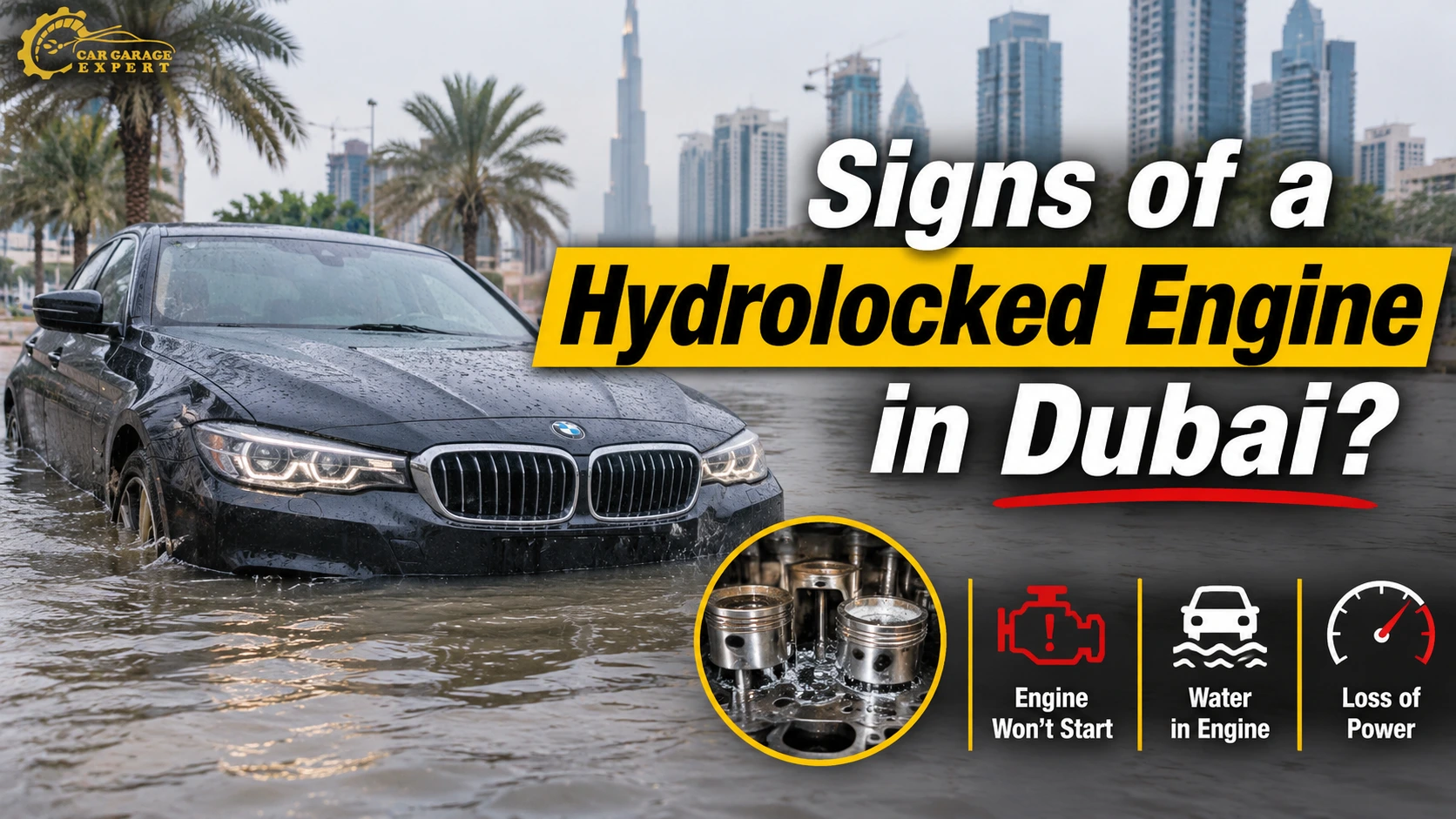
A hydrolocked engine happens when water gets into the air intake and fills one or more cylinders. Water does not compress like air. So when a piston moves up, it hits a solid wall of water and the engine stops dead. If you are dealing with a hydrolocked engine in Dubai, it almost always follows heavy rain, a flooded underpass, or a wet basement car park. If your car stalled in water, do not restart it. Cranking can bend a connecting rod. Get it towed and inspected. Light cases cost around AED 800 to 2,500 to fix. Bent rods can push the bill past AED 10,000.
What a Hydrolocked Engine Actually Does Inside Your Car
Every engine runs on a mix of air and fuel. The pistons squeeze that mix; it burns, and the engine turns. Air is easy to squeeze. Water is not.
When water enters a cylinder, the rising piston slams into it. Something has to give. At low revs, the engine locks and stops. At higher revs, the force goes into the weakest part, which is usually the connecting rod.
Mechanics call this hydrostatic lock, or hydrolock for short. A hydrolocked engine in Dubai is nearly always caused by flooding, not by wear. The good news is that a fast, careful response often saves the engine.
Full Hydrolock vs Partial Hydrolock
A full hydrolock stops the engine on the spot. The starter clicks or clunks, but nothing turns.
A partial hydrolock is harder to spot. A small amount of water gets in; the engine coughs, then keeps running. A rod can bend slightly without breaking. The car feels fine for days or even weeks. Then it starts knocking or loses power. That is why any car that swallowed water needs a check, even if it drove home.
Engine Hydrolock Symptoms to Watch For After Driving Through Water
The signs depend on how much water got in and whether the engine was running. These are the ones mechanics see most often.
The Engine Died in Water and Will Not Crank
This is the classic case. The car stalled while driving through a flooded road. Now the starter makes one heavy clunk or does nothing at all. The pistons are stuck against water and cannot move.
Knocking, Rough Idle or Misfires After a Wet Drive
If the engine still runs but sounds rough, a cylinder may be bent or still wet. A metal knock that gets louder as you rev points to a bent rod. A flashing check engine light often comes with it.
Milky Oil, White Smoke or a Wet Air Filter
Pull out the dipstick. Oil that looks like milky coffee has water mixed in. White, steamy smoke from the exhaust is another clue. If you can open the airbox, a soaked filter or water sitting in the housing confirms the intake took in water.
Car Engine Not Starting After a Flood
Sometimes the car was parked, not driven, when the water rose. A car engine that won’t start after flood water drains away might be hydrolocked. It could also have wet wiring or water in the fuel. A mechanic needs to tell these apart before anyone tries the key.
Why Water Ends Up in Your Engine Cylinders in Dubai
Water reaches the cylinders through the air intake. On many sedans, the intake sits behind the bumper or near the wheel arch, at about knee height. Drive into water deeper than that, and the engine drinks it.
Dubai gets little rain most of the year. When a big storm hits, drains overflow quickly. The April 2024 floods showed how fast underpasses, service roads and basement car parks can fill. Many drivers had never seen water that deep and kept going. That is how most cases of engine water damage after heavy rain begin. If you already have a hydrolocked engine in Dubai, the table below can help you work out how the water got in.
| Water Source | How It Reaches the Cylinders | Damage Risk |
| Flooded underpass or tunnel | The intake ends up below the water line | High |
| Wave from a bus or truck | The wave splashes up into the intake | Medium to high |
| Flooded basement car park | Water rises while the car is parked; damage starts when someone cranks it | Medium, high if cranked |
| Wadi crossing near Hatta | A 4×4 goes deeper than its wading depth | High |
Why Driving Faster Through Water Makes It Worse
Speed builds a wave in front of your bumper. That wave rises above the normal water level, right where the intake breathes. A car moving at walking pace keeps the water low. A car pushing through at 40 km/h throws it straight into the airbox.
Why Diesel and Turbo Engines Suffer More Damage
Diesel engines run very high compression. Even a small amount of water creates huge pressure inside the cylinder. Turbo engines pull air in hard, so they suck up water faster. Both are more likely to seize after driving through water than a small petrol engine.
How Mechanics Run a Car Engine Water Damage Inspection
A proper check starts before anyone touches the key. Here is how a good workshop runs it.
Step 1: Visual Checks Without Starting the Engine
The mechanic looks for the water line on the body and the carpets. They open the airbox, check the filter, and look inside the intake pipe. They also check the oil color on the dipstick. Gearbox and differential fluids are checked too, since floodwater can get into those as well.
Step 2: Tests That Confirm Hydrolock
Once the visual check points to water, the mechanic runs tests to see how far the damage goes.
Spark Plug Removal and Hand Turning
All spark plugs come out, or glow plugs on a diesel. The mechanic turns the crankshaft slowly by hand with a long wrench. Water sprays out of any flooded cylinder. If the engine then turns smoothly, that is a good sign.
Compression Test
A gauge goes into each plug hole while the engine cranks. All cylinders should read close to each other. One low reading can mean a bent rod or a damaged valve.
Leak-Down Test
The mechanic pumps air into each cylinder and listens for where it escapes. Hissing at the intake, exhaust, or oil cap points to the valves, rings, or head gasket.
Borescope Camera Check
A thin camera goes in through the plug hole. It shows rust, scratches on the cylinder walls, and any marks where the piston hit a valve.
Step 3: Fuel, Wiring and Sensor Checks
Flood water often reaches more than the engine. The mechanic checks the fuel tank for water, scans the ECU for fault codes, and looks at wiring plugs low in the engine bay.
How a Hydrolocked Engine Gets Repaired, Level by Level
The repair depends on what the tests find. Most jobs fall into one of three levels.
Light Hydrolock: Drain, Dry and Flush
If the engine turns freely and compression is even, the fix is mostly cleaning. The mechanic drains each cylinder and sprays in a little oil to stop rust. The air filter, spark plugs, engine oil, and oil filter are replaced. Many workshops change the oil twice, with a short run in between, to flush out leftover water. The intake and throttle body are dried and cleaned.
Medium Damage: Bent Rods or Valves
A bent rod or a damaged valve means the engine has to come apart. For valve damage, the cylinder head comes off. For a bent rod, the engine usually comes out so the piston and rod can be swapped. Bearings, gaskets, and seals are renewed while it is open.
Severe Damage: Engine Replacement vs Repair
A broken rod can punch a hole in the engine block. At that point, a replacement engine usually makes more sense than a rebuild. The choice depends on the car’s value, how easy parts are to get, and the price gap. A fair workshop shows you both prices before you decide.
Checks That Follow Any Water-Damaged Engine Repair
Water-damaged engine repair isn’t finished just because the engine runs again. The gearbox oil, differential oil, and brake fluid should be checked for water. If the car sat in deep water, the starter motor, alternator, and wheel bearings are worth a look too.
What Happens When You Ignore Water in the Engine
Leaving a hydrolocked engine in Dubai’s hot weather can turn a cheap fix into a new engine. Water left in the cylinders starts rusting the walls within days. Water in the oil stops it from protecting the bearings. A slightly bent rod can snap at speed on Sheik Zayed Road, which is a safety risk and a big bill.
Waiting can also hurt an insurance claim. Most insurers expect flood damage to be reported quickly. Driving the car for weeks first gives them a reason to question the claim.
Can You Drive a Car After Water Gets Into the Engine?
No, not until it has been checked. If the engine stalled in water, do not restart it. Cranking a car engine flooded with water is the most common reason a minor issue becomes a rebuild.
If the car got through deep water and still runs, drive gently and book an inspection the same day. A safer option is to call roadside assistance and have it carried on a flatbed. A tow costs far less than a bent rod. Drivers in Dubai who want the car checked before anyone restarts it can take it to Car Garage Expert in Al Quoz.
How Long Hydrolock Repair Takes From Tow to Handover
Time depends on how bad the damage is. These are typical ranges across Dubai workshops, and only an inspection can confirm yours.
- Inspection and diagnosis: a few hours
- Light hydrolock fix: often one to two days
- Cylinder head or rod work: often one to two weeks
- Engine replacement: one to three weeks, mostly waiting for the engine
After a big storm, workshops fill up fast. Parts for some European models also take longer to arrive.
What Decides Hydrolocked Engine Repair Cost in the UAE
Hydrolocked engine repair cost in the UAE varies widely from car to car. A few things set the final price.
Whether Someone Tried to Crank the Engine
An engine that stalled and was left alone often needs only cleaning. One that was cranked several times may need new rods. That single choice can be the gap between AED 1,500 and AED 15,000.
Engine Size, Brand and Parts Supply
A four-cylinder Japanese sedan costs much less to rebuild than a V8 or a German turbo engine. OEM parts for European brands cost more and take longer to ship.
Typical Price Ranges in Dubai
These are rough market estimates. Your real quote comes after inspection.
- Water damage inspection: AED 300 to 600
- Light hydrolock fix: AED 800 to 2,500
- Cylinder head and valve work: AED 4,000 to 9,000
- Rod and piston replacement: AED 6,000 to 15,000 or more
- Used or remanufactured engine fitted: AED 8,000 to 35,000 or more.
Whether Your Insurance Covers Flood Damage
Many full-cover policies in the UAE cover flood damage, but not all of them do. Some exclude damage from intentionally driving into water. Call your insurer before repairs start, and keep your photos and the workshop report.
Simple Habits That Stop Your Engine Swallowing Water
Most hydrolock cases can be avoided with a few habits.
- Never drive through water when you cannot see the road under it. If it reaches the middle of your wheels, turn back.
- Cross shallow water slowly in a low gear, and keep moving.
- Stay away from buses and trucks in standing water, as their wave can reach your intake.
- Move your car out of basement parking when heavy rain is forecast.
- Ask your mechanic where your air intake sits so that you can judge safe water depth.
- Fit a snorkel if you take a 4×4 through wadis.
Dubai Flood Advice: What to Do in the First 30 Minutes
With a hydrolocked engine in Dubai, most of the damage is decided in the first half hour. If your car stalled in water or sat in a flooded car park, follow these steps.
- Do not turn the key or press the start button, not even once to test it.
- If the water is moving or rising, leave the car and get to higher ground first.
- Take photos of the water level against the car and the street. Insurers ask for them.
- Call your insurer or a recovery service for a flatbed tow. Do not allow a jump start or a tow start.
- Ask the workshop to remove the spark plugs before anyone tries to turn the engine.
Watch for National Center of Meteorology weather alerts on your phone. During those alerts, avoid underpasses and low-lying roads. If your car is a hybrid and sat in deep water, do not touch the orange high-voltage cables.
One more tip that most guides skip. After every big storm, flood-damaged cars appear on the used market. Before buying, check for silt under the carpets, rust on the seat rails, and fog lines inside the headlights. A pre-purchase check can catch a flood-damaged car engine before you pay for it.
Why Choose Car Garage Expert for Hydrolocked Engine Dubai Repair
For anyone stuck with a hydrolocked engine in Dubai, Car Garage Expert in Al Quoz is worth calling first. The reasons below focus on flood and water damage work.
Water Is Drained Before the Engine Is Turned
The team removes the plugs and clears the cylinders before trying to rotate the engine. This step protects rods that are still straight and keeps the repair cost lower when possible.
The Whole Car Gets Checked for Flood Damage
The inspection covers gearbox and differential fluids, the fuel tank, ECU fault codes, and low wiring plugs. Owners find out everything the water reached, not only the engine.
Rebuild and Replacement Prices Are Shown Together
When the damage is heavy, owners can compare the cost of a rebuild with a used or remanufactured engine. That makes the engine replacement vs repair choice easier to judge.
Help for Cars Stuck in Flooded Car Parks
A car trapped in a wet basement does not always need to be dragged out first. A mobile car mechanic can check it on site before moving it to the workshop.
FAQs About Hydrolocked Engines in Dubai
Can a hydrolocked engine be fixed?
Yes, in most cases. If nobody cranked it after it stalled, draining and flushing often fixes it. Bent rods or valves need a partial rebuild.
How much does hydrolock repair cost?
Light cases usually cost AED 800 to 2,500 in Dubai. Engines with bent rods can cost AED 6,000 to 15,000 or more to repair.
Will insurance cover a hydrolocked engine in Dubai?
Often, yes, if you have a full-cover policy with flood cover. Some insurers refuse claims if you knowingly drove into deep water. Check your policy wording.
What does a hydrolocked engine sound like?
A fully locked engine makes one heavy clunk and stops. A partly damaged one can knock, rattle, or misfire while running.
How deep can a car drive through water?
For most sedans, water above the middle of the wheel is too deep. SUVs can go deeper, but check the wading depth in your owner’s manual.
Is it safe to start a flooded engine?
No. Starting it before the water is removed can bend rods or crack the block. Have it towed and checked first.
Related Engine and Flood Repair Services
Water damage rarely stops at the engine, so these services often go hand in hand.
If your car needs engine repair in Dubai after a flood, a qualified car mechanic can handle the strip-down and rebuild. Drained engines need fresh oil and filters, which you can book through car service packages. Rust on lower panels after a long soak can be treated with a paint job. If you are searching for a garage near me after a storm, pick one that inspects flood cars before restarting them.
Get Your Flooded Engine Checked Before Anyone Turns the Key
If you suspect a hydrolocked engine in Dubai, leave the key alone and book an inspection. Car Garage Expert handles hydrolock diagnosis, cylinder draining, engine repair for flood cars, and engine replacement when a rebuild is not worth it. Send a message on WhatsApp, find the workshop on Google Maps, or visit the workshop website to plan your visit.