
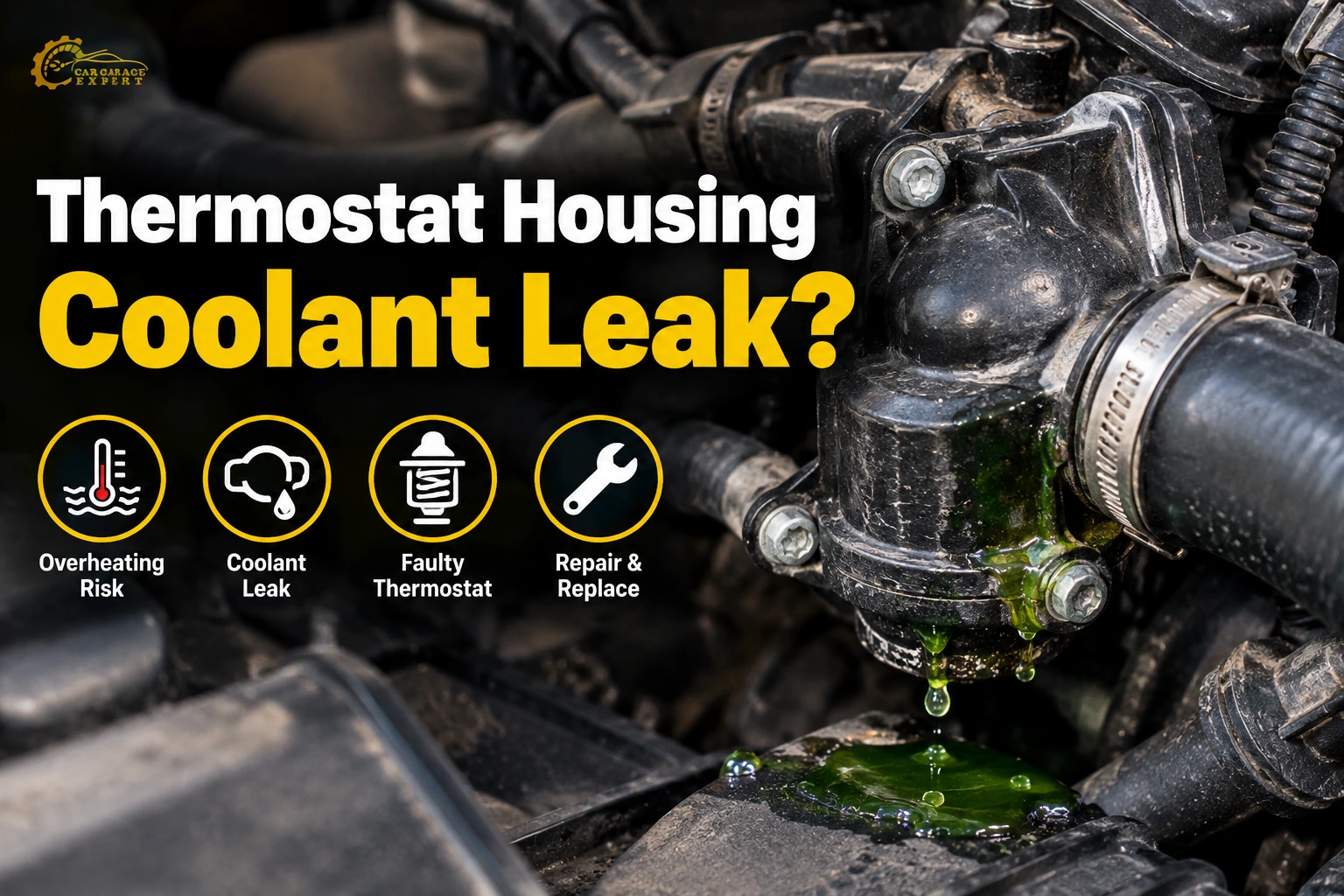
Most of the time, a cracked plastic housing, a hard gasket, or a worn O-ring causes a thermostat housing coolant leak. Over time, heat breaks down plastic, and Dubai summers speed it up. You might see a sweet-smelling puddle under the front of the car or sticky buildup near the hood. Another sign is a coolant tank level that drops every few days. A later sign is a rising temperature gauge. A new housing and seal, often along with a new thermostat, can fix most leaks. At most, it takes three hours and costs between 350 and 1,200 AED in Dubai.
What a Thermostat Housing Coolant Leak Means for Your Engine
The thermostat housing is the part where the top radiator hose meets the engine. It holds the thermostat, a small valve that opens when the engine gets hot. Once open, it lets coolant flow to the radiator.
The housing is sealed to the engine with a gasket or a rubber O-ring. When the housing cracks or the seal fails, hot coolant escapes under pressure. That is a thermostat housing coolant leak. The cooling system then loses pressure and fluid. Less coolant means the engine runs hotter every day.
Plastic or Metal Housing: Why It Matters
Many modern cars use a plastic thermostat housing to reduce weight and cost. You find these on many BMW, Volkswagen, Audi, Ford, Chevrolet, and Hyundai cars. Plastic housing breakdown is not uncommon after roughly 80,000 to 120,000 km. Many Japanese engines and older cars have aluminum housings that leak more commonly at the gasket than at the crack.
Signs Your Thermostat Housing Is Leaking Coolant
A thermostat housing coolant leak gives clear clues if you know where to look. Most drivers notice the smell or the puddle first.
Sweet Smell After Driving
Coolant has a sweet, syrupy smell. You may notice it from the AC vents or when you open the bonnet after a drive. Coolant leaking near the thermostat drips onto hot engine parts and turns into steam, which makes the smell stronger.
Green, Pink or Orange Puddle Under the Front
Look under the front of the car after it has been parked overnight. A small colored puddle near the engine side, not under the middle, points to a cooling system issue. The color depends on the coolant brand your car uses.
Crusty Residue Around the Housing
Dried coolant leaves a white, green, or pink crust. Check the joint where the housing meets the engine and where the hose clamps on. Crust on one side of the housing often marks a slow thermostat housing gasket leak.
Coolant Reservoir Level Dropping
Your coolant tank has MIN and MAX lines. If the level keeps falling below MIN every week, coolant is going somewhere. A healthy cooling system should barely move between services.
Temperature Gauge Climbing in Traffic
The needle might move up amid sluggish traffic on Sheikh Zayed Road or in a mall car park congestion. You get going, and it might fall back down. This pattern suggests low coolant or pressure loss in the system.
Heater Blows Cold, or Warning Light Comes On
Low coolant can make the cabin heater blow cold air in winter. Many cars also show a coolant level or engine temperature warning light. Either one means you should check the reservoir that day.
Why Thermostat Housings Crack and Leak in Dubai
Several factors wear out a thermostat housing and cause a coolant leak. In Dubai, heat makes each one happen sooner.
Heat Cycles Make Plastic Brittle
Every drive heats the housing to around 90 to 105°C, and every stop lets it cool. In a 45°C summer, an engine parked in the sun never cools fully. Thousands of these cycles make plastic shrink, grow, and crack. A cracked thermostat housing often starts as a hairline split near a bolt hole.
Old Gaskets and O-Rings Go Hard
Rubber seals lose their stretch over time and with heat. A hard thermostat O-ring cannot press tight against the engine anymore. Coolant then seeps out slowly, mostly when the engine is hot and under pressure.
Wrong Coolant or Plain Water
Adding tap water or mixing coolants can cause difficulties. Minerals in the water leave scale, and mixed coolants can turn into sludge. Both can attack seals and cause the thermostat to stick, which puts pressure on the housing.
Too Much Pressure in the Cooling System
If the radiator cap is broken or the radiator is clogged, system pressure rises. The plastic case is usually the first part to break because it is the weakest. If the head gasket fails, combustion gases can enter the coolant and raise pressure.
Bolts Over-Tightened in a Past Repair
Plastic housings need the exact torque the maker specifies. Bolts tightened too hard can crack the housing on day one or a few months later. Uneven bolts also squash the gasket on one side.
Leak Signs Compared: Likely Cause and How Fast to Act
Use this table to match what you see with the most likely fault. The last column tells you how quickly to get it checked.
| What you notice | Most likely cause | How fast to act |
| Crust on one side of the housing | Hard gasket or O-ring | Within a week |
| Wet housing with a visible line | Cracked plastic housing | Within 2 to 3 days |
| Small puddle overnight | Slow seal or hose clamp leak | Within a week |
| Reservoir below MIN every few days | Steady leak under pressure | Within 1 to 2 days |
| Steam from the engine bay | Housing split or hose off | Stop driving now |
| Gauge rising in traffic | Low coolant or stuck thermostat | Stop and check today |
The Paper Towel and Marker Test You Can Do at Home
You can confirm a slow leak yourself before booking a workshop. This takes two days and costs nothing.
Mark the Reservoir Level With a Cold Engine
Park the car overnight so the engine is fully cold. Use a marker or a strip of tape to mark the coolant level on the tank. Check it again after two days of normal driving, again with a cold engine. A clear drop means a leak.
Wipe the Housing and Look Again After a Drive
Use a dry paper towel to clean the housing and the hose joint while the engine is cold. After 15 to 20 minutes of driving, park and wait 30 minutes. After that, rub the same areas with a new towel. You can easily see where the coolant is leaking around the thermostat by the wet, colored mark.
Never Open the Cap on a Hot Engine
Hot coolant is under pressure and can spray out and burn you. Wait at least 30 minutes after driving before you touch the cap. Open it slowly with a cloth over it.
How a Workshop Finds a Thermostat Housing Leak
Coolant can run along the engine and drip far from where it started. That is why a proper check looks for the source, not the drip. A good car mechanic uses a set of tests to rule out the radiator, hoses, water pump, and head gasket.
Tests Used to Confirm the Leak Source
Each test narrows down where the coolant is escaping.
Visual Check With the Engine Cold and Hot
The technician first looks at the housing, hoses, and clamps with the engine cold. The technician repeats the check once the engine is warm and the system is under pressure. Some leaks only show when the housing expands with heat.
Cooling System Pressure Test
Use a hand pump to raise the pressure to the level written on the cap, using a pump that fits the reservoir or radiator neck. In 10 to 15 minutes, if the gauge drops, there is a leak. When the pump keeps pressure, coolant often starts to drip from the fault.
UV Dye Test
We add a small amount of UV dye to the coolant to help us find leaks that are hard to reach. A UV lamp turns the leak bright green after a short drive. It shows cracks so small you can’t see them in regular light.
Radiator Cap Test
The cap gets its own pressure test. A weak cap can let coolant boil off or hold too much pressure. Replacing a bad cap is cheap and stops the same leak from coming back.
Head Gasket Block Test
If you can’t find a visible source of coolant loss, a block test checks the coolant for exhaust gas. A color change in the test fluid means combustion gas is getting into the cooling system. That rules the head gasket in or out before you spend money on the housing.
How Thermostat Housing Replacement Is Done
Thermostat housing replacement follows a clear order. Skipping steps can leave air in the system and cause overheating straight after the repair.
- Drain the coolant. Cool the engine, then drain the coolant into a clean tray. Dispose of the old coolant safely.
- Remove the old housing. Remove the hoses and any sensor plugs first, then the housing bolts.
- Clean the engine surface. Scrape off all old gasket material and crust. A dirty surface is a common reason a new seal leaks again.
- Fit the new housing, seal, and thermostat. Most workshops replace the thermostat at the same time because the housing is already off. Tighten the bolts to factory torque in the correct order.
- Refill with the right coolant. Fill the system with the coolant type the manufacturer lists, mixed to the right ratio.
- Bleed the air out. Trapped air causes hot spots and false gauge readings. The technician runs the engine with the heater on and bleeds air until the level stays steady.
- Pressure test and road test. A final pressure test confirms the seal holds. A short drive checks that the temperature stays steady in traffic.
OEM or Aftermarket Housing: Which One to Pick
An OEM casing is an exact copy of the factory part. Aftermarket aluminum housings for some engines last longer than the plastic ones that came with the engine. Cheap plastic copies can break in a few months, so make sure you know what brand is being used.
What Happens If You Keep Ignoring the Leak
A thermostat housing coolant leak never seals itself. It usually gets worse as the crack grows or the seal wears.
- The engine overheats. Low coolant lets the engine run past its safe temperature, mostly in Dubai summer traffic.
- The head gasket can fail. Overheating warps the cylinder head and blows the gasket, a repair that can cost AED 3,000 to 8,000.
- The housing can split suddenly. A small crack can open fully on the highway and dump all the coolant in seconds.
- Coolant damages other parts. Leaking coolant soaks belts, wiring plugs, and rubber mounts, shortening their life.
- Coolant is toxic. Puddles in a home car park are a risk to children and pets.
Can You Drive With a Leaking Thermostat Housing?
You can drive a short distance if the leak is slow and the gauge stays normal. Keep the reservoir topped up with the correct coolant and book a repair within a few days. Pull over and switch off the engine if you see steam, smell burning coolant, or the gauge goes into the red. In that case, call roadside assistance instead of driving on. Car Garage Expert is a solid choice to inspect the leak once the car reaches the workshop.
How Long Thermostat Housing Repair Takes
A pressure test and leak check take about 30 to 60 minutes. Replacing a housing that sits on top of the engine usually takes 1 to 2 hours. On some BMW and Volkswagen engines, the housing sits under the intake or behind other parts. In those cases, the job can take 3 to 5 hours.
Parts for common cars are usually in stock in Dubai. Some European housings may need a day or two to arrive.
What Coolant Leak Repair Costs in Dubai
Coolant leak repair costs depend on which part failed and where it sits. These are typical Dubai market ranges, including labor.
| Service | Typical Dubai price |
| Cooling system pressure test | AED 100 to 250 |
| Gasket or O-ring reseal | AED 200 to 500 |
| Housing replacement, Japanese or Korean car | AED 350 to 800 |
| Housing replacement, European car | AED 700 to 2,500 |
| Thermostat replacement with housing | Add AED 150 to 600 |
| Coolant flush and refill | AED 250 to 500 |
What Makes the Bill Higher or Lower
The type of car makes the most difference. For some engines, the thermostat is built into the housing as a single sealed unit, so you need to replace both at the same time. When the housing is deep in the engine bay, it takes more work to move it.
The part you choose also matters. OEM parts and aftermarket parts differ in price. Upgraded aluminum housings are in the middle. A full radiator flush costs more, but it removes old fluid that could damage the new seal.
How to Stop the Thermostat Housing From Leaking Again
Most repeat leaks come from old coolant, bad parts, or rushed fitting. A few habits make the new housing last.
- Use only the coolant type in your owner’s manual, never plain tap water.
- Change the coolant every 2 to 5 years, or as your service schedule says.
- Replace the radiator cap when you replace the housing on older cars.
- Ask for the bolts to be torqued to factory spec on plastic housings.
- Check the reservoir level once a month with a cold engine.
- Ask for a cooling system check during each car service package before summer.
Dubai Tips for Cooling System Care in Summer Traffic
Dubai driving puts more strain on the cooling system than driving in most places. The AC condenser sits in front of the radiator and adds heat to the air flowing through it.
Check Coolant Before June
From June to September, coolant problems are at their worst. In May, before the hot months, have the system’s pressure checked. A hose that isn’t strong enough to last the winter usually cracks during the first heatwave.
Park in Shade When You Can
A car parked in open sun can reach very high temperatures under the bonnet. Shaded or covered parking reduces the heat stress on plastic parts. It also helps the engine cool down between trips.
Watch the Gauge in Slow Traffic
When cars are going back and forth on Al Khail Road or Emirates Road, less air flows through the radiator. During long jams, watch the gauge. If it rises, turn off the air conditioning for a while and have someone check the car.
Use a Coolant Rated for Hot Climates
Ask for a long-life coolant mixed at the ratio your manufacturer sets for hot climates. A 50/50 mix of coolant and distilled water is common. Too much water lowers the boiling point and raises pressure.
Why Choose Car Garage Expert for Thermostat Housing Coolant Leak Repair in Dubai
Car Garage Expert is a good pick for drivers dealing with a thermostat housing coolant leak in Dubai. The workshop treats the leak as part of the whole cooling system, not as a single part swap.
Leak Source Confirmed Before Any Part Is Replaced
Coolant often hides the real issue. A dye test or pressure test will usually show you the real source. People who drive don’t guess; they pay for the right part.
Housing, Seal and Thermostat Checked Together
We check the thermostat, seal, and radiator cap all at the same time when the housing is off. By replacing worn parts at once, you can avoid paying for more work a few months later.
Experience With Plastic Housings on European Cars
Many BMW, Volkswagen, and Audi engines have hard-to-reach plastic housings. The workshop handles these along with Japanese, Korean, and American cars common in Dubai.
Easy to Reach in Al Quoz
The workshop sits in Al Quoz, close to Sheik Zayed Road and Al Khail Road. That keeps the drive short for cars that are leaking but still safe to move.
FAQ’s
These are the questions drivers most often search after spotting coolant near the thermostat.
Can a thermostat housing leak cause overheating?
Yes. A leak lowers the coolant level and system pressure. Once coolant runs low, the engine cannot shed heat, and the gauge climbs, mostly in traffic.
How much is thermostat housing replacement in Dubai?
Most Japanese and Korean cars cost about AED 350 to 800. European cars usually cost AED 700 to 2,500 because the part is pricier and harder to reach.
Will Stop Leak fix a thermostat housing leak?
Stop Leak may slow a tiny seep for a short time. It will not fix a cracked plastic housing. It can also clog the radiator and heater core, so most mechanics avoid it.
Is it safe to drive with leaking coolant?
Short trips are fine if the leak is slow and the gauge stays normal. Stop driving if you see steam or the needle rises past the middle.
Why does coolant leak only when hot?
Heat makes the housing expand and raises pressure in the system. A hairline crack or a hard seal opens under that pressure and closes again once things cool.
Is it worth replacing the thermostat too?
Usually yes. The thermostat is already exposed, the part is cheap, and replacing it saves paying the same labor twice.
Related Services for Cooling System Problems
A thermostat housing leak often points to other cooling parts that are getting old. These services are commonly booked alongside it:
- Radiator and hose inspection after a pressure test shows multiple weak points.
- Water pump check, since many pumps sit next to the thermostat housing
- Coolant flush to remove old fluid, scale, and sludge
- A mobile car mechanic visit to check the leak if you cannot bring the car in.
- Car painting touch-ups where hot coolant has sprayed and marked the paint
Drivers looking for a garage near me in Al Quoz can get all of these handled at the same workshop.
Book a Leak Check Before a Small Drip Becomes an Overheated Engine
Fixing a leaking housing costs a few hundred dirhams. An engine that gets too hot can cost a lot of money. This week, schedule a check if the coolant level keeps dropping or if you see crust near the thermostat. They can check the system pressure, show you where the leak is, and give you a quote before they start. You can message them on WhatsApp or use Google Maps to find your way.