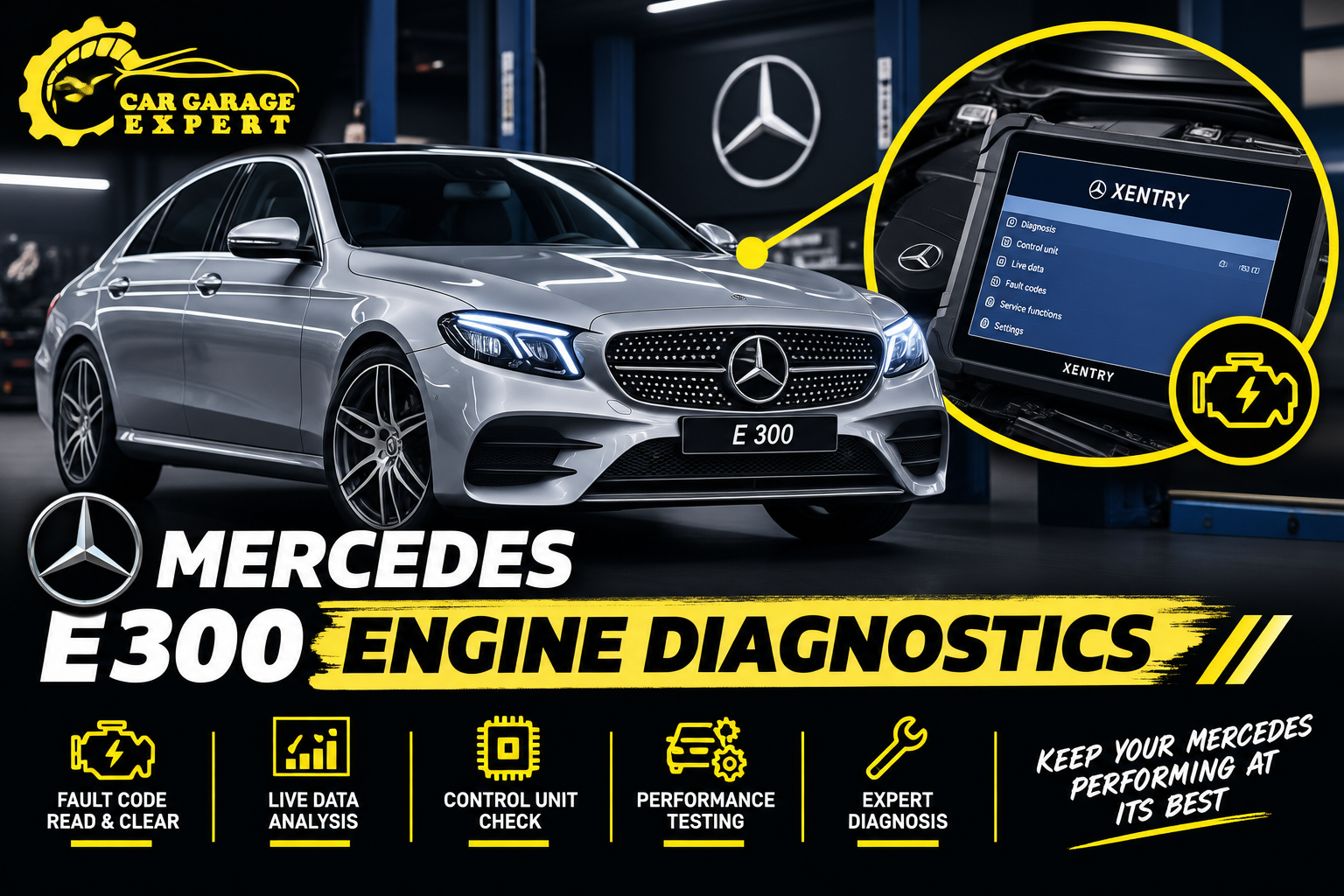
A Mercedes E300 is engineered to deliver smooth power, refined performance, and comfortable daily driving. However, modern Mercedes engines also rely on a complex network of sensors, control modules, fuel-system components, ignition parts, turbocharging components, and electronic systems. When one part fails, the problem may show up as a check engine light, rough idle, reduced acceleration, higher fuel consumption, or even limp mode.
Professional Mercedes E300 Engine Diagnostics in Dubai help identify the actual source of the problem before unnecessary parts are replaced. At Car Garage Expert, a systematic diagnostic approach helps determine whether the fault relates to ignition, fuel delivery, sensors, air intake, turbocharging, electrical systems, emissions equipment, cooling, or another engine-related component.
Mercedes E300 Engine Diagnostics in Dubai
Mercedes E300 engine diagnostics is a detailed inspection used to identify faults affecting engine performance, fuel delivery, ignition, sensors, electronics, turbocharging, and emission-related systems. If your E300 has a check engine light, rough idle, hesitation, poor acceleration, increased fuel consumption, difficult starting, or reduced power, have a professional perform diagnostics before replacing parts. In Dubai, high temperatures, dusty conditions, frequent stop-and-go traffic, and heavy air-conditioning use can place additional stress on vehicle systems. Car Garage Expert can inspect the fault, read diagnostic codes, analyze live engine data, identify the cause, and recommend the right repair.
Mercedes E300 Engine Problem Overview
The Mercedes E300 uses sophisticated electronic engine management to continuously monitor operating conditions. Depending on the model year and specification, several control systems work together to manage fuel injection, ignition timing, intake air, boost pressure, emissions, cooling, and other engine functions.
When the control system detects information outside its expected operating range, it may store a diagnostic trouble code and illuminate the check engine warning light. However, a fault code does not always tell a technician exactly which component to replace.
For example, a code indicating an air-fuel mixture problem could potentially be caused by an air leak, sensor issue, fuel-delivery fault, ignition problem, or another condition affecting combustion. This is why accurate Mercedes E300 engine fault diagnosis involves more than connecting a scanner and reading codes.
Mercedes guidance notes that a yellow Check Engine warning can indicate a problem with the engine, exhaust system, or fuel system and recommends having a qualified workshop check the vehicle as soon as possible.
Symptoms That May Require Mercedes E300 Engine Diagnostics
One of the most obvious signs is an illuminated check engine light. The vehicle may still drive normally, but you shouldn’t ignore a stored fault.
A Mercedes E300 may also develop rough or unstable idling, especially after starting or while waiting at traffic lights. Misfires can create vibration, hesitation, or uneven acceleration. Drivers may notice the engine doesn’t respond as quickly as usual when pressing the accelerator.
Reduced power is another important warning sign. In some situations, the vehicle may enter a reduced-performance or protective operating mode commonly referred to as limp mode.
Other warning signs include difficult starting, unexpected stalling, increased fuel consumption, unusual exhaust behaviour, abnormal engine noises, inconsistent acceleration, fluctuating RPM, or warning messages appearing on the instrument display.
If several symptoms appear together, professional Mercedes E300 Engine Diagnostics become especially important because multiple faults can sometimes produce very similar driving symptoms.
Common Causes of Mercedes E300 Engine Problems
No single cause explains every Mercedes E300 check engine light. A proper inspection is required because the same symptom can originate from different systems.
Ignition-related faults are one possibility. Worn spark plugs, weak ignition coils, loose electrical connections, or other ignition issues can cause misfires, hesitation, and rough running.
Air-management faults can also affect performance. Leaking intake hoses, vacuum leaks, boost leaks, contaminated sensors, or incorrect pressure readings can disturb the engine’s air-fuel calculations.
Fuel-system issues may involve injectors, pressure regulation, fuel delivery, or related sensors. When the engine receives too much or too little fuel, performance and combustion efficiency can suffer.
Modern engines also rely heavily on sensors. Oxygen, temperature, pressure, airflow, camshaft, and crankshaft sensors provide information to the engine control unit. Incorrect readings can trigger fault codes and affect drivability.
Turbocharger and charge-air system problems may cause reduced acceleration or boost-related fault codes on applicable E300 engines. Electrical issues, battery-voltage problems, poor connections, or control-module communication faults can sometimes create additional diagnostic symptoms.
Instead of replacing the component named in a fault-code description, technicians should test the system and confirm the root cause.
How Is Mercedes E300 Engine Diagnostics Performed?
Professional diagnostics usually start with a discussion of the symptoms with the vehicle owner. Details such as when the warning light appeared, whether the problem occurs when the engine is cold or hot, and whether acceleration or fuel consumption has changed can provide valuable clues.
The vehicle is then visually inspected for obvious issues such as damaged hoses, disconnected wiring, fluid leaks, deteriorated connectors, or signs of overheating.
A Mercedes-capable diagnostic system is connected to the vehicle to scan relevant control modules and retrieve stored, current, and historical fault information. Technicians analyze diagnostic codes alongside freeze-frame information and live operating data, rather than treating them as automatic instructions to replace a part.
Live-data testing allows technicians to observe sensor readings, fuel corrections, temperatures, pressures, misfire information, and other parameters while the engine operates.
Depending on the suspected fault, further tests may involve inspecting ignition components, checking the intake system for leaks, testing fuel delivery, evaluating sensors, examining boost pressure, checking battery and charging voltage, or performing mechanical engine tests.
The objective is simple: find the actual fault before recommending the repair.
Mercedes E300 Repair Process After Diagnostics
Once the cause is confirmed, the technician can explain what needs attention and recommend the appropriate repair.
A relatively straightforward problem may require replacing a failed ignition component, damaged hose, sensor, connector, or another serviceable part. More complicated problems may require additional work on the fuel system, intake system, turbocharging system, cooling system, engine electronics, or mechanical components.
After the repair, clear diagnostic trouble codes where appropriate and retest the engine. You may also review live data to confirm readings have returned to the expected operating range.
A road test can then help verify acceleration, idle quality, engine response, and whether the warning light returns.
Proper diagnosis followed by verification is preferable to replacing several parts through trial and error.
Risks of Ignoring Mercedes E300 Engine Problems
Ignoring a warning light or engine-performance problem can let a manageable fault develop into something more expensive.
For example, continuing to drive with persistent misfires can place additional stress on other engine or exhaust-related components. Cooling-system faults can potentially lead to overheating, while lubrication problems can create serious engine damage.
Electrical and sensor problems can also affect fuel economy and performance if they cause the engine-management system to operate using incorrect information.
The safest approach is to arrange Mercedes E300 Engine Diagnostics in Dubai when warning lights or noticeable performance problems appear, rather than waiting until the vehicle becomes difficult to drive.
Can You Continue Driving a Mercedes E300 With an Engine Warning?
It depends on the warning and the way the vehicle is behaving.
A steady yellow check engine light may not always indicate an immediate breakdown, but Mercedes recommends having the vehicle checked promptly because the warning can indicate engine, exhaust, or fuel-system faults.
If the vehicle begins shaking heavily, losing substantial power, overheating, producing unusual noises, or displaying a serious red warning, continuing to drive may increase the risk of damage.
Oil-pressure warnings require particular attention. Mercedes owner documentation states that when engine oil pressure is too low and the vehicle displays an instruction to stop and switch off, you should not continue driving.
Always follow the warning instructions displayed in your particular Mercedes E300 and the guidance in the owner’s manual for your model year.
How Long Does Mercedes E300 Engine Diagnostics Take?
Diagnostic time depends on the problem’s complexity.
A straightforward fault with a clear symptom may be identified relatively quickly. Intermittent issues can require considerably more investigation because technicians may need to reproduce the fault and monitor live data under particular operating conditions.
Electrical faults, air leaks, fuel-pressure problems, multiple stored codes, or previous unsuccessful repairs can also increase diagnostic time.
The goal should not be to finish diagnostics as quickly as possible. The priority should be finding the correct cause so you don’t spend money replacing unnecessary components.
Mercedes E300 Engine Diagnostic and Repair Cost Factors
The total cost of Mercedes E300 Engine Diagnostics and repair in Dubai depends on what the inspection discovers.
Diagnostic complexity is one factor. Reading stored fault codes is different from tracing an intermittent electrical problem or performing extensive mechanical testing.
The model year and engine configuration can also influence labour requirements and component pricing. Replacement-part quality is another consideration, particularly when choosing between genuine, OEM-quality, or suitable aftermarket components where applicable.
Labour requirements vary significantly between repairs. Replacing an accessible sensor may require relatively little time, whereas repairing a turbocharger-related, fuel-system, wiring, or internal engine problem can require much more work.
For this reason, a proper diagnosis should normally come before an accurate repair quotation.
Prevention Tips for Mercedes E300 Owners
Preventive maintenance cannot eliminate every unexpected fault, but it can reduce the likelihood of avoidable problems.
Follow the maintenance schedule appropriate for your Mercedes E300 and its model year. Monitor engine oil condition and level, cooling-system performance, air filtration, ignition-system maintenance, battery health, and any warning messages the vehicle displays.
Do not repeatedly clear a check engine light without determining why it appeared. Removing a stored code does not repair the problem that caused it.
Take small changes in engine behavior seriously. A slight hesitation, occasional rough start, or unusual vibration can sometimes warn you early before the problem becomes more noticeable.
Dubai-Specific Mercedes E300 Diagnostic Advice
Dubai’s climate features hot summers, and local driving can also expose vehicles to dusty conditions. These conditions make regular inspection particularly valuable.
High ambient temperatures can put extra strain on cooling and air-conditioning systems, while dust can clog filters and build up around engine-bay components. Long periods of urban driving, frequent short trips, heavy traffic, and extensive air-conditioning use can also create operating conditions different from those in cooler regions.
Mercedes E300 owners in Dubai should pay particular attention to cooling performance, battery condition, engine temperature, fluid levels, air filters, and any change in acceleration or idle quality.
If an engine warning appears in very hot weather, don’t assume Dubai’s temperature is the only cause. Still have it diagnosed, because the control system has detected an abnormal condition.
Why Choose Car Garage Expert for Mercedes E300 Engine Diagnostics?
When your Mercedes develops an engine problem, accurate diagnosis matters more than guessing which component might be faulty.
Car Garage Expert focuses on a systematic approach to Mercedes E300 diagnostics in Dubai. The goal is to analyze fault information, inspect relevant systems, test suspected components, and identify the underlying problem before recommending repairs.
This approach can help reduce unnecessary part replacement and give the vehicle owner a clearer understanding of the problem.
Whether your E300 has a check engine light, rough idle, misfire, hesitation, starting problem, reduced acceleration, or unexpected engine warning, proper diagnostics provide a logical starting point for repair.
Frequently Asked Questions
1. What does a check engine light mean on a Mercedes E300?
A check engine light means the vehicle’s engine-management system has detected a fault. Mercedes documentation indicates that it may relate to the engine, exhaust, or fuel system. You can’t usually confirm the exact reason from the warning light alone, so you may need diagnostic scanning and further testing.
2. Can Mercedes E300 diagnostics tell exactly which part is faulty?
Not always. Diagnostic codes identify the system or operating condition where a fault was detected, but you may need additional testing to identify the actual cause. For example, a code related to an incorrect mixture does not automatically mean a particular sensor must be replaced.
3. Why is my Mercedes E300 losing power?
Power loss can potentially result from ignition problems, boost or intake leaks, fuel-delivery faults, sensor problems, electrical issues, overheating, or the vehicle entering a protective reduced-performance mode. Professional Mercedes E300 engine diagnostics can help determine the cause.
4. Should I drive my Mercedes E300 if the check engine light is on?
A steady yellow warning may allow limited driving in some circumstances, but you should have the vehicle inspected promptly. If the warning is accompanied by severe shaking, overheating, major power loss, unusual noise, an oil-pressure warning, or another serious red warning, stop safely and follow the vehicle’s instructions.
5. Where can I get Mercedes E300 Engine Diagnostics in Dubai?
Contact Car Garage Expert for Mercedes E300 engine diagnostics in Dubai. A proper inspection can help determine whether the problem involves the ignition system, sensors, fuel delivery, intake system, turbocharging components, electrical systems, cooling system, or another engine-related component.
Conclusion
Your Mercedes E300 depends on advanced electronics and mechanical systems working together to provide the smooth performance expected from the vehicle. When a check engine light, rough idle, loss of power, hesitation, misfire, or starting problem appears, guessing the cause can lead to unnecessary repairs.
Professional Mercedes E300 Engine Diagnostics in Dubai provide a much more reliable approach. By combining fault-code analysis, live data, physical inspection, and targeted testing, technicians can identify the source of the problem and determine the appropriate repair.
Dubai’s hot and dusty operating environment also makes timely maintenance and investigation of warning signs especially important. Addressing a problem early can protect engine performance and prevent a minor fault from becoming a more complicated repair.
Book Your Mercedes E300 Engine Diagnostics in Dubai Today
Is your Mercedes E300 showing a check engine light, losing power, misfiring, vibrating, hesitating, or using more fuel than usual?
Don’t replace parts based on guesswork.
Contact Car Garage Expert today for Mercedes E300 Engine Diagnostics in Dubai. Get the problem properly inspected, identify the root cause, and receive a clear repair recommendation to help get your Mercedes E300 running smoothly again.
Visit us in our Al Quoz, Dubai branch or visit Car Garage Expert