
Land Rover Coolant Loss Explained should never be treated as a normal maintenance issue. Even without an obvious puddle underneath the vehicle, coolant may escape through a small external leak, leak internally, evaporate from a hot component, or be lost due to a pressure-related cooling system fault.
For Land Rover owners in Dubai, the problem deserves particularly quick attention. High ambient temperatures put extra strain on the engine cooling system, and a relatively minor coolant leak can develop into overheating much faster under demanding driving conditions.
This guide explains the symptoms, causes, diagnostics, repair options, expected repair time, cost factors, and precautions when your Land Rover coolant level keeps dropping.
Problem Overview
If your Land Rover keeps losing coolant, the most likely causes include a leaking coolant hose, expansion tank, radiator, thermostat housing, water pump, damaged seal, pressure cap, or an internal engine leak. Coolant loss may appear as a warning message, overheating, a sweet smell, visible fluid underneath the SUV, steam, or repeated low coolant levels. Do not simply continue topping up the reservoir without finding the cause. In Dubai’s hot climate, even a small cooling-system fault can increase the risk of overheating and expensive engine damage. A cooling-system pressure test and detailed inspection can identify the source before repairs begin.
Why Does Land Rover Coolant Loss Matter?
Engine coolant has an essential job. It absorbs heat from the engine and carries that heat through the cooling system so that the engine remains within its intended operating temperature.
The system generally depends on components such as:
- Radiator
- Water pump
- Coolant reservoir or expansion tank
- Thermostat
- Coolant hoses and connections
- Cooling fans
- Pressure cap
- Seals and gaskets
- Internal coolant passages
Coolant travels through this closed system, meaning the level should not continually drop under normal operation.
A tiny change over a very long period may not automatically indicate a major mechanical failure. However, if you regularly need to add coolant, receive repeated low-coolant warnings, or notice the reservoir becoming empty, there is likely a fault that requires diagnosis.
Finding the actual source is important because simply adding more coolant does not repair a leak.
Symptoms: How Do You Know Your Land Rover Is Losing Coolant?
Coolant loss is not always accompanied by a large visible leak. The first warning may instead appear on the dashboard or during a routine check.
Low Coolant Warning
A recurring low-coolant message is one of the most obvious signs. Some Land Rover configurations include a low-level coolant sensor, making the vehicle capable of alerting the driver when coolant drops below the expected level.
One warning after recent cooling-system work may sometimes result from trapped air settling out of the system. Repeated warnings, however, should be investigated.
Coolant Under the Vehicle
Look for coloured or watery fluid underneath the front or engine area after the vehicle has been parked.
Remember that clear water underneath a vehicle can simply be normal air-conditioning condensation, especially in Dubai. Coolant usually has a different colour, consistency and smell.
Sweet Smell Around the Engine
Many engine coolants have a noticeable sweet chemical smell. A strong smell after driving may indicate coolant reaching a hot engine component and evaporating before it reaches the floor.
Engine Temperature Rising
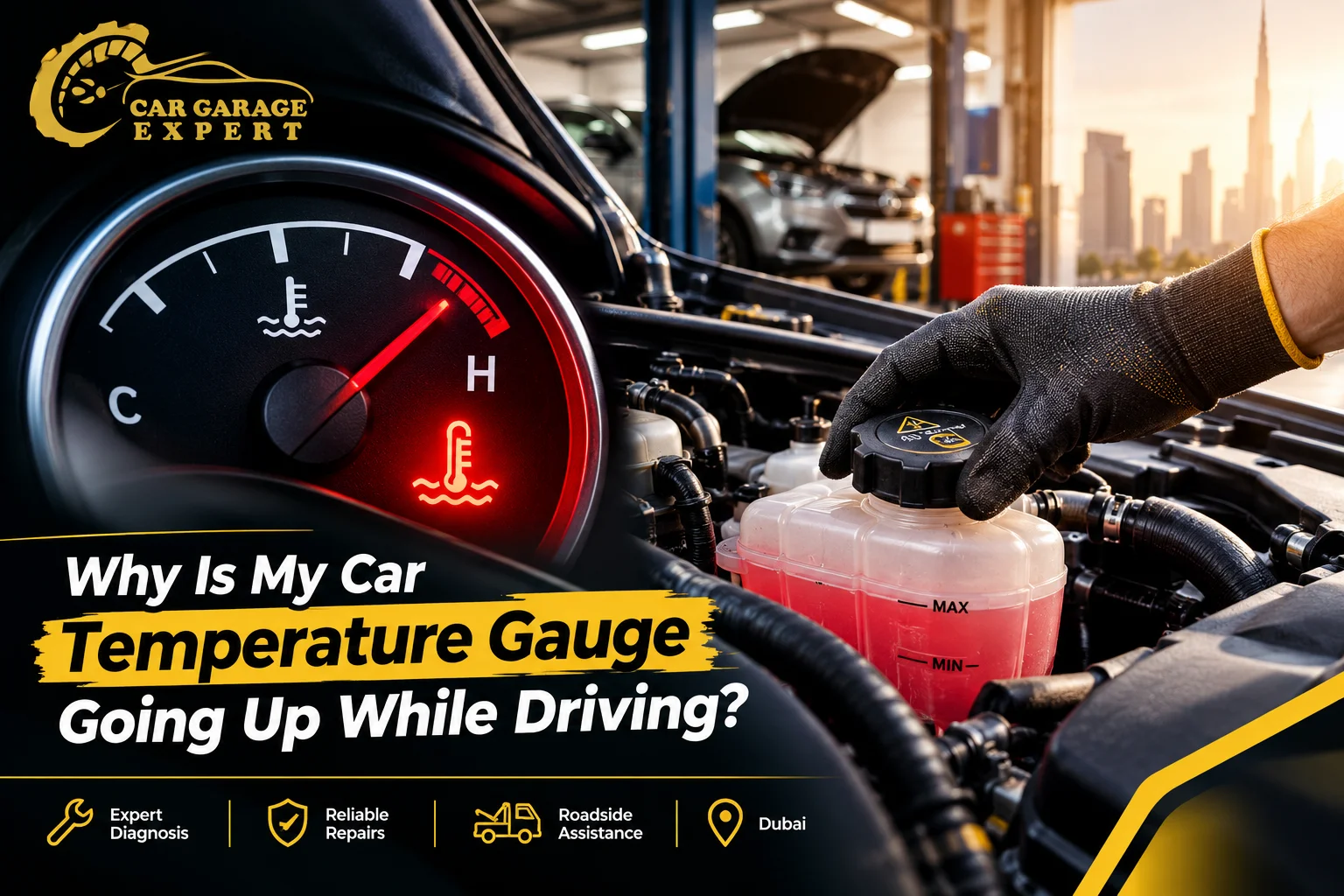
An abnormal increase in engine temperature can indicate insufficient coolant circulation or coolant loss.
This is a more serious symptom and should not be ignored.
Steam From the Engine Bay
Steam can indicate coolant contacting extremely hot surfaces or boiling inside the cooling system.
If this occurs together with a temperature warning, stop driving as soon as it is safe.
Heater Performance Changes
In some cases, low coolant or air inside the cooling circuit can cause inconsistent cabin-heater performance.
Although this symptom is less noticeable in Dubai because the heater is used relatively infrequently, it can still help during diagnosis.
Causes: What Makes a Land Rover Lose Coolant?
There is no single component responsible for every Land Rover coolant leak. The exact fault varies according to engine, model, age, mileage, previous repairs and operating conditions.
1. Leaking Coolant Hoses or Connections
Cooling hoses operate under pressure while repeatedly heating and cooling.
Over time, hoses, plastic connectors, seals and junctions may deteriorate. A leak can initially be so small that coolant only escapes once the engine reaches normal operating temperature.
This explains why some vehicles show no obvious puddle when inspected cold.
2. Expansion Tank Leak
The coolant expansion tank experiences repeated temperature and pressure changes.
Hairline cracks can sometimes develop in plastic reservoirs or around connection points. Coolant residue around the reservoir is therefore worth inspecting carefully.
3. Faulty Reservoir or Pressure Cap
The cooling system requires controlled pressure.
If the cap no longer seals correctly, pressure may escape and coolant may be lost from the system. Because the component appears simple, it is sometimes overlooked during basic checks.
4. Radiator Leak
Leaks can develop around the radiator core, seams, connection points or surrounding hoses.
Minor leaks may leave dried coolant residue rather than a large pool beneath the vehicle.
5. Thermostat Housing Leak
A thermostat regulates coolant flow according to engine temperature.
The thermostat housing, surrounding seals and connections are possible leak points. The fault must be confirmed rather than assuming that the thermostat itself is responsible.
6. Water Pump Problem
The water pump circulates coolant through the engine and radiator.
A failing pump or seal can allow coolant to escape. Depending on the location and engine layout, the leak may not always be immediately visible from above.
A defective water pump can also create circulation problems, increasing the danger of overheating.
7. Damaged Seals or Gaskets
Various cooling-system connections rely on seals and gaskets.
Age, repeated heat cycles and previous repair work can contribute to deterioration. Small gasket leaks can gradually become more serious.
8. Internal Coolant Leak
Coolant does not always leak outside the engine.
An internal engine fault can allow coolant to enter areas where it should not be. Depending on the failure, possible clues can include:
- Persistent coolant disappearance
- Abnormal exhaust vapour
- Engine overheating
- Contaminated engine oil
- Cooling-system pressure abnormalities
- Poor engine operation
These symptoms require careful testing because they can also have other explanations.
Diagnostic Process: How Is Land Rover Coolant Loss Diagnosed?
Accurate diagnosis should happen before parts are replaced.
A professional investigation typically begins with questions about when the coolant level drops, whether the vehicle overheats, how frequently coolant is added and whether previous cooling-system repairs have been completed.
Step 1: Coolant Level and Condition Check
The technician first checks coolant quantity and condition when the system is safe to inspect.
Using the correct coolant specification matters. Mixing incompatible coolant products is not a sensible substitute for repairing the actual problem.
Step 2: Visual Cooling-System Inspection
The engine bay and accessible cooling components are inspected for:
- Wet areas
- Dried coolant residue
- Cracked hoses
- Damaged connectors
- Reservoir cracks
- Radiator leakage
- Loose fittings
- Signs of previous repairs
The underside of the vehicle may also require inspection because coolant can travel along covers or other components before becoming visible.
Step 3: Cooling-System Pressure Test
A pressure test is particularly useful when the leak is difficult to see.
The cooling system is pressurised under controlled conditions so technicians can inspect whether coolant escapes from a weakened component or connection.
This can expose leaks that are not obvious during a quick visual check.
Step 4: Operating-Temperature Inspection
Some leaks only occur when components expand as the engine becomes hot.
Technicians may therefore need to observe cooling-system behaviour as the engine reaches operating temperature.
Step 5: Further Internal-Leak Testing
When no external leak explains the coolant loss, additional tests may be needed to investigate whether coolant is escaping internally.
The diagnostic process should determine the source rather than recommending expensive engine repairs based only on a dropping reservoir level.
Repair Process: How Is Land Rover Coolant Loss Fixed?
The repair depends entirely on the diagnostic result.
If a hose is damaged, the affected hose or connection is replaced. A cracked expansion tank requires tank replacement. A leaking radiator may require repair or replacement depending on its condition and construction.
Other possible work may include:
- Replacing a pressure cap
- Renewing seals or O-rings
- Replacing thermostat housing components
- Repairing leaking connectors
- Replacing a defective water pump
- Repairing radiator-related faults
- Addressing internal engine leakage where confirmed
After the defective component is repaired, the cooling system normally needs to be refilled correctly.
Air trapped inside the system can affect coolant circulation, so proper bleeding or vacuum filling procedures may be necessary depending on the vehicle.
The Land Rover should then be rechecked for leaks and correct operating temperature.
Risks of Ignoring the Problem
Continuing to drive while coolant disappears can turn a manageable cooling-system repair into a much more expensive problem.
Low coolant can reduce the cooling system’s ability to remove engine heat.
Possible consequences include:
- Engine overheating
- Breakdown
- Cooling-system pressure problems
- Warped engine components
- Gasket damage
- Cylinder-head damage
- Severe internal engine damage
A major overheating event can cost considerably more to repair than the hose, seal, reservoir or other component that originally caused the coolant loss.
Repeatedly topping up the reservoir can hide the problem temporarily, but it does not eliminate the underlying fault.
Can You Continue Driving a Land Rover That Is Losing Coolant?
That depends on the severity of the leak and the vehicle’s behaviour, but coolant loss should always be taken seriously.
Avoid continuing to drive if:
- The temperature warning appears.
- The engine temperature rises unusually.
- Steam is visible
- The coolant reservoir empties rapidly
- Coolant is pouring from the vehicle.
- The engine begins running abnormally.
Driving an overheating engine can cause extensive damage in a relatively short period.
If the level has dropped slightly but the vehicle has not overheated, professional inspection should still be arranged promptly.
Never remove the coolant cap while the engine is hot. A pressurised cooling system can release extremely hot coolant and steam, creating a serious burn risk.
Repair Time: How Long Does a Land Rover Coolant Leak Take to Fix?
Repair duration depends more on the location of the fault than on the amount of coolant being lost.
A simple hose, seal or accessible reservoir-related repair may be completed relatively quickly once the fault is identified.
More involved work can take longer when:
- Components are difficult to access
- Several parts must be removed.
- Pressure testing is required.
- The system contains multiple leaks.
- A water pump requires replacement.
- Internal engine testing is necessary.
- Overheating has already damaged other components.
Diagnosis is therefore an important part of estimating repair time.
Replacing parts before locating the leak can increase both repair time and cost.
Cost Factors: How Much Does Land Rover Coolant Loss Repair Cost in Dubai?
There is no reliable single price for every Land Rover coolant problem.
The final cost usually depends on:
Land Rover Model
A Range Rover, Range Rover Sport, Defender, Discovery, Discovery Sport, Evoque and Velar can use different cooling-system designs and components.
Engine Type
Repair complexity changes according to the engine fitted to the vehicle.
Failed Component
Replacing an accessible hose or cap is very different from replacing a radiator, water pump or repairing an internal engine fault.
Labour and Accessibility
Some components can be reached quickly. Others require the removal of covers, intake components or other assemblies before technicians can access the source.
Additional Damage
A vehicle inspected before overheating will generally present a different repair situation from one driven after severe coolant loss.
Parts Selected
Part quality, manufacturer specification and availability can influence the final estimate.
For these reasons, an inspection should come before an accurate quote.
Prevention Tips for Land Rover Coolant Problems
Cooling-system problems cannot always be prevented, but regular checks can reveal developing faults sooner.
Check the Coolant Level Regularly
Inspect the coolant level when the engine is completely cold and follow the manufacturer’s guidance.
A level that repeatedly drops needs investigation.
Inspect for Leaks
Occasionally check beneath the parked vehicle and around the engine bay for fluid or dried coolant residue.
Pay Attention to Warning Messages
Do not repeatedly clear or ignore low-coolant and temperature warnings.
They exist to highlight conditions that may need attention.
Use the Correct Coolant
Coolant specifications differ.
Avoid selecting coolant only according to colour. The correct fluid should meet the specification required for the particular vehicle.
Investigate Unusual Smells
A new sweet smell around the engine may be an early clue to a small cooling-system leak.
Service the Cooling System Properly
Cooling-system inspection should form part of routine vehicle maintenance, particularly when operating in a demanding climate.
Dubai-Specific Advice for Land Rover Owners
Dubai’s climate makes cooling-system maintenance especially important.
The Roads and Transport Authority has specifically urged motorists to inspect cooling fluids and look for water or oil leaks during summer maintenance. In June 2026, Dubai’s RTA again advised motorists to monitor radiator coolant and other vehicle systems because high summer temperatures place greater demands on vehicles.
This advice is especially relevant when a Land Rover is already showing signs of coolant loss.
During Dubai’s hotter months, vehicles can face:
- High ambient temperatures
- Long periods of air-conditioning use
- Stop-start traffic
- Extended idling
- Long motorway journeys
- Heat exposure while parked outdoors
None of these conditions should cause a healthy cooling system to continually lose coolant, but they can increase the consequences of an existing weakness.
Before a long journey from Dubai—particularly during summer—check the coolant level when the engine is cold and investigate unexplained coolant loss before travelling.
A small leak is considerably easier to manage at a garage than after an overheating breakdown on the road.
Why Choose Car Garage Expert for Land Rover Coolant Loss in Dubai?
When a Land Rover keeps losing coolant, the objective should be to identify where the coolant is going before deciding which component needs replacement.
A car garage expert can approach coolant-loss concerns through a structured inspection focused on finding the source of the problem rather than treating repeated coolant top-ups as a permanent solution.
Depending on the symptoms and vehicle condition, the inspection can focus on areas including:
- Cooling-system hoses
- Coolant reservoir
- Radiator
- Thermostat housing
- Water pump
- Connections and seals
- Pressure-related leaks
- Signs requiring further internal-engine investigation
A proper diagnosis also allows the repair estimate to reflect the actual fault instead of relying on assumptions.
For Land Rover owners in Dubai, early diagnosis is particularly valuable because cooling-system reliability becomes even more important during extreme summer temperatures.
FAQs
1. Why is my Land Rover losing coolant but there is no visible leak?
Coolant can escape only while the system is hot and pressurised, evaporate after reaching a hot engine component, or leak from an area hidden by engine covers. In some cases, coolant can also be lost internally. A cooling-system pressure test and detailed inspection can help locate leaks that are not visible during a basic check.
2. Is it normal to keep topping up coolant in a Land Rover?
No. A properly operating closed cooling system should not require frequent coolant additions. If the level repeatedly drops, the vehicle should be checked for external leaks, pressure problems or possible internal coolant loss rather than simply continuing to refill the reservoir.
3. Can low coolant cause my Land Rover to overheat in Dubai?
Yes. Insufficient coolant can reduce the system’s ability to control engine temperature. Dubai’s high summer temperatures can make an existing cooling-system problem more serious, which is why the RTA advises motorists to monitor coolant levels and vehicle condition during hot weather.
4. Why does my Land Rover coolant level drop only after driving?
Some leaks become active only after the engine warms up and the cooling system becomes pressurised. Heat can expand cracked components, weakened seals or connections enough for coolant to escape. This is one reason a cold visual inspection may fail to reveal the source.
5. Should I repair a small Land Rover coolant leak immediately?
Yes. Small leaks often worsen rather than repair themselves. Early diagnosis may limit the repair to the original leaking component, while continued coolant loss increases the possibility of overheating, breakdown and secondary engine damage.
Conclusion
Land Rover coolant loss can begin with something as simple as a leaking hose, cap, seal or reservoir, but it can also indicate a radiator, thermostat housing, water pump or internal engine problem.
The important point is not to judge the severity of the fault solely by how much coolant disappears.
Land Rover coolant loss explained simply coolant should remain inside the cooling system, and repeated loss means the cause needs to be found.
Watch for low-coolant warnings, unusual smells, visible leaks, temperature changes and steam. More importantly, do not continue topping up coolant indefinitely without investigating why the level is dropping.
This becomes particularly important in Dubai, where high temperatures place additional demands on an already compromised cooling system.
Visit us in our Al Quoz, Dubai branch or visit Car Garage Expert
Is Your Land Rover Losing Coolant? Book an Inspection Today
Do not wait for a small coolant leak to turn into an overheating breakdown.
Contact Car Garage Expert in Dubai today to arrange a Land Rover cooling-system inspection. Get the source of the coolant loss checked, understand the required repair, and address the problem before it leads to more extensive engine damage.
Book your Land Rover coolant-loss diagnosis with Car Garage Expert today.