Shock absorbers are among the most gradually failing components in a car — which makes them among the most consistently overlooked. The deterioration happens slowly enough that the driver adapts to the changing ride quality without noticing the transition from correct to compromised.
Car shock absorber replacement Dubai becomes relevant when that gradual change has reached the point where the vehicle’s handling, safety, and comfort are all measurably affected — even if the driver has normalised the difference from when the shocks were working correctly.
In Dubai’s specific conditions, shock absorbers wear faster than European service intervals account for. Speed bumps — frequent, inconsistently sized, and approached at speeds that would be genuinely alarming in most other cities — are the primary accelerant. Every significant speed bump impact compresses and extends the shock absorber through its full travel range under significant load. Repeated thousands of times across Dubai’s speed bump density, this creates wear that accumulates faster than sustained motorway driving ever would.
Car Shock Absorber Replacement Dubai — What Shock Absorbers Actually Do
Understanding why car shock absorber replacement Dubai matters starts with understanding what shock absorbers actually do — because many drivers confuse their function with the springs, which is a different component entirely.
Springs support the vehicle’s weight and determine ride height. Shock absorbers — dampers — control the rate at which the springs compress and extend. Without shock absorbers, a spring would oscillate freely after being compressed — bouncing the vehicle up and down repeatedly after every road irregularity until the energy dissipated naturally.
Shock absorbers convert that oscillation energy into heat through hydraulic fluid movement inside the damper body. The rate of energy conversion — the damping rate — is calibrated by the manufacturer to produce the correct balance of ride comfort and handling control for the specific vehicle.
A shock absorber that’s lost its damping capacity allows the spring to oscillate more freely than it should. The vehicle bounces after impacts. The body rolls more in corners. The weight transfers more dramatically under braking. The tyres lose consistent contact with the road surface — which is the safety concern that makes worn shock absorbers more than a comfort issue.
Why Dubai’s Conditions Accelerate Shock Absorber Wear
Dubai creates specific shock absorber wear conditions that aren’t replicated in European or American driving environments.
Speed Bumps — The Primary Wear Driver
Dubai’s speed bumps vary dramatically in height, profile, and marking quality. Some are clearly marked and gradual — designed to slow traffic effectively without harsh impact. Others are sharp, unmarked, and approached at speeds that create significant impact force through the suspension.
Each full-travel compression of the shock absorber at speed forces hydraulic fluid through small orifices in the piston at high pressure. Repeated full-travel events at high speed accelerate wear on the piston seals, the valve mechanisms inside the damper, and the damper body itself. A driver in Dubai hitting multiple uneven speed bumps at daily commute speeds accumulates shock absorber wear significantly faster than a driver on European roads where similar impacts are rare.
Heat Cycling of Hydraulic Fluid
Shock absorber hydraulic fluid — similar in function to other hydraulic fluids — degrades under sustained heat cycling. Dubai’s ambient temperatures of 40°C+ combined with the heat generated by shock absorber operation create fluid temperatures that are higher than European shock absorbers typically experience.
Heat-cycled hydraulic fluid loses viscosity consistency — it becomes thinner at operating temperature than the manufacturer’s calibration assumes. Thinner fluid provides less resistance through the damper’s valve system, which reduces the effective damping rate and accelerates internal wear.
Off-Road and Desert Use
Dodge Durango, Toyota Land Cruiser, Nissan Patrol, and Jeep Wrangler owners who use their vehicles for desert driving in Dubai experience particularly aggressive shock absorber wear. Desert driving involves repeated full-travel compression events at speed over dune faces and rough terrain — conditions that compress and extend the damper continuously and rapidly.
A car shock absorber replacement Dubai assessment for an off-road used vehicle should account for this accelerated wear pattern when assessing current condition.
Signs That Car Shock Absorber Replacement Dubai Is Needed
The gradual nature of shock absorber wear means the signs are often present well before owners recognise them. Knowing what to look for allows earlier identification.
Bouncing After Road Impacts
The clearest test for shock absorber condition is the bounce test — pushing firmly down on a corner of the car and releasing. A vehicle with correctly functioning shock absorbers settles immediately — one compression and return to rest. A vehicle with worn dampers bounces two or three times before settling.
This test is most diagnostic when comparing corners — a vehicle that settles immediately at the front but continues bouncing at the rear has rear shock absorber wear specifically.
Excessive Body Roll in Corners
Body roll during cornering is a normal vehicle dynamic — the vehicle’s weight transfers toward the outside of the corner, compressing the outside suspension. The rate and extent of that roll is controlled by the shock absorbers and anti-roll bars working together.
When shock absorbers lose their damping capacity, body roll is both more pronounced and slower to settle — the vehicle continues to lean through the corner rather than reaching a stable angle quickly. A car that feels like it’s “leaning into” corners more than it used to has developing shock absorber wear affecting cornering dynamics.
Nose Diving Under Braking
Under firm braking, the vehicle’s weight transfers forward — the front suspension compresses and the rear rises. Shock absorbers control the rate of this transfer. A vehicle whose nose dives aggressively toward the road surface under braking — more than it used to — has front shock absorbers that are no longer effectively controlling the weight transfer rate.
Excessive nose dive under braking affects braking performance because the front tyres are momentarily unloaded as weight shifts — a safety concern that makes car shock absorber replacement Dubai a priority item when this symptom is present.
Vibration at Highway Speed
Worn shock absorbers allow the tyre and wheel assembly to oscillate on the spring rather than being damped to consistent road contact. This oscillation — sometimes called wheel hop or wheel shimmy — produces vibration at highway speed that transmits through the steering wheel and seat.
Before attributing highway speed vibration to shock absorbers, wheel balance and tyre condition should be checked — these are more common causes of the same symptom. A shock absorber contribution to vibration is usually identified after balance has been confirmed correct and the vibration persists.
Uneven Tyre Wear
Shock absorbers that are no longer maintaining consistent tyre-to-road contact cause a specific wear pattern — cupping or scalloping of the tyre surface. This appears as uneven patches of wear around the tyre circumference rather than even wear across the full contact patch.
Cupped tyre wear is a strong indicator of shock absorber condition issues because it directly reflects inconsistent road contact — the tyre bouncing on the spring rather than maintaining consistent pressure against the road surface.
Visible Fluid Leakage from the Damper Body
A shock absorber with a visible oil film on the damper body — or an active leak of hydraulic fluid — has a failed internal seal. The hydraulic fluid is escaping from the compression chamber, reducing the volume of fluid available for damping and creating air pockets in the fluid that affect damping response.
A weeping shock absorber — a slight film of fluid rather than active dripping — may still be providing partial damping. An actively leaking damper has significantly compromised damping capacity. Either condition warrants car shock absorber replacement Dubai assessment.
Knocking or Clunking Over Bumps
A metallic knock or clunk over speed bumps or road irregularities can indicate shock absorber mounting issues — the top mount bushing or the lower mount hardware — rather than the damper itself. These mounting components wear separately from the damper and can produce similar symptoms.
The distinction matters for correct repair identification. A damper that’s mechanically sound but with worn top mount hardware is a different repair from a damper that’s internally worn. A proper ramp inspection distinguishes between these causes.
Types of Shock Absorbers — What’s in Your Vehicle
Understanding which type of shock absorber the vehicle uses affects the car shock absorber replacement Dubai approach and cost.
Conventional Hydraulic Dampers
Standard hydraulic dampers — also called twin-tube dampers — are the most common type across the majority of vehicles in Dubai’s market. They use a simple two-tube design with hydraulic fluid and a gas charge to provide consistent damping.
Conventional dampers are the most straightforward to replace and have the widest range of replacement options — OEM, OE-equivalent, and quality aftermarket. The quality of the replacement damper affects both the ride quality and the service life of the new component.
Gas-Filled (Monotube) Dampers
Monotube dampers — used on performance-oriented vehicles and in many OEM applications — use a single tube with a gas separator piston rather than the conventional twin-tube design. They provide more consistent damping under sustained hard use because the gas separation prevents aeration of the hydraulic fluid during rapid cycling.
Many premium European vehicles specify monotube dampers from the factory. A car shock absorber replacement Dubai using a twin-tube aftermarket replacement on a vehicle that originally had monotube dampers provides less precise damping than the original specification.
Electronically Controlled Dampers
Many modern premium vehicles — Mercedes-Benz with AIRMATIC, BMW with EDC, Audi with CDC, Land Rover with Electronic Air Suspension — use electronically variable dampers. These dampers adjust their damping rate in real time based on vehicle speed, road surface, and driver input through a dedicated suspension control module.
Car shock absorber replacement Dubai on electronically controlled systems requires manufacturer-compatible diagnostic access for calibration after installation. A damper replaced correctly but without electronic calibration produces a vehicle that rides and handles differently from its design specification regardless of the mechanical quality of the replacement.
Air Suspension Systems
Air suspension — which replaces conventional springs and dampers with air springs and often electronically controlled dampers — is a specific category of car shock absorber replacement Dubai work that requires both the correct component specification and diagnostic calibration capability.
Air spring replacement — the airbag that replaces the conventional coil spring — is the most common air suspension repair in Dubai’s market. The air spring membrane degrades from heat cycling, develops slow leaks, and eventually fails. Air damper replacement follows similar procedures to conventional damper replacement but with the additional requirement of electronic calibration.
Shock Absorber Replacement — What’s Included in a Proper Service
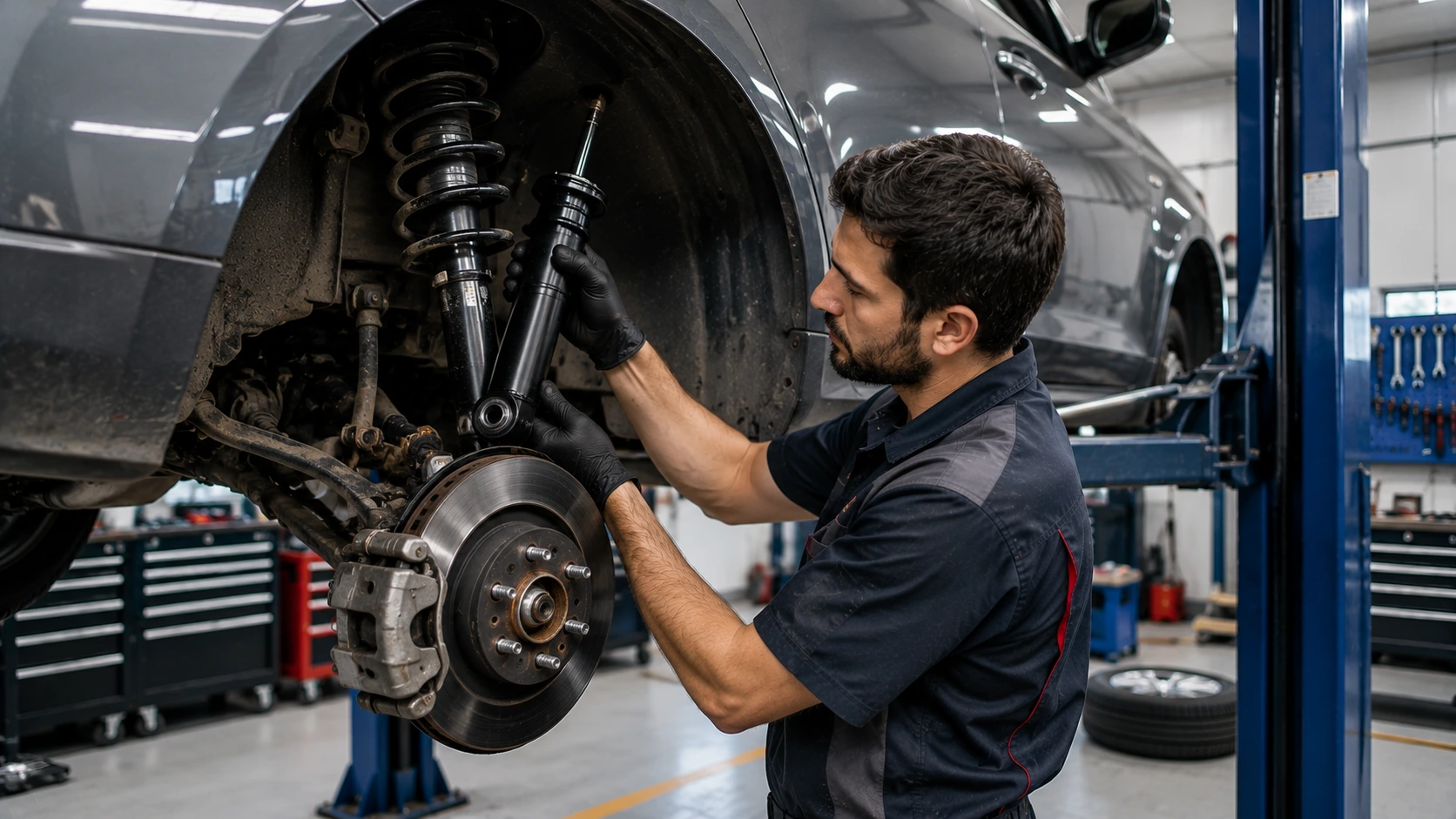
A professional car shock absorber replacement Dubai service covers more than the damper unit itself.
Component Assessment Before Replacement
Before any replacement is authorised, the correct assessment confirms which corners are affected and whether the fault is in the damper itself or in mounting components. Replacing all four shock absorbers when only two are worn isn’t economical. Replacing a damper when the actual fault is the top mount is an incorrect repair.
A ramp inspection with the suspension loaded confirms damper condition — visible leakage, body condition, and mount hardware assessment. A road test before and after the ramp inspection confirms whether the symptoms match the physical findings.
Alignment After Replacement
Shock absorber replacement — particularly when strut-type dampers are involved — affects wheel alignment. A strut replacement changes the geometric relationship between the wheel and the vehicle body.
A car shock absorber replacement Dubai service that doesn’t include a post-replacement wheel alignment check has completed the mechanical repair but left the vehicle with potentially incorrect alignment. The incorrect alignment causes tyre wear and handling characteristics that mask the improvement from the new dampers.
Spring and Top Mount Assessment
When dampers are replaced, the springs and top mounts should be assessed simultaneously — these components age on the same cycle as the dampers and may need replacement at the same service. Replacing dampers on worn springs or corroded top mounts reduces the effectiveness of the new dampers and leaves components that may need replacement before the new dampers’ expected service life.
Realistic Shock Absorber Replacement Costs in Dubai
Approximate figures for common car shock absorber replacement Dubai work at a quality independent in Al Quoz:
- Front shock absorber replacement — pair, standard saloon or SUV Quality independent: AED 600–1,200 | Dealer: AED 1,200–2,400
- Rear shock absorber replacement — pair, standard saloon or SUV Quality independent: AED 500–1,000 | Dealer: AED 1,000–2,000
- Front strut assembly replacement — includes spring and top mount Quality independent: AED 1,000–2,000 | Dealer: AED 2,000–4,000
- Air suspension spring replacement — single corner Quality independent: AED 1,400–2,500 | Dealer: AED 3,000–5,500
- Electronic damper replacement — MagneRide or CDC, single corner Quality independent: AED 1,200–2,500 | Dealer: AED 2,500–5,000
Four-wheel alignment after replacement Quality independent: AED 150–250 | Dealer: AED 300–500
These are approximate ranges — actual costs depend on vehicle type, damper specification, and findings during inspection.
After Shock Absorber Replacement — What to Expect
New shock absorbers require a short bedding-in period — typically 500–1,000 km — before reaching their optimal damping consistency. During this period, the hydraulic fluid settles to its correct distribution within the damper, the mounting hardware torques to its correct operating position, and the new rubber bushings in the mounting components compress to their working range.
After the bedding-in period, the improvement in ride quality, handling response, and cornering stability compared to worn dampers should be immediately apparent — particularly over Dubai’s speed bumps, which provided the most obvious symptom of the old dampers’ condition.
For owners who need mobile assessment of shock absorber condition, a mobile car mechanic can perform initial symptom assessment at the vehicle’s location. A complete car service alongside shock absorber replacement covers the full vehicle inspection at the same visit. A qualified car mechanic with the correct ramp access and suspension assessment experience handles the full car shock absorber replacement Dubai service correctly.
Proper roadside assistance ensures vehicles with seriously compromised suspension are transported correctly when they can’t be safely driven to the workshop. For owners in Al Quoz and surrounding areas looking for a garage near me that performs car shock absorber replacement Dubai correctly — proper assessment before replacement, correct component specification, and wheel alignment included after installation — the difference from a workshop that simply replaces dampers without checking alignment shows immediately in how the car handles and tracks after the service.
FAQ
How do I know if my shock absorbers need replacing in Dubai?
Excessive bouncing after speed bumps, more body roll in corners than the car used to show, nose diving under braking, and cupped tyre wear are the clearest signs of worn shock absorbers needing assessment.
How long do shock absorbers last in Dubai?
Typically 60,000–80,000 km depending on the vehicle and driving conditions — Dubai's speed bumps and heat conditions can reduce this to 40,000–60,000 km on vehicles used in dense urban areas.
Do I need to replace shock absorbers in pairs?
Yes — replacing only one side creates asymmetric damping that affects straight-line tracking and cornering balance. Front pair or rear pair should be replaced together.
Does shock absorber replacement require wheel alignment?
Yes — particularly on strut-type front suspension where the damper is part of the geometry. A post-replacement alignment check ensures the new dampers are operating in the correct geometric relationship.
Can worn shock absorbers affect braking distance in Dubai?
Yes — worn shock absorbers reduce consistent tyre-to-road contact, which reduces the effective braking grip available. The effect is most pronounced under heavy braking from motorway speed.
Conclusion
Car shock absorber replacement Dubai addresses the gradual wear that Dubai’s speed bumps, heat, and driving conditions accelerate faster than European service intervals assume. The symptoms — excessive bouncing, increased body roll, nose dive under braking, and cupped tyre wear — develop gradually enough that drivers normalise them. The improvement when correctly specified dampers are installed is immediate and significant — particularly on Dubai’s speed bumps that exposed the worn dampers most clearly.
Car Garage Expert in Al Quoz handles car shock absorber replacement for all makes — correct component specification, pre-replacement suspension assessment, and post-replacement wheel alignment included as standard. Book your appointment on WhatsApp or find the workshop on Google Maps.