A car that pulls to one side on Sheikh Zayed Road. A steering wheel that’s off-centre when driving straight. Tyres wear through faster than they should. These are the everyday consequences of wheel alignment that’s drifted out of specification — and in Dubai, the causes are more frequent and more varied than in most other markets.
Searching for wheel alignment near me Dubai means finding a workshop with the right equipment, the technical understanding to interpret the geometry readings correctly, and the capability to identify any underlying suspension faults that caused the misalignment before simply adjusting the numbers back to specification.
A wheel alignment adjustment on a car with worn suspension components is a temporary fix at best. The correct approach at a proper wheel alignment near me Dubai workshop starts with a suspension assessment, identifies any worn components, and performs the alignment after the vehicle’s geometry is structurally sound.
Wheel Alignment Near Me Dubai — Why Alignment Drifts Faster Here
Dubai’s road conditions accelerate wheel alignment departure from specification at rates that European driving conditions don’t produce.
Speed bumps are the primary driver. Dubai has them in every residential area, every car park, every school zone — inconsistently sized, sometimes poorly marked, and frequently approached at speeds that transfer significant impact energy through the front and rear suspension geometry. Each significant speed bump impact can shift the alignment values measurably. The cumulative effect of hundreds of Dubai speed bumps over a year of driving is consistent misalignment.
Kerb contact is the other major cause. Dubai’s parking environments — tight multi-storey car parks, narrow street parking, unfamiliar compound layouts — produce kerb strikes on wheel and tyre edges that shift steering geometry with a single impact. A kerb hit hard enough to feel through the steering wheel has almost certainly moved the alignment.
Pot holes on secondary roads and road surface changes at construction zone boundaries create the same impact-load conditions as speed bumps — particularly for lower-profile vehicles with stiffer suspension that transmit impact energy more directly to the geometry.
What Wheel Alignment Is and Why It Matters
Wheel alignment near me Dubai service adjusts three geometry parameters that determine how the tyres contact the road surface and how the car tracks in a straight line.
Camber
Camber is the angle of the wheel when viewed from the front of the vehicle — whether the top of the wheel leans inward (negative camber) or outward (positive camber) relative to vertical.
Incorrect camber produces uneven tyre wear across the width of the tyre — negative camber causes inner edge wear, positive camber causes outer edge wear. A tyre that’s visually acceptable across most of its width but wearing rapidly on one edge has a camber problem that’s wasting tyre life even when the visual appearance seems acceptable.
Most road vehicles use slight negative camber for improved handling stability. The key is that camber must be consistent between left and right — asymmetric camber causes the vehicle to pull toward the side with more positive camber.
Toe
Toe is the angle of the wheels when viewed from above — whether the front of the wheels point inward toward each other (toe-in) or outward away from each other (toe-out).
Toe misalignment is the most aggressive tyre wear cause in the wheel alignment near me Dubai repair context. Even small toe errors create significant tyre scrub — the tyres are being dragged sideways across the road surface during every forward movement rather than rolling straight. The resulting wear pattern is a feathering of the tyre surface — one edge of each tread block wears more than the other — visible when running a hand across the tyre surface in opposite directions.
Toe misalignment also reduces fuel efficiency — the tyres are generating rolling resistance from the scrub rather than simply rolling forward.
Caster
Caster is the angle of the steering axis when viewed from the side — how far forward or backward the top of the steering pivot point leans relative to vertical. Positive caster (top of the steering axis leaning backward) is used on modern vehicles for straight-line stability and steering returnability.
Caster adjustment isn’t available on most modern vehicles without replacing worn or damaged components. When caster is found to be outside specification, it usually indicates a bent or damaged suspension component — a strut, a subframe, or a control arm — rather than an adjustable geometric error.
When a wheel alignment near me Dubai assessment finds asymmetric caster, the correct response is suspension component inspection before any other alignment adjustments are made.
Four-Wheel Alignment vs Two-Wheel Alignment
The distinction between two-wheel and four-wheel alignment is significant and worth understanding before booking a wheel alignment near me Dubai service.
Two-Wheel (Front) Alignment
Two-wheel alignment adjusts only the front axle geometry — front camber and front toe. This was the standard approach when rear suspension geometry was fixed and non-adjustable on most vehicles.
Many older vehicles and simpler suspension designs have rear geometry that isn’t adjustable — in which case two-wheel alignment is the only option available.
Four-Wheel Alignment
Four-wheel alignment measures all four wheels — front and rear — and accounts for the relationship between the rear axle direction and the vehicle’s centreline (the thrust angle) when making front alignment adjustments.
A vehicle with a rear axle that isn’t pointing straight forward — even by a small amount — will be misaligned even if the front axle geometry is perfectly within specification. The front wheels may be aimed correctly relative to the front axle, but if the rear axle is pointing slightly left, the car will track to the right and the driver will correct with constant left steering input.
Four-wheel alignment is the correct approach for any vehicle with adjustable rear suspension — which includes most modern sedans, crossovers, and SUVs. A wheel alignment near me Dubai service for a BMW, Mercedes-Benz, Audi, Toyota, Nissan, or any other modern vehicle with independent rear suspension should always be four-wheel alignment.
Signs Your Car Needs Wheel Alignment Near Me Dubai
Recognising the symptoms of misalignment helps Dubai drivers act before the associated tyre wear becomes a cost rather than just a warning.
The Car Pulls to One Side
A vehicle that consistently drifts left or right on a straight, flat road without steering input is the most obvious alignment symptom. On a well-maintained motorway section — when the driver lifts hands from the wheel and the car tracks in a straight line — is the clearest test.
Some degree of pull toward camber and road crown is normal. A definitive pull that requires constant correction is not.
Steering Wheel Off-Centre on Straight Roads
A steering wheel that’s rotated slightly left or right when the vehicle is tracking straight is a toe or thrust angle problem. The front wheels are aimed slightly away from the direction the vehicle is actually travelling, requiring the driver to hold the wheel off-centre to maintain straight-line tracking.
This symptom is easily noticed during highway driving and is a clear indicator that wheel alignment near me Dubai service is needed.
Uneven Tyre Wear
Tyre wear that’s uneven across the tyre width — one edge wearing faster than the other — is a camber or toe symptom depending on the pattern. Inner edge wear indicates excessive negative camber. Outer edge wear indicates excessive positive camber. Feathered wear where one edge of each tread block is more worn than the other indicates toe misalignment.
A tyre with uneven wear is giving away tread life faster than a correctly aligned tyre. Beyond the cost of early tyre replacement, uneven wear creates grip asymmetry — the worn edge contacts the road with reduced effective tread depth compared to the opposite edge.
Steering Wheel Vibration
Steering wheel vibration at highway speed can indicate wheel alignment issues — but it’s more commonly caused by wheel balance, tyre damage, or worn suspension components. A wheel alignment near me Dubai assessment should include a check of balance and suspension condition to determine which factor is producing the vibration.
After a Significant Impact
Any significant kerb strike, pothole impact, or speed bump hit that was felt through the steering wheel should be followed by a wheel alignment near me Dubai check. These impacts can shift alignment immediately and measurably — particularly caster and camber changes that indicate component damage alongside the geometric shift.
What a Proper Wheel Alignment Service Covers
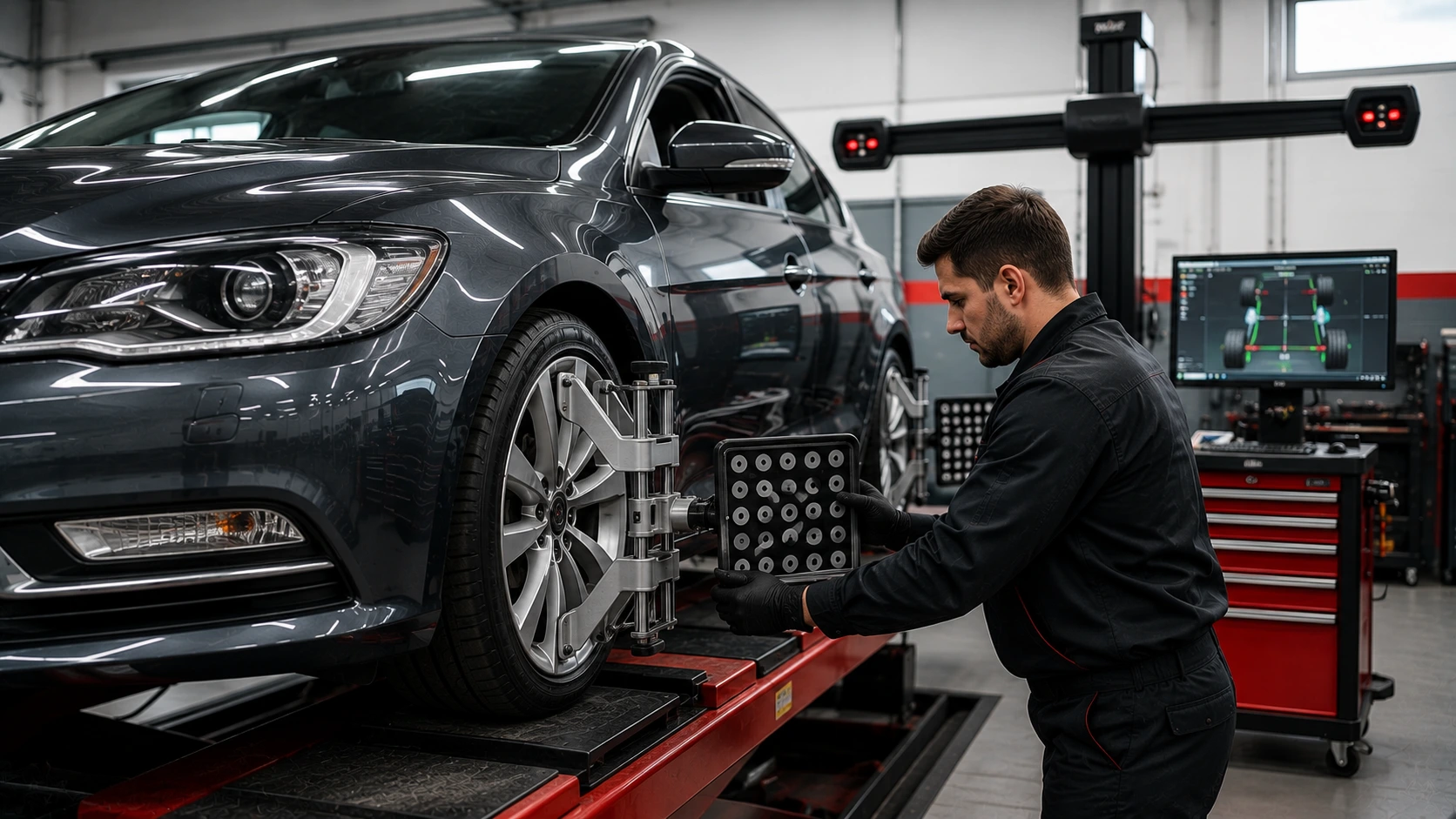
A proper wheel alignment near me Dubai service is more than connecting the car to an alignment rack and adjusting numbers.
Pre-Alignment Suspension Inspection
Before any alignment measurement is taken, the vehicle should be inspected on the ramp for worn suspension components. Worn ball joints, compressed subframe bushings, loose tie rod ends, and collapsed strut top mounts all affect the alignment readings — and adjusting alignment geometry on worn components produces alignment that moves immediately as the loose components shift under driving loads.
A wheel alignment near me Dubai workshop that performs alignment without a suspension inspection is setting geometry on a foundation that won’t hold it.
Tyre Pressure Verification
Tyre pressure affects ride height and, through ride height, affects camber on many suspension designs. Alignment must be performed with tyres at the correct cold inflation pressure — not the elevated pressure of hot tyres after a recent drive.
Alignment Measurement — Before and After
The alignment printout should show both the before and after measurements on the same report — confirming that the adjustments brought each parameter within specification and that the technician didn’t simply record the final values without adjusting from an out-of-specification starting point.
Each parameter — camber, caster, and toe for each wheel — should be within the manufacturer’s specification range. Parameters that are within range but at the edge of the range should be noted — they indicate components that are functioning but approaching the end of their adjustment range.
Post-Alignment Test Drive
A brief test drive after alignment confirms the steering wheel is centred, the car tracks straight without correction, and the steering returns naturally to centre after cornering. A car that left the alignment rack with correct numbers but returns to tracking incorrectly has a suspension component issue that the alignment adjustment couldn’t correct.
When Wheel Alignment Isn’t Enough
A wheel alignment near me Dubai service resolves geometry that has drifted from specification. It doesn’t resolve the underlying causes of misalignment that will repeat until they’re addressed.
Worn Suspension Components
Worn ball joints, subframe bushings that have lost their rubber compound, and tie rod ends with play all allow the geometry to shift after alignment adjustment. The car leaves the workshop aligned correctly and returns within weeks showing the same misalignment — because the components that locate the geometry aren’t holding their position correctly.
A proper wheel alignment near me Dubai workshop identifies these worn components during the pre-alignment inspection and advises on replacement before the alignment is performed.
A qualified car mechanic handles the suspension component replacement — ball joints, bushings, tie rod ends — alongside the alignment service, completing both in the same visit.
Bent Steering or Suspension Components
A component that’s bent from impact — a tie rod, a control arm, a strut — can’t be aligned to specification because the geometry it creates can’t reach the correct values regardless of adjustment. These components require replacement, not alignment adjustment.
The indicator is alignment values that can’t be brought within specification through normal adjustment — or caster asymmetry that indicates component damage rather than adjustable misalignment.
Wheel Alignment and Tyre Life in Dubai
In Dubai’s conditions, the relationship between wheel alignment and tyre longevity is particularly important because both tyre cost and driving conditions make premature tyre wear consequential.
A vehicle with toe misalignment of just 0.5 degrees is scrubbing its tyres against the road surface on every forward movement. Over 20,000 km of driving, this produces tyre wear equivalent to dragging the tyre several hundred metres sideways — wearing tread that would otherwise provide additional months of service life.
Correct wheel alignment near me Dubai service extends tyre life — particularly important given the cost of quality tyres for premium and performance vehicles common in Dubai’s market, and the UAE’s requirement for adequate tread depth on vehicles used at highway speeds.
A proper car service that includes tyre condition assessment alongside wheel alignment ensures both the geometric and the physical tyre condition are addressed in the same visit.
For suspension repairs identified during the alignment inspection, prompt attention prevents the misalignment from returning immediately after the alignment adjustment. A mobile car mechanic can perform initial suspension assessment at the vehicle’s location when the car can’t easily reach the workshop. For owners in Al Quoz and surrounding areas looking for a garage near me that performs wheel alignment near me Dubai correctly — pre-alignment suspension inspection, four-wheel measurement for modern vehicles, before-and-after documentation, and a post-alignment test drive — the difference from a workshop that simply adjusts the numbers without checking the foundation shows in how long the alignment holds.
FAQ
How often should I get wheel alignment in Dubai?
Every 10,000–15,000 km or after any significant impact — Dubai's speed bumps and kerb contacts shift alignment more frequently than European driving conditions produce.
What is the difference between wheel alignment and wheel balancing?
Alignment adjusts the angles of the wheels relative to each other and the vehicle — affecting tracking and tyre wear. Balancing corrects weight distribution around the tyre and wheel — affecting vibration at speed. Both are needed for correct tyre performance but address different issues.
Can I tell if my car needs alignment without going to a workshop?
A car that pulls to one side, a steering wheel that's off-centre on a straight road, or tyres showing uneven wear across their width are clear indicators of alignment issues that require professional measurement and adjustment.
Does wheel alignment affect fuel consumption?
Yes — toe misalignment causes tyre scrub that creates rolling resistance, increasing fuel consumption. Correct alignment reduces rolling resistance and improves fuel efficiency.
How long does a wheel alignment service take in Dubai?
A four-wheel alignment typically takes 45–60 minutes including pre-alignment inspection, measurement, adjustment, and post-alignment documentation.
Conclusion
Wheel alignment near me Dubai service keeps vehicles tracking correctly, extends tyre life, and reduces the fuel consumption that misalignment causes through rolling resistance. In Dubai’s specific conditions — where speed bumps, kerb contacts, and rough road surfaces shift alignment more frequently than in European markets — regular alignment checks and prompt adjustment after any significant impact are the practical steps that protect both tyre investment and vehicle handling.
Car Garage Expert in Al Quoz handles wheel alignment for all makes — four-wheel laser alignment with pre-alignment suspension inspection, before-and-after documentation, and post-alignment test drive included as standard. Book your appointment on WhatsApp or find the workshop on Google Maps.