
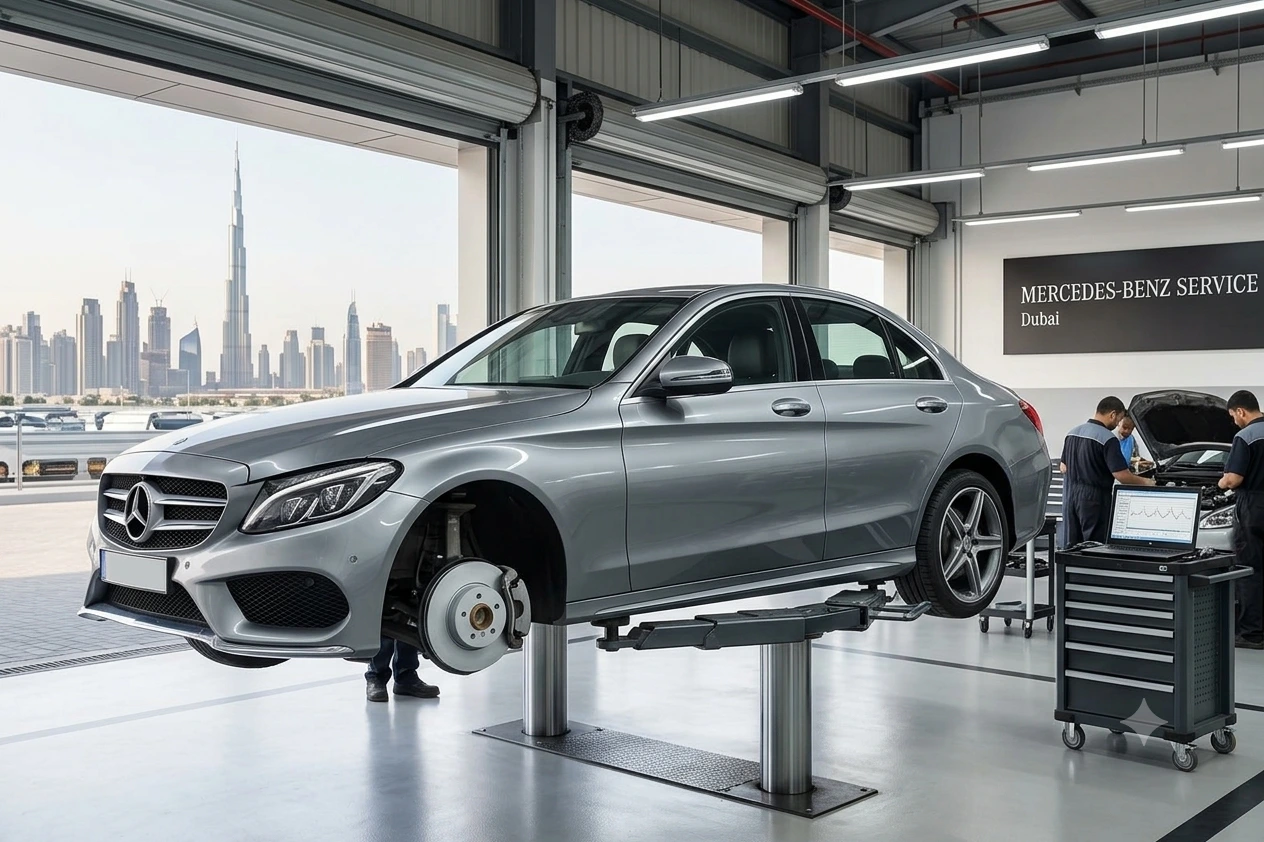
A brake problem is not like an oil change that can wait two weeks. When a service brake warning appears — or when the car starts behaving differently under braking — the window between catching it early and turning it into something genuinely dangerous is shorter than most drivers in Dubai appreciate.
Dubai’s driving conditions are hard on brake systems. Motorway-to-standstill traffic on Sheikh Zayed Road, aggressive braking from high speed on Al Ain Road, the sustained downhill sections on Hatta Road, heavy SUVs with undersized brake specifications driven daily in stop-start conditions — all of it accelerates brake wear beyond what a manufacturer’s standard service interval accounts for. And because modern brake systems are increasingly electronic as well as hydraulic, the range of faults that can develop has expanded considerably from the simple pad-and-disc wear that older vehicles were primarily limited to.
This covers the warning signs that matter, what causes them, and what a proper service brake inspection should find and fix — before a developing problem becomes a dangerous one.
Service Brake Warnings — What Dubai Drivers Need to Understand
Most drivers in Dubai encounter a service brake warning or a brake-related symptom at some point and make the same calculation — it’s probably fine, it can wait until the next service. Sometimes that’s correct. More often it isn’t, and the cost of waiting compounds the original problem considerably.
Why Dubai’s Conditions Accelerate Brake Wear
Heat is the defining factor. Dubai’s ambient temperatures are already pushing the thermal limits of brake fluid, brake pad compound, and disc metallurgy for more months of the year than almost any other major city. Add the specific driving patterns — frequent hard stops from motorway speed, extended slow-traffic crawls with light brake dragging, and the constant speed bump impacts that stress caliper guide pins and slide surfaces — and a brake system in Dubai ages faster than the manufacturer’s service interval was designed for.
Brake fluid is hygroscopic — it absorbs moisture from the atmosphere over time. As moisture content increases, the boiling point drops. In a standard brake system, fluid with degraded boiling resistance begins to vapourise under hard braking — a phenomenon called brake fade. The pedal goes spongy, braking distances increase, and the driver loses confidence in the system precisely when it’s needed most. In Dubai, where ambient humidity cycling between air-conditioned interiors and 45°C exteriors accelerates moisture absorption, brake fluid degrades faster than the standard two-year replacement interval assumes.
Brake disc temperatures in Dubai’s stop-start traffic can reach levels that cause accelerated metallurgical changes in the disc — a process that, over repeated heat cycles, makes the disc more prone to cracking and warping. Discs that warp at lower mileage than expected are one of the most common service brake complaints in Dubai’s workshop circuit, particularly on heavier SUVs.
What Drivers Get Wrong About Brake Warning Signs
The single biggest mistake Dubai drivers make with brake warnings is attributing them to a known cause without proper diagnosis. The pad wear indicator light comes on, the driver assumes it’s just worn pads, fits new pads without inspecting the discs or testing the fluid, and three months later the symptom is back — or worse, a new one has developed alongside it.
Brake warning signs rarely mean exactly one thing. They indicate a system that needs proper assessment — not just replacement of the most obvious component.
Warning Sign — The Service Brake Light on the Dashboard
The service brake warning light is the most direct signal the car gives that something needs attention. But not all brake warning lights mean the same thing, and understanding what the car is actually telling you matters.
Brake Pad Wear Indicator Light
Most modern vehicles — particularly European makes common in Dubai — have electronic pad wear sensors. A thin wire runs through the pad material, and when the pad wears to the minimum thickness, the wire contacts the disc and triggers the warning. This is a clear, actionable signal: the pads need replacement at the next available opportunity.
What it doesn’t tell you: whether the discs are also worn, whether the calipers are functioning correctly, whether the brake fluid is in acceptable condition, or whether the uneven wear that triggered the warning on one corner is being caused by a sticking caliper that will accelerate wear on the new pads immediately after fitting. A proper service brake inspection addresses all of these before the job is signed off.
Red Brake Warning Light
The red brake warning light — as distinct from the amber pad wear indicator — signals something more urgent. Common causes: low brake fluid level, which itself indicates either a leak in the hydraulic system or brake pads worn beyond the point where fluid level drop is detectable. Parking brake not fully released, which on electronic parking brake systems can indicate a fault rather than a simple application. A hydraulic system fault detected by the ABS or brake management control unit.
A red brake warning light should not be driven on until the cause is understood. This is not a “book it in for next week” situation.
ABS and Electronic Stability Warning Lights
ABS and ESC warning lights are brake-system related even though they don’t directly indicate pad or disc wear. An ABS fault disables the anti-lock function — on Dubai’s highways, where emergency stops from 120 km/h are occasionally necessary, ABS functionality is safety-critical. An ESC fault disables electronic stability control, which is the system that prevents the vehicle from spinning under hard cornering or sudden lane changes.
Wheel speed sensor faults are the most common cause of ABS warnings in Dubai. The sensors accumulate brake dust and road debris, and the sensor tip gap increases as the bearing they mount near develops play. A proper service brake diagnosis for an ABS light includes wheel speed sensor testing at all four corners, not just scanning for the fault code and replacing the sensor the code points to without verifying the others.
Warning Sign — Brake Pedal Feel Changes
Changes in how the brake pedal feels are among the most informative service brake warning signs — and among the most commonly dismissed by drivers who adapt to the change gradually without noticing how far it’s moved from normal.
Spongy or Soft Pedal
A brake pedal that requires more travel than usual before firm resistance builds up — or that feels soft and compressible rather than solid — indicates one of two things: air in the hydraulic system or brake fluid with elevated moisture content that is approaching vapour point.
Air in the system enters through a brake line that has developed a slow leak, through a caliper bleed nipple that wasn’t properly torqued after previous brake work, or through a master cylinder seal that is beginning to fail. Air compresses under pressure — hydraulic fluid doesn’t — and the result is a pedal that travels further before the system builds braking pressure.
A soft pedal from moisture-degraded fluid is the more common scenario in Dubai. The fix is a full brake fluid flush with fresh fluid to the correct specification — not a top-up. Topping up contaminated fluid with fresh fluid doesn’t restore the boiling point of the mixture. The entire system needs draining and refilling.
A Lexus GX came in with a spongy pedal after another workshop had performed brake pad replacement. The technician hadn’t bled the system correctly after the caliper pistons were pushed back during the pad fitting. Air had been introduced and not removed. Correct bleeding procedure resolved the pedal feel immediately. The owner had driven three weeks on a compromised brake system because nobody had test-driven the car after the repair.
Long Pedal Before Braking Begins
A pedal that travels a significant distance before braking force is felt — as distinct from a soft pedal under pressure — usually indicates a brake master cylinder fault or a brake booster issue. The brake booster uses engine vacuum or an electric vacuum pump to multiply the driver’s pedal input into hydraulic pressure. A failing booster makes the pedal feel heavy and requires significantly more effort to achieve the same braking result.
Master cylinder faults cause the pedal to travel further before pressure builds — sometimes sinking slowly toward the floor under sustained brake application, which is a direct hydraulic seal failure and requires immediate attention.
Pulsating or Vibrating Pedal
A brake pedal that pulsates — vibrates under the foot during braking — is a warped disc. In Dubai’s conditions, disc warping is one of the most common service brake complaints. It’s caused by uneven heat distribution across the disc face that creates slight thickness variations — as the disc rotates, the thick and thin sections alternately contact the pad, creating the vibration that transmits through the pedal and sometimes through the steering wheel.
Disc warping in Dubai accelerates from specific habits: holding the brake lightly when stationary after hard braking from high speed, which causes the hot disc to develop heat spots against the stationary pad. Correct practice after sustained hard braking is to keep the car moving at very low speed briefly to allow the disc to cool evenly before coming to a complete stop.
Warning Sign — Brake Noise
Brake noise is a service brake warning that drivers frequently dismiss as normal or annoying but not serious. Some brake noise is normal — certain pad compounds produce noise under specific conditions that doesn’t indicate a problem. Most brake noise in Dubai’s workshop context indicates something that needs attention.
Squealing During Normal Braking
Consistent squealing during normal brake application indicates pad wear past the minimum indicator. The wear indicator is a small metal tab designed to contact the disc before the pad backing plate does — producing a high-pitched squeal that signals replacement is needed. Some drivers hear this and wait. The next sound they hear will be the grinding of metal backing plate on disc, at which point both pads and discs need replacement rather than just pads.
High-pitched squeal on a vehicle with recently replaced pads can indicate the wrong pad specification — a pad compound with a different metallurgical composition from the disc material causes resonance under specific braking pressures. A proper service brake inspection after pad replacement includes a test drive to verify the new pads seat correctly and quietly.
Grinding or Scraping
Metal-on-metal grinding during braking is the sound of a pad worn completely through to its backing plate contacting the disc. This is beyond the “should book this in” stage — it causes rapid disc scoring that, if continued, damages the disc beyond resurfacing and makes full replacement necessary.
Grinding that occurs when not braking — during driving without brake pedal application — indicates a sticking caliper. A caliper that isn’t releasing fully keeps pad-to-disc contact continuous, causing the grinding noise alongside accelerated pad wear, reduced fuel economy from the rolling resistance, and disc heat damage from constant friction.
Clunking or Knocking on Brake Application
A clunk or knock felt through the pedal or the car structure when braking — particularly at low speed or over bumps — indicates loose brake components. A caliper mounting bolt that has worked loose, a worn caliper slide pin that allows the caliper to move under braking load, or a brake pad that isn’t correctly located in the caliper bracket all produce this sound. These are structural integrity concerns — a caliper that detaches from its mount under hard braking is a catastrophic failure scenario.
Warning Sign — Pulling Under Braking
A car that pulls to one side when the brakes are applied — steering wheel moves in one direction during braking without the driver steering — has a service brake imbalance between the two front corners.
Sticking Caliper
The most common cause of brake pull. A caliper that isn’t sliding freely on its guide pins applies uneven pressure between the two front corners — the side with the sticking caliper applies more braking force, pulling the car toward it. Sticking calipers in Dubai are accelerated by dust contamination of the slide pins, corrosion on the slide pin bores from humidity cycling, and brake fluid that has absorbed moisture and contaminated the caliper piston seals.
A sticking caliper doesn’t always produce pulling — sometimes it manifests as a single corner that runs hotter than the others, a pad that wears faster on one side, or a slight vibration at low speed that feels like it might be a tyre issue. A proper service brake inspection includes caliper slide pin condition on all four corners — not just the obvious side.
Uneven Pad Wear
Significant pad thickness difference between the left and right front — or left and right rear — indicates either a sticking caliper or a hydraulic pressure imbalance between the two sides. A proper inspection measures pad thickness at all four corners as a baseline before any work is done. This measurement often tells the diagnosis story more clearly than any fault code.
Warning Sign — Burning Smell After Driving
A burning smell from the wheel area after driving — particularly after stop-start city driving or after descending a long gradient — indicates brake system thermal stress.
Sticking Caliper Heat Signature
A single wheel that produces a burning smell or feels significantly hotter than the others after driving has a sticking caliper. The sustained pad-to-disc contact from a caliper that isn’t fully releasing generates heat continuously — the disc and surrounding components reach temperatures that cause the characteristic burning smell, accelerate pad glazing, and in extreme cases can ignite brake dust accumulation in the wheel. This is a service brake issue that needs same-day attention, not a scheduled booking.
Brake Dragging After Aggressive Driving
All four corners producing a burning smell after aggressive driving — as distinct from a single corner — can indicate a brake booster check valve fault that causes partial brake application when the accelerator is released. Less common but worth checking if the symptom is consistent.
What a Proper Service Brake Inspection Covers
A proper service brake inspection at Car Garage Expert in Al Quoz covers every component in the system — not just the parts that are obviously worn.
Pad thickness measurement at all four corners — documented, not estimated. Disc thickness measurement and comparison to minimum specification. Disc runout check using a dial gauge — warping that hasn’t yet caused pedal vibration is caught this way before it develops. Brake fluid moisture content test using a calibrated refractometer — not a visual check. Caliper slide pin condition — pulled, inspected, and lubricated with the correct non-petroleum grease. Caliper piston retraction quality — testing whether the caliper releases correctly, not just whether it applies correctly. Brake hose condition — rubber brake hoses that have internally collapsed cause caliper drag from a one-way valve effect. Handbrake or electronic parking brake effectiveness and adjustment. ABS wheel speed sensor condition and gap check at all four corners.
A car service visit is the right time to request this full brake assessment as part of the overall inspection — not waiting for a warning light to force the issue.
For owners who’ve noticed brake pull, a change in pedal feel, or a warning light while away from the workshop, a qualified mobile car mechanic can assess the immediate situation on-site and advise whether the car is safe to drive to the workshop or requires recovery.
When a brake failure or serious brake fault occurs on the road, proper roadside assistance ensures the car is recovered safely — not driven further on a compromised brake system because the recovery option wasn’t available.
A qualified car mechanic with genuine brake system experience doesn’t just replace the part the warning light points to. They assess the full system, document the findings, explain what’s urgent versus what can wait, and perform the repair in a sequence that leaves the system functioning correctly as a whole — not just the replaced component working in isolation.
For cars that need paint or bodywork alongside brake repairs — wheel arch damage from a caliper failure, for example — professional car painting handles colour-matched repairs without requiring a separate workshop visit.
Owners in Al Quoz and surrounding Dubai areas looking for a garage near me that performs brake work correctly — full system assessment, correct parts specification, proper bleed procedure, and a test drive before handover — will find the difference from a workshop that simply fits the parts and returns the car.
FAQ
What does a service brake warning light mean on my car?
It means one or more brake system components need immediate inspection — pad wear sensor triggered, low fluid level, or a hydraulic or electronic system fault.
How often should brake fluid be changed in Dubai?
Every 18–24 months — Dubai's humidity cycling accelerates moisture absorption in brake fluid, reducing its boiling point faster than the standard two-year interval assumes.
Why does my brake pedal feel spongy after new pads were fitted?
Usually air introduced into the hydraulic system when the caliper pistons were pushed back during the pad change — a proper brake bleed after pad replacement resolves it.
Can a warped brake disc be resurfaced or does it need replacement?
Minor warping can sometimes be corrected by resurfacing — but if the disc is below minimum thickness specification after machining, replacement is the correct solution.
Is it safe to drive with an ABS warning light on?
The car will still brake, but ABS function is disabled — in an emergency stop from highway speed in Dubai, the absence of ABS significantly increases stopping distance and loss of steering control risk.
Conclusion
A service brake warning — whether it’s a light on the dashboard, a change in pedal feel, noise under braking, or a pull to one side — is the car communicating that something in the system needs attention. In Dubai’s driving conditions, where brake systems work harder and wear faster than the manufacturer’s standard interval accounts for, the owners who act on these signals early spend less and drive more safely than those who wait.
Car Garage Expert in Al Quoz handles full brake system inspections, pad and disc replacement, fluid flushing, caliper servicing, and ABS fault diagnosis for all makes. Book your appointment on WhatsApp or find the workshop on Google Maps.


