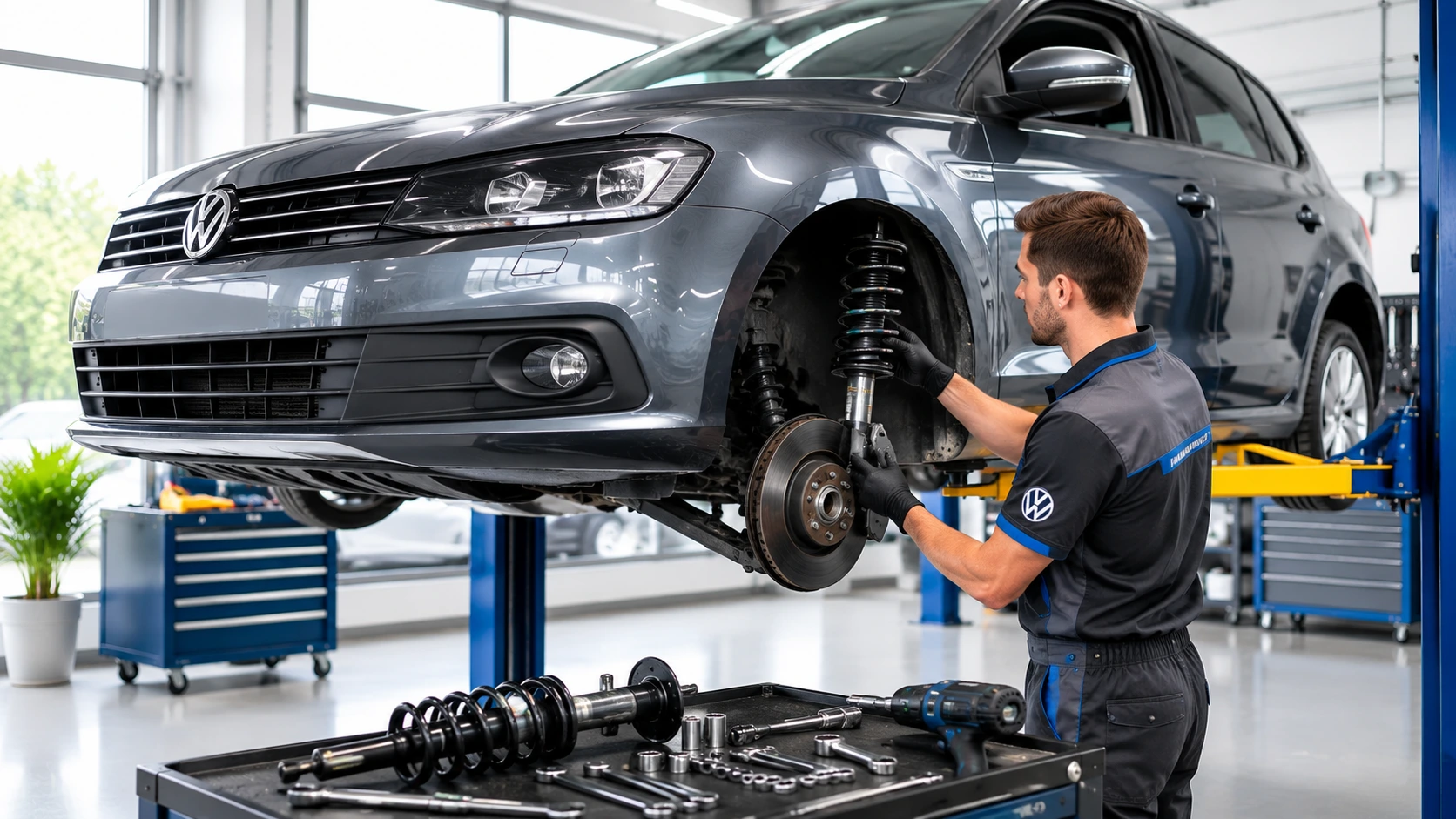
Suspension problems on a Volkswagen in Dubai develop faster than in most other markets. The combination of aggressive speed bumps, sustained heat that hardens rubber bushings faster than European conditions produce, and the daily thermal cycling that suspension components endure in UAE ambient temperatures creates wear patterns that catch owners off guard.
Volkswagen suspension repair isn’t always obvious from the driver’s seat — at least not immediately. The car starts feeling slightly vague at highway speed. A clunk appears over a specific type of road surface. The steering returns to centre a fraction more slowly than it used to. These are early signals that develop gradually until something is genuinely wrong, at which point the repair is more involved than catching it earlier would have been.
Understanding what the signs mean, what causes them on specific VW platforms, and what a proper Volkswagen suspension repair involves helps owners make faster, better-informed decisions when something feels different.
Volkswagen Suspension Repair Dubai — Why These Cars Wear Faster Here
Dubai’s road conditions create a specific set of suspension wear patterns that the manufacturer’s European-market service intervals don’t fully account for.
Speed bumps are the primary accelerant. Dubai has them in every residential area, every car park, every school zone — inconsistently sized, sometimes poorly marked, and frequently approached at speeds that transfer significant shock load through every suspension component. Each impact compresses ball joints, loads subframe bushings, and stresses strut top mounts in ways that sustained highway driving simply doesn’t.
Heat cycling is the secondary factor. Rubber suspension bushings expand and contract daily through a temperature range in Dubai that far exceeds European conditions. This cycling hardens the rubber faster, reduces its elasticity, and creates the cracked, compressed bushings that appear on vehicles with far lower mileage than their European equivalents would show.
The practical result: Volkswagen suspension repair on Dubai-operated vehicles typically becomes necessary 30–40% earlier by mileage than the same car driven in Germany or the UK.
Signs Your Volkswagen Needs Suspension Repair
Knowing what to listen and feel for means catching developing problems before they become serious. A proper Volkswagen suspension repair workshop recognises these symptoms immediately — but the owner who notices them early and acts on them saves considerably more.
Clunking and Knocking Noises
Clunking over speed bumps or road irregularities is the most common early signal in any Volkswagen suspension repair assessment. Different clunk characteristics point to different components.
A hollow, single clunk from one corner over a speed bump usually indicates a worn strut top mount. The mount allows the strut to move slightly within its housing rather than being firmly located — the clunk is the strut shifting under load.
A more metallic knock that appears on both compression and rebound of the suspension — the bump and the recovery — typically indicates a worn shock absorber piston or a damaged bump stop. On MQB-platform Golfs and Tiguans, bump stop degradation from heat is common on higher-mileage examples.
Subframe and Bushing Clunks
A clunk that’s difficult to locate — seems to come from everywhere and nowhere — is often a subframe bushing fault. The subframe itself is moving slightly within its mounting points rather than being firmly located, and the resulting clunk transmits through the body structure in a way that’s hard to directionalise from the driver’s seat.
Subframe bushing wear on the Golf MQB and Tiguan MQB platforms is one of the most common Volkswagen suspension repair findings in Dubai — the combination of speed bump impacts and rubber degradation from heat makes these a known wear item here.
Vibration and Wheel Wobble
Vibration felt through the steering wheel at highway speed — typically between 80–120 km/h — points to one of several causes that need distinguishing before any Volkswagen suspension repair work is authorised.
Tyre imbalance is the most common cause and the cheapest fix. Wheel balance should always be checked first before assuming a suspension fault.
Worn wheel bearings produce a consistent humming vibration that changes character when the steering wheel is turned slightly — the load shift alters the bearing’s contribution to the vibration. A worn left front bearing hum reduces when turning slightly right and increases when turning slightly left.
Tie Rod End and Ball Joint Vibration
A vibration accompanied by steering wheel shimmy that’s particularly pronounced on road surface changes — transitioning from smooth motorway to textured service road — often indicates worn tie rod ends or outer ball joints. These components are wear items on higher-mileage VW models in Dubai, particularly on Tiguans where the vehicle’s weight accelerates wear.
Pulling to One Side
A Volkswagen that consistently pulls to one side without driver input — or that requires constant steering correction to hold a straight line — has a Volkswagen suspension repair concern that goes beyond tyre pressure.
Uneven tyre wear between left and right is sometimes the cause — and is itself often caused by an underlying suspension geometry issue. Checking tyre condition across the axle before assuming alignment is the starting point.
Seized brake caliper on one side causes asymmetric braking force and produces pulling that’s particularly pronounced during brake application. A caliper that’s partially seized also produces a burning smell from the affected wheel after driving.
Alignment and Geometry Issues
Persistent pulling after a recent impact — a significant speed bump hit, a kerb strike, or a pothole — indicates suspension geometry knocked out of specification. A wheel alignment check after any significant impact is part of correct Volkswagen suspension repair practice — geometry that looks fine from the outside can be significantly out of specification after a hard hit.
Excessive Body Roll
Body roll during cornering that’s noticeably more pronounced than the car used to produce indicates worn anti-roll bar components — bushings and drop links.
The anti-roll bar connects the left and right suspension across an axle, transferring load between sides during cornering. When the rubber bushings that locate the bar have compressed and hardened, or when the drop links that connect the bar to the suspension struts have worn their ball joints, the bar can’t control body roll correctly.
Anti-Roll Bar Bushings on Golf and Tiguan
Anti-roll bar bushing wear is among the most common Volkswagen suspension repair items on Dubai-operated MQB-platform vehicles. The rubber compound hardens from heat cycling faster than in European climates, and the bushings develop the characteristic squeak over slow-speed bumps and roundabouts that indicates they’ve lost their elasticity.
Drop link wear produces a more metallic rattle — particularly noticeable at low speed over rough surfaces.
Steering Wheel Off-Centre
A steering wheel that’s no longer centred when driving straight — pointing slightly left or right when the car is tracking correctly — indicates wheel alignment out of specification.
This is often caused by a suspension component change — a replaced tyre, a ball joint that shifted slightly during installation, or simply cumulative wear that has allowed geometry to drift. It’s one of the easier Volkswagen suspension repair items to address, but it’s one that owners sometimes adapt to rather than correcting, which allows the underlying tyre wear pattern to develop.
Bottoming Out Over Bumps
A Volkswagen that grounds out over moderate bumps — or that rides noticeably harder than it used to — has failed or collapsing shock absorbers.
Shock absorbers on Dubai-operated Volkswagens develop wear faster from the combination of speed bump impacts and heat. A shock that’s lost its damping capacity allows the spring to oscillate freely after a bump input — producing the characteristic “floaty” feeling on recovery after a bump, and the harder-than-normal impact as the suspension reaches its travel limit.
DCC Adaptive Suspension Faults
Golf, Tiguan, and Passat models with DCC (Dynamic Chassis Control) adaptive suspension can develop electronic faults in the adaptive damper actuators alongside physical component wear. A DCC fault combined with worn dampers requires both the mechanical component and the electronic calibration to be addressed in a single Volkswagen suspension repair session.
VCDS access is required to test DCC actuator function and calibrate the system after component replacement — a workshop without VCDS cannot complete DCC-related suspension work correctly.
What a Proper Volkswagen Suspension Repair Covers
A proper Volkswagen suspension repair assessment starts from the ramp — not from the symptoms description alone. Physical inspection under load, combined with a VCDS scan for electronic suspension faults, gives the complete picture.
Ramp Inspection
Ball joint play assessed under applied load — not just visual inspection. A ball joint can look acceptable visually and show meaningful play under load. Tie rod end condition checked by applying force to the wheel and feeling for movement at the joint. Subframe bushing compression quality — a bushing that compresses with finger pressure has lost its structural function.
Shock absorber fluid weeping is visible from below. A damp shock body indicates internal seal failure — the component can still be providing partial damping but the capacity is declining. Catching this before the shock fails completely means addressing it as a planned repair rather than an emergency.
Wheel Bearing Assessment
Wheel bearing play is checked with the wheel on the ramp by grasping the tyre at 12 and 6 o’clock and applying force — any play here indicates bearing wear. A bearing producing noise during the road test is confirmed on the ramp by spinning the wheel by hand and listening for roughness.
Road Test Assessment
A road test as part of Volkswagen suspension repair diagnosis covers: clunk characterisation over specific surfaces, vibration onset speed and behaviour under steering input, pull assessment under straight driving and under braking, body roll behaviour through slow corners.
The road test tells the technician which components to prioritise on the ramp. The ramp inspection confirms what the road test suggested and often finds additional items that weren’t obvious from the driver’s seat.
VCDS Electronic Scan
A full VCDS scan as part of any Volkswagen suspension repair assessment identifies DCC faults, ABS sensor issues affecting ESC behaviour, and geometry-related control unit flags that indicate the suspension system’s electronic monitoring has detected something the driver hasn’t yet noticed.
Wheel speed sensor faults often appear as ABS or ESC warnings rather than suspension symptoms — but the underlying cause is frequently a damaged sensor from road debris or a bearing with increased play affecting the sensor gap.
Common Volkswagen Suspension Repair Costs in Dubai
Approximate figures for common Volkswagen suspension repair work at a quality independent in Al Quoz:
Front lower ball joint replacement — Golf or Tiguan Quality independent: AED 400–700 | Dealer: AED 800–1,400
Anti-roll bar bushings and drop links — front axle Quality independent: AED 350–600 | Dealer: AED 700–1,200
Strut top mount replacement — front axle Quality independent: AED 500–900 | Dealer: AED 1,000–1,800
Front shock absorber replacement — pair Quality independent: AED 800–1,400 | Dealer: AED 1,600–2,800
Subframe bushing replacement — front Quality independent: AED 600–1,100 | Dealer: AED 1,200–2,000
Wheel alignment — four wheel Quality independent: AED 150–250 | Dealer: AED 300–500
Wheel alignment is always included after any Volkswagen suspension repair involving steering or suspension geometry components — it’s not optional.
For owners needing immediate support when a suspension fault develops on the road, a qualified mobile car mechanic assesses the severity on-site and determines whether the car can be driven to the workshop or requires recovery.
Proper roadside assistance ensures a Volkswagen with a failed suspension component is recovered correctly — incorrect recovery technique on a car with a collapsed strut or disconnected drop link causes additional damage.
A complete car service that includes a suspension inspection at every visit catches developing wear before it produces symptoms — the difference between a planned bushing replacement and an emergency strut failure.
For paint damage alongside accident-related suspension repairs — a kerb strike that damaged both the wheel and the lower control arm, for example — professional car painting handles the cosmetic repair at the same visit.
A qualified car mechanic with VCDS access and genuine VW platform experience handles the full scope of Volkswagen suspension repair correctly — mechanical component replacement, electronic calibration, and wheel alignment as a single complete service rather than separate visits.
For owners in Al Quoz and surrounding areas looking for a garage near me that handles VW suspension correctly from diagnosis to alignment — the difference from a workshop applying generic suspension logic to a VW platform shows in the quality of the result.
FAQ
What causes clunking over speed bumps on a Volkswagen in Dubai?
Most commonly worn strut top mounts, degraded subframe bushings, or failed anti-roll bar drop links — all accelerated by Dubai's speed bumps and heat cycling.
How often should Volkswagen suspension components be inspected in Dubai?
At every service visit — Dubai's road conditions and heat accelerate suspension wear significantly faster than European service intervals assume.
Does wheel alignment need to be done after every suspension repair?
Yes — any replacement of steering or suspension geometry components requires a four-wheel alignment check afterward to restore correct handling and prevent accelerated tyre wear.
Can DCC adaptive suspension faults be diagnosed without VCDS?
No — DCC actuator testing and calibration after component replacement requires VCDS access. Generic scanners see nothing useful in the DCC system.
What's the most common Volkswagen suspension repair in Dubai?
Anti-roll bar bushing and drop link replacement — heat cycling hardens and cracks the rubber bushings faster here than in European climates, and drop links wear from repeated speed bump impacts.
Conclusion
Volkswagen suspension repair in Dubai requires understanding how this specific environment accelerates wear — heat-hardened bushings, speed bump-stressed ball joints, and DCC electronic faults that need VCDS access alongside the mechanical work. Catching the early signs — clunks, vibrations, pull, excessive body roll — and acting on them promptly keeps the repair straightforward rather than complicated.
Car Garage Expert in Al Quoz handles Volkswagen suspension repair across the full model range — Golf, Tiguan, Passat, Polo, and Touareg — with VCDS-compatible diagnostics, correct component specification, and four-wheel alignment included as standard. Book your appointment on WhatsApp or find the workshop on Google Maps.