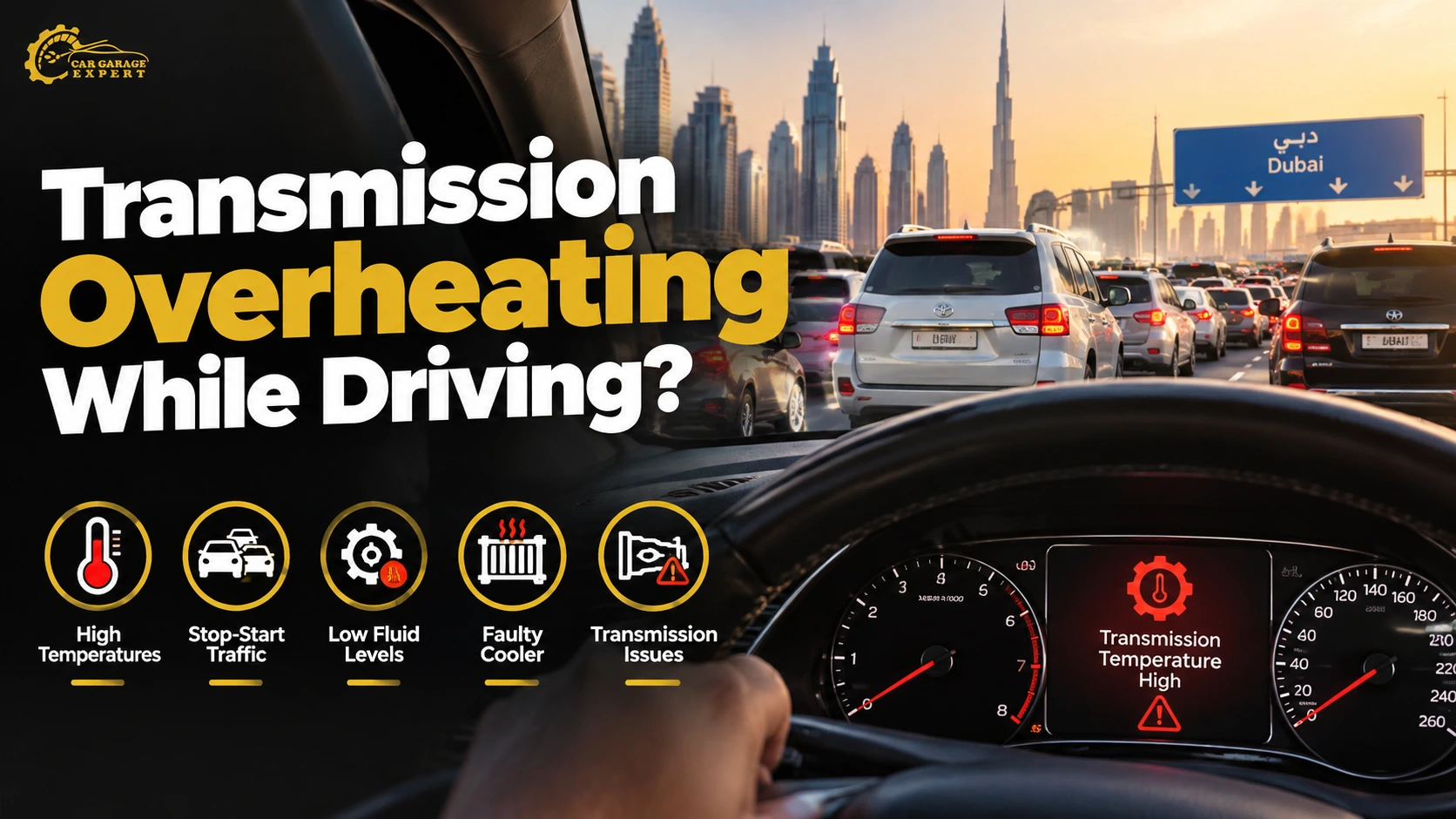
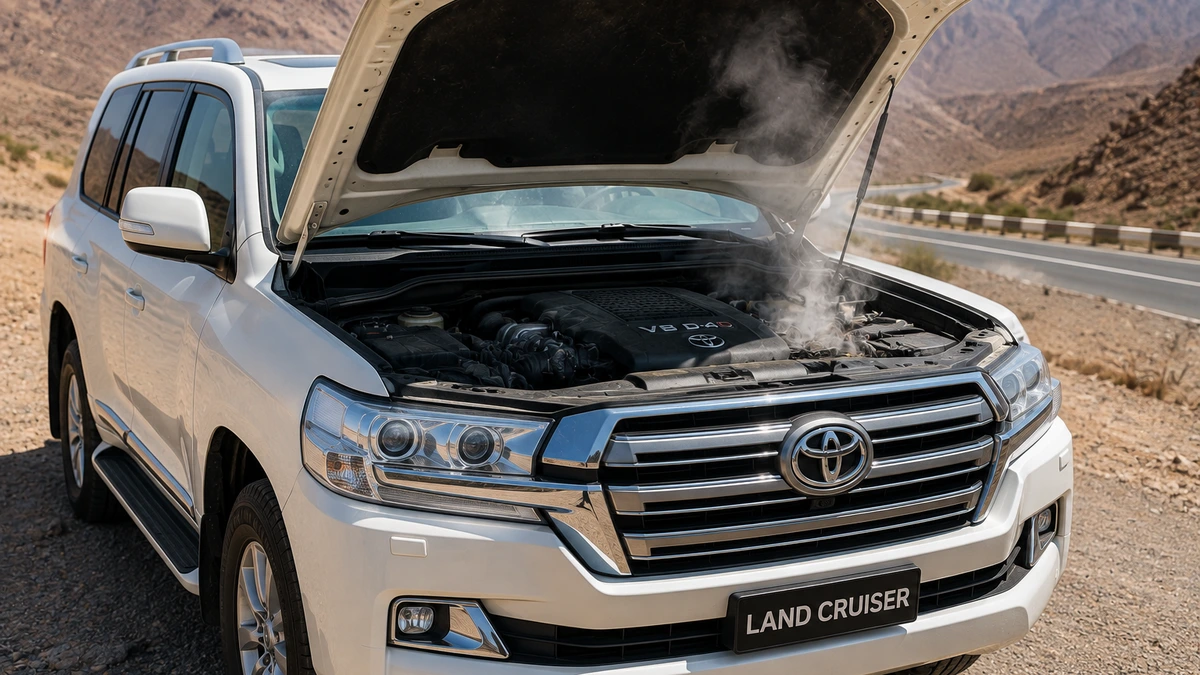
Toyota Land Cruiser overheating Dubai is the most common cooling complaint we see at our Al Quoz workshop — especially between May and September. The Land Cruiser is built tough. But Toyota Land Cruiser overheating Dubai shows that even the toughest engine struggles when the cooling system can’t keep up with 45°C ambient heat, heavy traffic, and continuous AC load.
The good news is that Toyota Land Cruiser overheating Dubai is almost always preventable. And when it does happen, the cause is usually one of a handful of known faults — all diagnosable and fixable the same day.
This blog explains what causes Toyota Land Cruiser overheating Dubai, what we check, and what services protect your engine.
Toyota Land Cruiser Overheating Dubai — Quick Answer
The Toyota Land Cruiser overheats in Dubai mainly because of three reasons: a failing thermostat that stops coolant from reaching the radiator, a blocked or dirty radiator that can’t reject heat fast enough, or a low coolant level from a slow leak. Dubai’s summer heat reduces the cooling system’s margin significantly. This is the core of every Toyota Land Cruiser overheating Dubai pattern — a system fine in winter that fails in July traffic on Sheikh Zayed Road. Early warning signs include the temperature gauge climbing above its normal position, the AC suddenly blowing warm air, and steam from under the bonnet.
Table of Contents
- Why the Land Cruiser Is Vulnerable to Overheating in Dubai
- The Thermostat Fault That Starts Most Overheating Events
- How a Blocked Radiator Causes Heat Buildup in Stop-Start Traffic
- Low Coolant From a Slow Leak — The Silent Cause
- How a Failing Water Pump Stops Coolant Circulation
- Why the Cooling Fan Matters More in Dubai Than Anywhere Else
- What to Do the Moment Your Land Cruiser Starts Overheating
- How We Diagnose Toyota Land Cruiser Overheating in Dubai
- The Services That Fix and Prevent Overheating
- How Much Does Cooling System Repair Cost in Dubai?
- Why Rapid Overheating Causes Serious Engine Damage
- How Often to Service the Cooling System in Dubai
- Why Car Garage Expert?
- FAQ
- Conclusion
Why the Land Cruiser Is Vulnerable to Overheating in Dubai
The Land Cruiser’s V8 engine produces a lot of heat. Under normal conditions, the cooling system handles it easily. In Dubai, the conditions are anything but normal.
Ambient temperatures stay above 40°C for months. The engine starts hot and gets hotter quickly. Traffic on Al Khail Road and Business Bay means low speeds and minimal airflow across the radiator.
Add a continuous AC compressor load and you have a system working at maximum capacity every single drive. Any weakness — a dirty radiator, a slow thermostat, a small coolant leak — gets exposed fast.
This is exactly why Toyota Land Cruiser overheating Dubai complaints peak every summer, even on well-maintained vehicles.
The Thermostat Fault That Starts Most Overheating Events
The thermostat controls when coolant flows from the engine to the radiator. When the engine is cold, it stays closed. Once the engine reaches operating temperature, it opens and lets hot coolant flow through for cooling.
A faulty thermostat gets stuck closed. Coolant stops reaching the radiator. The engine temperature climbs with nowhere for the heat to go.
This is the most common single cause of Toyota Land Cruiser overheating Dubai. The thermostat is a small and inexpensive part. But a failed one can destroy a head gasket within minutes if the driver keeps going.
The fix is straightforward — thermostat replacement takes two to three hours and costs AED 400–900 including coolant refill.
How a Blocked Radiator Causes Heat Buildup in Stop-Start Traffic
The radiator rejects heat from the coolant into the outside air. When its fins are blocked with Al Quoz dust, construction debris, or internal scale from old coolant, it can’t do this efficiently.
At highway speed, airflow through the grille compensates slightly. In slow traffic, there is no compensation. The radiator is working at reduced capacity with zero airflow assistance.
This produces the classic Dubai pattern — temperature gauge normal on the highway, climbing toward the red in traffic.
This is one of the most common findings in a Toyota Land Cruiser overheating Dubai inspection — external fin blockage cleaned with a pressure wash from the rear face. Internal scale from degraded coolant usually means radiator replacement. Our car mechanic team inspects both external and internal radiator condition on every overheating diagnosis.
Low Coolant From a Slow Leak — The Silent Cause
A coolant system with a slow leak loses fluid gradually. The driver doesn’t notice because the reservoir still shows fluid. But the actual coolant volume in the system is dropping.
Less coolant means less heat-carrying capacity. The system that handled Dubai summer last year starts struggling this year — because there’s simply less fluid doing the job.
Common leak locations on the Land Cruiser include the lower radiator hose connection, the water pump seal, and the radiator core itself. We find the exact leak with a cooling system pressure test — a gauge holds pressure in the system while we look for where it drops.
Once the leak is sealed, the system is refilled to specification and tested again.
How a Failing Water Pump Stops Coolant Circulation
The water pump circulates coolant around the engine and through the radiator. It runs continuously whenever the engine runs.
A water pump with a worn impeller, a failed bearing, or a cracked housing reduces or stops circulation. The coolant sits in the engine block getting hotter instead of flowing to the radiator for cooling.
Signs of a failing water pump include a rumbling noise from the front of the engine, coolant leaking from the pump housing, and overheating that appears regardless of traffic speed.
Water pump replacement on the Land Cruiser takes three to five hours depending on the engine variant. Our car service packages include a water pump inspection at every major service for Land Cruisers over 80,000 km.
Why the Cooling Fan Matters More in Dubai Than Anywhere Else
At highway speed, air pushes through the grille naturally. At idle and in slow traffic, the electric cooling fan is the only thing moving air across the radiator.
A cooling fan running at 70% of its rated speed is invisible at highway speed. In Dubai’s summer traffic, it’s the difference between a normal temperature gauge and one heading toward the red zone.
The fan motor degrades from Dubai’s sustained underbonnet heat. A failing relay can supply reduced voltage to the fan. A temperature switch that activates late allows the engine to rise too high before the fan kicks in.
We test fan activation temperature and output speed as part of every Toyota Land Cruiser overheating Dubai diagnosis. For any cooling emergency on the road, our roadside assistance team covers Al Quoz and all nearby Dubai areas.
What to Do the Moment Your Land Cruiser Starts Overheating
Acting quickly when the temperature gauge rises is critical in any Toyota Land Cruiser overheating Dubai situation — it prevents minor faults from becoming major damage. Here is exactly what to do.
Switch off the AC immediately. This removes the compressor load and reduces heat generation. The temperature gauge often stabilises after this step alone.
Turn on the cabin heater to maximum. It sounds counterintuitive. But the heater core is part of the cooling circuit. Running maximum heat pulls heat out of the coolant and into the cabin — buying time to find somewhere safe to stop.
Pull over as soon as it is safe. Do not push through overheating hoping it resolves. A few minutes of driving at critical temperature is enough to warp a cylinder head.
Do not open the bonnet immediately. Let the engine cool for 20–30 minutes before touching anything. A pressurised hot cooling system can cause serious burns.
Do not add cold water to a hot engine. The thermal shock can crack the engine block. Wait until cool, then add the correct coolant.
How We Diagnose Toyota Land Cruiser Overheating in Dubai
We follow a structured diagnosis for every Toyota Land Cruiser overheating Dubai case — not guesswork. Here is what the process looks like.
Cold start temperature observation. We connect the diagnostic scan and watch coolant temperature from cold start. A thermostat fault shows as temperature rising too high before stabilising. A sensor fault shows as an abnormal reading from the very beginning.
Cooling system pressure test. We hold pressure in the system and watch for drops. Any drop confirms a leak. We then trace where the pressure is escaping.
Radiator external inspection. We assess fin blockage from the rear face. We also check the radiator cap — a failing cap that doesn’t hold pressure is a surprisingly common cause of intermittent overheating.
Fan output and activation test. Fan speed and activation temperature are measured against specification. A fan running below rated speed is replaced before anything else is adjusted.
Combustion gas test. We check the coolant reservoir for combustion gases — bubbling or froth indicates a head gasket breach where exhaust gases are entering the cooling circuit.
The Services That Fix and Prevent Overheating
These are the specific services we perform based on the confirmed cause.
Thermostat replacement. New thermostat, fresh coolant refill, pressure test after installation. AED 400–900.
Radiator cleaning or replacement. External clean for fin blockage — AED 200–400. Full radiator replacement where internal scale is confirmed — AED 800–2,500 depending on the Land Cruiser variant.
Coolant flush and refill. Old coolant is drained completely, the system is flushed, and fresh coolant is filled to the manufacturer’s concentration. AED 300–600. This is the single most preventive service for overheating — and the most skipped.
Water pump replacement. AED 800–2,000 including gaskets and coolant refill.
Cooling fan repair. Relay replacement: AED 150–400. Fan motor replacement: AED 500–1,200.
Head gasket replacement. Where overheating has progressed to gasket damage — AED 3,000–7,000 depending on cylinder head condition. Our Toyota repair Dubai team handles all Land Cruiser engine variants including the 4.0 V6, 4.5 V8 diesel, and 5.7 V8 petrol.
How Much Does Cooling System Repair Cost in Dubai?
| Service | Cost Range |
| Thermostat replacement | AED 400–900 |
| Radiator external clean | AED 200–400 |
| Radiator replacement | AED 800–2,500 |
| Coolant flush and refill | AED 300–600 |
| Water pump replacement | AED 800–2,000 |
| Cooling fan motor | AED 500–1,200 |
| Head gasket replacement | AED 3,000–7,000 |
All quotes are confirmed after the diagnostic assessment. No work starts without a written quote and your approval. Our mobile car mechanic covers Al Quoz and nearby Dubai areas for on-site cooling system assessment.
Why Rapid Overheating Causes Serious Engine Damage
The Land Cruiser’s engine is built to operate between 85°C and 105°C. Above 110°C, damage begins.
At 115°C, the head gasket starts to fail. The metal cylinder head begins to warp slightly. At 120°C and above, the damage becomes permanent — head replacement is required alongside the gasket.
This is why acting on the first sign of overheating matters so much. The difference between a AED 600 thermostat replacement and a AED 6,000 head job is often just a few minutes of continued driving after the gauge entered the danger zone.
How Often to Service the Cooling System in Dubai
Coolant flush and refill: Every two years regardless of mileage. Dubai’s heat degrades coolant’s corrosion inhibitors faster than any European schedule assumes.
Radiator fin inspection: Annually — especially for Land Cruisers used in Al Quoz or construction-adjacent areas where dust loading is highest.
Thermostat and water pump check: At every major service from 80,000 km onwards.
Cooling fan output test: Before every summer — April at the latest. A fan identified as underperforming in April is replaced before it causes a July breakdown. Our garage near me in Al Quoz serves drivers from Business Bay, Jumeirah, Barsha, Downtown, Satwa, and the Sheikh Zayed Road corridor.
Why Car Garage Expert?
Toyota Land Cruiser overheating Dubai cases need a structured diagnosis — not a parts replacement guess. We test each component in sequence, confirm the cause with pressure data and live temperature readings, and only then recommend the repair.
We stock cooling system components for all Land Cruiser variants. Our technicians are familiar with the 200 Series, 300 Series, and Prado cooling system differences. Every repair comes with a written report of what was found and what was done.
If you have a Toyota Land Cruiser overheating Dubai situation, don’t wait. Book through WhatsApp or find us on Google Maps.
FAQ — Toyota Land Cruiser Overheating Dubai
Here are the questions Dubai Land Cruiser owners ask us most about overheating.
Why does my Land Cruiser overheat in traffic but stay normal on the highway?
In traffic, there is no natural airflow through the grille. The cooling fan carries the full burden. Any weakness in the fan, radiator, or coolant level that is masked at speed becomes fully exposed when the car stops. This pattern almost always points to the fan or a partially blocked radiator.
Can I keep driving my Land Cruiser when it starts overheating?
No. Pull over as soon as it is safe and switch off the engine. Even five minutes of driving at critical temperature can warp the cylinder head. A AED 500 thermostat repair becomes a AED 6,000 head replacement if you drive through it.
How do I know if it's the thermostat or the radiator causing the overheating?
A thermostat fault typically causes the temperature gauge to rise steadily from startup and not stabilise at the normal position. A radiator fault typically allows normal temperature at idle but causes the gauge to climb in traffic when airflow is limited. A diagnostic scan and coolant flow test confirm which one is the cause.
Does the Land Cruiser's V8 engine overheat more than the V6?
The 5.7 V8 petrol produces more heat than the 4.0 V6 and places higher demand on the cooling system. It is more susceptible to overheating when the cooling system is marginal. The 4.5 V8 diesel runs hotter than both and requires the most attentive cooling system maintenance in Dubai's conditions.
How often should I change coolant on my Land Cruiser in Dubai?
Every two years — not the factory maximum of five years. Dubai's heat depletes coolant's corrosion inhibitors significantly faster. Old coolant becomes acidic and attacks aluminium cooling components from the inside. Two-year replacement prevents the internal corrosion that eventually blocks the radiator and damages the water pump.
Conclusion
Toyota Land Cruiser overheating Dubai has a clear cause in every case — thermostat, radiator, coolant leak, water pump, or cooling fan. Each cause has a direct fix. The key is catching it early before the temperature gauge enters the red zone and the engine damage becomes permanent.
For any bodywork or paint repairs alongside cooling system work, our car painting team handles colour-matched repairs at the same visit.
Car Garage Expert in Al Quoz diagnoses every Land Cruiser overheating case with a pressure test, fan output check, and live temperature data — before recommending any repair.
Car Garage Expert is in Al Quoz, serving Business Bay, Jumeirah, Downtown, Barsha, Satwa, and the Sheikh Zayed Road corridor. Book on WhatsApp or find us on Google Maps.
Car Garage Expert — Toyota Land Cruiser Overheating Dubai | Al Quoz, Dubai