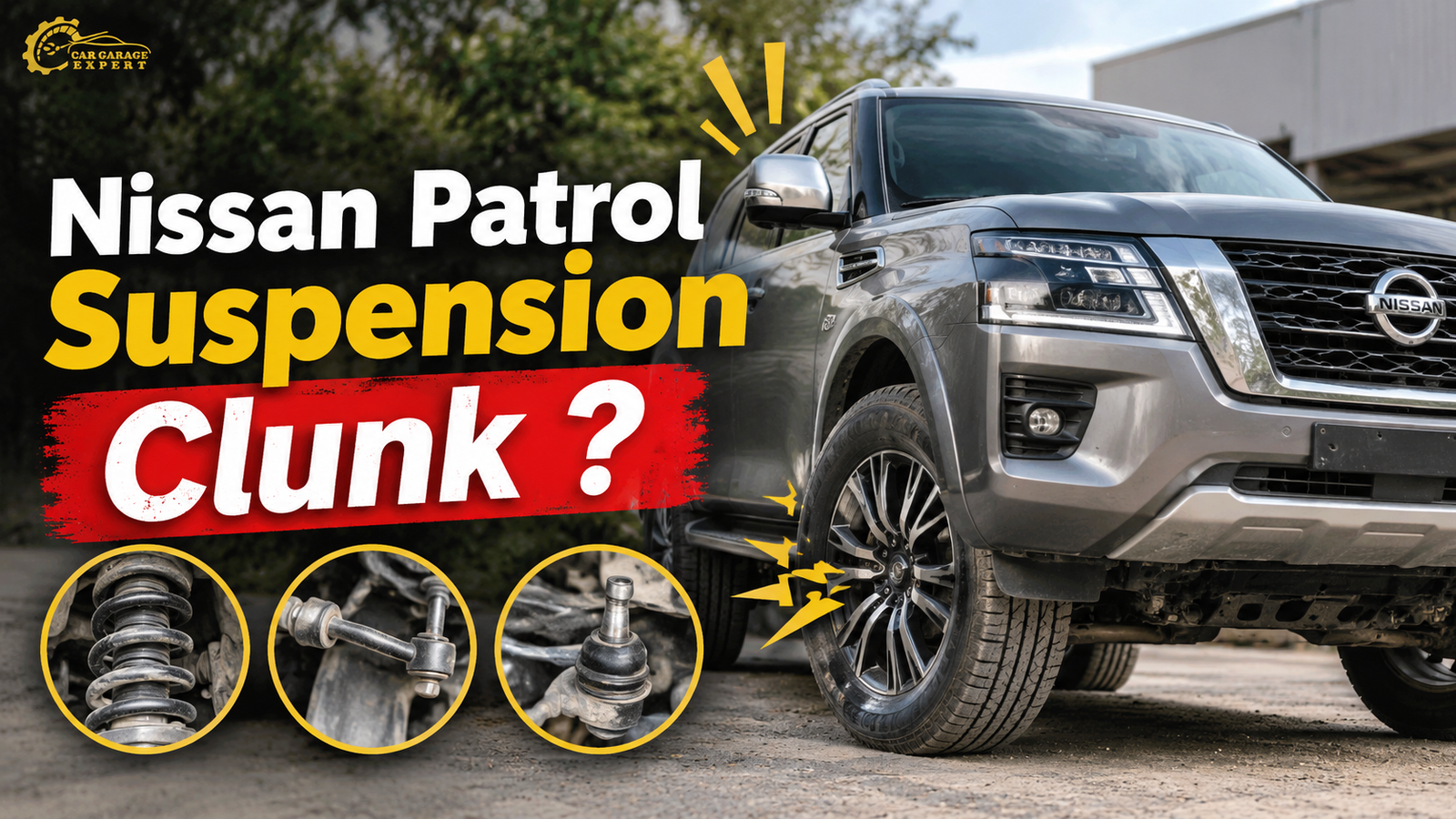
A Nissan Patrol suspension clunk at low speeds is most often caused by worn sway bar links, tired control arm bushes, loose shock mounts, or a worn ball joint. On Y62 models with Hydraulic Body Motion Control (HBMC), low fluid pressure can also cause knock over bumps. The noise shows up below 40 km/h because speed bumps, curbs and car park ramps load the suspension slowly, and any gap between metal parts makes a sound. A mechanic finds the source with a road test, a lift check, and a pry-bar test at each joint. Most fixes take two to five hours. Check a clunk that keeps getting louder within a week.
What a Low-Speed Clunk in Your Patrol Is Telling You
A Nissan Patrol suspension clunk means two parts that should be held tight are now moving against each other. The Patrol weighs close to 2.8 tonnes, so even a small gap in a bush or joint makes a loud knock. Most owners first hear it on speed bumps, in car park ramps or when turning into a driveway.
The noise is a warning, not a breakdown. The car still drives, which is why many owners put it off for months. By the time they visit a garage after a search result near me, one worn part has often started wearing out the parts next to it.
Patrol owners in Dubai drive two main models. The Y62 (2010 to 2024) has independent suspension at both ends, and higher trims add the HBMC system. The Y61 Patrol Safari uses solid axles with coil springs, radius arms, and a panhard rod. The clunk can come from different places on each one.
Signs the Knock Is Coming From the Suspension
Nissan Patrol suspension clunck noise changes with bumps and steering, not with engine speed. If the noise gets louder when you rev the engine in park, the cause is more likely an engine or exhaust mount.
Clunking Noise Over Bumps and Speed Breakers
A single deep knock as each wheel goes over a speed bump points to sway bar links, shock mounts, or control arm bushes. A Nissan Patrol clunking noise over bumps that comes from one corner only usually means one side has worn first.
Knocking Sound When Turning at Low Speed
A Nissan Patrol knocking sound at low speed while turning in a car park often comes from a worn ball joint, tie rod end, or upper strut mount. The weight shifts to one side, and the loose joint knocks as it takes the load.
Front Suspension Clunk Versus Rear Suspension Knocking
A Nissan Patrol front suspension clunk is felt through the steering wheel and floor near your feet. Nissan Patrol rear suspension knocking is felt through the seat and sounds like something loose in the boot. Ask a passenger to sit in the back while you drive over a bump. They can usually tell you which end it is.
A Two-Minute Check You Can Do at Home
Put the car down on a flat surface and press down hard on each corner twice. A healthy Patrol stops moving after one bounce. If a corner keeps bouncing or you hear a knock when you push it, it needs more attention. Turn the steering wheel from lock to lock while the car is parked. Make sure the engine is still running. The front end, not the back, made a noise during this test.
Why a Nissan Patrol Suspension Clunk Happens at Low Speeds
It’s easy to hear sounds through small gaps when the vehicle is moving slowly, and the cabin is quiet. At highway speeds, road and wind noise can hide the same knock. The heat, weight, and rough roads make these parts wear out faster.
Worn Sway Bar Links and Bushes
Sway bar links are the most common source of Patrol suspension noise. Each link has a small ball joint at each end. Once the rubber boot cracks, sand gets in and loosens the joint. The sway bar bushes that hold the bar to the chassis also dry out in summer heat and start to knock.
Tired Control Arm Bushes
Control arm bushes are rubber sleeves that keep the arms from touching each other when they pivot. Over time, the Patrol’s weight crushes them. When the rubber tears or shrinks, the arm moves slightly and makes a thud every time you stop or hit a bump.
Loose or Leaking Shock Absorbers and Mounts
A shock that has lost its oil cannot control the spring, so the wheel drops and slams back up. The rubber top mounts can also split, letting the shock knock against the body. Oil stains on the shock body are an easy sign to look for.
Worn Ball Joints and Tie Rod Ends
Ball joints connect the control arms to the wheel hub. When they wear, they knock during turns and over uneven ground. A worn ball joint is a safety risk because a failed joint can drop the wheel.
HBMC System Pressure Loss on the Y62
The Y62 LE, Platinum and NISMO trims use HBMC, which links the shocks with hydraulic lines and accumulators. When an accumulator loses pressure or a line leaks, the body leans more, and the car can knock over bumps. HBMC parts cost more than standard shocks, so a correct diagnosis matters.
Driveline Parts That Sound Like Suspension
Some clunks blamed on the suspension come from the driveline. A dry slip joint on the rear propeller shaft can clunk when you pull away or shift from drive to reverse. Worn engine or transmission mounts can do the same. A good mechanic rules these out before changing suspension parts.
Which Clunk Points to Which Part
The table below matches the sound you hear to the part that usually causes it.
|
What you hear and when |
Most likely cause |
How urgent |
| Light rattle or knock over small bumps | Sway bar links or bushes | Book within 2 to 3 weeks |
| Deep thud over speed bumps from one corner | Control arm bushes or shock mount | Book within 1 to 2 weeks |
| Knock while turning in a car park | Ball joint or tie rod end | Check within a few days |
| Body bounces and knocks after bumps | Leaking shocks or HBMC pressure loss | Check within a week |
How Mechanics Track Down the Exact Source of the Clunk
Finding the right part first saves money on any Nissan Patrol suspension clunk. Guesswork repairs are the most common reason a Patrol still clunks after a repair.
Road Test With the Owner
The mechanic drives the car over speed bumps, through tight turns, and on a car park ramp. Riding along with the owner helps, because you can point out the exact moment the noise appears.
Lift Inspection
With the car on a lift and the wheels hanging, we check each part by hand and by eye.
Pry Bar Test on Joints and Bushes
We use a pry bar to load each control arm, link, and ball joint. Any movement or knock shows the joint is worn.
Shock and HBMC Leak Check
Check the shocks, hydraulic lines, and accumulators for oil stains and wet spots. On HBMC cars, the system pressure is also checked.
Driveline Play Check
Twist the propeller shafts by hand to feel for play in the joints and slip yoke. The mechanic checks engine and gearbox mounts for cracks.
Chassis Ear or Stethoscope Test
For noises that are hard to place, small microphones can be clipped to suspect parts before a road test. The mechanic then listens to each one to identify the source. This test is useful when the knock only happens on certain roads.
How Each Faulty Part Gets Repaired
Once the source is confirmed, the repair is usually a straight part swap. The choice between OEM, aftermarket, and heavy-duty parts depends on how you use the car.
Replacing Sway Bar Links and Bushes
Links are swapped in pairs so both sides wear evenly. New sway bar bushes are greased with a rubber-safe grease so they don’t squeak in the heat.
Changing Control Arm Bushes or Full Arms
You can press out and replace the bushes, or swap the whole arm. A full arm often makes more sense on a high-mileage Patrol, because it comes with a new ball joint already fitted.
Fitting New Shocks or Repairing HBMC
Replace shocks in pairs on the same axle. On HBMC cars, the fault may be one accumulator, a leaking line, or a shock. Some owners choose to convert to standard shocks when HBMC parts are hard to find, which changes how the car handles off-road.
Wheel Alignment After the Repair
Any work on control arms, ball joints, or tie rods changes the wheel angles. Get a four-wheel alignment right after, or the tires will wear unevenly.
What Happens If You Keep Ignoring the Noise
A Nissan Patrol suspension clunk rarely stays small. A loose part puts extra load on nearby components. A worn sway bar link that costs a few hundred dirhams can, over months, wear out the bushes and the shock next to it. Uneven tire wear also starts, and Patrol tires are not cheap to replace.
Braking and handling get worse too. The car leans more in turns and dives harder under braking. With a worn ball joint, the risk is much higher, because a failed joint can make the car lose steering at that wheel.
Is It Safe to Keep Driving a Patrol That Clunks?
You can usually drive gently for a short time if the clunk is light and the steering feels normal. Avoid desert trips, towing, and high speeds until you have it checked.
Stop driving if the steering feels loose, the car pulls hard to one side, or the clunk turns into a grinding sound. Those signs point to a ball joint or arm that may be close to failing. In that case, call roadside assistance and have the car moved on a flatbed rather than driving it to the workshop.
How Long Patrol Suspension Repairs Usually Take
Most Patrol suspension repairs are done the same day if the parts are in stock. A diagnosis takes about one hour. The repair times below are typical for Dubai workshops.
- Sway bar links or bushes: 1 to 2 hours.
- Control arm bushes or full arms: 3 to 5 hours, plus alignment
- Shock absorbers (pair): 2 to 3 hours
- HBMC repair: 1 to 2 days, longer if parts must be ordered
What Decides the Repair Cost in Dubai
The final bill depends on the failed part, your Patrol model, and whether you choose OEM or aftermarket parts. HBMC-equipped trims cost much more to fix than base models. For Nissan Patrol suspension clunk repair in Dubai, the ranges below are typical market figures including labor, not fixed quotes.
- Suspension inspection and road test: AED 150 to 350
- Sway bar links (pair): AED 300 to 700
- Control arm bushes (per side): AED 600 to 1,500
- Shock absorbers (pair): AED 1,200 to 3,500
- HBMC accumulator or line repair: AED 3,000 to 12,000
- Four-wheel alignment: AED 150 to 300
Car Garage Expert can give you an exact price once the source of the noise is confirmed on the lift.
How to Stop the Clunk From Coming Back
Suspension parts wear with use, but simple habits make a Nissan Patrol suspension clunk less likely to return. Slow down to under 10 km/h on speed bumps and take them straight, not at an angle. Rinse sand from under the car after any desert drive, mainly around the links and ball joint boots.
Ask for a suspension check at every service. Many car service packages in Dubai include a lift inspection, which is the best time to catch a split boot or a leaking shock early. Keep tire pressure at the figure on the door sticker, because soft tires send more shock into the suspension.
How Dubai Roads and Desert Trips Wear Out Patrol Suspension
Dubai is hard on Patrol suspension in ways many owners don’t expect, and many Nissan Patrol suspension clunck problems here start with speed bumps. Residential areas and malls have dense speed bumps, and each one loads the bushes and links. A daily school run through Al Barsha or Mirdif can mean more than 40 speed bumps.
Desert trips add more strain. Owners often drop tire pressure for dune driving and forget to reinflate it fully on the road home. Fine sand gets into rubber boots and wears ball joints from the inside. Summer heat then dries out rubber bushes faster than in cooler countries.
Lift kits and larger tires are popular on Patrols here. They look good, but they change suspension angles and add load to the arms and joints. A lifted Patrol should have its suspension checked more often.
Why Choose Car Garage Expert for a Nissan Patrol Suspension Clunk
If you own a Patrol and want to confirm the source of the clunk before replacing anything, visit Car Garage Expert in Al Quoz. The workshop does analysis, suspension repair, and service all in one place, so you only have to make one trip to finish the job.
A Clear Diagnosis Before Any Parts Are Changed
Before installing any parts, ask for a road test and a lift check. This step can save you from paying for new links when the problem is really a bush or a joint on the propeller shaft. This is the first thing you should ask for at the workshop.
Suspension, Servicing and Roadside Help From One Team
The same workshop offers servicing, a mobile mechanic and roadside assistance. If a Patrol becomes unsafe to drive, the team can recover and repair it without involving a second company.
Easy Contact Through WhatsApp
Owners can send a short video of the noise on WhatsApp before booking. Hearing the sound early helps the team plan the inspection.
A Central Al Quoz Location
The workshop is in Al Quoz, close to Sheik Zayed Road and Al Khail Road. That makes it a short drive from most parts of Dubai.
Frequently Asked Questions
Q1: Why Does My Patrol Clunk Over Bumps?
The most common cause is worn sway bar links or control arm bushes. Leaking shocks and loose shock mounts are the next most likely causes.
Q2: Is It Safe to Drive With a Suspension Clunk?
For a light knock with normal steering, short gentle drives are usually fine. If the steering feels loose or the car pulls, stop and have it towed.
Q3: How Much Is Patrol Suspension Repair in Dubai?
Most repairs fall between AED 300 and 3,500 depending on the part. HBMC repairs on Y62 trims can cost AED 3,000 to 12,000.
Q4: Can Bad Shocks Cause a Clunking Noise?
Yes. A shock that has lost its oil lets the wheel bang up and down, and a split top mount can knock against the body.
Q5: What Is HBMC on a Nissan Patrol?
HBMC stands for Hydraulic Body Motion Control. It links the shocks through hydraulic lines to reduce body roll on Y62 LE, Platinum, and NISMO trims.
Q6: Does Wheel Alignment Fix a Suspension Clunk?
No. Alignment corrects wheel angles but does not fix worn parts. Do it after you replace the worn parts.
Related Services for Nissan Patrol Owners
A suspension check often turns up other work worth doing at the same visit. An experienced car mechanic can also check engine mounts, brakes, and steering parts while the car is on the lift.
If you can’t bring the car in, a mobile car mechanic can do a first check at your home or office. Off-road trips can also leave scrapes on bumpers and side steps, which a car painting team can repair once the mechanical work is done.
Get Your Patrol Checked Before the Knock Gets Worse
A clunk that starts small rarely stays that way, and an early fix usually costs a fraction of a late one. Book an inspection at Car Garage Expert to find the exact cause. Send a video of the noise on WhatsApp, or get directions on Google Maps to the Al Quoz workshop.