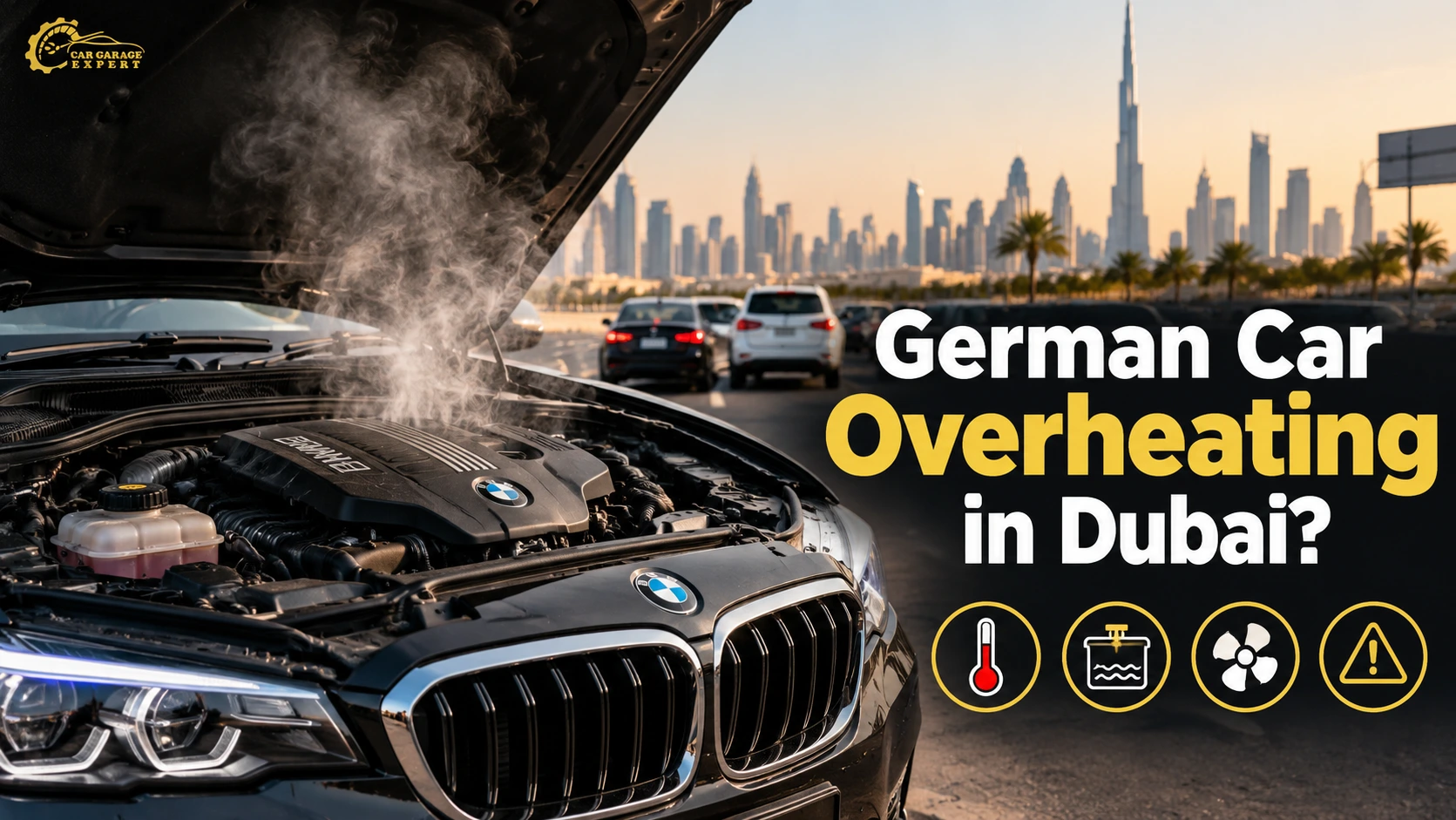
Your BMW, Mercedes, or Audi feels fine on the highway. Then you sit in traffic on Sheik Zayed Road in August, and the warning light comes on. Some drivers smell sweet coolant first. Others only notice when the AC starts blowing warm air.
German car overheating in Dubai is one of the most common faults workshops see each summer. This guide explains why these engines get hot, how a mechanic finds the real cause, and what the repair usually costs. It also highlights warning signs your dashboard may not show.
What Causes German Car Overheating in Dubai
A German car overheating in Dubai is usually not an engine problem, but a cooling system issue. The usual suspects are a failed electric water pump, a jammed thermostat, or a weak radiator fan. Spills are also commonly caused by broken plastic parts. German engines are designed to operate hot, frequently at 105C or more. Dubai adds higher temperatures, heavy air-conditioning use, and long idling in traffic. That leaves precious little room for error. Dust and sand also block the AC condenser and radiator, reducing the amount of air that passes through. In most situations, it takes an hour of a pressure test and live data scan to determine the cause.
Why BMW, Mercedes and Audi Engines Run Closer to the Edge
German engines are made to run hotter than most Japanese or Korean engines. A hotter engine burns fuel more cleanly and gives off fewer emissions. Many BMW engines use a map-controlled thermostat that lets the coolant reach about 105°C to 110°C at light load. That is normal for them, but it leaves only a small gap before trouble starts.
Most of these engines also have a turbocharger packed into a tight engine bay. The turbo adds a lot of heat in a small space. On top of that, many cooling parts are made of plastic to save weight. The expansion tank, thermostat housing, and hose connectors can go brittle after years of heating and cooling.
Dubai pushes all of this harder. Summer air often passes 45°C. The AC runs at full power for months, which adds load to the engine and heat to the radiator. The AC condenser sits right in front of the radiator, and sand and dead insects clog it over time. When air can’t pass through, the radiator can’t shed heat. Stop-and-go traffic makes it worse, because there is no airflow from driving. That mix is the main reason German car overheating in Dubai peaks between June and September.
Your Temperature Gauge May Be Hiding the Problem
Many German cars don’t show the real coolant temperature on the dashboard. On many VW, Audi, and BMW models, the needle is set to sit in the middle across a wide range. The real coolant temperature can move from about 75°C to 110°C or more, and the needle won’t move at all.
The needle only moves once the engine is already well past normal. By the time you see it climb, the problem has often been building for weeks. That hidden build-up is why German car overheating in Dubai so often seem to come from nowhere. Some BMW models have no needle at all. They only show a warning light once the temperature is high.
A mechanic can plug in a scan tool and read the real temperature live. That shows if the engine is creeping too hot in traffic, long before the warning light. Has your car shown even one warning? Get the live data checked at a garage near me in Dubai. Don’t wait for the needle.
The Cooling Parts That Fail Most on Each German Brand
Each brand has its own weak spots behind German car overheating in Dubai. Knowing them helps a mechanic test the right parts first.
BMW
Most BMW engines from the last 15 years use an electric water pump instead of a belt-driven one. It can fail with no noise and no warning, and the engine heats up fast once it stops. The plastic expansion tank and its bleed screw also crack with age. Coolant hoses with plastic quick-connect ends leak at the joints.
Mercedes-Benz
Mercedes engines often suffer from a thermostat that sticks shut or opens late. The electric radiator fan and its control unit can also fail, so the fan doesn’t spin up in slow traffic. Leaks from the expansion tank cap and coolant pipes are common on higher-mileage cars.
Audi and Volkswagen
Many Audi and VW petrol engines use a plastic water pump and thermostat housing built as one unit. It tends to leak once the car passes about 80,000 to 100,000 km. You may see a pink crust around the front of the engine or a low coolant warning that keeps coming back.
Porsche
Older Porsche Cayenne V8 models used plastic coolant pipes under the intake manifold. These crack with heat and can dump coolant without much warning. Most of these cars have had metal pipes fitted by now, but it’s worth checking on any used Cayenne.
The table below matches common warning signs to the usual cause and the typical repair cost in Dubai.
| Warning Sign | Most Likely Cause | Typical Fix Cost (AED) |
| Heats up fast, even on short trips | Failed electric water pump | 1,800 to 3,800 |
| Runs hot only in traffic or with AC on | Weak radiator fan or blocked condenser | 400 to 3,000 |
| Temperature goes up and down | Sticking thermostat | 700 to 1,800 |
| Low coolant warning keeps coming back | Leaking tank, hose or pump housing | 400 to 2,500 |
| White smoke or milky oil | Head gasket failure | 4,500 and up |
These are typical market ranges for BMW, Mercedes, and Audi models in 2026. Larger engines and newer models cost more. Always ask for a written quote after the diagnosis, not before.
What to Do the Moment the Temperature Warning Comes On
When a German car overheating in Dubai traffic, the first few minutes can decide the repair bill. Driving on with a hot engine can turn a AED 1,500 fix into a AED 15,000 engine rebuild.
Turn off the AC straight away. Then turn the heater to full hot with the fan on high. It feels awful in Dubai, but it pulls heat away from the engine and buys you time. Pull over as soon as it is safe and switch the engine off.
Don’t open the coolant cap while the engine is hot. The system is under pressure, and boiling coolant can spray out and burn you. Wait at least 30 minutes. Don’t top up with tap water either. Tap water leaves scale in the radiator, and mixing coolant types can turn it into sludge.
If the warning came on fast, or you see steam, don’t drive the car again. Call for roadside assistance and have it taken in on a recovery truck.
How a Workshop Diagnoses German Car Overheating in Dubai
A good diagnosis tests the system before changing any parts. Guessing is expensive on German cars, because a water pump alone can cost more than AED 2,000.
Live Data Scan
The mechanic connects a scan tool to the OBD-II port and reads fault codes from the engine computer (ECU). They also watch live readings for coolant temperature, thermostat position, fan speed, and water pump speed. On BMW, the scan tool can run the electric pump and show if it responds.
Cooling System Pressure Test
A pressure tester is fitted to the expansion tank and pumps the system up to its normal working pressure. If the pressure drops, there is a leak somewhere. The mechanic then traces it using UV dye or by checking for dried coolant crust. Old coolant that has dried on the bumper or bonnet for weeks can also stain the clear coat. That may require a repaint.
Combustion Leak Test
This test checks if exhaust gas is getting into the coolant. A special fluid changes color if it finds combustion gas. That points to a blown head gasket or a cracked cylinder head.
Fan, Radiator and Coolant Checks
The mechanic tests each radiator fan speed using scan equipment. They check the radiator and condenser for obstructed fins. The refractometer measures coolant strength. If the coolant is brown or oily, it is contaminated.
Repairs and Services That Stop the Overheating From Coming Back
Fixing the failed part is only half the job. The cooling system also needs the right coolant and a proper refill, or the problem returns.
Use only the coolant your carmaker approves. Most VW and Audi models use pink or purple G12 or G13 coolant. Most BMW and many Mercedes models use blue coolant. Mixing types can cause gel and blockages. Flush and replace the coolant every three to five years, or as your service book says.
German cooling systems also need careful bleeding after any repair. Trapped air pockets cause hot spots and fake overheating. BMW engines with an electric pump need a bleed routine run through the ignition or a scan tool.
Old plastic parts are worth changing as a set. Once a car passes 100,000 km, the expansion tank, thermostat and main hoses often fail one after another. Replacing them together saves on labor. Ask if the parts are OEM, OE-supplier, or aftermarket, as prices and quality vary.
Before each summer, have the condenser and radiator cleaned from the front. You can add a cooling check to most car service packages in Dubai. That small step keeps German car overheating in Dubai from catching you out in July.
Signs the Engine Has Already Been Damaged
Sometimes the overheating has gone too far. These signs mean the engine needs proper checks before you drive it any further.
White smoke from the exhaust with a sweet smell often means coolant is burning inside the engine. Oil on the dipstick that looks milky, like coffee with cream, means coolant is mixing with oil. Bubbles in the expansion tank with the engine running point to a head gasket leak.
A warped cylinder head or blown head gasket is a major repair. On a German engine, it can cost AED 4,500 to 12,000 or more. A skilled car mechanic can tell you if a repair or a replacement engine makes more sense—both the car’s age and value matter.
Why Car Garage Expert Is a Good Choice for German Cooling Repairs
For BMW, Mercedes, Audi and VW owners in Dubai, Car Garage Expert is a sensible place to take an overheating car. The Al Quoz workshop handles German cooling faults from initial testing to final bleed.
Testing Before Any Parts Are Quoted
German car overheating in Dubai can have many causes, and several share the same symptoms. A pressure test and live data scan come first, so the quote is based on what failed. That stops owners paying for a new water pump when an AED 300 cap was the real problem.
Help When the Car Can’t Be Driven
Drivers can book a mobile car mechanic for a coolant check at home or the office. If the car has already overheated on the road, it can be recovered to the Al Quoz workshop. That beats driving it any further.
Clear Quotes on WhatsApp
Owners get the test results and a written quote on WhatsApp before work starts. Parts are named as OEM or aftermarket, so the price difference is clear.
Frequently Asked Questions
Q1: Why does my BMW overheat in traffic?
Slow traffic means no air moves through the radiator, so the electric fan has to do all the work. Usually, it’s a weak fan, a blocked condenser, or a failed electric water pump. Dubai summers make it show up faster with the AC load.
Q2: Can I drive with an overheating German car?
No. Driving even a few kilometers while overheating can warp the cylinder head. Pull over, switch off, and have the car recovered if the warning stays on.
Q3: How much does overheating repair cost in Dubai?
A thermostat on a German car usually costs AED 700 to 1,800 fitted. An electric water pump runs about AED 1,800 to 3,800. Head gasket work starts around AED 4,500.
Q4: Is it normal for German engines to run hot?
Yes, up to a point. Many run at 105°C to 110°C under light load. Anything above about 115°C, or a warning on the dashboard, means something is wrong.
Q5: Can the AC cause a German car to overheat in Dubai?
The AC doesn’t cause it on its own. It adds load and heat, so it shows up a weak fan or a blocked condenser faster. If the car only overheats with AC on, check those parts first.
Q6: What coolant does my German car need?
Use the coolant your carmaker approves. VW and Audi usually need pink or purple G12 or G13. Most BMW and many Mercedes models use blue coolant.
Get Your Overheating German Car Checked in Al Quoz
Has the temperature light come on, or does the car run hot in traffic? Send a message to Car Garage Expert on WhatsApp with the make, model and year. Also say when the problem of German car overheating, such as only with the AC on or after a long drive. That helps the workshop plan the right tests before you arrive.
You can find the Al Quoz workshop on Google Maps.