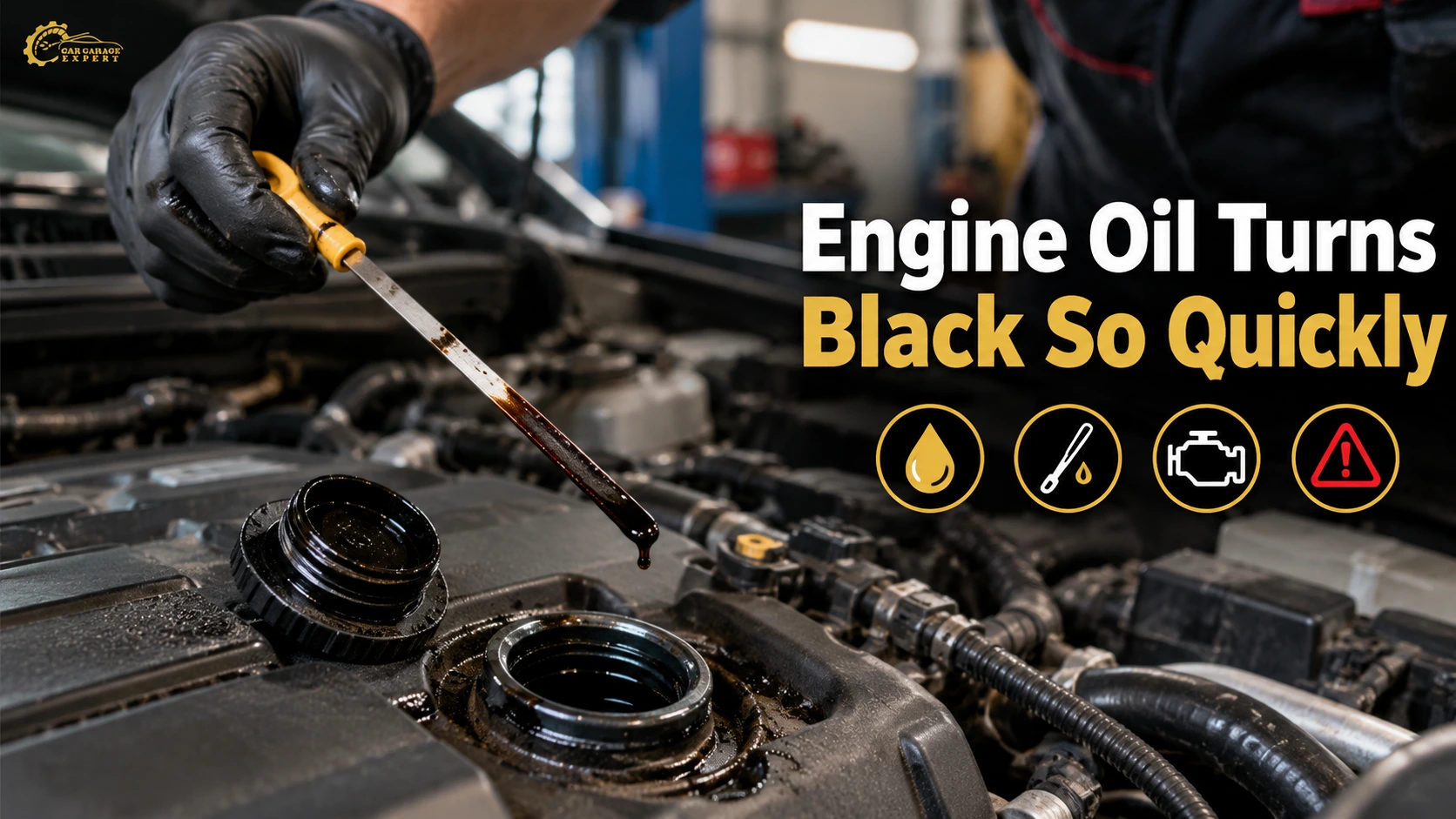
In most cars, the engine oil turns black after a few hundred kilometers, and that is typically normal. Modern oils have cleaning ingredients that catch soot and old deposits and hold them suspended. Dark oil implies the additives are working. If the oil feels gritty, smells of petroleum, looks thick like tar, or the level drops, it becomes an issue. Common culprits are old sludge from overdue changes, a blocked PCV valve, damaged piston rings and long idling in Dubai traffic. A spot test and a mechanic’s check will determine whether your oil is just dark or truly dirty.
Table of Contents
- What It Really Means When Engine Oil Turns Black
- Signs Your Dark Engine Oil Is Actually Dirty
- Why New Engine Oil Goes Dark So Fast: The Main Causes
- How a Mechanic Checks Whether Black Oil Is a Problem
- Services That Fix Dirty Engine Oil After Replacement
- What Happens If You Ignore Contaminated Engine Oil
- Is It Safe to Drive When Engine Oil Turns Black?
- How Long the Oil Service and Related Repairs Take
- What Affects the Cost of Fixing Black Engine Oil in Dubai
- How to Keep Engine Oil Cleaner for Longer
- Why Dubai Driving Makes Engine Oil Darken Faster
- Why Choose Car Garage Expert for Engine Oil Change in Dubai
- FAQs
- Related Services for Oil and Engine Care
- Book an Oil Check Before Small Deposits Become Sludge
What It Really Means When Engine Oil Turns Black
Fresh engine oil is golden or light amber. It does not stay that way for long. Every time the engine runs, a tiny amount of soot and burnt fuel slips past the pistons and into the oil.
Good oil is designed to handle this. It contains detergents and dispersants. These additives pick up soot and carbon and keep them floating in the oil. The filter catches the bigger bits. The fine soot stays in the oil until the next change, and that soot is what makes it look black.
So when engine oil turns black quickly, the color itself doesn’t mean the oil has failed. What matters more is how it feels and smells and whether it stays at the right level. Usually, good oil is thin, smooth, and dark at the proper level. But thick, gritty, or fuel-smelling oil is not.
Signs Your Dark Engine Oil Is Actually Dirty
Dark oil is common. Dirty oil that needs attention shows other signs too. Pull the dipstick with the engine off and warm, and look for these:
- The oil feels gritty or sandy when you rub it between your fingers.
- It is thick, sticky, or looks like tar.
- It smells strongly of petrol.
- You see shiny metal flecks in it.
- The level has dropped since the last change.
- Brown sludge appears under the oil filler cap.
Some signs show up while you drive. The oil warning light may flicker at idle. The engine may sound louder or tick on a cold start. You might also see blue-grey smoke from the exhaust.
If you notice two or more of these, book a check at a trusted garage near me instead of waiting for the next service.
Try the White Paper Spot Test
This simple test shows more than the dipstick alone. It costs nothing and takes a few minutes.
Warm the engine, switch it off, and wait five minutes. Put one drop of oil from the dipstick onto plain white paper or a coffee filter. Leave it for an hour, then look at the spot:
- A wide, even spread with a light outer ring: the oil is dark but healthy.
- A dark center with a thin, clear outer ring: soot is building up; plan a change soon
- A thick black dot that barely spreads: the oil is overloaded and needs changing now
- A yellow or milky ring: possible coolant in the oil; see a mechanic quickly
Take a photo of the paper. It helps your mechanic judge the oil before even opening the bonnet.
Why New Engine Oil Goes Dark So Fast: The Main Causes
A handful of causes can be the reason of engine oil turns black, and most are easy to fix. Some are normal for your engine type. Others point to a part that needs attention.
Old Deposits Left From Past Oil Changes
An oil change drains most of the old oil, but not all of it. Around 10 to 15 percent stays in the oil passages, cooler, and turbo. If earlier changes were late, the engine walls also carry old carbon. New oil starts cleaning that carbon off straight away, so it goes dark within 100 to 300 km.
Diesel and Direct Injection Engines
Diesel engines make a lot of soot. Their oil often turns black after a single drive, which is normal. Petrol engines with direct injection, often badged GDI, TSI, TFSI, or similar, also make more soot than older engines. Expect their oil to darken within 500 to 1,000 km.
A Blocked PCV Valve
The PCV valve permits gases from inside of the engine to escape and be burnt. When it clogs, the gases are trapped. Oil picks up moisture and soot, which makes it dark and sludgy faster.
Worn Piston Rings or Valve Stem Seals
Piston rings seal the gap between the piston and the cylinder wall. When they wear, more burnt gas leaks past into the oil. This is called blow-by. Worn valve stem seals can also let oil burn in the cylinders. Both make oil darken quickly and drop in level.
Too Much Idling and Short Trips
Oil needs to get fully hot to burn off moisture and fuel. Short trips never get it there. Long idling with the AC running is also hard on oil, because the engine works but the car hardly moves. Fuel and water stay in the oil and speed up the darkening.
Cheap Oil, Wrong Grade or a Poor Filter
Low-grade oil has fewer additives, so it breaks down faster when it gets hot. Oil that does not meet your carmaker’s spec may not suit your engine. A cheap filter can clog early and open its bypass valve. When that happens, oil flows around the filter without being cleaned.
Rich Fuel Mixture
A faulty oxygen sensor, leaking injector, or dirty air filter can make the engine burn too much fuel. Extra soot ends up in the oil. You may also notice worse fuel use or a check engine light.
Engine Oil Turns Black: Color and Cause Compared
Use this table to match what you see on the dipstick with the likely reason and the next step.
| What You See | Likely Reason | What to Do |
| Dark but smooth and thin | Additives holding normal soot | Nothing, keep to your schedule |
| Black within one drive (diesel) | Normal diesel soot | Nothing, use diesel-rated oil |
| Dark within 300 km after a late change | Old deposits being cleaned out | Do a short-interval change |
| Black, thick and sludgy | Overdue changes or blocked PCV valve | Change oil, check PCV valve |
| Black with a petrol smell | Fuel in the oil from short trips or a rich mixture | Check injectors and sensors |
| Black and level dropping | Worn rings or valve seals | Compression or leak-down test |
| Gritty to the touch | Dust past the air filter or engine wear | Replace air filter, inspect engine |
| Milky or light brown | Coolant in the oil | Stop driving, check head gasket |
How a Mechanic Checks Whether Black Oil Is a Problem
A good engine oil contamination check goes beyond the color. A mechanic looks at feel, smell, level, and what is happening inside the engine. These are the usual steps:
- Check the oil level and how much has been added since the last change.
- Rub the oil between the fingers and do a spot test on white paper.
- Smell the dipstick for fuel and look for a milky color.
- Remove the oil filler cap and look for sludge underneath.
- Inspect the old filter and the air filter for dirt and damage.
- Test the PCV valve and its hoses for blockage.
- Scan the engine for fault codes, such as a rich mixture or misfires.
- Run a compression or leak-down test if you suspect blow-by.
For a deeper answer, some owners send an oil sample to a lab. The report shows levels of fuel, coolant, dust, and metal. Most of these checks take under an hour at a workshop. A skilled car mechanic can usually tell you on the same visit whether the dark color is normal.
Services That Fix Dirty Engine Oil After Replacement
The fix depends on why the engine oil turns black. Changing the oil repeatedly without finding the cause costs money.
A Proper Oil and Filter Change
Fresh oil that meets the spec in your owner’s manual is the first step. Look for the right grade, like 5W-30 or 0W-20, and the carmaker’s approval code. A quality filter matters just as much. You should also replace the drain plug washer.
A Short-Interval Cleaning Change
A mechanic may propose two changes close together if the engine contains old deposits. The initial oil run is 1,000 to 1,500 km, and it picks up the loose carbon. The second change takes that away. It’s easier than a harsh chemical flush.
Engine Flush, Only When Needed
A flush is a cleaning liquid added to the old oil before draining. It can help in a badly sludged engine. On a high-mileage engine, it can also loosen chunks that block small oil passages. Ask the mechanic to explain why the engine needs one before agreeing.
PCV Valve and Breather Hose Replacement
Replace a blocked PCV valve and any cracked or oily hoses. On many cars, this is a small part and a quick job. It often makes the next oil stay cleaner for much longer.
Air Filter and Fuel System Service
A fresh air filter keeps the dust out. If the engine is running rich, the mechanic might clean the injectors or replace a bad oxygen sensor. Fixing the fuel mixture decreases soot that gets into the oil.
Engine Repair for Blow-By
If tests show worn rings or valve seals, the engine needs a bigger repair. You can sometimes replace valve stem seals without removing the engine. Piston rings usually mean opening up the engine.
What Happens If You Ignore Contaminated Engine Oil
Leaving dirty oil in the engine slowly wears it out. When engine oil turns black and also turns thick, it stops flowing well on cold starts. Parts run with less protection for those first few seconds.
Sludge can block the oil pickup screen and the small passages to the turbo and camshafts. A turbo starved of oil can fail and cost AED 3,000 to 8,000 or more to replace. Timing chains can stretch and rattle.
Fuel in the oil thins it and weakens the film between metal parts. Coolant in the oil is worse and can quickly ruin bearings. Leaving any of these too long can end with a full engine rebuild or replacement.
Is It Safe to Drive When Engine Oil Turns Black?
Yes, in most cases. If the oil is dark but smooth and at the right level, keep driving normally and stick to your service schedule.
Stop driving and get help if:
- The red oil pressure light comes on.
- The oil looks milky or like coffee with cream.
- The engine knocks or rattles.
- Thick smoke comes from the exhaust.
In these cases, turn off the engine and call for roadside assistance. Driving on with low oil pressure can seize the engine. If the oil is just overdue and you cannot get to a workshop, a mobile car mechanic can do the oil change at your home or office.
How Long the Oil Service and Related Repairs Take
A standard oil and filter change takes 30 to 45 minutes. A full oil check with a spot test and sludge inspection adds about 20 minutes.
PCV valve replacement takes 30 minutes to 2 hours, based on where the valve sits. An air filter change takes about 10 minutes. Injector cleaning takes 1 to 3 hours.
Compression and leak-down tests take about 1 hour. If the engine needs new valve stem seals or piston rings, plan for 2 to 5 working days. Lab oil analysis usually returns results in 3 to 7 days.
What Affects the Cost of Fixing Black Engine Oil in Dubai
Your cost depends on the cause, your engine size, and the oil type. A small 4-cylinder engine needs about 4 liters. A large V8 can need 8 liters or more, and some European cars need special approved oil. Labor also rises if parts are hard to reach.
Rough Dubai market prices, parts and labor included:
- Oil and filter change, fully synthetic: AED 150 to 450 for most cars
- Oil change for large or European engines: AED 400 to 900
- Air filter replacement: AED 60 to 250
- PCV valve replacement: AED 150 to 700
- Engine flush added to an oil change: AED 80 to 200
- Injector cleaning: AED 300 to 800
- Compression or leak-down test: AED 150 to 350
- Lab oil analysis: AED 100 to 300
- Valve stem seal or piston ring repair: AED 2,500 to 9,000
Prices vary by model and workshop. Ask what oil grade and filter brand they use before the work starts.
How to Keep Engine Oil Cleaner for Longer
You cannot stop oil from darkening, but you can keep it from turning into sludge. Follow the “severe service” interval in your owner’s manual. Most Dubai driving counts as severe because of heat, idling, and dust.
For many cars, that means changing fully synthetic oil every 5,000 to 7,500 km or every 6 months. Use oil with your carmaker’s approval code, not just the right number on the bottle. Ask for a good-quality filter each time.
Replace the air filter at least once a year, or more often if you drive near sandy or industrial areas. Have the PCV valve checked at every second service.
Try to drive for 20 minutes or more at least once a week so the oil fully heats up. Avoid idling the engine for long periods. Booking a car service package in Dubai that includes oil, filters, and a full inspection keeps all these jobs on one schedule.
Why Dubai Driving Makes Engine Oil Darken Faster
Dubai is hard on engine oil. In a 45°C summer, engine bay temperatures in slow traffic climb well above 100°C. Heat speeds up oxidation, which thickens oil and darkens it.
Stop-start traffic on roads like Sheik Zayed Road and Al Khail Road means long idling with the AC on. The engine runs for hours but covers few kilometers. Your trip meter may show 5,000 km, while the oil has done the work of far more.
Fine sand and dust also get in through a tired air filter. Once inside, they mix with oil and act like sandpaper. This is why engine oil turns black and gritty faster here than the service sticker suggests.
For Dubai owners, a mid-interval oil check every 2,500 km is a smart habit. Car Garage Expert in Al Quoz is a good place to get that check and an engine oil change when it is due.
Why Choose Car Garage Expert for Engine Oil Change in Dubai
An oil change is only useful if you use the right oil and filter. A good workshop shows you the old oil, explains what it found, and uses oil that matches your carmaker’s approval.
The workshop is based in Al Quoz, near Sheik Zayed Road and Al Khail Road. Drivers can book oil changes and engine checks via WhatsApp, saving time for busy owners. The workshop also handles related jobs in one visit, from PCV valves and filters to engine diagnostics. For drivers who want their engine oil change done properly, it is a practical choice.
FAQs
Q1: Why is my new oil already black?
Old deposits left in the engine mix with the new oil. Diesel and direct injection engines also darken oil quickly. If the oil is smooth and at the right level, it is usually normal.
Q2: Is black engine oil bad for the engine?
Not always. Dark oil that is thin and smooth is still protecting the engine. Black oil that is thick, gritty, or smells of fuel needs to be changed.
Q3: How fast should engine oil turns black?
Diesel oil can go black in one drive. Most petrol engines darken within 1,000 to 3,000 km. Older engines with deposits can darken within 300 km.
Q4: Does an engine flush help black oil?
It can help an engine with heavy sludge. For most cars, two oil changes close together are a safer way to clean out deposits.
Q5: Can dirty oil cause engine knocking?
Yes. Thick or low oil cannot protect the bearings and timing chain well. Get it checked quickly if you hear knocking.
Q6: How often should I change oil in Dubai?
Most cars in Dubai do best with an oil change every 5,000 to 7,500 km or 6 months. Check the severe service interval in your manual.
Q7: What does milky engine oil mean?
Milky oil usually means coolant is mixing with it. A failing head gasket or oil cooler is the common cause. Stop driving and see a mechanic.
Related Services for Oil and Engine Care
Black oil often prompts other checks during the same visit. Air filter and cabin filter replacement go well with any oil change. Injector cleaning helps if the engine is running rich. An engine diagnostic scan can catch faulty sensors before they add more soot to the oil.
Oil changes also leave owners time to sort out small cosmetic jobs. If your bumper or bonnet has scratches or faded paint, a car painting service can fix them during the same visit.
Book an Oil Check Before Small Deposits Become Sludge
If your engine oil turns black within days of a change, a quick check will show whether it is normal or a warning sign. Book an inspection or engine oil change with Car Garage Expert in Al Quoz. Send a photo of your dipstick or spot test on WhatsApp, or get directions on Google Maps.