A car’s interior tells the story of how it’s been lived in. The driver’s seat bolster compressed and cracked from repeated entry and exit. The steering wheel leather worn smooth at the grip points. Dashboard panels faded and surface-cracked from years of Dubai’s UV exposure through the windshield. Door card fabric lifting at the corners from humidity cycling between the air-conditioned cabin and 45°C exterior temperatures.
Car upholstery Dubai services exist to reverse this story — restoring interiors that have aged in Dubai’s specific conditions back to a standard that makes the car feel like what it was when new, or in many cases better.
The transformation is often more significant than owners expect. A cabin that felt tired and worn drives differently after professional upholstery restoration — not mechanically, but in the quality of the daily experience. The tactile connection to the materials, the visual quality of the space, and the sense of ownership that comes from a well-maintained interior all improve together.
Car Upholstery Dubai — Why Dubai Ages Interiors Faster Than Most Markets
Dubai’s specific environment creates interior wear patterns that European and American vehicles weren’t specifically designed to resist at the rate UAE conditions produce.
UV radiation through glass is the primary accelerant. Dubai’s UV index is among the highest globally — and despite the protection of window tinting that’s common on UAE vehicles, UV radiation still passes through glass and attacks interior surfaces consistently over years. Dashboard plastics become brittle and develop surface cracks. Leather dries out as UV breaks down the conditioning compounds in the surface treatment. Fabric fades from consistent UV exposure across any surfaces that receive direct light.
Heat amplifies the UV damage. Parked cabin temperatures in Dubai summer regularly exceed 70°C. At these temperatures, plastics off-gas, leather oils evaporate faster than they can be replenished through normal use, and adhesives that bond door card fabrics and trim panels lose their grip. The expansion and contraction cycle as the cabin heats and cools daily stresses every bonded joint and seal in the interior.
Sweat, sunscreen, and body oils transfer to leather surfaces with greater frequency in Dubai’s heat — more perspiration contact accelerates the breakdown of leather surface coatings and changes the material’s surface chemistry in ways that cause cracking and colour loss faster than in cooler climates.
What Car Upholstery Dubai Services Actually Cover
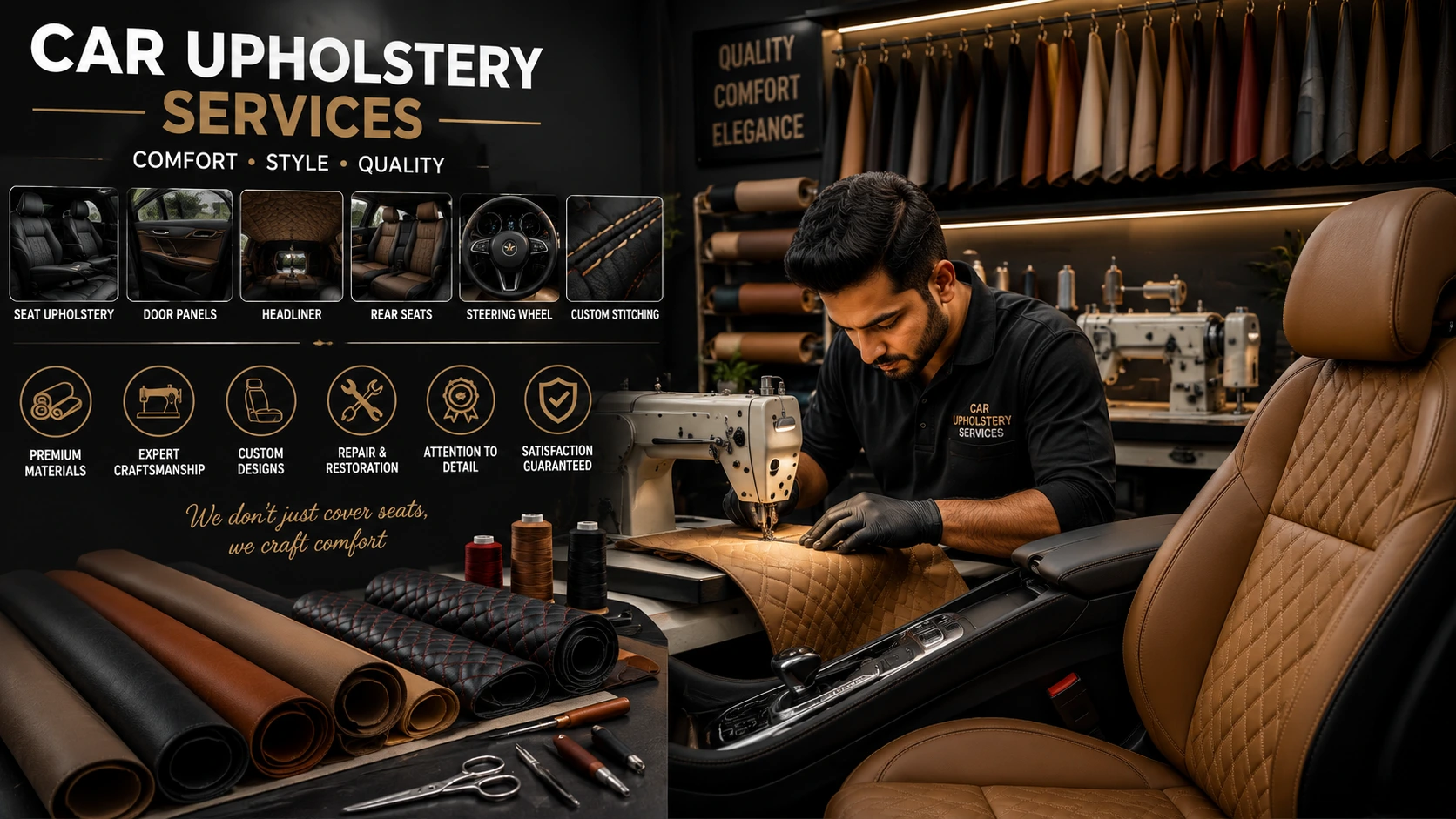
Car upholstery Dubai covers a wider range of services than most owners initially associate with the term. The full scope extends from targeted seat restoration to complete cabin transformations.
Leather Seat Restoration
Leather seat restoration is the most common car upholstery Dubai service — addressing the cracking, fading, colour loss, and surface damage that Dubai’s conditions produce faster than in other markets.
The restoration process begins with deep cleaning — removing accumulated body oils, sunscreen residue, and surface contamination that a standard car wash never reaches. Surface contamination must be fully removed before any repair or recolouring work begins — new material applied over contaminated leather fails faster than the original surface damage.
After cleaning, surface cracks are assessed for depth and extent. Shallow surface cracking in the leather’s top coat is addressable through flexible filler compounds that fill the crack network and create a smooth surface for recolouring. Deep cracks that have penetrated through the top coat into the leather substrate require more intensive filling and possibly section replacement if the structural integrity of the seating surface has been compromised.
Colour Matching and Recolouring
Leather recolouring uses the vehicle’s original colour code where available — but colour matching on aged leather requires more than mixing to the original specification. Leather that has spent three years in Dubai’s UV environment has faded slightly from its original shade. A recolour matched exactly to the new-leather specification will appear slightly different from the surrounding original surfaces.
Correct recolouring technique for aged leather involves adjusting the colour mix to match the current aged shade, applying multiple thin coats to build depth without the heavy painted appearance of a single thick application, and blending into surrounding original surfaces where the recolouring meets unrestored areas.
Finishing Compounds and UV Protection
The recoloured surface is finished with a protective top coat — the quality of which determines how long the restoration holds in Dubai’s conditions. A UV-resistant top coat that’s appropriate for Dubai’s solar intensity maintains the restored colour and surface integrity significantly longer than standard finishing compounds designed for temperate markets.
A proper car upholstery Dubai leather restoration includes UV-resistant finishing as standard — not as an optional upgrade. In Dubai’s UV environment, finishing without UV protection means the restoration starts degrading from the first summer afternoon.
Steering Wheel Restoration
The steering wheel is the highest-contact leather surface in the vehicle — and the one that shows wear fastest. The grip points at nine and three o’clock develop the characteristic smooth, worn appearance faster than any seat surface because of the combination of consistent mechanical contact and the transfer of hand oils and perspiration.
Steering wheel restoration follows the same sequence as seat leather restoration — deep cleaning, crack filling where present, recolouring, and UV-protective finishing. The additional consideration for steering wheels is the heat they reach when parked — a steering wheel in a Dubai summer reaches temperatures that make it uncomfortable to touch immediately after entry, and these temperature extremes accelerate surface deterioration.
For higher-specification vehicles with heated steering wheel elements, the restoration process must avoid introducing moisture or solvent chemicals into the heating element connection areas — a car upholstery Dubai specialist working on these vehicles understands the additional care the heated element requires during the restoration process.
Dashboard and Trim Panel Restoration
Dashboard surface cracking in Dubai is the result of UV radiation and heat cycling breaking down the plasticiser compounds in the vinyl or leather dashboard material. As plasticisers evaporate under sustained heat and UV exposure, the surface becomes brittle and develops a network of fine cracks — initially superficial, eventually structural.
Car upholstery Dubai dashboard restoration addresses surface cracking through vinyl repair compounds that restore flexibility to the affected areas, preparation processes that clean and key the surface correctly, and recolouring that restores the dashboard’s original appearance.
The challenge with dashboard restoration is the large, complex surface area involved — multiple curves, vents, speaker grilles, and trim inserts all in close proximity to the damaged surfaces. A specialist with dashboard restoration experience works around these components correctly. A non-specialist causes trim damage trying to mask or remove components that should have been worked around.
Alcantara and Suede Inserts
Higher-specification vehicles in Dubai’s market often feature Alcantara or suede dashboard and trim inserts alongside leather. These materials require different restoration approaches from leather — specific cleaning products that maintain the nap of the suede surface, brushing techniques that restore the material’s tactile quality, and recolouring where fading has occurred.
A car upholstery Dubai specialist handles both leather and Alcantara correctly — using the appropriate product chemistry for each material type rather than applying the same treatment across everything.
Door Card and Panel Restoration
Door card fabric lifting at corners and edges is the most common door panel fault in Dubai. The heat cycling causes the adhesive bonding fabric to the door card substrate to lose its grip — the fabric lifts progressively, eventually pulling free from the panel entirely.
Correct repair involves releasing the remaining adhesive contact, cleaning both the fabric and substrate surfaces completely, applying fresh contact adhesive with the correct coverage and cure time, and repositioning the fabric correctly before pressing.
The critical quality indicator in door card fabric re-adhesion is the adhesive selection and application technique. Contact adhesive applied too thinly fails under the first hot day. Adhesive applied with insufficient coverage leaves unbonded areas that lift progressively. A car upholstery Dubai specialist applies the correct adhesive with complete coverage to both surfaces and allows the correct open time before contact — producing a bond that holds through Dubai’s temperature extremes.
Leather Door Card Panels
Vehicles with leather door card panels develop the same cracking and colour loss as seat leather. Restoration follows the same process — cleaning, filling, recolouring, and UV-protective finishing. The additional challenge on door panels is panel removal — accessing the full panel surface for restoration often requires door trim removal to reach edges and lower sections correctly.
Fabric Seat Deep Cleaning and Restoration
Fabric-seated vehicles in Dubai’s market develop specific soiling patterns from the combination of sweat, sunscreen, and general use in a hot climate. Standard car washes clean surface contamination but don’t penetrate the fabric pile to address the embedded body oil residue that accumulates over years of use.
Professional fabric deep cleaning uses heated extraction equipment — applying cleaning solution under pressure, agitating the fabric pile, and extracting both the cleaning solution and the embedded contamination. This process restores the fabric’s colour uniformity and removes the odour that develops from embedded biological material.
For fabric seats that have reached the point where cleaning can’t restore acceptable appearance, re-trimming in matching or upgraded fabric is the correct solution. A car upholstery Dubai specialist sources fabric matched to the original specification for vehicles where continuity matters, or provides upgraded options for owners wanting an improvement on the original material.
Headliner Restoration and Replacement
The headliner — the fabric panel covering the vehicle’s roof interior — sags in Dubai’s heat as the foam backing delaminates from the base substrate under sustained thermal cycling. The characteristic headliner droop that affects older vehicles is the foam backing separating, allowing gravity to pull the covering material away from the roof structure.
Car upholstery Dubai headliner restoration involves removing the headliner panel from the vehicle, stripping the delaminiated foam and original fabric, applying new foam backing to the substrate where needed, and recovering with matching or upgraded headliner fabric using proper contact adhesive with complete surface coverage.
Headliner replacement is more complex than it appears — the headliner panel has multiple penetrations for sunroof apertures, interior lighting, sun visor attachments, and grab handle mounting points. All of these must be correctly cut, positioned, and re-attached after the covering is applied.
Full Interior Transformation — When Restoration Becomes Upgrade
Some car upholstery Dubai clients aren’t looking to restore the original interior — they’re looking to upgrade it. A factory cloth interior replaced with full leather. A standard leather colour replaced with a custom colour not offered from the factory. A sports car equipped with Alcantara inserts in the OEM seat centres.
These transformations are within the scope of professional car upholstery Dubai work when approached correctly — the key is material quality selection, correct pattern development from the original seat profile, and the precision cutting and sewing that determines whether the finished result looks factory-correct or custom.
Material Selection for Dubai’s Climate
Material selection for an upgraded interior in Dubai should account specifically for the climate. Full-grain natural leather develops a patina in Dubai’s heat and UV that some owners appreciate as part of the material’s character — but it requires more active conditioning maintenance than semi-aniline or protected leather grades.
Semi-aniline and pigmented leather grades with UV-stable protective coatings are more practical choices for Dubai’s conditions — they require less maintenance conditioning, resist UV fading more effectively, and hold their surface integrity better through the temperature extremes of Dubai’s seasonal cycle.
Perforated leather is a practical choice for Dubai’s climate specifically — the perforation allows air circulation between the occupant and the seat surface, reducing the heat build-up that makes leather seats uncomfortably hot after parking in full sun.
Custom Colour and Stitching Options
A car upholstery Dubai full re-trim allows colour combinations not available from the factory. Contrasting stitching in a complementary colour. Two-tone seat centre and bolster colour combination. Alcantara seat centres with leather bolsters. All of these are achievable with the correct pattern development and material sourcing.
The quality of the finished result depends on the precision of the pattern cutting — a pattern developed from the original seat profile produces a finished seat that fits correctly, with stitching lines that run straight, seams that align across the seat, and a finish that looks intentional rather than improvised.
Combining Upholstery with Other Services
Car upholstery Dubai work is most efficiently combined with other maintenance or repair visits — the car is already at the workshop, and combining interior work with mechanical service avoids separate appointments.
A complete car service alongside interior restoration addresses both the mechanical and cosmetic condition of the vehicle in one visit. A qualified car mechanic assesses any mechanical concerns identified during the interior inspection — a sunroof that’s been leaking, for example, produces water damage in the headliner that the upholstery restoration will address, but the leak itself needs the mechanical fix.
For exterior paintwork alongside interior restoration, professional car painting handles colour-matched exterior repairs at the same workshop visit — bringing the vehicle’s full presentation back to a consistent standard inside and out.
For owners needing initial on-site assessment, a mobile car mechanic can attend the vehicle’s location and advise on the extent of interior damage and appropriate restoration scope. For owners in Al Quoz and surrounding areas looking for a garage near me that handles both interior upholstery and full vehicle servicing — combining both at one workshop visit saves time and ensures the interior restoration is completed alongside any mechanical items identified during the service inspection.
When recovery or transport is needed, proper roadside assistance ensures the vehicle arrives at the workshop without additional interior damage during transport.
FAQ
How long does car upholstery restoration take in Dubai?
Targeted seat restoration typically takes one to two days. Full interior re-trimming including seats, door cards, dashboard, and headliner can take three to five days depending on scope.
Can cracked leather seats be fully restored or do they need replacing?
Most cracked leather is restorable through filling and recolouring — full replacement is only needed when the leather has torn through structurally or the foam padding beneath has collapsed.
Does car upholstery restoration in Dubai include UV protection?
A quality restoration should include UV-resistant finishing as standard — in Dubai’s solar intensity, restoration without UV protection degrades significantly faster than the original untreated surface.
How do I know if my headliner needs restoration or full replacement?
Localised sagging from heat delamination in specific areas can often be re-adhered. Full-panel sagging where the foam has completely separated from the substrate typically requires full headliner removal and re-covering.
Is leather upholstery practical in Dubai’s heat?
Perforated leather is the most practical leather option — the perforation allows air circulation that reduces heat build-up. Semi-aniline and pigmented leather grades with UV-stable coatings require less maintenance conditioning than full-grain natural leather in Dubai’s conditions.
Conclusion
Car upholstery Dubai services transform interiors that Dubai’s specific conditions have aged — UV-cracked leather, heat-faded dashboard surfaces, lifting door card fabric, and sagging headliners — back to a standard that matches or exceeds the original. The transformation is both visual and tactile — the daily experience of a well-maintained interior is genuinely different from a worn one, and in Dubai’s market where vehicle presentation affects both ownership satisfaction and resale value, the investment in professional interior restoration consistently delivers.
Car Garage Expert in Al Quoz handles the full range of car upholstery services — leather seat restoration, steering wheel restoration, dashboard repair, door card re-adhesion, headliner replacement, and full interior re-trimming — for all makes. Book your appointment on WhatsApp or find the workshop on Google Maps.