Carnauba wax used to be the standard answer to “how do I get my car shining.” That answer has changed. Car polish in 2026 means something closer to a science than a Sunday afternoon chore — paint correction with dual-action polishers, nano-ceramic coatings that chemically bond to the clear coat, and a layered approach that protects the paint rather than just making it look temporarily glossy.
At Car Garage Expert in Al Quoz, we apply these current techniques with one adjustment that matters more in Dubai than almost anywhere else — everything we do accounts for UV intensity and heat that ages paint and coatings faster than in moderate climates.
Car Polish in 2026 — Why the Old Method Stopped Working
A traditional car polish with carnauba wax gave a deep, warm shine — and lost it within a few washes. That short lifespan made sense when wax was the only option. It makes less sense now that ceramic coatings exist, last years instead of weeks, and have become accessible enough that they’re no longer a $1,500 luxury reserved for showroom cars.
The shift isn’t really about chasing a trend. It’s that ceramic chemistry does something wax never could — it forms a hard, cross-linked layer that becomes genuinely part of the paint surface rather than sitting temporarily on top of it. In Dubai, where UV exposure and heat punish unprotected paint constantly, that difference matters more than the shine itself.
Car Polish — Paint Correction Comes Before Any Coating
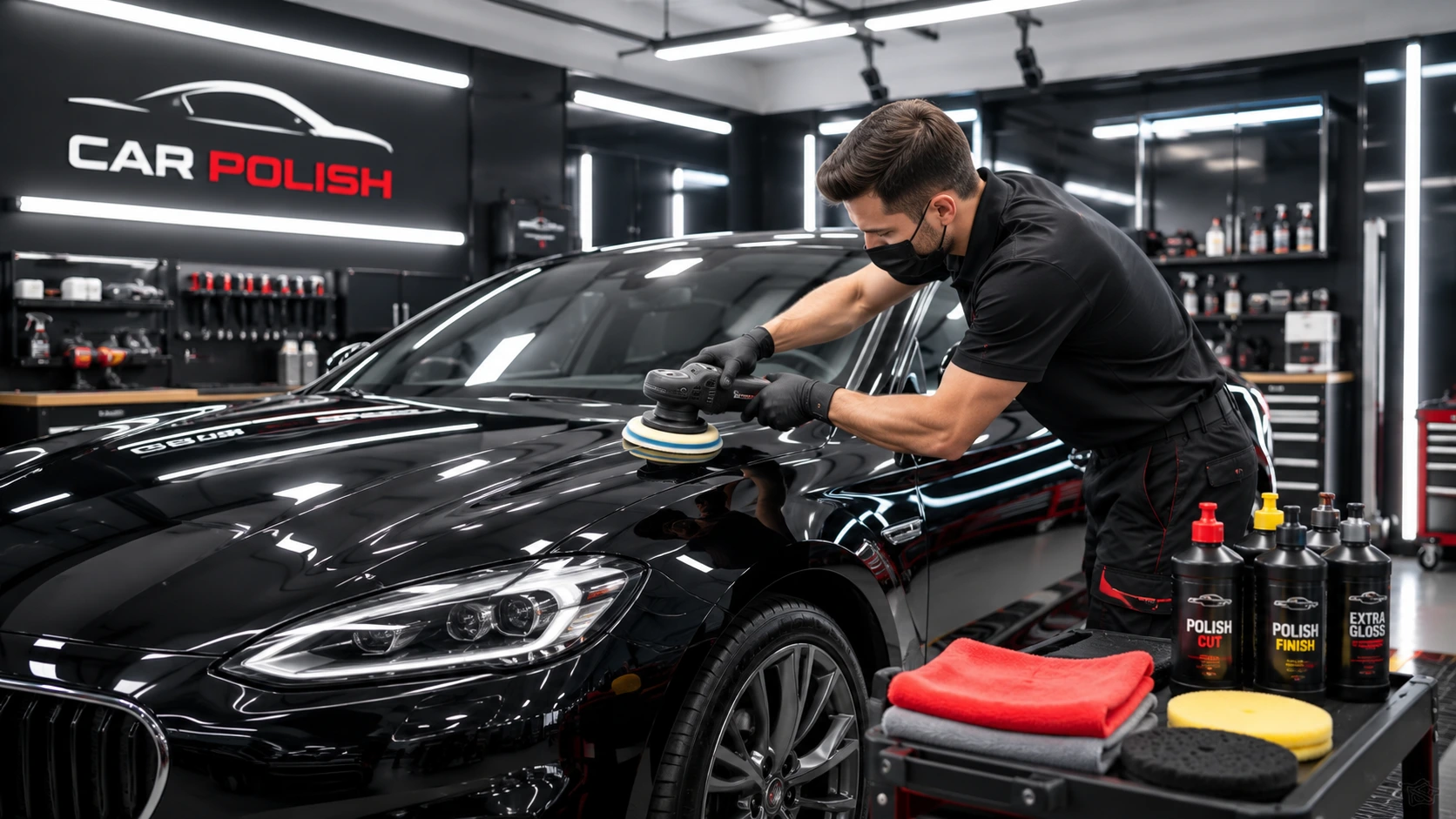
The detailing industry has settled on a clear rule for 2026: you can’t put a quality coating over a scratched or swirled surface and expect it to look right. Car polish in the modern sense starts with paint correction — using abrasive compounds and a polishing machine to remove existing imperfections before anything protective gets applied.
Dual-action polishers have replaced rotary buffers as the standard tool. Older rotary buffers spin in one direction only and can burn through clear coat in inexperienced hands. Dual-action (DA) polishers oscillate and rotate simultaneously, which makes them far safer on factory clear coat — particularly relevant in Dubai, where clear coat is already working harder against UV exposure than in cooler climates and doesn’t have margin to spare from an aggressive correction process.
Decontamination happens before correction, not after. A proper paint correction sequence starts with a two-bucket wash using pH-neutral shampoo, followed by iron decontamination to dissolve embedded brake dust and rail dust particles that a standard wash leaves behind, then a clay bar or synthetic clay treatment to shear off bonded contaminants like tar and tree sap. Skipping this step means polishing over contamination that gets dragged across the paint, creating new fine scratches in the process.
Scratch depth determines the correction approach. Not every scratch needs the same fix — a light surface swirl responds to a gentle polish, while deeper scratches need a more aggressive compound stage first. Treating every imperfection the same way either under-corrects deep damage or over-works panels that didn’t need it.
Ceramic Coating — What It Actually Does and What It Doesn’t
Ceramic coating has become the standard recommendation that replaces traditional wax in any serious car polish service, and understanding what it does — and doesn’t do — matters before committing to it.
The chemistry behind ceramic protection relies on nanotechnology — microscopic particles in the liquid penetrate the invisible pores in the clear coat and form a covalent bond, creating a hard layer that becomes a functional part of the surface rather than a film resting on top. Silicon Dioxide (SiO2) provides hardness and the hydrophobic water-beading effect; Titanium Dioxide (TiO2) is often added to boost gloss.
“9H hardness” is a real measurement, but it has limits. The rating refers to resistance on the pencil hardness scale and means the coating resists fine scratches and chemical etching — but it is not scratch-proof, and it won’t stop a stone chip or a deep keying scratch. For genuine impact protection, paint protection film (PPF) remains the better solution, and increasingly the two are used together: PPF on high-impact areas like the bonnet and front bumper, ceramic coating across the rest of the vehicle.
Tiered protection levels are now standard. Reputable providers in 2026 offer an entry-level ceramic, a mid-tier option, and a flagship multi-year coating — rather than pushing the most expensive option on every customer regardless of how the car is actually used and stored. A vehicle that’s garaged most of the time has a different protection need than one parked outdoors in Dubai sun seven days a week.
Graphene coatings are the newer alternative gaining attention, offering additional durability and notably better heat resistance than traditional ceramic formulas — a genuinely relevant advantage in Dubai’s climate specifically, where surface temperatures on dark-coloured panels can reach extremes that test any coating’s thermal stability.
Our car painting team carries out paint correction and ceramic application as a complete process — decontamination, correction, panel prep, and coating — not a quick spray-and-wipe shortcut.
Dubai’s Climate — What Changes for Paint Protection Here
UV intensity is the biggest factor that differentiates car polish care in Dubai from almost anywhere else. Unprotected paint here fades and oxidises within a single summer in a way that takes years in a temperate climate. A ceramic coating’s UV resistance isn’t a marketing bonus in this market — it’s the main reason to get one.
Heat cycling matters too. The daily swing between air-conditioned underground parking and exterior surface temperatures that can exceed 60°C on a dark panel puts genuine thermal stress on any coating. This is part of why curing protocol matters so much — a coating applied and cured correctly, in a controlled environment with the right temperature and humidity, bonds properly. One rushed in direct Dubai sun risks an uneven cure that fails early.
Sand and dust create a different problem than most markets face. A vehicle exposed to a haboob picks up fine abrasive particles across every panel — these create swirl marks if washed incorrectly afterward, which is why a proper decontamination wash before any polish or coating work matters more here than in cleaner-air climates.
Interior Protection — The Other Half of a Complete Detail
A complete car polish and protection service in 2026 increasingly extends inside the cabin. Interior ceramic coatings for leather and plastic surfaces are one of the fastest-growing detailing services, protecting against Dubai’s UV exposure through windows and the heat that dries out and cracks untreated leather and dashboard plastics over time. Matte-finish leather conditioners have also become preferred over older glossy formulas — nobody wants a slick, shiny seat surface in summer heat.
For owners doing regular family use or rideshare driving, interior protection has become as much a priority as exterior shine — the cabin takes daily wear that exterior paint doesn’t.
Maintenance — Why the Coating Doesn’t End the Conversation
A ceramic coating is not a one-time service that requires no further attention. The better detailing providers in 2026 build maintenance into the ownership experience — scheduled decontamination washes, topper applications when the hydrophobic effect starts to fade, and periodic inspections to check how the coating is actually performing rather than assuming it’s still working as installed.
This matters because real-world performance — water behaviour, gloss retention, how the surface responds to Dubai’s dust and heat — depends on how the coating is washed and maintained afterward, not just how it was applied. A coated car washed incorrectly with the wrong chemicals or technique degrades the coating faster than its rated lifespan suggests.
For any breakdown or mechanical issue alongside cosmetic work, our roadside assistance covers Al Quoz and nearby Dubai areas. For on-site assessment before bringing the car in, our mobile car mechanic covers Al Quoz and nearby Dubai areas. Our car service packages can be combined with paint correction and coating work in a single visit.
Finding Car Polish and Paint Protection in Al Quoz
If you’ve been searching for a garage near me in Dubai for proper paint correction, ceramic coating, or PPF work, Car Garage Expert is in Al Quoz — accessible from Business Bay, Barsha, Jumeirah, Satwa, Downtown, and the Sheikh Zayed Road corridor. For any mechanical work needed alongside cosmetic care, our car mechanic team handles both under one roof.
In Conclusion
Car polish in 2026 means paint correction with the right tools, ceramic or graphene coating chosen to match how the car is actually used, and ongoing maintenance that accounts for Dubai’s UV intensity and heat specifically. That combination protects the investment rather than just producing a temporary shine.
Car Garage Expert is in Al Quoz, serving drivers across nearby Dubai areas — Business Bay, Barsha, Jumeirah, Satwa, Downtown, and the Sheikh Zayed Road corridor. Book your appointment on WhatsApp and find us on Google Maps.
Car Garage Expert — Car Polish and Paint Protection | Al Quoz, Dubai