
Customer Complaint
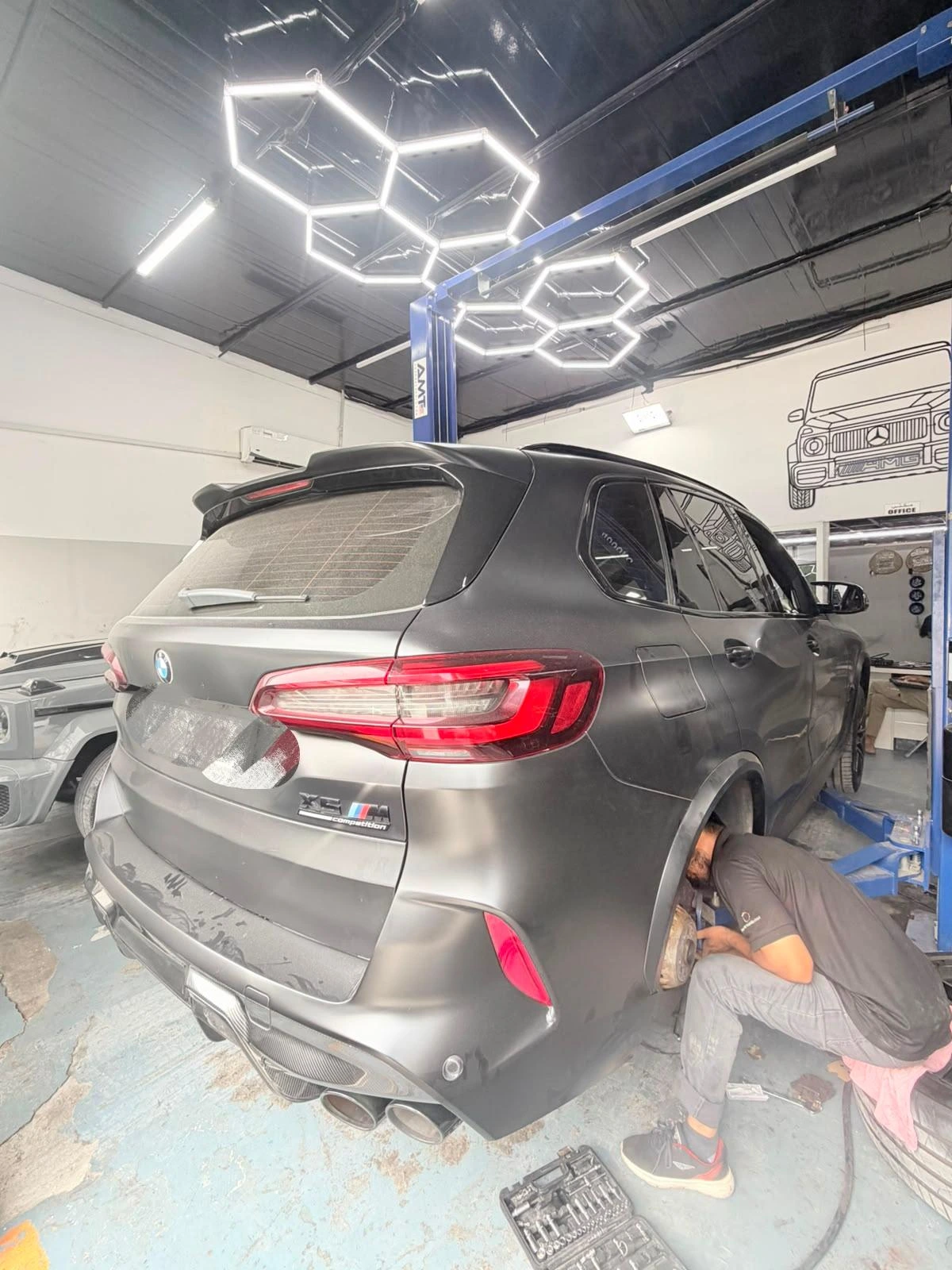
A BMW X5 M came into the workshop with a mix of concerns that, on the surface, looked like three unrelated issues. The owner’s main complaint was a noise coming from the rear brakes whenever the car slowed down. Alongside that, the dashboard was showing a service message, and a quick visual check during intake showed the engine oil level was found lower than it should have been.
None of that is unusual on its own for a car with this kind of mileage. But once the vehicle was properly connected to diagnostic equipment, a fourth issue surfaced that the customer hadn’t mentioned at all low voltage affecting both the main and auxiliary battery systems. On a car like the X5 M, that’s not a minor detail. These vehicles lean heavily on their electrical batteries to run everything from the suspension electronics to the driver assistance systems. Hence, a voltage problem left unchecked tends to cause knock-on issues elsewhere long before it becomes obvious to the driver.
The BMW X5 M had covered approximately 118,464 km at the time it came in for inspection.
Vehicle Details
| Detail | Information |
| Vehicle | BMW X5 M |
| Model Year | 2020 |
| Engine | S63 |
| Mileage | 118,464 km |
| Main Complaint | Rear brake noise |
| Additional Concern | Service message |
| Maintenance Finding | Low engine oil |
| Electrical Finding | Main & auxiliary battery voltage issue |
| Diagnostic Equipment | Autel MaxiSys Ultra |
The diagnostic scan covered 42 vehicle systems and returned 31 diagnostic trouble codes spread across several modules. That’s a wide net for what started as a simple brake noise complaint, and it’s a good example of why a full scan matters even when the customer’s description points to one specific area.
Diagnostic Inspection Of BMW X5

Rather than jumping straight to the rear brakes based on what the customer described, the car was connected to professional diagnostic equipment for a full electronic scan first. On a performance BMW X5 with this many interconnected modules, working from a complete picture avoids the common trap of fixing the obvious problem while missing the one that’s quietly getting worse in the background.
The scan specifically flagged the following:
- Engine oil service required
- Rear brake-pad wear sensor fault
- Several voltage-related and intermittent electrical faults
- Battery undervoltage recorded in the body domain controller.
- Voltage-supply degradation in the rear electric active roll stabilization system
- Similar voltage-supply degradation in the front electric active roll stabilization system
So the scan confirmed exactly what the customer had already noticed, but it also pulled back the curtain on the electrical issues that weren’t causing any obvious symptoms yet. That’s often how voltage problems work on modern BMWs — they sit quietly in the background until a module starts behaving oddly. By then, the battery has usually degraded further than anyone realizes.
Rear Brake Noise Diagnosis
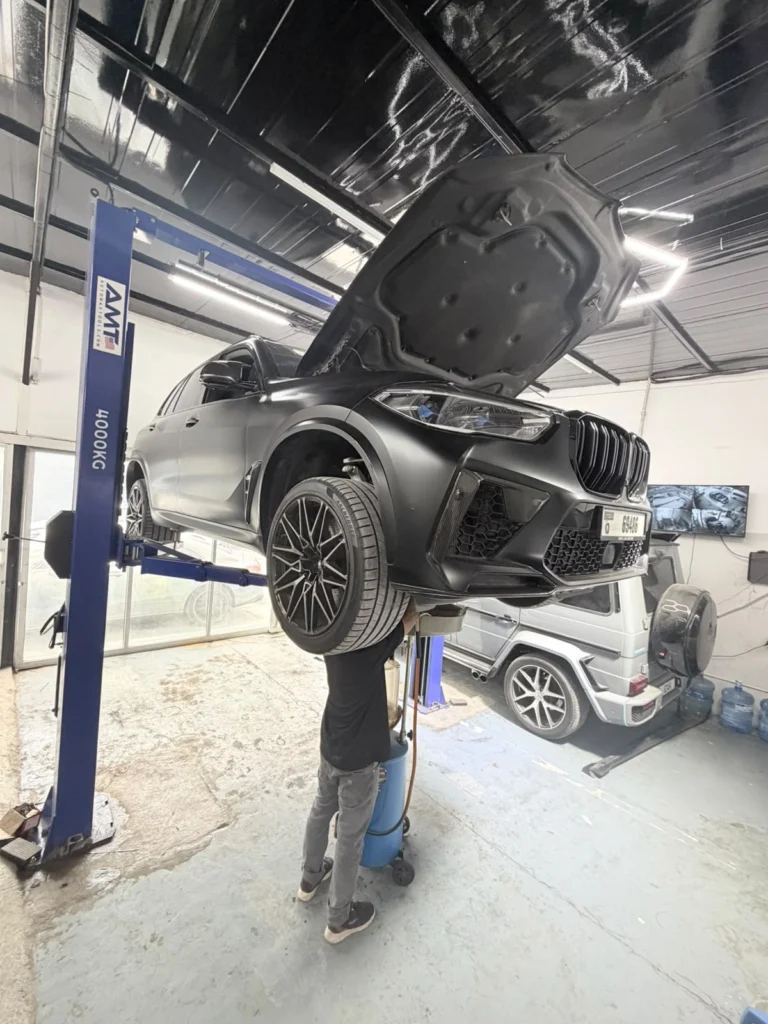
With the scan results in hand, attention turned to the rear brake system the customer had originally come in for. The diagnostic report pointed to a specific fault on the rear axle brake-pad wear sensor, which lined up with what the technician found on physical inspection — the rear pads had worn down to the point where replacement was overdue.
The work carried out on the brakes included:
- Rear brake pads replaced.
- Genuine brake-pad wear sensor installed
- Rear brake discs skimmed to restore a smooth, even braking surface.
- A full brake system check was carried out following the repair to confirm everything was seated correctly and functioning as expected.
Images from the workshop throughout the task show the BMW on the lift, the rear wheel off, and the brake assembly in clear view during the inspection and repair. Here it made sense to skim the discs rather than just replace them entirely as the rotors were still in a serviceable thickness and didn’t display the kind of scoring or warping that would call for full replacement.
Engine Oil Service
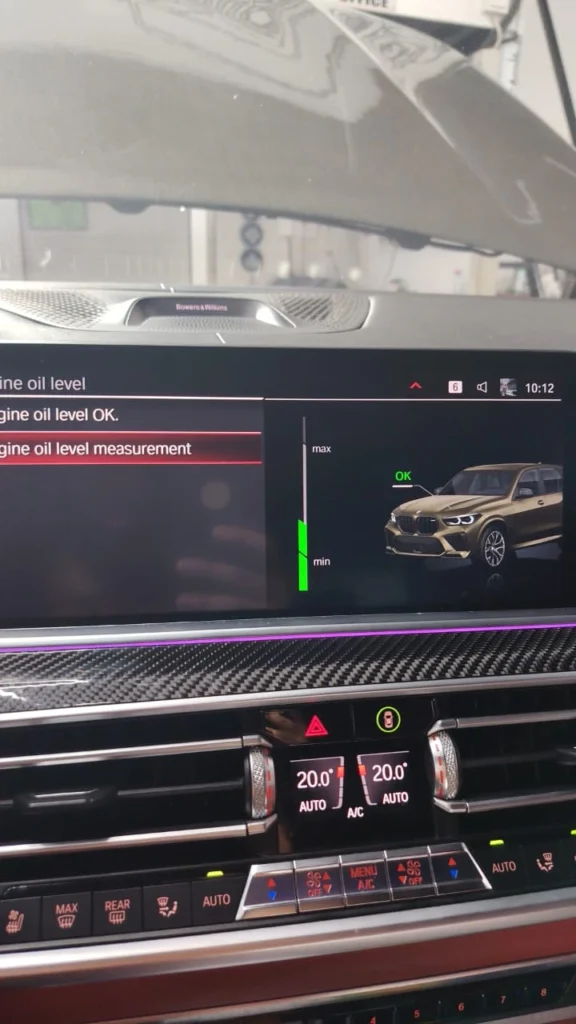
Alongside the brake work, the low oil level flagged during intake was addressed properly rather than just cleared from the dashboard. The diagnostic system had logged a permanent message indicating that an engine oil service was overdue, which matched what the technician found when checking the dipstick.
To take care of this, the workshop carried out a minor service that included:
- Engine oil change using the correct specification oil for the S63 engine
- Oil filter replacement
- Oil-level check and top-up to bring it back to the correct range
Note that some workshops take the shortcut of simply clearing a service notice on the dashboard without properly changing the oil, and that tends to catch up with the client later. Here, we actually changed the oil and filter that the alert was indicating, not just reset it.
Main & Auxiliary Battery Diagnosis
Probably the most significant finding during this inspection was the state of the vehicle’s battery systems. The diagnostic report recorded multiple undervoltage-related faults across different modules. The body domain controller, for instance, logged an intermittent undervoltage fault tied to the radio remote-control battery. At the same time, both the front and rear electric active roll stabilization systems recorded voltage-supply degradation.
Faults like these tend to be easy to overlook because they don’t always produce a warning light the driver notices day-to-day. Instead, they show up as odd, hard-to-pin-down symptoms a suspension system that feels slightly off, an infotainment system that resets randomly, or comfort features that stop working intermittently. By the time a driver notices something’s wrong, the underlying battery has usually been struggling for a while.
Based on the inspection, both battery systems were found to have degraded to the point where replacement was the right call rather than trying to nurse them along with a charge.
Main Battery
A genuine main battery matched to the vehicle’s specification was installed to replace the failing unit.
Auxiliary Battery
A genuine 60Ah auxiliary battery was also installed, since the auxiliary system had shown the same pattern of voltage degradation as the main battery.
Battery Adaptation & Calibration
Once both batteries were physically replaced, the systems were adapted and calibrated through the diagnostic tool. This step matters more than people realize on a modern BMW. Simply swapping in a new battery doesn’t finish the job, the vehicle’s battery management system needs to be told about the replacement so it can correctly track charge cycles, adjust charging behavior, and stop flagging false faults down the line. Skipping this step is one of the more common reasons a battery replacement doesn’t fully resolve the electrical symptoms a customer came in with.
Repairs Completed
Taken together, the BMW X5 M left the workshop having received:
Minor Service
- Engine oil replacement
- Oil filter replacement
Rear Brake Repair
- Genuine rear brake pads
- Genuine brake-pad sensor
- Rear disc skimming
Battery Replacement
- Genuine main battery
- Genuine 60Ah auxiliary battery
- Battery adaptation and calibration
Three separate concerns, tackled in a single visit, without the customer needing to book the car in again for issues that would likely have surfaced within weeks if left untouched.
Final Inspection
After all the work was done, the car was given a final check to make sure everything was as it had been asked and as the diagnostics had flagged. The rear brake components had been rebuilt and the discs scraped; the engine had been serviced for oil; and both batteries were fitted and appropriately integrated with the systems of the vehicle.
A final diagnostic scan indicated the vehicle’s MIL (malfunction indication lamp) was OFF, verifying that no fault codes remained active after the repairs.
Summary:
Customer Concern → Diagnosis → Solution
Customer Concern: Rear brake noise, a service warning message, and noticeably low engine oil.
Additional Finding: Low-voltage issues affecting both the main and auxiliary battery systems, uncovered only through a full diagnostic scan.
Diagnosis: A combination of professional electronic scanning and hands-on physical inspection identified the worn rear brake pads, confirmed the overdue oil service, and revealed several voltage-related faults across multiple modules.
Solution: Rear pads and the wear sensor were replaced, the discs were skimmed, the engine received a proper oil and filter change, and both batteries were replaced and correctly adapted to the vehicle’s electronic systems.
Result: The BMW left with its brake concern resolved, its scheduled maintenance brought up to date, and its electrical system stabilized — all handled in one workshop visit instead of being spread across multiple return trips.
Why This BMW X5 Case Matters
This case is a good reminder that a warning light or an unusual noise shouldn’t automatically be treated as a standalone issue. The owner’s original concern was the rear brake noise, and that alone would have been a fairly routine repair. But because the car went through a full diagnostic scan rather than a quick visual check limited to the brakes, the workshop also caught an overdue oil service and an electrical fault pattern that hadn’t yet turned into a noticeable problem for the driver.
Had the voltage issue gone unaddressed, it’s likely the customer would have been back within a matter of weeks with a different, more confusing complaint — perhaps a suspension warning, an intermittent electronics glitch, or a battery that wouldn’t hold charge overnight. Catching it early, while it was still traceable to a clear root cause, meant the fix could happen properly the first time instead of through a process of trial and error later on.
For high-performance BMWs in particular, the electrical demands are higher than on a standard model, which makes voltage issues both more likely to occur and more disruptive when they do. Pairing physical inspection with proper electronic diagnostics gives a much more complete picture of what’s actually going on under the surface, rather than treating each symptom in isolation.
BMW X5 M Repair at Car Garage Expert
This BMW X5 M case was worked through using a combination of full diagnostic scanning, hands-on mechanical inspection, genuine replacement parts, brake servicing, routine maintenance, and battery-system programming — not just a single fix aimed at the customer’s original complaint.
At Car Garage Expert, our approach starts with figuring out what’s actually wrong rather than replacing parts based on a guess or a single symptom. A brake noise complaint can sometimes be exactly that and nothing more, but in cases like this one, a proper scan often uncovers issues the driver hasn’t noticed yet — and dealing with them together, in one visit, tends to save both time and hassle down the line.
If your BMW is showing brake noise, a service warning, battery problems, low voltage symptoms, or is due for routine maintenance, a full diagnostic inspection is the right place to start. Reach out to Car Garage Expert for professional BMW diagnostics, servicing, brake repair, and battery replacement handled by technicians who work on these vehicles every day.