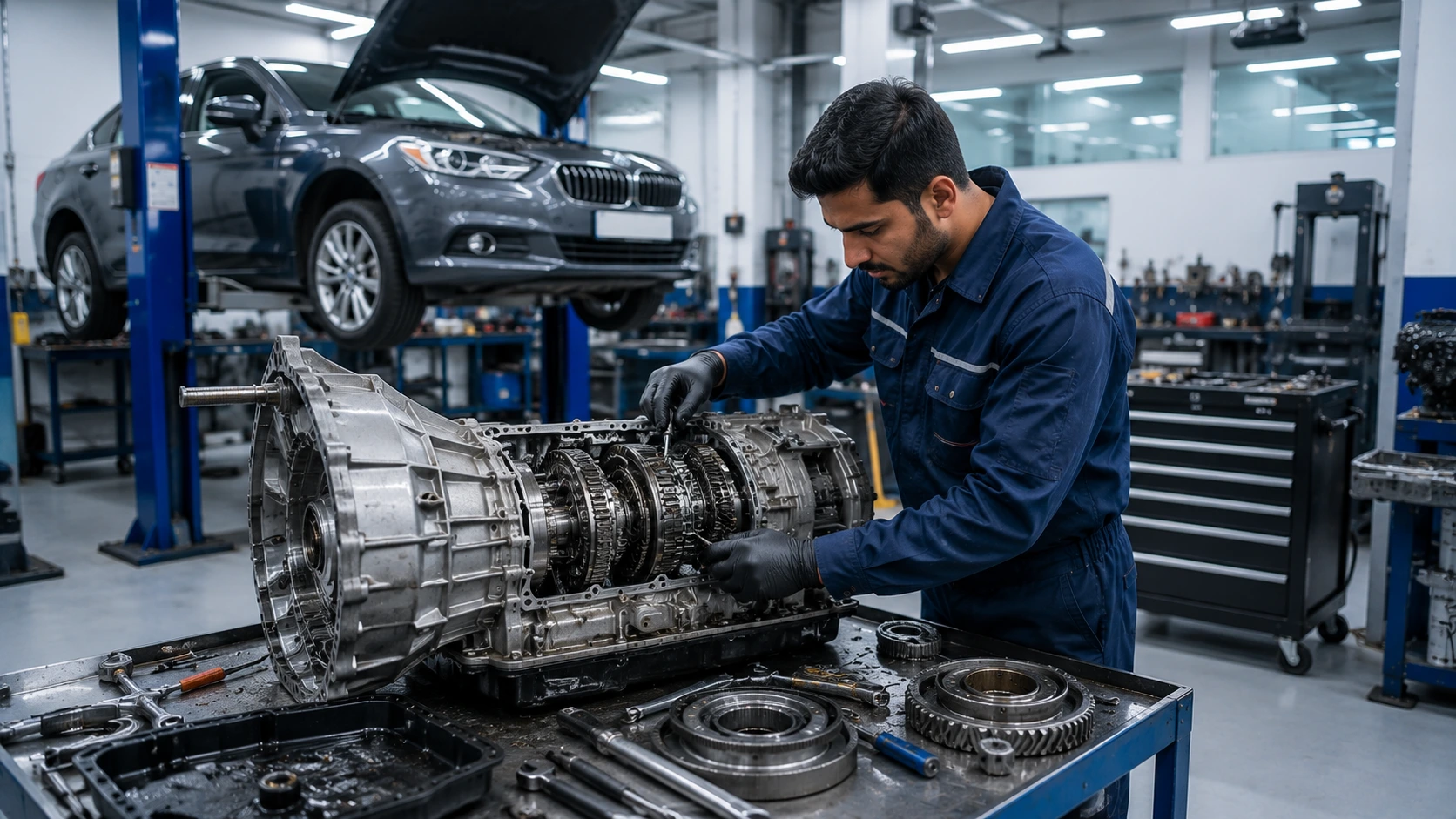
An automatic gearbox problem in Dubai rarely announces itself with a sudden, unmistakable failure. It develops gradually — a hesitation between gears that appeared a few months ago, a shudder that’s been attributed to road surface rather than the transmission, a slight delay engaging Drive that’s become normalised.
By the time the symptom is obvious enough for most drivers to act on it, the fault has usually been developing long enough that the correct repair is more involved than it would have been at the early stage.
Automatic gearbox care in Dubai requires understanding what the specific transmission type in your vehicle needs, what Dubai’s operating conditions do to that transmission faster than the manufacturer’s European or American schedule assumes, and what proper diagnosis looks like before any mechanical work is authorised.
Automatic Gearbox Dubai — Why This Climate Creates Specific Problems
Dubai’s operating environment is among the most demanding for automatic gearbox systems globally. Three specific factors accelerate transmission wear and fluid degradation beyond what manufacturer service schedules account for.
Sustained ambient heat above 40°C from May through September raises the baseline operating temperature of every transmission fluid. A ZF 8-speed running at 80°C operating temperature in Germany runs at 90–95°C in the same vehicle in Dubai in July — without any driving change, just from ambient temperature difference. This thermal increase accelerates oxidation of the fluid’s additive package and reduces its viscosity at the high end of the operating range.
Stop-start urban traffic on Al Khail Road and Sheikh Zayed Road creates continuous low-speed engagement cycles. On torque converter automatics, this means sustained torque converter slip at low vehicle speeds — generating heat in the fluid at the torque converter housing. On dual-clutch transmissions, it means repeated clutch engagement and disengagement at the low-speed engagement point — the condition most likely to stress the clutch pack and generate friction heat.
Short-trip driving that never fully warms the transmission — school run, supermarket, office commute — allows moisture to accumulate in the fluid from condensation that doesn’t get driven off by reaching operating temperature. Over time, moisture in the transmission fluid promotes internal corrosion and reduces the fluid’s viscosity and lubrication properties.
Automatic Gearbox Types — What Each Requires
Not all automatic gearboxes are the same, and the service requirements, fault patterns, and repair approaches differ significantly between types.
Torque Converter Automatic — ZF 8HP and Aisin Units
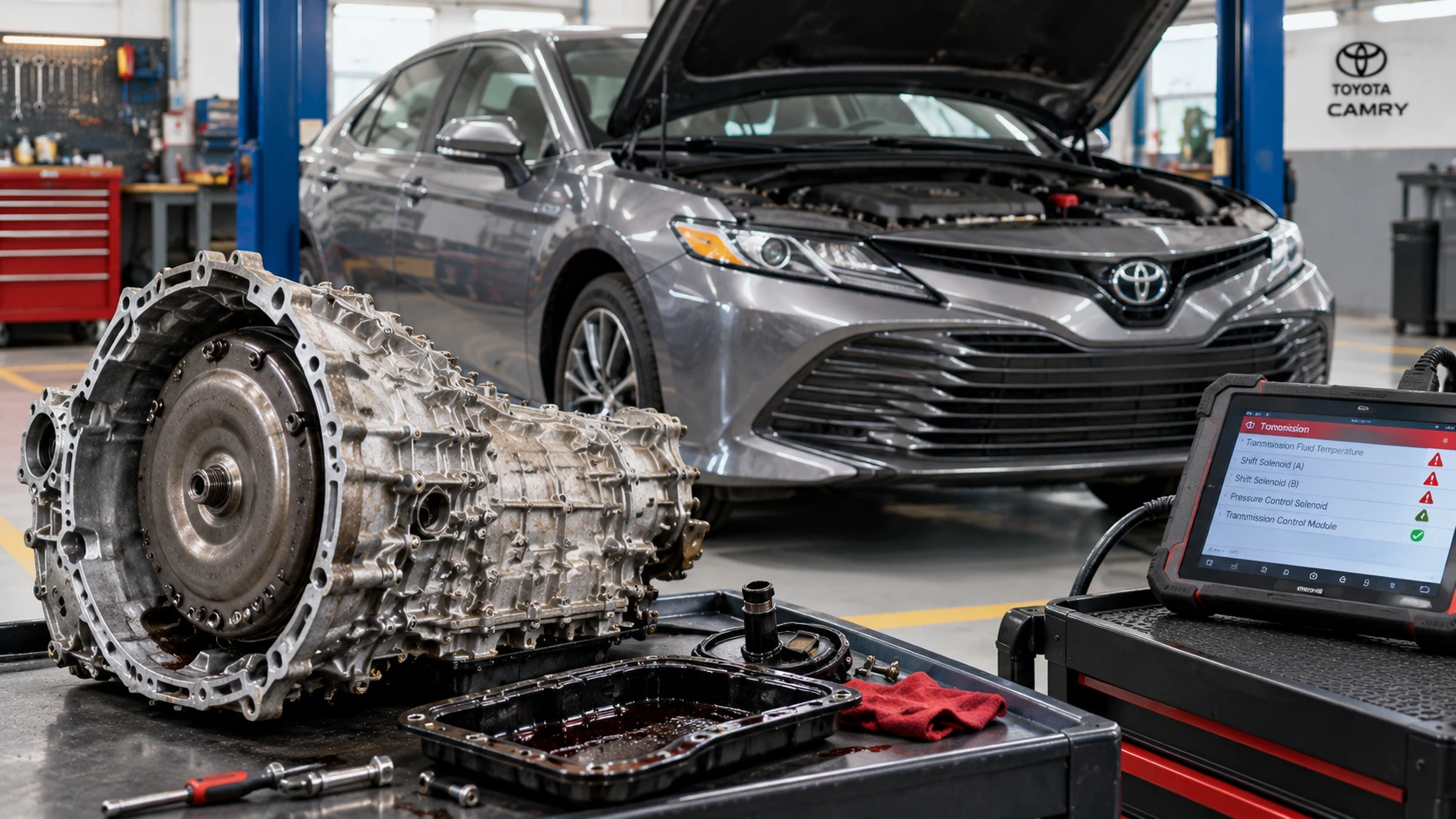
The torque converter automatic is the most common transmission type in Dubai’s premium car market. The ZF 8HP appears in BMW, Mercedes-Benz, Jaguar, Land Rover, Porsche, Bentley, Rolls-Royce, and Audi applications. Aisin torque converter units appear in Lexus, Toyota, Honda, and Volvo applications.
Both use a hydraulic torque converter to transfer power at low speed — allowing the transmission to remain in gear at idle without stalling the engine. At higher speeds, a lock-up clutch inside the torque converter mechanically connects the engine to the transmission input shaft for efficiency.
ZF 8HP Fluid Service
The ZF 8HP is listed as a sealed-for-life transmission in European market documentation — a designation that doesn’t apply in Dubai’s operating temperatures. At 60,000 km or four years in Dubai, the transmission fluid should be serviced regardless of what the European schedule states.
The ZF 8HP uses a specific fluid — ZF LifeGuard Fluid 8 for most applications. Using generic Dexron or Mercon ATF in a ZF 8HP causes progressive wear of the clutch pack friction surfaces and the torque converter lock-up clutch, because the friction characteristics of generic ATF don’t match the specification the ZF clutch materials were designed for.
After fluid service, a ZF 8HP in a BMW, Mercedes-Benz, or Jaguar application requires transmission adaptation reset via the manufacturer-compatible diagnostic system. Without this reset, the gearbox continues applying pre-service clutch engagement values to the new fluid’s different friction characteristics.
Torque Converter Lock-Up Shudder
The most common torque converter automatic gearbox complaint in Dubai’s market is a shudder felt through the vehicle at low-to-moderate speed under very light throttle — specifically when the torque converter is transitioning to lock-up mode.
This shudder is caused by either fluid degradation changing the friction characteristics of the lock-up clutch facing material, or actual wear of the lock-up clutch facing. Fluid service with the correct specification fluid and an adaptation reset resolves fluid-degradation cases. Actual clutch wear requires torque converter replacement.
Distinguishing between these causes requires live data monitoring of torque converter lock-up status and slip percentage during the road test conditions where the shudder occurs — ISTA for BMW, XENTRY for Mercedes-Benz, ODIS for VW Group. A proper car mechanic with manufacturer-compatible diagnostic equipment performs this assessment correctly.
Dual-Clutch Transmission — DSG, DCT, PDK
Dual-clutch transmissions use two clutch packs — one for odd gears, one for even gears — pre-selecting the next gear while the current gear is engaged. This allows faster shifts than any torque converter automatic because there’s no torque converter lag and no hydraulic coupling to engage.
Dubai’s stop-start traffic is harder on dual-clutch transmissions than on torque converter units. The dry-clutch variants — Volkswagen’s DQ200, Ford’s DPS6 PowerShift — were designed for smooth-flow driving and develop specific problems in repeated low-speed engagement cycles.
DQ200 Dry-Clutch DSG — The Dubai Challenge
The DQ200 used in Golf, Polo, Tiguan 1.4, and similar applications is the automatic gearbox type that generates the most service complaints in Dubai’s market. The dry clutch design is excellent on open roads and develops shudder and hesitation under repeated low-speed engagement.
The fault pattern is consistent: adaptation values drift progressively as the clutch adjusts to heat-affected engagement behaviour. The VCDS adaptation reset is the correct first intervention — recalibrating the clutch engagement parameters. This resolves the shudder in a significant proportion of DQ200 complaints without any mechanical work.
A workshop that proceeds directly to clutch pack replacement without attempting the adaptation reset first has skipped the most important diagnostic step for a DQ200 shudder complaint.
DQ250 and DQ500 Wet-Clutch DSG
The DQ250 (Golf GTI, Golf R, Tiguan 2.0 TSI, Passat) and DQ500 (heavier Passat variants, Audi) use wet-clutch packs — the clutches run in the same fluid that lubricates the gearbox. This is more tolerant of heat than the dry-clutch DQ200.
Fluid service at 60,000 km in Dubai. After fluid replacement, VCDS adaptation reset is mandatory — the gearbox must relearn clutch engagement for the new fluid’s friction characteristics.
Porsche PDK
The PDK dual-clutch in the 911, Cayenne, Macan, and Panamera is among the finest automatic gearbox designs in production. It responds directly to fluid condition in Dubai’s heat.
PDK fluid service at 60,000 km or four years in Dubai — the sealed-for-life European designation doesn’t apply here. After fluid service, a PIWIS adaptation reset is required. Early symptoms of degraded PDK fluid: shudder at low-speed engagement, hesitation selecting Drive or Reverse, reduced Sport mode responsiveness.
CVT — Continuously Variable Transmission
CVT transmissions use a steel belt running between two variable-diameter pulleys rather than fixed gear ratios. The belt-pulley interface is sensitive to the friction characteristics of the CVT fluid — more so than any other automatic gearbox type.
CVT Fluid Sensitivity
Generic “CVT compatible” fluids that approximately meet manufacturer specifications cause progressive wear on the belt-pulley interface. The friction coefficient of generic CVT fluid doesn’t precisely replicate the manufacturer’s specified fluid — and the CVT’s belt drive relies on that precise friction coefficient for correct power transfer.
Nissan and Infiniti CVTs require NS-2 or NS-3 specification. Honda CVTs require HCF-2. Toyota CVTs require Toyota Genuine CVT Fluid. Suzuki and Mitsubishi CVTs require their own specific specifications. Using the correct fluid — not a generic alternative — at the correct interval (35,000–40,000 km in Dubai) is the most important CVT maintenance item.
CVT Belt Slip
Progressive belt-pulley wear from incorrect fluid or extended service intervals produces a characteristic symptom pattern: a surging sensation at steady speed, hesitation on light acceleration, and in advanced cases, a hunting feeling where the CVT seems unable to hold a consistent ratio.
By the time belt slip is noticeable to the driver, the pulley surface wear is significant. Earlier intervention — at the surging stage — still allows fluid service to slow the progression. Later intervention — at the slip stage — may require CVT replacement.
9-Speed and 10-Speed Automatics
Newer transmission designs with more gear ratios — Ford’s 10-speed, ZF’s 9HP in FCA and Land Rover applications, Honda’s 10-speed — create more frequent gear changes in Dubai’s stop-start traffic. The transmission is constantly selecting between ratios under low-speed conditions, creating higher fluid thermal load per kilometre than a 6-speed equivalent in the same conditions.
Fluid service at 60,000 km in Dubai for these multi-ratio units, using the specific fluid designation for each unit — Ford Mercon ULV for the 10-speed, ZF LifeGuard Fluid 9 for the ZF 9HP, Honda ATF DW-1 for the Honda 10-speed.
Warning Signs — What Automatic Gearbox Problems Look Like
Recognising early automatic gearbox warning signs allows intervention at the stage when the correct action is fluid service and adaptation reset — rather than at the stage when mechanical component replacement is necessary.
Hesitation or Delay Engaging Drive or Reverse
A delay between selecting Drive or Reverse and feeling the transmission engage is one of the earliest automatic gearbox warning signs. On torque converter automatics, this indicates fluid degradation affecting the hydraulic circuit’s response time. On dual-clutch units, it indicates clutch adaptation drift.
A delay that’s barely noticeable at first — half a second rather than the instant engagement of a healthy transmission — typically progresses to a more pronounced delay and eventually to difficulty engaging at all.
Shudder Under Light Load
A vibration or shudder felt through the vehicle under very light throttle at low-to-moderate speed is the torque converter lock-up clutch or the dual-clutch pack engaging inconsistently. This is fluid degradation territory in the majority of cases — the friction characteristics of degraded fluid cause irregular clutch engagement that produces the characteristic vibration.
Early intervention with fluid service resolves this in most cases. Allowing it to continue without action means the clutch faces wear unevenly from the inconsistent engagement, eventually requiring mechanical replacement.
Gear Hunting
A transmission that repeatedly shifts between the same two adjacent gears — hunting back and forth rather than settling in a ratio — indicates either fluid degradation affecting the shift solenoid response, an incorrect throttle position or load signal from the engine management system, or adaptation values outside their correct range.
Full scan via manufacturer-compatible diagnostic equipment distinguishes between these causes. A automatic gearbox that’s hunting under light load at highway speed may be responding to an engine management input that the engine management technician should address, not the transmission specialist.
Slipping Under Load
A transmission that produces a sudden increase in engine RPM without a corresponding increase in vehicle speed — as if the clutch has been released momentarily — is slipping. This is clutch pack wear on dry-clutch dual-clutch units, torque converter clutch wear on torque converter units, or belt-pulley wear on CVTs.
Slipping under load is beyond the fluid service stage. The mechanical component is worn. Accurate diagnosis of which component is worn, and what replacement entails, requires live data monitoring during the slip conditions — not a static scan.
Fault Codes and Warning Lights
A transmission warning light — or a check engine light combined with hesitation — stores fault codes that provide the starting point for diagnosis. But fault codes are starting points, not diagnoses.
A P0700 code (transmission control system fault) triggers a check engine light and requires accessing the transmission control module for specific sub-codes. P0741 (torque converter clutch circuit performance) indicates torque converter lock-up clutch concern — but doesn’t distinguish between a fluid issue and a worn clutch. P0730 (incorrect gear ratio) on a CVT points toward belt-pulley wear — but fluid service should still be assessed before any mechanical decision.
A car service that includes a full transmission system scan at every visit catches developing fault codes before they produce noticeable symptoms.
Automatic Gearbox Repair — What’s Actually Involved
When automatic gearbox faults progress beyond what fluid service and adaptation reset resolve, mechanical repair or replacement becomes necessary.
Valve Body and Solenoid Repair
The valve body is the hydraulic control centre of a torque converter automatic — a complex casting containing the solenoid valves that control gear selection, lock-up clutch engagement, and hydraulic pressure management.
Solenoid faults within the valve body produce specific fault codes and specific shift quality symptoms. ODIS, ISTA, or XENTRY actuator testing — cycling individual solenoids and monitoring their response — confirms whether the fault is in the solenoid itself or in its wiring circuit.
On many modern transmissions, the valve body is an integrated assembly with the TCU — the transmission control unit. Replacing a solenoid requires replacing the valve body assembly. This requires transmission fluid drain, valve body removal, and after replacement, full adaptation reset via the diagnostic system.
Mechatronic Unit on DSG and ZF
The ZF 8HP’s mechatronic unit integrates the valve body, solenoids, and TCU into a single combined component. When a solenoid within the mechatronic unit develops a fault, the entire unit is the replacement item.
Mechatronic unit replacement is a significant automatic gearbox repair — the transmission must be partially removed to access and replace the unit. After replacement, ODIS, ISTA, or XENTRY is required to code the new unit to the vehicle and perform initial adaptation before the transmission operates correctly.
Torque Converter Replacement
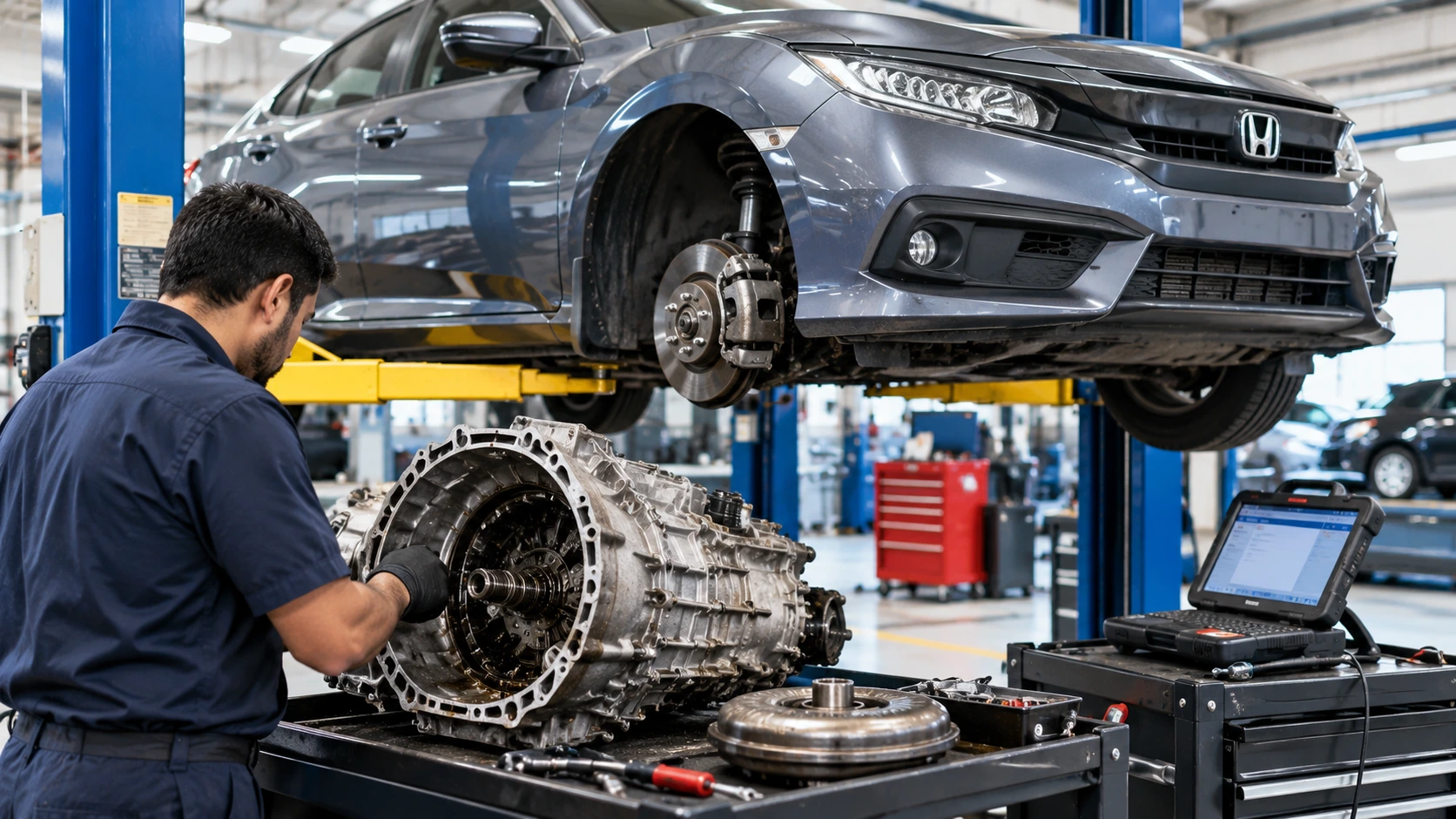
A worn torque converter lock-up clutch that produces persistent shudder after correct fluid service and adaptation reset requires torque converter replacement. The transmission must be removed from the vehicle to access the torque converter. After replacement, fluid refill and full adaptation reset are required.
CVT Unit Replacement
When CVT belt-pulley wear has progressed to slip under load, the CVT unit itself typically requires replacement — individual pulley or belt replacement within the existing unit is not generally performed in the field. CVT unit replacement is a significant repair — the unit must be removed, a replacement sourced, fitted, and the shift control system calibrated using the manufacturer-compatible diagnostic system.
Realistic Automatic Gearbox Repair Costs in Dubai
Approximate figures for common automatic gearbox work at a quality independent in Al Quoz:
- ZF 8HP fluid service with adaptation reset Quality independent: AED 600–900 | Dealer: AED 1,200–1,800
- DQ200 DSG adaptation reset (software intervention) Quality independent: AED 200–350 | Dealer: AED 400–700
- DQ250 DSG fluid, filter, and adaptation reset Quality independent: AED 700–1,000 | Dealer: AED 1,200–1,800
- CVT fluid service — Honda, Nissan, Suzuki Quality independent: AED 400–650 | Dealer: AED 750–1,100
- Torque converter replacement — ZF 8HP Quality independent: AED 4,000–8,000 | Dealer: AED 8,000–16,000
- Mechatronic unit replacement — ZF 8HP Quality independent: AED 5,000–9,000 | Dealer: AED 10,000–18,000
- CVT unit replacement — compact family car Quality independent: AED 5,000–10,000 | Dealer: AED 10,000–18,000
For owners who need mobile support when an automatic gearbox fault leaves them unable to reach the workshop, a mobile car mechanic performs on-site fault code scanning and basic assessment — determining whether the car can be driven to the workshop or requires recovery. Proper roadside assistance ensures correct vehicle handling during transport — DSG and CVT-equipped vehicles must not be towed in a gear that engages the transmission.
For paint or bodywork alongside transmission service, professional car painting handles colour-matched repairs at the same workshop visit. For owners in Al Quoz and surrounding areas looking for a garage near me that diagnoses automatic gearbox faults correctly before authorising repair — the difference between a workshop that performs adaptation resets and fluid services with the correct specification fluid and manufacturer-compatible diagnostic equipment, versus one that replaces components based on symptom alone, is measured in thousands of dirhams per transmission visit.
FAQ
How often should automatic gearbox fluid be changed in Dubai?
Every 60,000 km for ZF 8-speed and DSG units, 35,000–40,000 km for CVTs — regardless of manufacturer sealed-for-life designations written for European conditions.
What causes automatic gearbox shudder in Dubai's stop-start traffic?
Usually torque converter lock-up clutch friction characteristic change from fluid degradation — correct fluid service with adaptation reset resolves most shudder cases without mechanical intervention.
Can a DSG adaptation reset fix shudder without replacing the clutch?
Yes — in many cases the DQ200 and DQ250 DSG shudder is adaptation drift rather than clutch wear, and VCDS reset resolves it without mechanical work.
Why does my automatic gearbox hesitate when selecting Drive in Dubai heat?
Fluid viscosity changes from heat degradation affect hydraulic response time in torque converter automatics — and clutch adaptation drift affects engagement timing on dual-clutch units. Both are fluid service and reset territory in early stages.
Does automatic gearbox fluid type really matter if it approximately meets the specification?
Yes — ZF, DSG, CVT, and other specialist transmissions have specific friction requirements that generic ATF approximations don't replicate correctly, causing accelerated wear on the clutch pack and torque converter components.
Conclusion
Automatic gearbox care in Dubai starts with understanding that sealed-for-life fluid designations don’t apply in UAE operating temperatures, that the correct fluid specification for each transmission type matters practically rather than theoretically, and that most early-stage transmission complaints resolve with fluid service and adaptation reset — before they require the mechanical repairs that develop from ignoring the early signs.
Car Garage Expert in Al Quoz handles automatic gearbox diagnosis, fluid service, adaptation reset, and mechanical repair across all transmission types — ZF 8-speed, DSG, PDK, CVT, and torque converter automatics — for all makes. Book your appointment on WhatsApp or find the workshop on Google Maps.