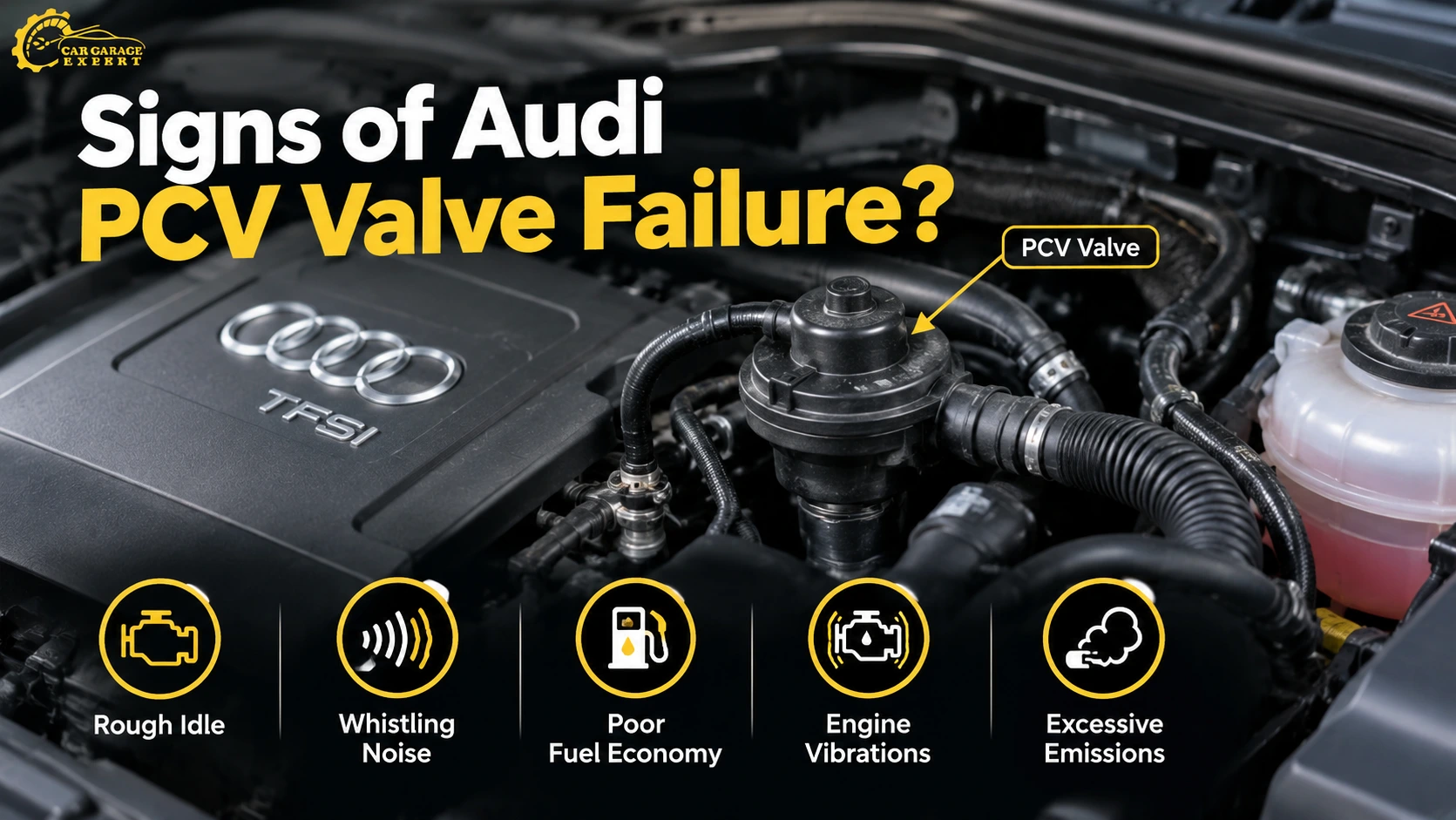
Oil and petrol can be burnt in the engine because the PCV valve lets them leave the crankcase. On most Audi petrol engines, it sits inside an oil separator with a thin rubber diaphragm. Age and heat make that lung tough until it tears. Once it tears, unchecked air gets into the engine. If your Audi PCV valve failure, you might hear a whistle or hiss coming from the engine bay, use more oil, and see the check engine light come on. Each engine has its own signs. If you think you see a vacuum leak, worn spark plugs or a weak coil, make sure you’re not seeing anything else.
What Is an Audi PCV Valve and How Does It Work?
Audi PCV valve failure is one of the most common faults on modern TFSI engines, and it starts with a small part doing a big job. Every engine lets some combustion gas slip past the piston rings. Mechanics call this blow-by. The PCV system removes it.
What Does the Positive Crankcase Ventilation System Do?
The Audi crankcase ventilation system pulls blow-by gas out of the crankcase and sends it back into the intake. The engine then burns it. Without that path, pressure would build inside the engine and push oil out through the seals. The PCV valve controls how much intake vacuum reaches the crankcase. Too little flow lets pressure build. Too much flow sucks oil vapor into the intake.
How Does the Audi Oil Separator Control Crankcase Pressure?
Blow-by gas carries a fine oil mist. The oil separator catches that mist and drains the oil back into the sump. Cleaner gas then passes through the PCV valve. On most Audi petrol engines, the valve uses a rubber diaphragm and a spring. The diaphragm flexes to open or close as intake vacuum changes. When it splits, the valve can no longer control vacuum. Audi oil separator failure and a failed PCV valve are often the same fault, since the valve lives inside the separator on many engines.
Which Audi Engines Commonly Experience PCV System Problems?
The 1.8 and 2.0 TFSI four-cylinder engines, known as the EA888 family, get the most PCV complaints. They power many A3, A4, A5, A6, Q3 and Q5 models. On older versions, the oil separator bolts to the side of the engine block. On the third-generation engine, from around 2013, the PCV valve is built into the valve cover. The 3.0 TFSI V6 and the older 4.2 V8 also have breather parts that wear with age. The exact part that fails depends on the engine code.
What Are the Common Symptoms of Audi PCV Valve Failure?
Most Audi PCV valve failure show up at idle first. Intake vacuum is highest at idle, so a torn diaphragm leaks the most air there. Some owners notice one sign. Others get several at once.
Why Is My Audi Engine Idling Roughly?
A torn diaphragm lets in air that the airflow sensor never measured. The engine runs lean, which means too much air for the fuel. At idle, that extra air makes up a big share of total airflow. The engine shakes, the rev needle may hunt up and down, and the car may stall at traffic lights. An Audi rough idle caused by the PCV valve often smooths out once the revs rise.
Can a Bad Audi PCV Valve Cause a Whistling or Hissing Noise?
Yes. Air rushing through a small tear makes a high whistle. You hear it best at idle with the bonnet open. The sound usually comes from the PCV valve area on the valve cover or the side of the block. It may fade or change pitch when you rev the engine.
Does Audi PCV Valve Failure Cause Excessive Oil Consumption?
It can. A failed valve lets too much vacuum reach the crankcase. Oil mist then gets pulled into the intake and burned. You may need to top up oil between services. Blue-grey smoke at start-up is another clue. Some early 2.0 TFSI engines also had a piston ring problem that burned oil, so a PCV repair will not cure every case.
Why Does My Audi Check Engine Light Come On?
The engine computer monitors fuel trims. It saves a fault when it keeps adding fuel to make up for a lean mixture. P0171 (system too lean), P2187 (too lean at idle), and P0507 (idle speed too high) are codes that are often linked to PCV leaks. These codes tell you the air-fuel mix is off. Because they don’t name the PCV valve, it’s important to test it properly.
Can a Faulty Audi PCV Valve Cause Engine Misfires?
A large leak can. When the mixture gets too lean, one or more cylinders may fail to fire. You may feel a stumble or shake, and codes from P0300 to P0304 may appear. Lean misfires are most common at idle and light throttle. A flashing check engine light means the misfire is bad enough to harm the catalytic converter.
Can Audi PCV Problems Cause Oil Leaks?
Yes, when the valve sticks shut or the breather path blocks. Pressure then builds inside the crankcase and pushes oil past the weakest seals. Common leak points include the valve cover gasket, crankshaft seals, and oil filler cap seal. A dipstick that rises on its own or oil mist puffing from the filler neck are signs of high crankcase pressure.
Audi PCV Valve Failure Symptoms vs Other Common Causes
The table below matches each symptom with its likely PCV reason, and the other fault a mechanic should rule out.
| Symptom | Likely PCV Reason |
Other Fault to Rule Out |
| Rough idle | Torn diaphragm lets in unmeasured air | Worn spark plugs or weak ignition coils |
| Whistling at idle | Air passing through a split diaphragm | Cracked intake hose or boot |
| Oil use between services | Too much vacuum pulls oil into the intake | Worn piston rings on some early 2.0 TFSI engines |
| Lean codes P0171 or P2187 | Unmeasured air at idle | Dirty airflow sensor or intake manifold leak |
| Fresh oil leaks | Blocked breather builds crankcase pressure | Old valve cover gasket |
| Misfire at idle | Mixture too lean to fire | Carbon build-up on intake valves |
What Causes an Audi PCV Valve Failure?
Most failures come down to rubber and plastic wearing out under heat. Oil quality and long service gaps add to the problem.
Torn or Damaged PCV Diaphragm
The diaphragm is a thin rubber disc that flexes thousands of times on every drive. Heat slowly hardens it until it cracks or splits. On many EA888 engines, a torn diaphragm is the single most common PCV fault. Cleaning cannot repair it.
Blocked Crankcase Breather Hoses
The Audi crankcase breather valve and its lines move oil vapor out of the engine. Over time, sludge can narrow or block them. When a path is blocked, pressure builds up inside the engine. A small check valve in the breather line can also get stuck open or closed on some engines.
Deteriorated Seals and Plastic Components
The oil separator housing and many of the breather parts on an Audi are made of plastic. Plastic weakens when it’s repeatedly heated and cooled. Some parts of the housing break, quick-connect fittings snap, and O-rings go flat. Any of these can cause a vacuum leak in an Audi engine that acts like a diaphragm that is torn.
Oil Sludge and Contamination
Old oil, or oil that does not meet the Audi spec, breaks down faster in heat. It leaves deposits in the separator and the valve. Those deposits stop the valve from moving freely. Long gaps between oil changes make the build-up worse.
Age, Engine Heat and Component Wear
PCV parts sit on or next to a hot engine. Under-bonnet temperatures climb fast in summer traffic, and rubber ages faster as a result. Many owners report failures between 60,000 and 120,000 km. Some fail sooner.
How Can You Diagnose Audi PCV Valve Failure?
A good diagnosis confirms the fault before ordering any parts. PCV signs overlap with many other faults, so guessing gets expensive.
Checking Audi Engine Fault Codes and Fuel Trims
First, use an Audi-compatible scan tool to read the saved codes. After that, watch live fuel trims. High positive trims at idle, often above 10%, can indicate a PCV leak. At about 2,500 rpm, those trims slowly go away. That pattern shows a leak that matters most when the throttle is open. Inspecting the PCV Diaphragm and Breather Hoses
A visual check comes next. Where the diaphragm is reachable, the mechanic looks for splits. The mechanic squeezes breather hoses and checks for cracks, oil soaking, and broken clips. Owners can try one simple check at home. With the engine warm and idling, a filler cap that is very hard to lift, or an engine that stumbles badly when it is lifted, points to too much vacuum. Keep your hands clear of belts and hot parts.
Measuring Crankcase Vacuum and Pressure
The oil filler or dipstick tube is linked to a gauge called a manometer. It shows crankcase pressure when the engine is at rest and when it’s revving faster. A healthy Audi crankcase has a small amount of air in it. A torn diaphragm is likely when the Hoover is very high. A blocked breather or heavy blow-by can indicate positive pressure. Many shops don’t do this test, but it’s the best way to see whether there is a problem with the PCV.
Using a Smoke Test to Identify Vacuum Leaks
A smoke machine pumps harmless vapor into the intake at low pressure. Smoke escapes wherever there is a leak. It may come out of the PCV valve, a cracked hose, or an intake boot. The test finds leaks that are too small to see.
Can a Bad PCV Valve Cause Serious Audi Engine Problems?
It can if the fault is left for months. Damage from an Audi PCV valve failure builds slowly, which is why many drivers put it off.
Can PCV Failure Damage Engine Seals?
Yes. A blocked breather builds pressure, forcing oil past the seals. The rear main seal is the expensive one, because the gearbox has to come out to replace it. Fixing the PCV early costs far less than chasing leaks later.
Can a Faulty PCV System Increase Oil Consumption?
It does on many engines. Burned oil leaves carbon on the intake valves and spark plugs. On turbo Audis, oil can also collect in the intercooler pipes. Over time, oil burning can harm the catalytic converter. Running the engine low on oil adds wear to the bearings and the turbo.
Can You Drive an Audi With a Bad PCV Valve?
You can for a short time if the signs are mild. A light whistle or a slightly rough idle usually lets you drive to a workshop. Check the oil level first and top it up if needed. Stop driving if you see any of these warnings:
- A flashing check engine light
- Strong misfires or heavy shaking
- A low oil pressure warning
- Oil dripping fast or smoke from the engine bay.
In those cases, call for roadside assistance and have the car moved instead of driving on.
How Is an Audi PCV Valve Repaired or Replaced?
The repair depends on which part failed and how your engine is built. Some jobs need one valve. Others need a full valve cover or oil separator.
When Does the PCV Valve Need Replacement?
Replace it when tests confirm a torn diaphragm, a cracked housing, or a stuck valve. You can’t clean a diaphragm-type PCV valve back to health. Sludged hoses can sometimes be cleared, but cracked hoses should be renewed.
Does the Complete Audi Oil Separator or Valve Cover Need Replacement?
On third-generation EA888 engines, Audi supplies the PCV as part of the valve cover. Some aftermarket kits let a mechanic replace only the diaphragm, which cuts the parts bill. Kit quality varies, so ask which brand is being fitted. On older 2.0 TFSI engines, you usually replace the full oil separator as one unit. V6 and V8 engines may need valve cover or breather pipe parts.
What Happens During Audi PCV Valve Replacement?
A typical Audi PCV valve replacement follows these steps:
- Confirm the fault with codes, fuel trims, and a crankcase pressure test.
- Remove the engine cover and any intake parts in the way.
- Disconnect the breather hoses and remove the old valve, separator, or valve cover.
- Clean the mounting faces and fit new seals.
- Fit the new part and tighten the bolts to Audi torque specs.
- Clear the codes and reset the fuel trim adaptation.
Job time depends on the engine. On many four-cylinder engines, the work takes about one to three hours. Valve cover jobs and V6 or V8 work can take longer.
How Much Does Audi PCV Valve Replacement Cost in Dubai?
The Audi PCV valve replacement cost in Dubai depends on the engine, the parts, and anything else found during the job. A fair quote comes after diagnosis, not before it.
Does Audi Model and Engine Type Affect Replacement Cost?
Yes, by a wide margin. A bolt-on separator on an older four-cylinder is a smaller job. A valve cover with a built-in PCV costs more in parts. V6 and V8 engines need more labor hours to reach the parts.
Genuine vs Aftermarket PCV Components
OEM Audi parts fit and feel like they did when the factory made them. Most of the time, good aftermarket names last longer and cost less. Cheap, non-branded parts can break again within months. Before you give the go-ahead, ask what brand will be installed.
Labor, Diagnostics and Additional Repairs
Labor time changes with the engine layout. Many workshops charge for diagnostic tests separately. Extra work may include spark plugs fouled by oil, cracked breather hoses or a leaking valve cover gasket. Ask for each item to be listed on the quote so the final bill holds no surprises.
Which Audi Models Can Experience PCV Valve Problems?
PCV design changes by model, model year, and engine. Two cars with the same badge can use different parts. The engine code on the service sticker or in a VIN check tells the mechanic which part fits.
Audi A3 and A4 PCV Valve Problems
Most A3 and A4 cars in Dubai run 1.4, 1.8, or 2.0 TFSI engines. The 2.0 TFSI in the A4 B8, built from about 2008 to 2015, uses a block-mounted oil separator. The A3 8V and the A4 B9 use the third-generation engine with the PCV inside the valve cover. Whistling and rough idle are the usual complaints on both.
Audi A5 and A6 Crankcase Ventilation Issues
The A5 shares its 2.0 TFSI engines with the A4, so the PCV faults are the same. Many A6 models use the 3.0 TFSI V6. On that engine, breather parts sit on top of the engine and age with the heat. Leaks there often show up as an oily smell, lean codes, or oil on the valve covers.
Audi Q3 and Q5 PCV System Problems
The Q3 and Q5 mostly use the 2.0 TFSI. The first-generation Q5, known as the 8R, shares the A4 B8 engine and its separator design. Early Q5 engines may also burn oil through worn piston rings, so do a full check before blaming the PCV.
Audi Q7 and Other Engine-Specific PCV Issues
The Q7 uses larger V6 and V8 engines. Its PCV and breather parts are harder to reach, which adds labor time. S and RS models use their own engines, each with a different breather layout. Not every model listed here has the same weak point, so diagnosis by engine code matters most.
How Can You Prevent Audi PCV Valve Problems in Dubai?
Rubber will always age, but you can slow the wear and catch faults early.
Following the Correct Audi Engine Oil Maintenance Schedule
Use oil that meets the Audi spec in your owner’s manual, such as VW 502 00 or VW 504 00, depending on the engine. Fresh oil leaves fewer deposits in the PCV system. City driving in heat counts as severe use, so many owners shorten the gap between oil changes. A planned car service package keeps those changes on schedule.
Inspecting Crankcase Breather Hoses During Servicing
Ask for the breather hoses and PCV area to be checked at every service. A mechanic can spot cracks, oil soaking, and loose clips in a few minutes. Replacing a cracked hose costs less than waiting for lean codes to appear.
Addressing Oil Leaks and Rough Idling Early
You can fix a faint whistle or a slightly rough idle for the least amount of money. If you don’t fix it, the fault can cause plugs to get dirty, seals to leak, and the engine to use more oil. Write a cheque as soon as the idle changes.
How Dubai Heat and Stop-and-Go Traffic Affect Engine Components
Dubai’s summer air is often warmer than 45°C. When you drive slowly along Sheikh Zayed Road during rush hour, the temperature under the hood rises. With the AC on, the engine also sits there for long periods. The PCV diaphragm is always under load when the engine is idle for a long time. Rubber and plastic parts wear out faster when they move daily from hot streets to cool underground parking lots.
Why Car Garage Expert Is the Best Option for Audi PCV Valve Failure in Dubai
For Audi PCV valve repair in Dubai, Car Garage Expert is a strong choice because the workshop proves the fault before replacing parts. That matters for a fault with so many lookalikes.
Crankcase Pressure Testing Before Any Parts Are Ordered
The workshop measures crankcase vacuum and runs a smoke test instead of relying on a code read alone. Many garages replace the PCV valve because of a P0171 code. A pressure reading shows whether the PCV is really the cause.
Before and After Fuel Trim Records
Fuel trims are recorded before the repair and again after it. Owners can see the numbers return toward zero. A fixed car then has numbers to back it up.
Repairs Matched to the Audi Engine Code
The PCV system configuration is slightly different for each Audi engine. The crew starts by checking the engine code, then quotes the correct item: a separator, valve cover, or diaphragm kit. “Owners have the option of OEM or premium aftermarket items.
Central Al Quoz Location With Mobile Checks
The workshop is in Al Quoz, within easy reach of most areas in Dubai. Owners who cannot bring the car in can book a mobile car mechanic for first checks. Drivers looking for an Audi-friendly garage near me will find the workshop close to Sheik Zayed Road.
Frequently Asked Questions About Audi PCV Valve Failure
What are the first signs of a bad Audi PCV valve?
A rough idle and a whistle from the engine bay usually come first. Some owners notice higher oil use or a check engine light with lean codes.
Can a bad PCV valve cause an Audi to lose power?
Yes. A lean mixture can cause misfires and weak throttle response. The loss is most noticeable at low speed and when pulling away.
Why does my Audi make a whistling noise at idle?
Air is being pulled through a small leak. A torn PCV diaphragm is a common cause, but a cracked intake hose can sound the same.
Can a faulty Audi PCV valve cause a check engine light?
Yes. It often sets lean codes such as P0171 or P2187. Misfire codes can follow if the leak is large.
Can I drive my Audi with a faulty PCV valve?
For a short trip to a workshop, usually yes. Check the oil level first. Stop if the check engine light flashes or the oil pressure warning comes on.
How long does an Audi PCV valve last?
There is no fixed interval. Many owners report failures between 60,000 and 120,000 km, and heat can shorten that.
Does an Audi PCV valve need cleaning or replacement?
Diaphragm-type valves need replacement because the rubber cannot be restored. Blocked hoses can sometimes be cleaned.
How much does Audi PCV valve replacement cost in Dubai?
The price depends on the engine, part design, and brand. A written quote after diagnosis gives the real figure for your car.
Related Services for Audi Owners in Dubai
PCV faults often go hand in hand with other engine and body work.
- Audi repair and engine diagnostics for misfires, oil leaks and warning lights
- Spark plug and ignition coil replacement when oil has fouled the plugs
- Valve cover gasket replacement for top-end oil leaks
- Car painting for bodywork and paint repair
Get Your Audi PCV Valve Inspected in Dubai
A whistle or rough idle is the cheapest sign of a PCV fault. The right first step is a diagnosis, not a parts swap. Book an engine diagnostic at Car Garage Expert in Al Quoz so we can find the cause before replacing anything. Send your Audi’s model, year, and symptoms on WhatsApp, or get directions to the workshop.