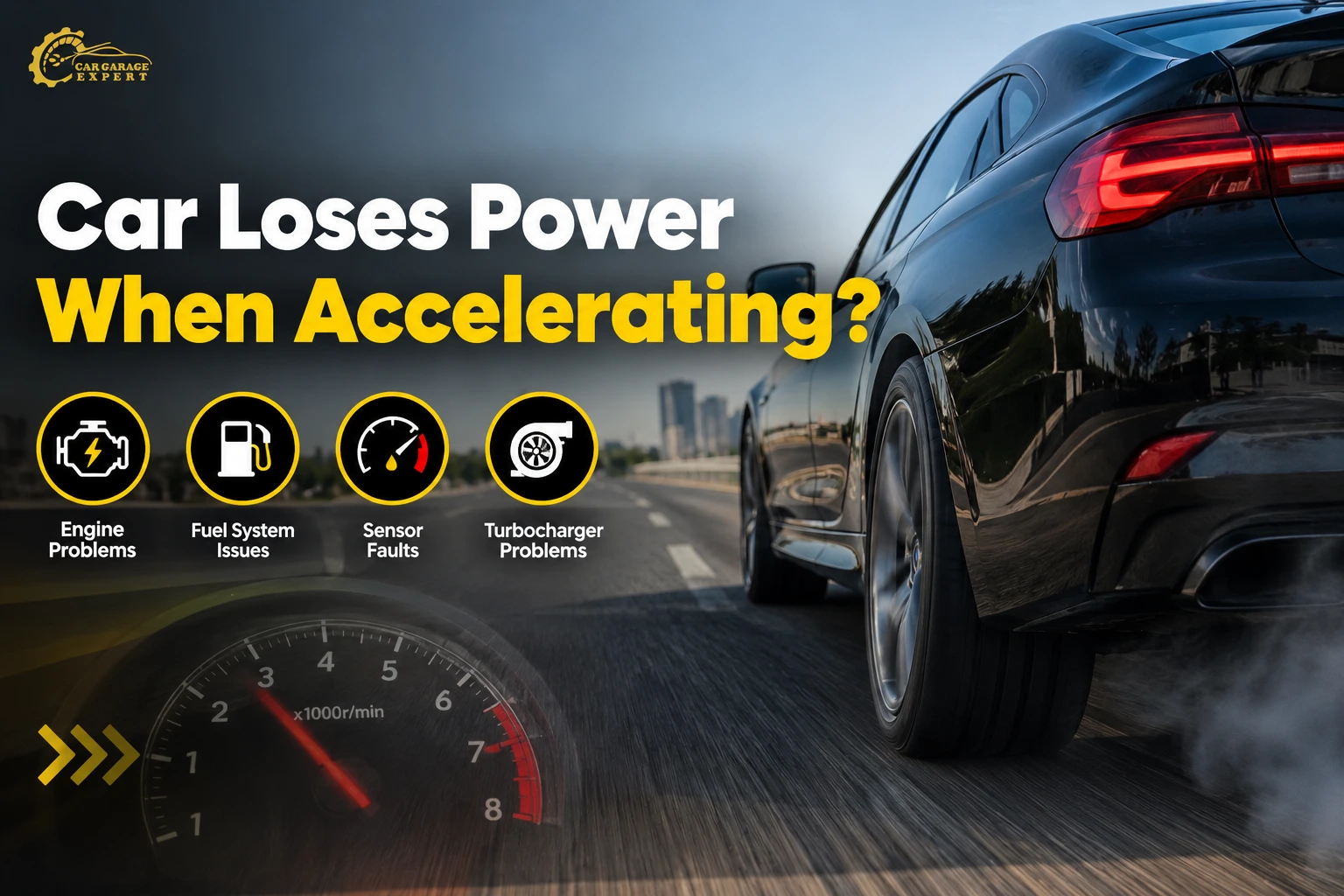
When a car loses power when accelerating, the engine may lack air, fuel, or spark, or the power may not be reaching the wheels. Common causes are fuel delivery problems, like a clogged fuel filter, and airflow faults, like a dirty air filter. Worn spark plugs, turbo boost leaks, a blocked exhaust, and a slipping transmission can do it too. Heat can also push the engine into a reduced-power mode to protect itself. A sudden drop in power is a big clue. Loss from a stop points to a different fault than loss at 120 km/h or on a hill. A scan and a fuel pressure test find the real cause before you replace any parts.
How Your Engine Makes Power and Where It Goes Wrong
An engine makes power by burning the right mix of air and fuel at the right moment. The engine computer controls that mix using readings from its sensors. If any part of that chain falls short, the engine cannot give full power when you ask for it.
Acceleration is when the engine works hardest. It needs the most air, the most fuel, and the strongest spark right then. That is why a weak part can hide at idle and only show up when you press the pedal.
Power can also be lost after the engine. If the transmission slips, the engine still makes power, but the wheels never get all of it. A car loses power when accelerating for one of these two reasons, and finding which side the fault sits on is the first job.
What Are the Common Symptoms of a Car Loses Power When Accelerating?
Power loss shows up in a few different ways. Each one points the mechanic toward a different area.
Car struggles to accelerate from a stop.
The car feels heavy when you pull away from a light. It takes longer than usual to reach 60 km/h. This often comes from a dirty air filter, a faulty sensor, or a weak fuel supply at low speed.
The engine hesitates or jerks when you press the accelerator.
You press the pedal, and there is a pause, a stumble, or a jerk before the car picks up. Hesitation usually means the air-fuel mixture is temporarily out of balance. An engine misfire from worn plugs or a weak coil can feel like a shake or a jerk.
Car loses power when climbing hills.
The car is fine on flat roads but slows down on ramps, bridges, and hills. Climbing puts the engine under heavy load. Weak fuel, ignition, or cooling parts often show up first here.
Engine RPM rises, but the car does not gain speed.
The rev needle climbs, but the speed does not follow. This is a classic sign of transmission slipping. The engine is working, but the power is not reaching the road.
The check engine light appears with reduced power.
A yellow check engine light with weak pulling often means the engine has gone into engine limp mode. The computer cuts power on purpose to protect the engine or gearbox. The stored fault code tells the mechanic where to start.
What Causes a Car to Lose Power During Acceleration?
Most cases come down to one of nine faults. Some are cheap filters. Others need proper testing before changing any parts.
Clogged air filter or restricted airflow
The engine needs clean air to burn the gasoline. A dirty air filter chokes that supply, so the engine can’t produce full power. Filters clog significantly faster in dusty cities than the service book advises. A split intake pipe may also let unmeasured air in.
Faulty fuel pump or clogged fuel filter
A bad fuel pump can’t provide enough fuel when you accelerate aggressively. The pump may be fine, but a blocked fuel filter can stop flow. Both cause a weak pull that worsens under load. You might also hear a whining sound coming from the back of the automobile.
Dirty fuel injectors
Injectors spray a fine mist of fuel into the engine. A blocked fuel injector turns that mist into a weak, uneven spray. Some cylinders then get less fuel than others. The result is rough running and slow pickup.
Worn spark plugs or failing ignition coils
Worn-out spark plugs produce a weaker spark that fails under load. An ignition coil failure will prevent one cylinder from firing at all. Both cause an engine misfire that you may feel as shaking or jerking (typically with a blinking check engine light).
Faulty mass airflow sensor or throttle body
A faulty mass airflow sensor (MAF) tells the computer the wrong amount of air is coming in. The computer then adds the wrong amount of fuel. Throttle body problems, like carbon build-up or a failing motor, stop the throttle from opening fully. Both cause hesitation and a flat feeling when you press the pedal.
Turbocharger problems or boost leaks
Turbo engines rely on boost pressure for most of their power. A turbocharger boost leak from a split hose or loose clamp lets that pressure escape. A worn turbo or a stuck wastegate does the same. The car then drives like a much smaller engine.
Blocked catalytic converter or exhaust restriction
The engine has to breathe out as well as in. A blocked catalytic converter or other exhaust restriction traps hot gas inside the engine. Power fades the harder you push. You may also smell rotten eggs or notice heat under the car.
Transmission slipping or incorrect gear changes
Low or burnt transmission fluid can cause the clutches inside the gearbox to slip. A faulty solenoid can also hold the car in the wrong gear. In both cases, the engine revs, but the car doesn’t pull as it should.
Engine overheating or reduced-power mode
Engine overheating forces the computer to cut power to protect the engine. Some cars do this before the temperature gauge reaches red. A weak radiator fan, low coolant, or a blocked radiator are the usual causes.
Quick Match: Cause, Clue and Usual Fix
Use this table to match what you feel with the most likely cause.
| Likely Cause | What You Usually Notice |
Usual Fix |
| Dirty air filter or intake leak | Slow pickup, worse in dusty weather | Replace filter, fix hose |
| Weak fuel pump or clogged fuel filter | Power drops at high speed or uphill | Pressure test, replace pump or filter |
| Worn plugs or bad coil | Shaking, jerking, flashing engine light | Replace plugs or faulty coil |
| Faulty MAF or throttle body | Hesitation when you press the pedal | Clean or replace sensor, clean throttle |
| Turbo boost leak | Car feels like a small engine, hissing sound | Smoke test, replace hose or clamp |
| Blocked catalytic converter | Power fades the harder you push | Back pressure test, replace converter |
| Slipping transmission | RPM rises but speed does not | Fluid check, solenoid test, gearbox repair |
Why Does My Car Lose Power When Accelerating at High Speeds?
High speed demands the most fuel, air, and boost at once. Faults that stay hidden in the city often show up on the highway.
Fuel delivery cannot meet engine demand.
At 120 km/h, foot flat to the floor, the engine eats petrol quickly. A tired pump or a partially blocked filter can keep up in town, but not here. Then the pressure drops, it runs lean, and the car quits pulling.”
Turbocharger boost pressure drops.
Boost leaks grow worse as pressure rises. A small split in a hose may be fine at low boost but open up at big boost. The engine computer may then cut power to protect the turbo.
Ignition misfires under load
Under high-load conditions, a worn plug or weak coil will take more voltage to fire. The cylinder can’t deliver that voltage, so it misfires, and you feel it as a stutter or surge at speed.
Why Does My Car Lose Power When Accelerating Uphill?
Climbing loads the engine and gearbox more than any other kind of driving. Weak parts that pass on flat roads often fail first here.
Engine performance problems under heavy load
On a hill, the engine needs full power for longer. Any air, fuel or spark malfunction. Slow climbing or a car that drops a gear and still struggles. First check fuel pressure and misfire counts.
Transmission or cooling system issues
Because of the extra weight, a gearbox may slip a lot on hills. Climbing also makes more heat. The engine can get too hot, and the computer may cut power if the cooling system isn’t strong.
When the Power Drops Tells You Where to Look
Most guides list causes but do not help you narrow them down. The timing of the power loss is the clue most drivers miss. Use this guide before your workshop visit.
- Only from a stop: often the air filter, MAF sensor, or throttle body.
- Only at high speed: often fuel delivery or turbo boost.
- Only uphill: often fuel pressure, misfire under load, or transmission slip.
- After 20 to 30 minutes of driving: often heat-related, like a failing coil, fuel pump, or cooling fault.
- RPM climbs without speed: almost always the transmission.
Before you book, note four things. Write down your speed, whether the AC was on, how hot the day was, and how much fuel was in the tank. These details cut diagnosis time and help the mechanic repeat the fault on a test drive. If your car loses power when accelerating only in one of these situations, say so clearly.
Can Dubai’s Heat Cause a Car to Lose Power When Accelerating?
Yes. Dubai’s climate makes several of these faults more likely and more noticeable.
High intake temperatures and reduced engine performance
Hot air holds less oxygen than cool air. On a 45°C summer day, the engine pulls in thinner air and makes less power. Turbo engines feel this most, because the intercooler struggles to cool the boosted air. A small fault you wouldn’t notice in winter can become clear in August.
Cooling system problems in hot weather
The cooling system works at its limit in Dubai traffic. Long idling with the AC on gives the radiator little airflow. A weak fan, old coolant, or a dust-clogged radiator can lead to engine overheating and a power cut.
Heat-related fuel and ignition faults
Fuel cools the fuel pump as it flows through the tank. Driving on a near-empty tank in summer makes the pump run hotter and wear faster. Ignition coils also crack and fail sooner in high heat. Both faults often show up after the car has been driven for a while.
Dubai drivers can cut these risks with a few habits:
- Keep the fuel tank above a quarter full in summer.
- Check the air filter at every service, not only when it is due.
- Test the cooling fan and coolant before May.
- Park in shade where you can to keep engine bay heat down.
How Do Mechanics Diagnose Acceleration Problems?
Good diagnosis follows a set order. Guessing and replacing parts wastes money, so each step tests one area before moving on. Car Garage Expert follows this order, and it is the workshop to call if you want the cause found before any parts are fitted.
Scan the engine control module for fault codes.
The first step is an OBD-II diagnostic scan. It reads stored fault codes and freeze-frame data, which shows the speed, load, and temperature when the fault happened. The mechanic also checks live data, like fuel trims, which show an air-fuel mixture imbalance even when no code is stored.
Inspect fuel pressure and fuel delivery.
A gauge on the fuel line shows whether the pump holds pressure under load. The mechanic compares the reading with the manufacturer’s figure. Low pressure points to the pump, filter, or regulator.
Check ignition components and air intake sensors.
Misfire counters show which cylinder is weak. Remove the plugs and check them for wear. Swap coils between cylinders to see if the misfire moves. Compare the MAF reading with expected airflow, and check the throttle body for carbon.
Test turbo boost, exhaust flow and transmission operation where relevant
Boost leaks that are too small to hear can be found with a smoke test. A back pressure test checks whether the exhaust is blocked. The mechanic checks the fluid level and condition, reads the gearbox codes, and monitors how the gears change while the car is on the road.
How a Workshop Fixes Power Loss, Step by Step
Once the cause is confirmed, the repair targets only that fault. The usual services include:
- Air intake service. Replace the air filter, fix any cracked hoses, and clean the MAF sensor and throttle body.
- Fuel system service. Replace the fuel filter, test or replace the pump, and clean or replace blocked injectors.
- Ignition service. Fit new spark plugs and replace any failing coil.
- Turbo repair. Replace split boost hoses or clamps, or repair the turbo or wastegate.
- Exhaust repair. Replace a blocked catalytic converter and find out why it blocked, often due to a past misfire.
- Transmission service. Change the fluid and filter, replace faulty solenoids, or repair the gearbox.
- Cooling system service. Flush the coolant, test the fan, and replace a weak radiator or thermostat.
After the repair, the mechanic clears the codes and road tests the car under the same conditions that caused the fault. A good workshop rechecks the live data after the drive to confirm the fix.
What Happens If You Keep Ignoring Weak Acceleration
Small faults don’t stay small for long. Constant misfires send unburnt fuel into the exhaust. Too much of that fuel can break down the catalytic converter, which costs much more than a coil.
A weak fuel pump can fail and leave you without fuel. Every week, a slipping gearbox wears out its clutches faster. If the cylinder head gets too hot, it can bend.
Safety also has a cost. When merging onto Sheikh Zayed Road or passing a truck, it is dangerous for a car that can’t speed up.
Can You Continue Driving a Car That Loses Power When Accelerating?
You can drive a short distance with mild power loss, but get it checked within a few days. Avoid motorways, heavy loads, and hills until then. Some signs mean you should stop right away.
Warning signs that require you to stop safely
Stop driving if you see any of these:
- A flashing check engine light, which means a serious misfire.
- The temperature gauge rises toward red or steam from the bonnet.
- A burning smell, smoke or a loud knocking noise.
- The car cuts out completely or drops into limp mode on a fast road.
When to arrange roadside assistance
Call for help if the car will not hold speed in traffic, overheats, or keeps stalling. Driving on can turn a coil or sensor fault into a damaged engine or converter. Pull over in a safe place and call roadside assistance to recover the car to a workshop.
How Long the Repair Usually Takes
Time depends on what the scan finds:
- A full diagnosis takes about 1 to 2 hours.
- An air filter, plugs, or a sensor clean takes 1 to 2 hours.
- A fuel pump or fuel filter job takes about 2 to 4 hours.
- A catalytic converter replacement takes 2 to 4 hours if the part is in stock.
- Transmission repairs can take one to several days.
How Much Does It Cost to Fix a Car That Loses Power in Dubai?
The cost depends far more on the cause than on the symptom. A cheap filter and a gearbox repair can feel the same from the driver’s seat.
Factors that affect diagnosis and repair costs
These are the main things that set the final bill:
- The fault itself. A new air filter is a small job. A fuel pump, turbo, or catalytic converter costs much more.
- Car make and engine. Turbo and European engines often have dearer parts and need more labor time.
- Part type. OEM, aftermarket, and remanufactured parts cost different amounts.
- Related damage. A long-ignored misfire can add a converter to the bill.
- Access. Some fuel pumps sit under the rear seat, while others require dropping the tank.
Why the cause should be confirmed before replacing parts
Many drivers fit new plugs, then a coil, then a sensor, and still have the problem. Each guess costs money. One proper test usually costs less than one wrong part. Ask the workshop to show you the scan results and test readings before they replace anything.
Simple Habits That Keep Your Car Pulling Strongly
Most power loss faults build slowly. Regular car service catches them early.
- Replace the air filter more often if you drive in dusty areas.
- Change spark plugs at the interval in your owner’s manual.
- Use good-quality fuel from busy stations.
- Keep the tank above a quarter full, especially in summer.
- Change transmission fluid at the manufacturer’s interval.
- Get any check engine light scanned within a few days.
Why Car Garage Expert Is a Smart Pick for Power Loss in Dubai
Car Garage Expert in Al Quoz is a great choice for people whose car loses power when accelerating. It performs professional diagnostics in Dubai, testing to confirm the problem before replacing parts.
It finds out why your car loses power when accelerating before replacing parts.
Every job starts with a scan, live data, and the right test for the suspected area. That avoids paying for parts that do not fix the problem.
It tests under real driving conditions.
Many power loss faults only show up when the engine is hot or under load. Road tests repeat those conditions so the fault can be seen and confirmed.
It covers the engine, turbo, exhaust, and gearbox.
Power loss can come from several systems. One workshop that checks all of them avoids sending you to different places for one problem.
It explains the results before the repair.
You see the codes and test readings first. That makes the repair decision clear before you spend any money.
Frequently Asked Questions
Q1: Why does my car lose power but no warning light appears?
Many faults do not trip a code at first. A dirty air filter, a weak fuel pump, or a clogged fuel filter can reduce power with no light. Live data and a fuel pressure test can find these faults.
Q2: Why does my car hesitate when I press the accelerator?
Hesitation usually means the air-fuel mixture is wrong for a moment. Common causes are a dirty MAF sensor, a carbon-coated throttle body, dirty injectors, or a weak spark plug.
Q3: Can a dirty air filter cause loss of engine power?
Yes. A clogged air filter starves the engine of air, so it cannot burn enough fuel to make full power. In dusty conditions, check it at every service.
Q4: Can a bad fuel pump make a car slow to accelerate?
Yes. A failing pump cannot supply enough fuel under load. The car may feel fine at low speed but go flat at high speed or on hills.
Q5: Why does my car lose power after driving for a while?
Heat is the usual cause. A failing ignition coil, an overheating fuel pump, or a weak cooling system can all work fine when cold and fail once hot.
Q6: Can transmission problems cause poor acceleration?
Yes. A slipping gearbox lets the engine rev without passing full power to the wheels. Low or burnt fluid and faulty solenoids are common causes.
Related Services
These services often go hand in hand with a power loss repair:
- A car mechanic for diagnostics, fuel, ignition, and turbo repairs.
- Car service packages in Dubai that include filters, plugs, and fluid checks.
- A mobile car mechanic for a scan at your home or office.
- Car painting if your car also needs bodywork.
- Search for a garage near me to find the closest workshop in Dubai.
Get Your Car Pulling Properly Again
If your car loses power when accelerating, get it tested before the fault spreads to the converter or gearbox. Car Garage Expert can scan the car, test the suspected system, and show you the results before any work starts. Message the workshop on WhatsApp, find it on Google Maps, or book your diagnosis online.