A car that won’t start is stressful, especially in a car park at 45°C. The good news is that the cause is often cheaper to fix than a new starter.
What Causes a Car Starter Motor to Fail?
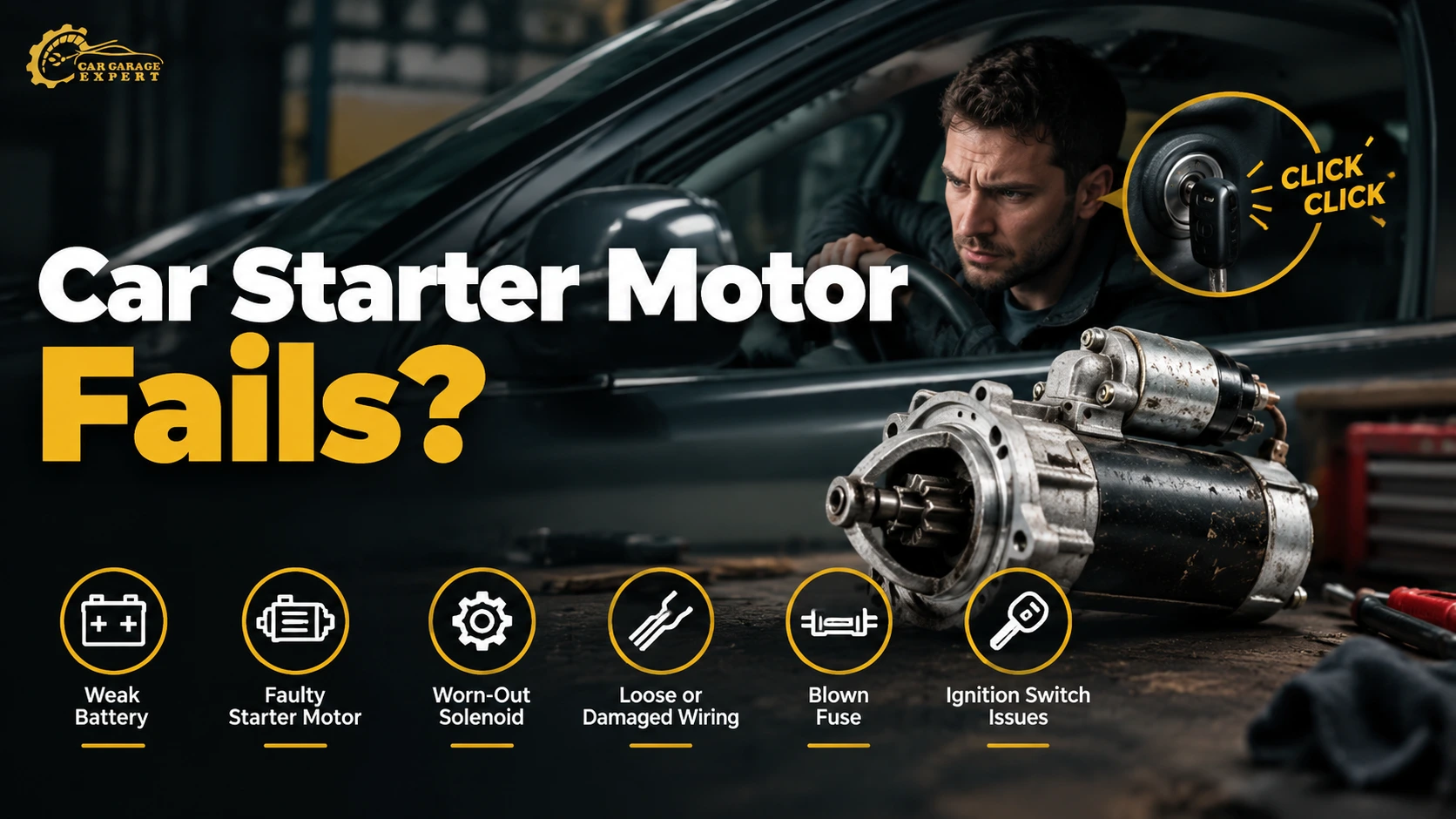
A car starter motor usually fails because of a weak battery or a worn solenoid. Worn brushes inside the motor and a damaged pinion gear are also common. Electrical faults are just as common. A bad relay, a worn ignition switch, corroded terminals, or a loose ground strap can all cut power to the starter. Heat is another cause. In Dubai, the starter sits close to the hot exhaust, and summer heat can stop it working after a short stop. Signs include clicking, slow cranking, grinding, or no response at all. A proper test of the battery, cables, and starter shows which part has actually failed.
How a Starter Motor Turns Your Engine Over
The starter is a small, strong electric motor bolted to the side of the engine. When you turn the key or press the start button, it spins the engine fast enough for it to fire up.
The process happens in a second or two. Power flows from the battery through a relay to the starter solenoid. The solenoid pushes a small gear, called the pinion, forward to lock into the teeth on the engine’s flywheel. At the same time, it sends heavy current to the motor, which spins the flywheel. Once the engine runs, the pinion pulls back.
That job drains 100 to 250 amps or more off the battery. it chain is only as strong as its weakest link, and it makes the car starter motor appear bad. It often isn’t.
What Are the Most Common Causes of Car Starter Motor Failure?
Most starter problems come from seven causes. Some are cheap fixes. Others mean a new starter.
Weak or Dead Car Battery
The most common reason a car won’t crank is a weak battery. The starter needs a huge surge of electricity. A flat battery won’t provide it.
When the voltage drops too low, the solenoid clicks but the motor can’t turn. Running a starter on low voltage also makes it draw more current and run hotter. Over time, that wears the starter faster.
Faulty Starter Solenoid
The solenoid is the switch on top of the starter. It does two jobs. It pushes the pinion gear forward and closes the heavy contacts that send power to the motor.
Those copper contacts burn and pit with every start. Once they wear, you hear a single click and nothing more. Sometimes the solenoid sticks and the starter keeps spinning after the engine starts.
Worn Starter Motor Brushes and Internal Components
Inside the motor, carbon brushes carry current to the spinning part, called the armature. The brushes wear down a little every time you start the car.
When they get too short, contact becomes patchy. The starter may work one day and not the next: worn bushings and a dirty commutator cause slow, labored cranking.
Damaged Starter Pinion Gear
The pinion gear meshes with the flywheel ring gear for a split second on every start. Over time, its teeth chip and round off.
Damaged teeth cause a grinding or whirring noise. In bad cases, the starter spins freely without turning the engine. If the pinion has damaged the flywheel teeth too, that repair costs much more.
Faulty Starter Relay or Ignition Switch
The relay is a small switch that tells the solenoid to engage. The ignition switch, or the start button on newer cars, sends the signal to the relay.
If either one fails, no signal reaches the starter. The car is completely silent when you try to start it, even with a good battery.
Loose Wiring or Corroded Battery Terminals
White or green crust on the battery terminals blocks current. So does a loose clamp or a frayed cable.
The starter then gets only part of the power it needs. It clicks or cranks slowly, like a weak battery.
Starter Motor Overheating
Long cranking makes a starter overheat. Heat from a nearby exhaust manifold or turbo can, too.
Heat raises the resistance in the wiring inside the motor and solenoid. A hot starter may refuse to work until it cools down. Repeated overheating can melt the insulation and ruin the windings.
What Are the Warning Signs of a Bad Starter Motor?
Symptoms of a bad starting motor usually start modest and get worse. Catch them early to avoid being stranded.
Clicking Noise When Starting the Car
A single loud click likely means a solenoid issue or worn motor brushes. If it clicks fast, like a clock ticking, this is likely a low battery or bad connection.
A starter motor clicking noise is the most common complaint drivers report. It does not always mean the starter itself has failed.
Engine Does Not Crank
You turn the key, press the button,, and nothing happens. The dashboard lights come on, but the engine just sits there.
This usually points to the relay, ignition switch, a safety switch, or a dead starter. A bad brake pedal switch can give the same sensation in push-button autos.
Intermittent Starting Problems
The car starts fine some days and only clicks on others. This is a classic sign of worn brushes or a dead spot on the armature.
Some drivers find that tapping the starter gets it working again. That is a sign it is close to failing.
Grinding Noise During Engine Startup
A grinding noise means the pinion gear and flywheel teeth are not meshing properly. You may also hear it if the starter stays engaged after the engine runs.
Keep driving with this noise, and you risk damage to the flywheel teeth.
Smoke or Burning Smell from the Starter Motor
Smoke or a hot electrical smell after cranking means the starter has overheated. It can also mean a short circuit in the wiring.
Stop trying to start the car. A stuck solenoid can keep feeding current and create a fire risk.
What Your Starting Symptoms Point To
Use this table to match what you hear with the most likely cause. It helps you explain the problem clearly when you call a mechanic.
| What You Notice | Most Likely Cause | First Thing to Check |
| Rapid clicking, dim dashboard lights | Weak battery or loose terminal | Battery voltage and terminal clamps |
| One loud click, then nothing | Worn solenoid or starter brushes | Voltage at the starter during cranking |
| No sound at all | Relay, ignition switch, or safety switch | Relay, fuses, and start signal |
| Slow, laboured cranking | Weak battery, corroded cables, or worn starter | Voltage drop on cables and ground |
| Grinding or whirring noise | Damaged pinion or flywheel teeth | Pinion gear and flywheel ring gear |
| Won’t start when hot, fine when cold | Heat soak in the starter or solenoid | Heat shield and starter current draw |
| Burning smell or smoke | Overheated starter or stuck solenoid | Starter wiring and solenoid contacts |
How Can You Tell If the Starter Motor Is Bad or the Battery Is Weak?
The battery and the starter cause similar symptoms. A few simple checks point you in the right direction.
Symptoms of a Weak Car Battery
- Rapid clicking when you turn the key
- Dashboard lights and headlights dim sharply while cranking.
- Slow cranking that gets slower with each try
- The car starts fine after a jump start.
- The battery is more than two to three years old in Dubai.
Symptoms of a Faulty Starter Motor
- One loud click while the lights stay bright
- No change after a jump start
- Grinding or whirring without the engine turning
- Starting problems that come and go
- Problems that get worse when the engine is hot
How a Mechanic Tests the Battery and Starter System
A mechanic tests the battery first with a load tester. A healthy battery reads about 12.6 volts at rest and should stay above about 9.6 volts while cranking.
Next, the mechanic performs a voltage drop test on the main cables and ground strap. This shows whether the power is getting lost before it reaches the starter. Finally, an amp clamp measures how much current the starter pulls. Very high draw points to a dragging motor. Very low draw points to a bad connection.
Can Electrical Problems Cause Starter Motor Failure?
Yes. Many cases of a car starter not working are caused by the circuit that feeds it, not the motor itself.
Faulty Starter Relay
A relay with burnt contacts cannot pass the start signal to the solenoid. The automobile says nothing.
The relay is fairly inexpensive. For a quick test, swap the starter relay for a known good one before anyone handles the starter.
Ignition Switch Malfunction
On key-start cars, the contacts inside the ignition switch wear out. On push-button cars, the start button, key fob signal, or brake pedal switch can fail.
In both cases, the start signal never reaches the relay. A scan tool can often show whether the car’s computer is blocking the start.
Damaged Starter Motor Wiring
The thick cable from the battery to the starter takes a beating from heat, vibration, and road grime. It can corrode inside the insulation where you can’t see it.
The thin signal wire to the solenoid can also loosen or break. Either fault cuts power to the starter.
Poor Ground Connection
The engine ground strap completes the circuit back to the battery. A corroded or loose strap starves the starter of current, just like a weak battery.
This fault is easy to miss. It is also one of the cheapest to fix.
The Summer Heat Problem Most Starter Guides Skip
Many Dubai drivers report the same pattern. The car starts fine in the morning. Then, after a short stop at a mall or petrol station in summer, it just clicks or cranks slowly.
This is called heat soak. When you switch off a hot engine, no airflow cools the engine bay. Heat from the exhaust manifold soaks into the starter and solenoid sitting next to it. Hot copper has higher resistance, so the starter gets less current and struggles to turn.
Heat soak usually shows up on starters that are already wearing out. A healthy starter can handle the heat. A tired one can’t. A missing or damaged heat shield makes it worse.
If your car only fails to start when hot, tell the mechanic. They can test the starter’s current draw while it is hot. They can also check the heat shield and the cables near the exhaust. Many shops test only a cold engine and find nothing wrong.
Cars with automatic start-stop also face extra strain. The starter may run 10 times more often in Dubai traffic than in a car without start-stop. These cars use a heavy-duty starter and an AGM or EFB battery. Fitting a cheaper standard battery shortens the life of both the battery and the starter.
How Do Mechanics Diagnose Car Starter Motor Problems?
A proper diagnosis tests the entire starting circuit before replacing any part. Car Garage Expert is a good choice for this, because guessing often means paying for a starter you don’t need.
Battery and Charging System Testing
The mechanic load-tests the battery and checks its age and condition. They also check the alternator output, which should read about 13.8 to 14.7 volts with the engine running.
A weak alternator leaves the battery undercharged. That puts extra strain on the starter every morning.
Starter Motor Voltage and Current Testing
The mechanic measures voltage at the starter terminal while someone cranks the engine. If the battery reads well but the starter gets much less, the fault is in the cables.
An amp clamp then measures how much current the starter draws. The reading shows if the motor is worn, dragging, or short of power.
Inspecting the Starter Solenoid and Wiring
The mechanic checks the solenoid for a clean click and full engagement. The mechanic inspects the signal wire, main cable, relay, and fuses.
On newer cars, a scan tool checks for immobilizer, start-stop, or body control module faults that can prevent the engine from starting.
Checking the Starter Motor and Flywheel Engagement
If there is grinding, the mechanic removes the starter to inspect the pinion gear. They also check the flywheel ring gear through the starter opening.
They must find damaged flywheel teeth before installing a new starter. Otherwise, the new starter will wear out quickly.
How a Faulty Starter Motor Gets Repaired or Replaced
Once the tests confirm the fault, the repair follows a clear process.
Fixing the Cause Before Touching the Starter
If the battery, relay, cables, or ground strap caused the problem, the mechanic fixes that first. Cleaning terminals, tightening clamps, or fitting a new relay often solves the issue for a fraction of the cost.
Rebuilding or Replacing the Starter
If the starter has failed, you have two options. A rebuild replaces the worn brushes, bushings, and solenoid contacts. A replacement means fitting a new OEM unit, an aftermarket unit, or a remanufactured one.
The mechanic disconnects the battery, removes the starter, and bench-tests it. After installing the new or rebuilt unit, the mechanic torques the bolts correctly and cleans and refits the cables. On start-stop cars, a new battery may need to be registered to the car’s computer with a scan tool.
How Long Starter Motor Repair Takes
Repair time depends on where the starter sits:
- Relay, terminal, or cable fix: under an hour
- Starter replacement on most compact cars: about one to three hours
- Starter replacement on some V6 and V8 engines: four hours or more, as the intake manifold may need to come off
- Starter rebuild sent out to a specialist: often one to two days.
Can You Drive a Car with a Failing Starter Motor?
You can drive as long as the car starts and runs. A failing starter does not affect the engine once it is running.
Why a Failing Starter Can Leave You Stranded
The risk comes when you switch off. You may not be able to start the car again. That could happen at a petrol station, in a car park, or at home late at night.
If you rely on a failing starter, avoid switching off in places where you can’t get help.
When to Stop Repeated Starting Attempts
Crank for no more than 5 to 10 seconds at a time. Wait at least 30 seconds between tries so the starter can cool.
After three or four failed attempts, stop. Repeated cranking overheats the starter and drains the battery. If the car is stuck on a busy road, call roadside assistance instead of trying again.
When to Arrange Professional Car Electrical Repair
Book a car electrical repair check as soon as you hear clicking, grinding, or slow cranking. Get it checked right away if you notice a burning smell or smoke.
A starter that’s starting to fail rarely fixes itself.
How Much Does Car Starter Motor Repair or Replacement Cost in Dubai?
The cost depends on your car, where the starter sits, and which part has failed. Here are typical Dubai market ranges.
| Repair | Typical Cost in Dubai |
| Starter system diagnosis | AED 100 to AED 300 |
| Battery terminal or cable repair | AED 100 to AED 400 |
| Starter relay replacement | AED 50 to AED 200 |
| Solenoid replacement | AED 250 to AED 700 |
| Starter rebuild | AED 400 to AED 900 |
| Aftermarket or remanufactured starter, fitted | AED 600 to AED 1,500 |
| OEM starter, fitted | AED 1,200 to AED 3,500 |
| Luxury or hard-to-reach starters | AED 2,500 to AED 5,000 and above |
Factors That Affect Starter Motor Repair Costs
The make and model matter most. A starter for a Toyota Corolla costs far less than one for a Range Rover or a German luxury car.
Access is the next factor. Some starters bolt on in minutes. Others sit under the intake manifold. Start-stop starters also cost more than standard ones.
Starter Motor Repair vs. Replacement
A rebuild suits a good-quality starter that only has worn brushes or solenoid contacts. It usually costs less than a new unit.
Starter motor replacement makes more sense if the windings are burnt or the casing is cracked. It also suits high-mileage cars. A new unit also comes with a fresh warranty.
Labor Costs and Replacement Parts
Labor in Dubai usually runs about AED 150 to AED 300 per hour at independent workshops. Dealers charge more.
Parts choice changes the price too. OEM parts cost the most. Aftermarket and remanufactured units cost less, and good ones work well. Ask which type you are getting before you agree to the work.
How Can You Prevent Car Starter Motor Failure?
A starter wears out over time, but good habits can add years to its life.
Maintain a Healthy Car Battery
A strong battery means less strain on the starter. In Dubai, test the battery before summer and replace it every two to three years.
On start-stop cars, use the same AGM or EFB battery type the car came with.
Keep Battery Terminals Clean
Check the terminals every few months for white or green crust. Clean them with a wire brush and a little baking soda and water.
Tighten the clamps so they can’t twist by hand.
Avoid Repeated and Prolonged Cranking
Don’t hold the key or button longer than 10 seconds. If the engine doesn’t fire, wait before trying again.
Long cranking usually means a fuel or ignition fault. Fix it instead of wearing out the starter.
Address Electrical Problems Early
Dim lights, a slow crank, or a battery warning light all point to electrical faults. Fixing them early protects the starter.
A yearly car service usually includes a battery and charging test.
Dubai Advice for Starter Problems in the Heat
Dubai summer heat shortens battery life to around two to three years. A weak battery is the first thing to rule out when your car won’t start.
Try to park in shade or a covered car park in summer. Lower engine bay heat helps both the battery and the starter.
Be careful when you wash the engine bay. High-pressure water can get into the solenoid connections and cause corrosion. Fine dust from desert roads and construction sites can also build up around the starter terminals.
If your car won’t start at home or work, a mobile car mechanic can test the battery and starter where the car is parked. That saves you a tow when the fix is a battery or a loose cable.
Why Car Garage Expert Is the Best Option When Your Starter Motor Fails in Dubai
This Al Quoz workshop is a strong choice for Dubai drivers whose cars click, grind, or won’t crank.
- Located in Al Quoz, close to Sheikh Zayed Road and Al Khail Road
- Tests the battery, cables, ground, and starter before replacing any part
- Uses voltage drop and current draw tests to find the real fault
- Checks for heat soak problems that only show up when the engine is hot
- Offers rebuild, aftermarket, and OEM starter options with a clear quote
- Easy to reach on WhatsApp for a quick booking
Frequently Asked Questions
Q1: What Is the Most Common Cause of Starter Motor Failure?
A weak battery and worn solenoid contacts cause most starting problems. Inside the starter, worn brushes are the most common failure.
Q2: Can a Bad Battery Damage a Starter Motor?
Yes. Low voltage makes the starter draw more current and run hotter. Over time, this wears the solenoid contacts and windings faster.
Q3: How Long Does a Car Starter Motor Usually Last?
Most starters last about 150,000 km or more. Heat, short trips, and start-stop systems can shorten that.
Q4: Can a Starter Motor Fail Without Warning?
Yes, it can. Many starters give signs first, such as clicking, slow cranking, or starting problems that come and go. Some fail suddenly, especially after heat damage.
Q5: Does a Clicking Sound Always Mean a Bad Starter Motor?
No. Rapid clicking usually means a weak battery or loose terminal. A single click is more likely to be the solenoid or the starter itself.
Q6: Should I Repair or Replace a Faulty Starter Motor?
Repair it if only the brushes or solenoid are worn. Replace it if the windings are burnt, the gear is badly damaged, or the car has high mileage.
Related Services for Starting Problems
Starting problems often link to other work on your car. These services can help:
- A car mechanic for car engine not starting issues, misfires, and warning lights
- Battery testing and replacement for weak or old batteries
- Alternator and charging system repair
- Car painting for paint damaged by battery acid leaks near the battery tray
Book a Car Starter Motor Inspection in Dubai
If your car clicks, grinds, or struggles to start, get the starting system tested before it leaves you stuck. Looking for a garage near me in Al Quoz? Car Garage Expert can test your battery, wiring, and car starter motor in one visit.
Send a WhatsApp message to book, or find the workshop on Google Maps. You can also see all services at cargarageexpert.com.