A puff of smoke in the mirror is easy to ignore. Sometimes it is just water vapor. Sometimes it is the first sign of a fault that will cost thousands if you wait.
Your engine burns fuel and air. In a healthy engine, the gas that leaves the tailpipe is almost invisible once the engine is warm. When oil, coolant, or too much fuel gets into the burn, the smoke changes colour. Exhaust smoke colours give you a clue about what is going wrong inside.
A clue is not a diagnosis, though. The same colour can come from more than one fault. A mechanic needs to confirm the cause with real tests. This guide explains what each colour usually means, why it happens, and what repair it may need.
What Do Different Exhaust Smoke Colours Mean?
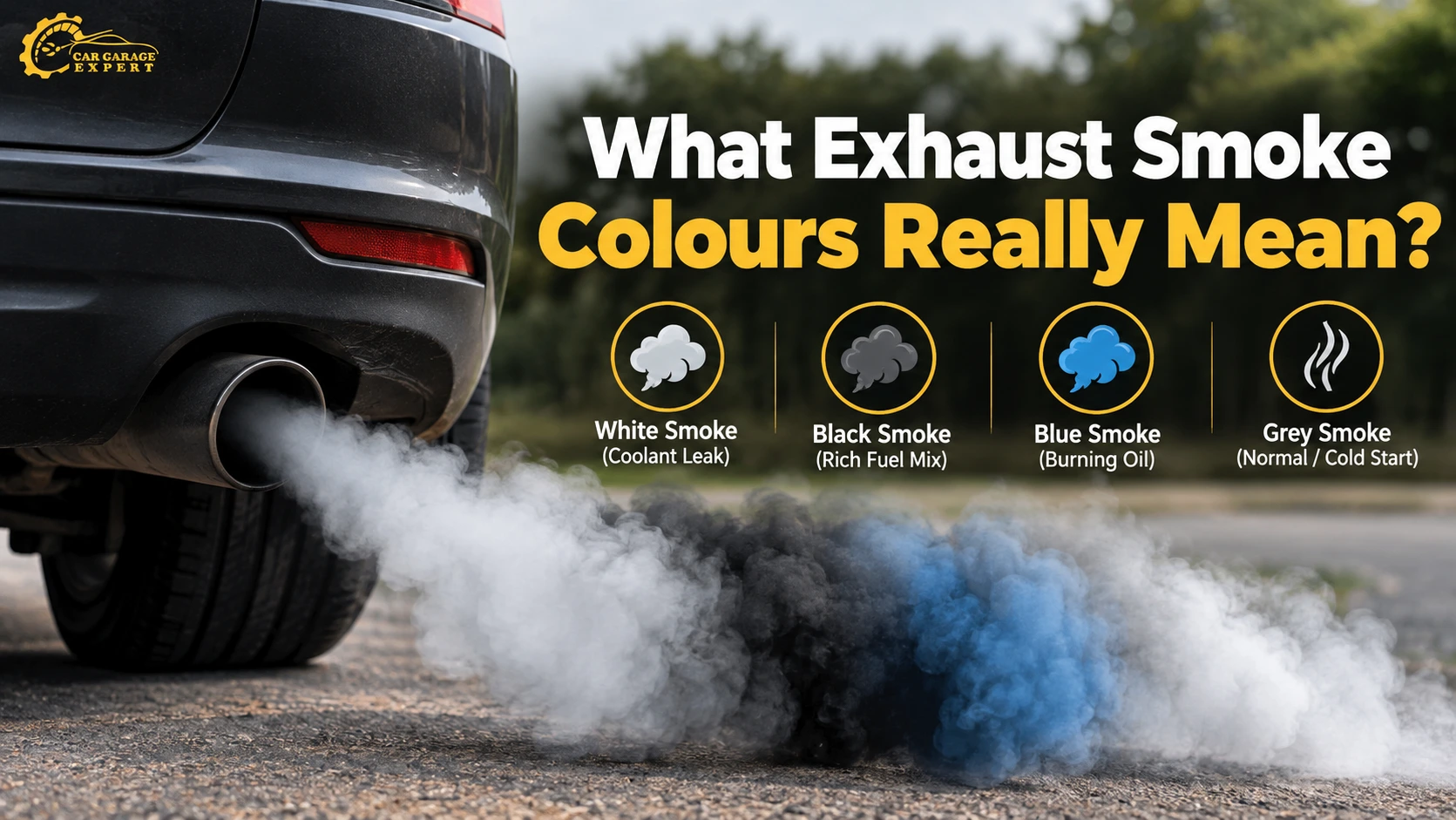
Exhaust smoke colours point to what the engine is burning that it shouldn’t. Thin white vapor on a cold morning is usually harmless condensation. Thick white smoke that keeps coming after warm-up can mean coolant is getting into the engine, often from a head gasket fault. Blue smoke means engine oil is burning, usually from worn piston rings, valve stem seals or a leaking turbo. Black smoke means too much fuel or poor combustion, often from a dirty air filter, faulty injectors, or a sensor fault. Grey smoke is harder to read. It can come from oil burning, a faulty PCV valve or a turbo problem.
| Smoke Colour | Possible Explanation |
| White | Condensation or, if persistent and dense, possible coolant leakage |
| Blue | Engine oil burning |
| Black | Excess fuel or incomplete combustion |
| Grey | Possible oil burning, PCV or turbocharger problems, or other engine faults |
What Does White Smoke From the Exhaust Mean?
White smoke has two very different causes. One is harmless water vapour. The other is coolant burning inside the engine. Timing, thickness, and smell tell them apart.
White Smoke When Starting the Car
Thin white smoke for the first few minutes after a cold start is usually normal. Burning fuel makes water. On a cool morning, that water condenses in the cold exhaust and comes out as vapour. You may also see a few drops of water dripping from the tailpipe.
This vapour fades quickly as the exhaust warms up. It has no strong smell. It disappears fast in the air, like breath on a cold day.
White Smoke That Continues After the Engine Warms Up
White smoke that stays after 10 to 15 minutes of driving is not condensation. Thick, billowing white smoke that hangs in the air usually means coolant is burning in the cylinders. It often smells sweet, a bit like syrup.
Other signs usually come with it. The coolant level drops with no visible leak. The engine may run hot or overheat. The heater may blow cold air, and the engine may run rough at idle.
In diesel cars, white smoke can also come from unburnt fuel. This happens when injection timing is wrong, a glow plug fails, or an injector sticks open. That smoke smells of raw diesel and stings the eyes.
Can a Blown Head Gasket Cause White Exhaust Smoke?
Yes. A blown head gasket is the most common reason for coolant burning. The gasket seals the gap between the engine block and the cylinder head. It keeps oil, coolant, and combustion gases in separate channels.
When it fails, coolant can leak into a cylinder and burn with the fuel. Overheating is the usual cause. Heat makes the cylinder head expand and warp, and the gasket loses its seal. A cracked cylinder head or engine block can cause the same smoke, though less often.
Look for milky, light brown sludge under the oil filler cap. That can mean coolant is mixing with oil. Stop driving if you see it.
What Does Blue Smoke From the Exhaust Mean?
Blue or blue-grey smoke means the engine is burning oil. Oil should stay in the bottom of the engine and on the cylinder walls. When it gets into the combustion chamber, it burns and leaves a blue haze with a sharp burnt-oil smell.
You may also notice the oil level dropping between services. Some cars need a top-up every few hundred kilometers when this happens.
Why Does Blue Smoke Appear When Accelerating?
Blue smoke under hard acceleration often points to worn piston rings or a leaking turbo. When you press the pedal, pressure inside the cylinders rises. Worn rings let oil slip past into the chamber, and it burns.
Smoke that shows when you accelerate after a long idle, or after coasting downhill, points more to valve stem seals. Oil collects above the valves while the engine runs with low load. When you speed up, that oil gets drawn in and burns in one puff.
Can Worn Piston Rings or Valve Stem Seals Cause Blue Smoke?
Yes, both are common causes. Piston rings seal the gap between the piston and the cylinder wall. They also scrape oil off the wall. Worn rings let oil stay on the wall, and it burns on every stroke. High-mileage engines and engines that missed oil changes wear rings faster.
Valve stem seals are small rubber seals on top of each valve. Heat makes them hard and brittle over time. Once they crack, oil leaks down the valve stems into the cylinders.
Ring wear usually smokes under load. Seal wear usually smokes at start-up or after idling.
Can a Turbocharger Leak Cause Blue Exhaust Smoke?
Yes. A turbo spins on a shaft that is fed with engine oil. Seals on each side keep that oil in. When the bearings or seals wear, oil leaks into the turbo’s intake or exhaust side.
Turbo leaks often show as blue smoke under boost and oil inside the intake pipes. You may also hear a whistling or siren-like sound and notice weaker acceleration. A blocked oil return line can also push oil past healthy seals, so mechanics check it before replacing the turbo.
What Does Black Smoke From the Exhaust Mean?
Black smoke means the engine is burning too much fuel for the air it gets. Unburnt fuel turns into soot, and the soot comes out as black smoke. You may also notice poor fuel economy, a fuel smell, and black soot around the tailpipe.
Common Causes of Black Smoke in Petrol Cars
Healthy petrol engines rarely make black smoke. When they do, the fuel mix is too rich. Common reasons include:
- A dirty or blocked air filter
- A faulty mass airflow (MAF) sensor that under-reads the air coming in
- A faulty oxygen sensor sending wrong readings to the engine computer
- A leaking or stuck-open fuel injector
- A faulty fuel pressure regulator sending too much fuel
A rich mix can also damage the catalytic converter. The extra fuel burns inside it and overheats it.
Why Do Diesel Cars Produce Black Exhaust Smoke?
Diesels make some black smoke more easily than petrol cars. A short puff under hard acceleration can be normal on older diesels. Constant black smoke is not.
Common causes include worn or dirty injectors, a blocked air filter, a stuck EGR valve, and turbo boost problems. A turbo that leaks boost or doesn’t spin up fully sends too little air for the fuel. Modified or “tuned” diesels that add fuel without enough air also smoke heavily. Many diesel pickups and SUVs in the UAE use a diesel particulate filter (DPF). A damaged DPF can let soot pass straight out.
Can a Clogged Air Filter or Faulty Fuel Injector Cause Black Smoke?
Yes. These are two of the most common causes. A clogged air filter starves the engine of air, so the same amount of fuel burns rich. It is also the cheapest fix on this list.
A faulty injector can drip fuel instead of spraying a fine mist. Large droplets don’t burn fully and turn into soot. A leaking injector can also flood one cylinder. That causes a misfire, a rough idle, and a strong fuel smell.
What Does Grey Smoke From the Exhaust Mean?
Grey smoke is the hardest color to read. It sits between blue and white, so it can come from oil burning, a turbo fault, or a ventilation problem. Light and the angle you look from can make blue smoke look grey too.
Why Does Grey Smoke Appear When Accelerating?
Grey smoke when you accelerate often means a small amount of oil is burning. The cause is often early piston ring wear or a turbo that has started to leak. In some cars, a rich fuel mix makes grey smoke before it turns fully black.
On automatic cars, older guides mention transmission fluid as a cause. That can happen on some older models with a vacuum modulator, but it is rare on modern cars.
Can a Faulty PCV Valve Cause Grey Smoke?
Yes. The PCV (positive crankcase ventilation) valve lets gases from the bottom of the engine flow back into the intake to be burned. When it sticks or clogs, pressure builds up inside the engine. That pressure pushes oil past seals and into the intake, where it burns as grey or blue smoke.
A stuck PCV valve can also cause oil leaks, a whistling noise, and a rough idle. It is a cheap part. It is often worth checking before blaming the rings or turbo.
Can Turbocharger or Engine Problems Cause Grey Smoke?
Yes. A turbo with worn seals often makes grey or blue smoke, especially after the car has idled and then pulls away. Worn rings, worn valve guides, and a failing head gasket can also show as grey smoke in their early stages.
Because grey smoke has so many possible causes, it needs proper testing. Guessing often means replacing the wrong part.
Smoke Clue Table: Colour, Smell and Timing
Exhaust smoke colours alone don’t confirm a fault. When the smoke appears and how it smells narrows the cause down a lot. Use this table before you call a workshop.
| What You Notice | Most Likely Cause | What to Do |
| Thin white vapour at cold start, gone in minutes, no smell | Normal condensation | Nothing |
| Thick white smoke after warm-up with a sweet smell | Coolant burning (head gasket or cracked head) | Stop driving and check coolant |
| Blue puff at start-up or after idling, then clears | Worn valve stem seals | Book an inspection |
| Blue smoke under hard acceleration, burnt oil smell | Worn piston rings or turbo leak | Book an inspection soon |
| Black smoke with a fuel smell and poor economy | Rich fuel mix (air filter, injector or sensor) | Book an inspection |
| Grey smoke with oil leaks or whistling | Stuck PCV valve or early turbo wear | Book an inspection |
| Any smoke with a warning light, overheating or knocking | Serious engine fault | Stop and call for recovery |
The Tailpipe Tissue Test You Can Do at Home
Most guides on exhaust smoke colours stop at the colour. This simple test gives you and your mechanic a better clue. You need a white paper towel and a phone.
- Start the engine and let it idle. Never touch the tailpipe, as it gets very hot.
- Hold the paper towel about 10 cm behind the tailpipe for 10 seconds, so the exhaust blows onto it.
- Look at the mark it leaves.
Clear water drops that dry with no mark are normal condensation. Oily spots that leave a greasy ring point to oil burning. Black, dry, powdery soot points to a rich fuel mix. A sweet smell on a damp towel suggests coolant.
Next, film the tailpipe for 10 seconds at cold start and again after a short drive with a firm press on the pedal. Smoke often stops by the time you get to the garage. A video shows the mechanic exactly what you saw.
Other Signs That Often Come With Exhaust Smoke
Smoke rarely shows up alone. These signs help confirm what is wrong:
- The oil level drops between services
- The coolant level drops with no visible leak.
- The temperature gauge rises or the engine overheats.
- The check engine light or oil pressure light comes on.
- The engine misfires, idles roughly, or loses power.
- Fuel economy gets worse.
- Milky sludge appears under the oil filler cap.
- Soot or oil collects around the tailpipe.
What Causes Exhaust Smoke in a Car?
Every type of smoke comes from something burning that shouldn’t, or fuel that doesn’t burn fully. These are the five main sources of car exhaust smoke problems.
- Engine oil leaking into the combustion chambers. Worn piston rings, valve stem seals, and valve guides let oil past. This gives blue or grey smoke.
- Coolant leaks into the cylinders. A blown head gasket, warped head, or cracked block lets coolant burn. This gives thick white smoke.
- Fuel system faults. Leaking injectors, bad sensors, and wrong fuel pressure make the mix too rich. This gives black smoke.
- Restricted air intake. A blocked air filter, a damaged intake pipe, or a faulty MAF sensor starves the engine of air. This also gives black smoke.
- Turbocharger problems. Worn turbo seals leak oil, and boost leaks reduce air. This can cause blue, grey, or black smoke.
Overheating is behind many of these faults. It can warp heads, harden seals, and break down oil. That is why a cooling system fault often ends in a smoke problem later.
How Do Mechanics Diagnose Different Exhaust Smoke Colors?
A proper engine smoke diagnosis starts with simple checks and moves to deeper tests only when needed. A good car mechanic usually follows these steps:
- Visual inspection of the exhaust. The mechanic checks the smoke’s color, thickness, and smell at idle and under revs. They also look for soot or oil at the tailpipe.
- Engine oil and coolant level checks. Falling levels show which fluid is being burned. The mechanic also checks the oil for coolant and the coolant for oil.
- Diagnostic trouble-code scanning. Codes for misfires, fuel trims, MAF or oxygen sensors, and boost pressure point to fuel and air faults.
- Cooling system pressure testing, where indicated. The system is pressurized to find leaks. A combustion gas test (block test) checks the coolant for exhaust gases, which confirms a head gasket leak.
- Further engine or turbocharger testing as required. This can include a compression test, a leak-down test and a turbo shaft play check. A PCV valve test or a borescope camera look inside the cylinders may follow.
The mechanic should explain which test confirmed the cause before any big repair starts.
Why Diagnosing Exhaust Smoke Colours Takes More Than a Look
A quick look at the smoke can mislead. Blue smoke may look grey in daylight. A small coolant leak may only smoke for a few seconds after start-up. Two faults can also happen together, such as worn rings and a leaking turbo. Tests like a compression check and a block test give a firm answer.
How Workshops Fix Each Type of Exhaust Smoke
The repair depends on what the tests found. These are the usual fixes:
For white smoke from coolant:
- Repair the cooling system to stop the overheating that caused it.
- Head gasket replacement, with the cylinder head checked for warping and skimmed if needed.
- Cylinder head or engine replacement if cracked
For blue or grey smoke from oil:
- PCV valve replacement and crankcase breather cleaning
- Valve stem seal replacement.
- Turbo repair or replacement, with the oil feed and return lines cleaned or replaced
- Piston ring replacement or an engine rebuild for severe wear
For black smoke from fuel and air:
- Air filter replacement
- MAF sensor cleaning or replacement
- Oxygen sensor replacement
- Injector cleaning, testing, or replacement
- EGR valve cleaning and DPF cleaning on diesels
After the repair, the workshop should road test the car and check that the smoke is gone and no warning lights remain.
What Happens If You Ignore Exhaust Smoke?
Smoke is an early warning. Ignoring it usually turns a smaller repair into a bigger one.
- Coolant burning can lead to overheating, a warped head, and a seized engine.
- Oil burning can foul spark plugs, damage the catalytic converter, and leave the engine low on oil.
- Black smoke wastes fuel, clogs the catalytic converter or DPF and can wash oil off cylinder walls.
- Heavy smoke can fail a vehicle inspection and draw police attention.
Is It Safe to Drive a Car That Is Producing Exhaust Smoke?
It depends on the colour and what comes with it. Thin white vapour that clears in a few minutes is safe. Most other smoke needs an inspection within days, not weeks.
Book an inspection soon if you see:
- Blue or grey smoke with an oil level that keeps dropping
- Black smoke with poor fuel economy or a fuel smell
- Any smoke that has been getting worse over time
Stop driving and switch off the engine if:
- Thick white smoke comes with a rising temperature gauge.
- The oil pressure light comes on, or the check engine light flashes.
- The engine knocks, misfires badly, or loses power.
- Smoke comes from under the bonnet, not just the exhaust.
In these cases, call roadside assistance rather than driving on. A recovery costs far less than a new engine.
How Long Does It Take to Fix Exhaust Smoke?
Time depends entirely on the cause:
- An air filter or PCV valve takes under an hour.
- Sensor replacement or injector cleaning usually takes 1 to 3 hours.
- Turbo replacement often takes most of a day.
- A head gasket or valve stem seal job can take 2 to 4 days, including head machining.
- An engine rebuild can take one to three weeks, depending on parts.
How Much Does It Cost to Fix Exhaust Smoke Problems in Dubai?
There is no single price for smoke repairs. A blocked air filter and a cracked engine block can both cause smoke, but their costs can differ by thousands of dirhams. The cost depends on four things:
- The cause, confirmed by testing
- The make, model, and engine type, as turbo and European engines cost more.
- The parts used, whether OEM or aftermarket.
- The labour hours, which rise sharply when the engine must be opened
As a rough guide, Dubai market prices for common passenger cars fall into these bands. Your quote will depend on the car and the fault.
|
Repair |
Rough Dubai Range (AED) |
| Air filter or PCV valve | 100 to 600 |
| Sensor replacement (MAF or oxygen) | 300 to 1,200 |
| Injector cleaning or replacement | 400 to 3,000 |
| Turbo repair or replacement | 2,500 to 10,000 |
| Head gasket replacement | 2,500 to 8,000 |
| Engine rebuild | 8,000 to 25,000+ |
Ask for a written, itemized quote that lists the test results, parts, and labor.
How to Prevent Exhaust Smoke Problems
Most smoke problems start with heat, old oil, or missed maintenance. These habits help:
- Book every car service and oil change on time, using the oil grade in your manual.
- Check oil and coolant levels monthly.
- Replace the air filter on schedule, and sooner if you drive on dusty roads.
- Watch the temperature gauge and stop at the first sign of overheating.
- Let a turbo engine idle for 30 to 60 seconds before switching off after hard driving.
- Use fuel from busy, reputable stations.
- Fix small oil leaks before they reach hot exhaust parts.
Dubai-Specific Advice on Exhaust Smoke
Local conditions affect which exhaust smoke colors show up most often in Dubai cars.
How Dubai Heat Changes Exhaust Smoke Colours
Summer heat is hard on cooling systems. A weak radiator or fan that copes in winter can fail in a 45°C summer. Overheating is the most common route to a blown head gasket and white smoke. Heat also hardens valve stem seals faster, which leads to blue smoke on older engines.
Dust is the second factor. Fine sand clogs air filters quickly, especially near construction sites and desert roads. A blocked filter is a common cause of black smoke here.
A few more local points:
- Water dripping under the car after driving with the AC on is normal. It comes from the AC, not the exhaust.
- On humid winter mornings, white vapor is more visible at start-up. It should clear within minutes.
- Many diesel pickups and Land Cruisers here use a DPF. Short city trips don’t give it time to clean itself, which can lead to black smoke and warning lights.
- Long idling in traffic with the AC on is hard on turbos and cooling systems. Keep both checked before summer.
Why Car Garage Expert Is a Strong Choice for Engine Repair in Dubai
For smoke problems that need proper testing and engine work, Car Garage Expert in Al Quoz is worth considering. Here’s why it suits this kind of fault.
Testing Before Replacing Parts
Smoke faults are easy to misread, and a wrong guess can mean replacing a turbo that wasn’t the problem. Asking for test results such as a compression check or block test, before agreeing to a big repair, protects you. A workshop that does both diagnosis and engine repair can explain the result and carry out the fix.
Service, Diagnosis and Repair at One Workshop
The garage offers routine servicing as well as mechanical and engine repair. A smoke fault found during a service can be tested and repaired without moving the car to another shop.
Help When the Car Shouldn’t Be Driven
If smoke comes with overheating or warning lights, don’t drive the car far. The garage offers roadside assistance and a mobile car mechanic service, so help can start where the car stopped.
Easy to Reach in Al Quoz
Al Quoz sits between Sheik Zayed Road and Al Khail Road. That keeps the drive or recovery distance short from much of Dubai.
Frequently Asked Questions
Q1: What is the most serious exhaust smoke colour?
Thick white smoke after warm-up is usually the most serious. It often means coolant is burning, which can lead to overheating and major engine damage.
Q2: Is white smoke from the exhaust always a problem?
No. Thin white vapour at cold start that clears in a few minutes is normal condensation. Thick, sweet-smelling white smoke that stays is a problem.
Q3: What does blue smoke mean in a car?
Blue smoke means the engine is burning oil. Common causes include worn piston rings, worn valve stem seals, or a leaking turbo.
Q4: Why is my car blowing black smoke when accelerating?
The engine is getting too much fuel for the air. Common causes are a dirty air filter, faulty injectors, a bad MAF sensor, or a turbo boost leak.
Q5: Can low engine oil cause exhaust smoke?
Low oil doesn’t usually cause smoke on its own. But engines that burn oil often run low, so smoke and a low oil level usually show up together. Overfilling with oil can cause smoke too.
Q6: When should I take my car to a mechanic for exhaust smoke?
Book a check if smoke lasts after warm-up, keeps coming back, or gets worse. Stop driving right away if smoke comes with overheating, warning lights, or knocking.
Related Services for Exhaust Smoke Problems
A smoke inspection often leads to one or more of these services:
- Engine diagnostics and fault code scanning
- Cooling system and radiator repair
- Head gasket and cylinder head repair
- Turbo inspection and replacement
- Fuel injector cleaning and replacement
- Air filter, oil and full car servicing
- Car painting to fix soot or oil stains on the rear bumper around the tailpipe
Where Can You Get Exhaust Smoke Problems Diagnosed in Dubai?
Exhaust smoke colours point you in the right direction, but only testing gives a firm answer. A typical check covers the smoke itself, the oil and coolant levels, and a fault code scan. Where needed, it also includes a cooling system pressure test, block test, compression test, or turbo check. You then get a clear explanation of the cause before any repair begins.
If you need a garage near me that can test a smoke problem, book an inspection with Car Garage Expert in Al Quoz. Send a WhatsApp message with your car’s make and model, the smoke color, and your tailpipe video. You can also find the workshop on Google Maps.