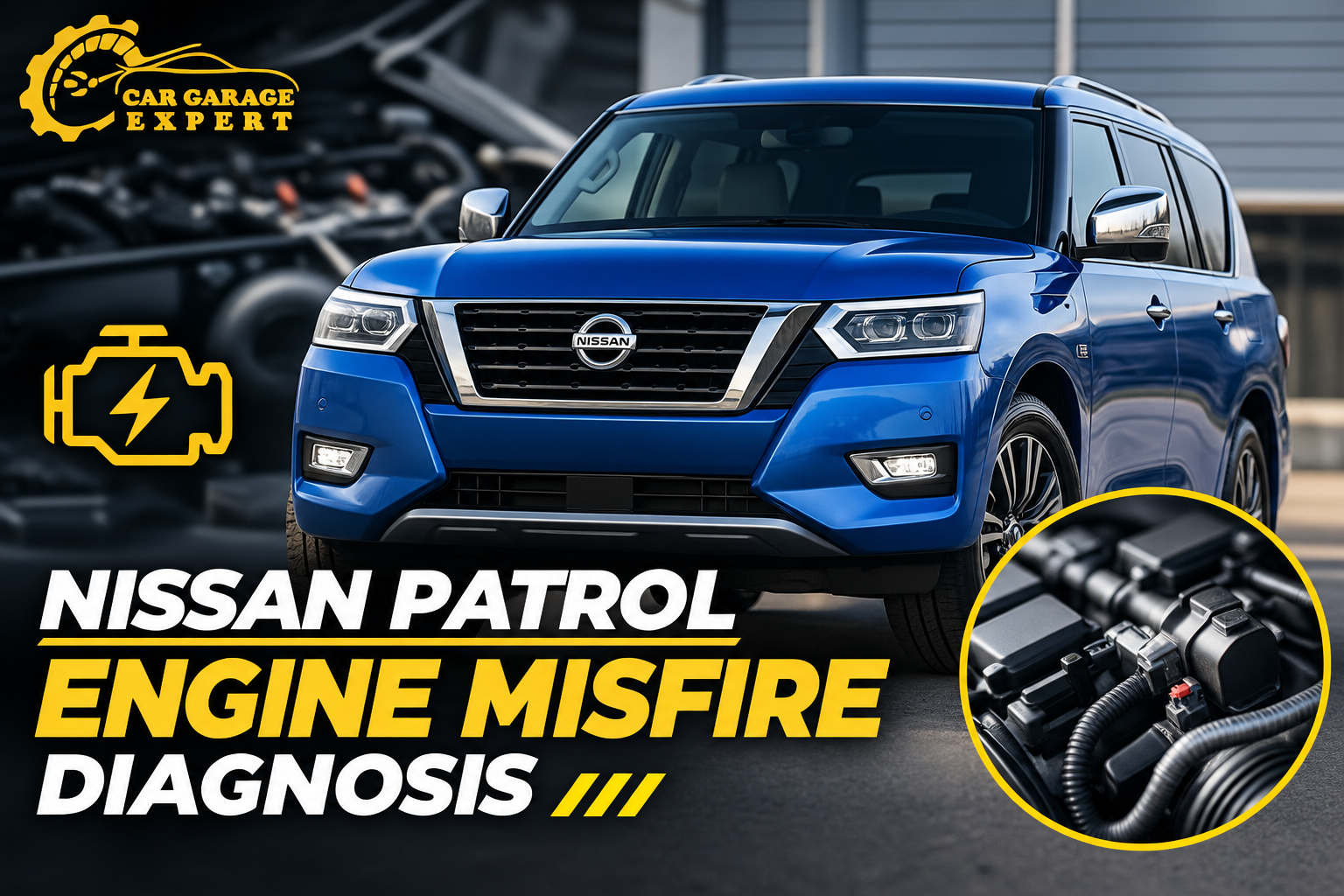
A Nissan Patrol engine misfire occurs when one or more cylinders fail to burn the air-fuel mixture correctly. Common signs include rough idling, engine shaking, hesitation, reduced acceleration, poor fuel economy, and a flashing or illuminated check-engine light. Possible causes range from worn spark plugs and defective ignition coils to fuel injector problems, vacuum leaks, sensor faults, or engine compression issues. Accurate Nissan Patrol engine misfire diagnosis requires professional scanning, ignition and fuel-system testing, and sometimes compression or leak-down testing. In Dubai, prompt diagnosis matters because high temperatures and heavy traffic can put extra stress on the engine and ignition system.
Problem Overview
A Nissan Patrol is designed to deliver strong performance, smooth power delivery, and dependable operation. However, an engine misfire can quickly affect these characteristics.
An engine misfire happens when combustion inside one or more cylinders is incomplete, irregular, or absent. The problem may stem from the ignition system, fuel delivery, air intake, engine timing, sensors, or internal mechanical components.
The challenge is that several different faults can produce similar symptoms. Replacing parts without identifying the actual cause can therefore become expensive and ineffective.
Professional Nissan Patrol engine misfire diagnosis focuses on why combustion is failing, not just clearing the check-engine light.
Early diagnosis can help prevent secondary damage, improve drivability, and reduce the possibility of a much more expensive engine or catalytic-converter repair.
What Symptoms Indicate a Nissan Patrol Engine Misfire?
Recognising the warning signs early makes diagnosis and repair easier. Common symptoms include:
Rough or Unstable Idling
The engine may shake or feel uneven when the Patrol is stationary. RPM can fluctuate as the engine struggles to maintain consistent combustion.
Engine Shaking
You may notice a noticeable vibration when accelerating, idling, or driving at low speeds. Severity often depends on how often the cylinder misfires.
Poor Acceleration
A misfire can prevent the engine from producing its normal power. You may notice hesitation when accelerating from a stop or when overtaking.
Check Engine Light
The check-engine light may illuminate when the engine computer detects combustion irregularities. A flashing warning light can indicate a more serious active misfire.
Increased Fuel Consumption
Incomplete combustion can reduce fuel efficiency. If your Patrol suddenly requires more fuel than usual, consider an engine misfire among the possible causes.
Difficult Starting
Some misfires are accompanied by extended cranking, rough starting, or an engine that struggles to settle into a stable idle.
Unusual Exhaust Smell
Incomplete combustion can allow unburned fuel into the exhaust system, potentially producing an unusual fuel-related odour.
What Causes a Nissan Patrol Engine Misfire?
There is no single cause of a misfire. A proper diagnosis should consider several systems.
Worn or Fouled Spark Plugs
Spark plugs ignite the air-fuel mixture. Worn electrodes, carbon deposits, incorrect gaps, or damaged plugs can cause intermittent or consistent misfires.
Defective Ignition Coils
Ignition coils generate the high voltage needed to produce a spark. A weak or failing coil can cause one cylinder to misfire, especially under acceleration.
Faulty Fuel Injectors
A blocked, dirty, leaking, or electrically defective injector may deliver too much, too little, or an inconsistent amount of fuel.
Vacuum or Intake Leaks
Unmetered air entering the intake system can alter the air-fuel mixture. Cracked hoses, damaged seals, or intake leaks may contribute to lean misfires.
Sensor Problems
Engine management depends on information from various sensors. Incorrect readings can affect fuel delivery, ignition timing, and overall combustion.
Fuel Delivery Problems
Low fuel pressure, a restricted fuel system, or another fuel-delivery issue can prevent the engine from receiving the correct fuel quantity.
Timing or Mechanical Problems
A misfire may also originate from internal engine problems, valve issues, timing-system faults, or inadequate cylinder compression.
Because these causes can overlap, professional testing is more reliable than replacing components based on symptoms alone.
How Is Nissan Patrol Engine Misfire Diagnosed?
A professional diagnostic process should be systematic.
1. Initial Inspection
A technician first checks the engine’s condition and looks for obvious signs of damaged wiring, disconnected hoses, fluid contamination, or other visible problems.
2. Diagnostic Scan
A professional scan tool can retrieve diagnostic trouble codes and identify misfire-related information. Codes can help narrow the investigation but don’t always identify the failed component on their own.
3. Misfire Pattern Analysis
Technicians can determine whether the problem affects a particular cylinder or occurs across multiple cylinders.
4. Spark Plug Inspection
Spark plugs can reveal useful clues about combustion. Their condition may help identify ignition problems, fuel-related issues, or abnormal combustion conditions.
5. Ignition System Testing
The ignition coils, wiring, connectors, and related components are checked to determine whether the cylinder is receiving a reliable spark.
6. Fuel System Testing
If the ignition components appear healthy, the technician may inspect the fuel system. This can include checking injector operation and fuel pressure where appropriate.
7. Air Intake Inspection
The technician checks for vacuum leaks, intake-system damage, and other sources of unmetered air.
8. Compression Testing
If ignition, fuel, or air issues can’t explain the problem, the technician may test cylinder compression.
9. Further Mechanical Testing
Depending on the findings, additional testing may be required to identify valve, timing, or other internal engine problems.
This step-by-step approach helps avoid unnecessary parts replacement.
How Is a Misfiring Nissan Patrol Repaired?
The repair depends entirely on the diagnosed cause.
For ignition-related faults, the solution may involve replacing worn spark plugs, a failed ignition coil, or damaged electrical components.
For fuel-related problems, technicians may need to service or replace an injector, correct fuel-pressure issues, or repair another fuel-system component.
If a vacuum leak is responsible, damaged hoses, seals, or intake components may need replacement.
More complex cases may require sensor replacement, wiring repairs, timing-system work, or internal engine repairs.
After the repair, the vehicle should be tested to confirm the misfire is resolved and engine performance has returned to normal.
What Are the Risks of Ignoring an Engine Misfire?
Continuing to ignore a misfire can turn a relatively manageable fault into a larger repair.
A persistent misfire can affect engine performance and fuel economy. More importantly, unburned fuel entering the exhaust system can potentially increase the thermal load on emissions components.
Ignoring the problem may also add stress to engine and drivetrain components and make the vehicle less predictable during acceleration.
If the check-engine light is flashing or the vehicle is running extremely rough, seek professional attention promptly rather than continuing to drive normally.
Can You Continue Driving a Misfiring Nissan Patrol?
It depends on the severity and cause.
A minor intermittent issue may let you reach a workshop safely, but that doesn’t mean continued everyday driving is advisable.
If the Patrol is shaking heavily, losing significant power, producing unusual noises or smells, or showing a flashing check-engine light, limit driving.
If you suspect a serious misfire, arranging a professional inspection or recovery can be safer than risking further damage.
How Long Does Misfire Repair Take?
Repair time depends on the underlying fault.
A simple spark-plug or ignition-coil issue may be diagnosed and repaired relatively quickly. Injector problems, wiring faults, intake leaks, or sensor issues can require additional testing.
Mechanical engine problems generally take longer because technicians must perform more detailed inspections and repairs.
A professional workshop should provide a clearer time estimate after completing the initial diagnosis.
What Factors Affect Nissan Patrol Misfire Repair Cost?
The cost of Nissan Patrol engine misfire diagnosis and repair depends on several factors:
- The specific Patrol engine and model year
- Number of affected cylinders
- Diagnostic complexity
- Spark plug and ignition coil condition
- Fuel injector condition
- Sensor or wiring faults
- Parts quality and availability
- Whether mechanical engine repairs are required
- Workshop labor requirements
A proper diagnosis can actually help control costs because it reduces unnecessary parts replacement.
Instead of changing multiple components based on guesswork, technicians can identify the system responsible for the fault and repair it accordingly.
How Can You Prevent Future Nissan Patrol Misfires?
Preventive maintenance can reduce the likelihood of ignition and fuel-system problems.
Follow the recommended maintenance schedule for spark plugs and other serviceable components. Use suitable replacement parts, and don’t ignore warning lights or changes in engine behaviour.
Regular inspections can also help identify damaged hoses, deteriorating connectors, fluid leaks, and other problems before they develop into more serious faults.
It is also important to address small performance changes early. Slight hesitation or rough idling can sometimes indicate a developing issue.
What Should Dubai Nissan Patrol Owners Know?
Dubai’s climate creates demanding operating conditions for vehicles. High ambient temperatures can increase the thermal load placed on engines, electrical components, cooling systems, and other under-hood components.
Heavy traffic and frequent stop-and-go driving can add further stress, particularly when the vehicle spends extended periods idling or operating at low speeds.
For Dubai Patrol owners, regular maintenance and early diagnosis are therefore particularly valuable.
If your Nissan Patrol develops rough running, hesitation, poor acceleration, or a check-engine warning, prompt inspection can help prevent a minor fault from becoming a larger problem.
Choosing a workshop familiar with Nissan vehicles and local driving conditions can also speed up diagnostics.
Why Choose Car Garage Expert for Nissan Patrol Engine Misfire Diagnosis?
At Car Garage Expert, we aim to identify the underlying cause of a Nissan Patrol misfire rather than simply replacing parts until the symptoms disappear.
A professional diagnostic approach can include electronic fault-code scanning, ignition-system inspection, fuel-system checks, intake inspection, and mechanical testing when required.
This approach helps determine whether the problem originates from spark, fuel, air, sensors, or internal engine components.
For Dubai drivers, timely inspection can also help maintain dependable performance in demanding traffic and weather conditions.
If your Nissan Patrol is experiencing an engine misfire, getting a professional diagnosis is a practical first step toward restoring smooth performance.
FAQs Nissan Patrol Engine Misfire Diagnosis
1. What is the most common cause of a Nissan Patrol engine misfire?
Common causes include worn spark plugs, faulty ignition coils, fuel injector problems, intake or vacuum leaks, sensor faults, and fuel-delivery issues. Confirm the cause through diagnostic testing rather than assuming it from symptoms alone.
2. Can a bad spark plug cause a Nissan Patrol to misfire?
Yes. A worn, damaged, fouled, or incorrectly gapped spark plug can prevent reliable ignition and cause a cylinder to misfire. However, other faults can create similar symptoms, so the ignition system should be properly tested.
3. Is it safe to drive a Nissan Patrol with a misfire?
Minimise driving if you have a significant misfire. A severe or persistent misfire can affect engine performance and may damage exhaust-system components. A flashing check-engine light or severe shaking warrants prompt professional attention.
4. How is Nissan Patrol engine misfire diagnosis performed?
Diagnosis typically begins with a visual inspection and diagnostic scan. Technicians may then inspect spark plugs and ignition coils, test fuel delivery and injectors, check for intake leaks, and perform compression or other mechanical tests when necessary.
5. How much does Nissan Patrol misfire repair cost in Dubai?
There is no single fixed price because the cost depends on the cause. A spark-plug or ignition-coil repair is generally simpler than injector, wiring, timing, or internal engine repairs. A proper diagnosis provides a more accurate estimate before you perform major repairs.
Conclusion Nissan Patrol Engine Misfire Diagnosis
A Nissan Patrol engine misfire should never be treated as a minor inconvenience, particularly when the problem is persistent or accompanied by a flashing check-engine light, severe vibration, or power loss.
Causes can range from simple ignition faults to fuel-system, electrical, sensor, or internal engine problems. That is why accurate Nissan Patrol engine misfire diagnosis is essential before replacing expensive components.
For Nissan Patrol owners in Dubai, early professional inspection can help restore smooth performance, protect the vehicle from potentially avoidable secondary damage, and keep repair costs under control.
Need Nissan Patrol Engine Misfire Diagnosis in Dubai?
Don’t let rough running, hesitation, shaking, or a check-engine warning turn into a bigger repair.
Visit us in our Al Quoz, Dubai branch or visit Car Garage Expert
Contact Car Garage Expert today to arrange a professional Nissan Patrol engine misfire inspection and find the real cause.