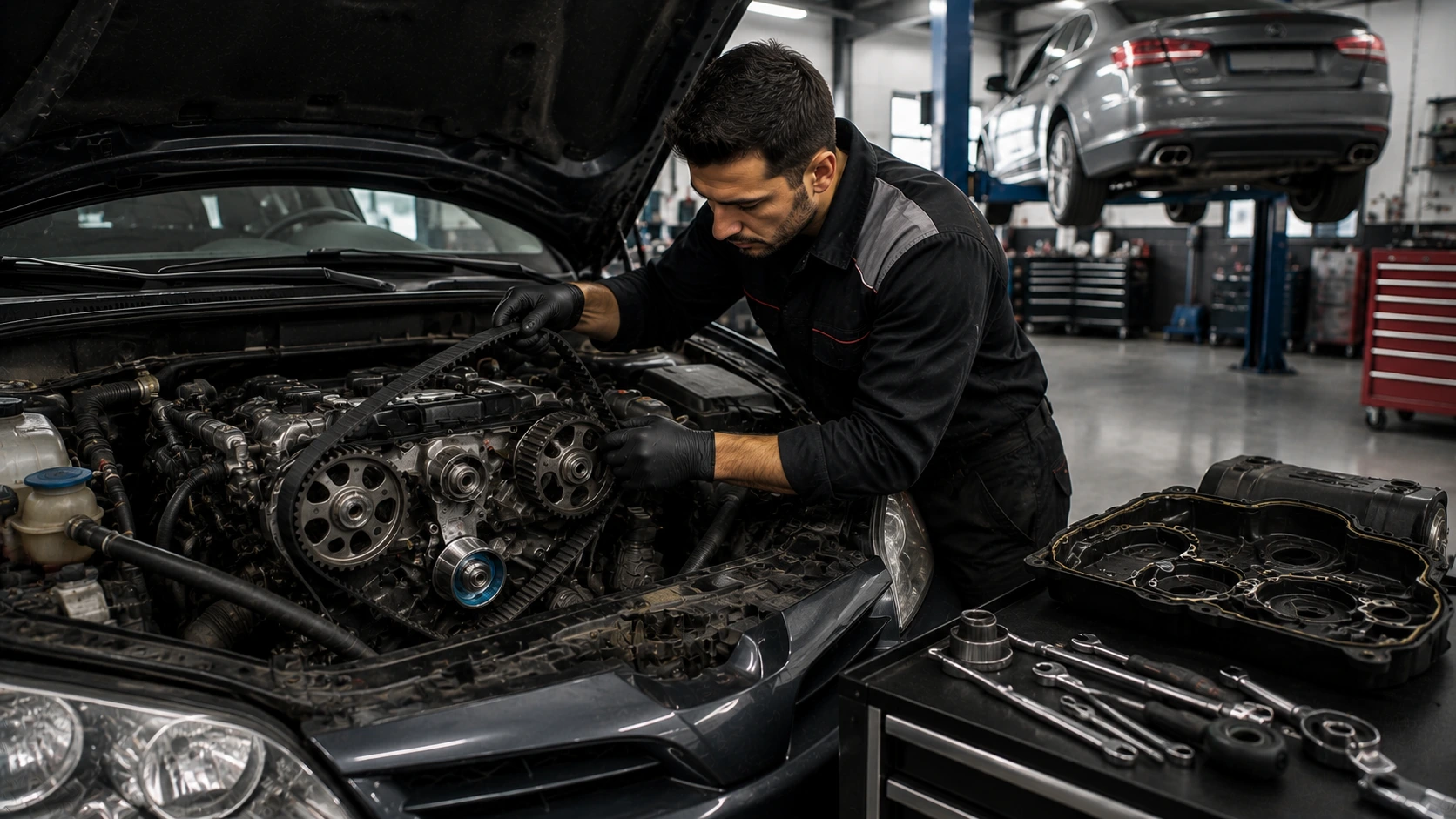
A timing belt failure is one of the few automotive faults that gives no warning before it causes catastrophic engine damage. No warning light. No unusual sound in the days before. No performance change that signals something is wrong. The belt snaps, the engine’s timing relationship between the crankshaft and camshafts is immediately destroyed, and on an interference engine the valves and pistons collide in fractions of a second.
Timing belt replacement Dubai is the maintenance item that prevents this outcome — and it’s one of the few car service items where the interval is a hard limit rather than a guideline. The manufacturer’s specified replacement interval exists because the belt’s rubber compound degrades to the point of failure risk beyond that interval. Exceeding it isn’t a calculated risk — it’s gambling with the engine.
In Dubai’s specific conditions, the case for replacing the timing belt at or before the manufacturer’s interval is even stronger than in cooler markets. Heat accelerates rubber degradation. And the difference between catching a timing belt at its service interval and discovering it failed on Sheikh Zayed Road is the difference between a planned workshop visit and an engine rebuild.
Timing Belt Replacement Dubai — What the Timing Belt Does
Understanding why timing belt replacement Dubai is so consequential starts with understanding what the timing belt actually does.
The timing belt connects the crankshaft — which drives the pistons up and down — to the camshafts, which open and close the intake and exhaust valves. The precise timing of this relationship determines when the valves open and close relative to piston position. On a correctly timed engine, the valves open and close in the spaces between piston movements — there’s no physical contact between valves and pistons.
When the timing belt fails, this relationship is instantly lost. The camshafts stop rotating while the crankshaft continues. On a non-interference engine, the valves simply stop moving — the engine stalls but survives. On an interference engine — which the majority of modern engines are — the pistons move into the space the stopped valves now occupy, and the collision bends valves, damages pistons, and in severe cases damages the cylinder head.
The repair cost for a timing belt failure on an interference engine ranges from AED 8,000 for a minor head repair on a four-cylinder engine to AED 40,000 or more for a complete engine on a V6 or V8 with extensive damage. The cost of a preventive timing belt replacement Dubai service: AED 800–2,500 depending on the vehicle. The economic case is straightforward.
Why Dubai’s Conditions Make Timing Belt Replacement More Urgent
Dubai’s operating environment accelerates timing belt degradation in ways that European service schedules don’t fully account for.
Heat Degrades Rubber Faster
The timing belt is made of rubber-reinforced composite material — typically HNBR (Hydrogenated Nitrile Butadiene Rubber) or similar high-performance compound. This material maintains its flexibility and tensile strength within a specific temperature range.
Dubai’s engine bay temperatures — ambient heat above 40°C combined with engine operating heat — push the belt’s operating environment beyond the range that temperate-market service intervals assume. Rubber compound at high sustained temperatures oxidises faster, develops microcracks in the belt structure sooner, and loses tensile strength at an accelerated rate.
The practical implication: a timing belt that’s safely within its service interval by mileage on a European-market vehicle may be approaching its thermal degradation limit on the same vehicle operated in Dubai’s heat for the same number of kilometres.
Age-Based Limits Are More Relevant in Dubai
Manufacturers specify timing belt replacement Dubai intervals in two ways — mileage and time, whichever arrives first. The time-based limit is often 5 years regardless of mileage.
In Dubai, where vehicles sometimes accumulate low mileage but experience high heat exposure — a car driven primarily for short local trips covers fewer kilometres but experiences the same thermal cycling as a high-mileage vehicle — the time-based limit is frequently the more relevant trigger.
A vehicle at 40,000 km after four years in Dubai has experienced four cycles of summer heat exposure to the belt. The manufacturer’s 5-year replacement limit reflects this accurately. The mileage might suggest the belt is fine. The age and thermal history tell a different story.
Short-Trip Driving and Cold Start Stress
Short-trip driving in Dubai’s stop-start traffic creates repeated cold-start tension cycles on the timing belt. Each cold start puts maximum tension on the belt as the engine accelerates from cold — and in a vehicle that makes multiple short trips per day, these maximum-tension events accumulate faster than in a vehicle making fewer but longer journeys.
The tensioner and idler pulleys that maintain correct belt tension are also subject to bearing wear from these repeated cold-start cycles. A timing belt replacement Dubai service that includes tensioner and idler pulley replacement prevents bearing failure from becoming the secondary cause of belt failure even after the belt itself has been renewed.
Timing Belt vs Timing Chain — Understanding Which Your Car Has
Not every vehicle uses a timing belt — many modern engines use a timing chain instead. Understanding which system is in the vehicle determines whether timing belt replacement Dubai is a scheduled maintenance item or not.
Timing Belts — Scheduled Replacement Required
Vehicles with timing belts require replacement at the manufacturer’s specified interval without exception. The belt is a wear item with a finite service life — its rubber compound degrades over time and mileage regardless of how well the engine is maintained.
Common vehicles in Dubai’s market that use timing belts include many Toyota, Honda, Mitsubishi, Hyundai, Kia, and Volkswagen Group models — though the specific engine variant determines which system is used. A 2.0-litre engine in the same model may use a belt while the 2.5-litre in the same body uses a chain.
The correct approach is to confirm from the owner’s manual or a qualified workshop which system the specific engine uses rather than assuming based on the brand or model name.
Timing Chains — No Scheduled Replacement
Timing chains are metal and don’t have a scheduled replacement interval like timing belts. They’re designed to last the life of the engine with correct oil maintenance.
However, timing chains aren’t failure-proof. Timing chain tensioner wear — indicated by the cold-start rattle that clears within 10–15 seconds as oil pressure builds — is a known concern on several common Dubai market engines including the BMW N20, VW Group EA888, and certain Ford EcoBoost variants. Catching this early with a tensioner replacement prevents the chain slack that eventually causes a timing event.
Chain stretch and guide wear on higher-mileage engines can produce similar consequences to belt failure — a jumped chain causes a timing event with the same valve-piston collision damage. The difference is that chains give more warning than belts before they fail completely.
What’s Included in a Proper Timing Belt Replacement Dubai Service
A proper timing belt replacement Dubai service is never just the belt alone. The components that the belt interacts with and drives must all be assessed and typically replaced at the same service interval.
Timing Belt Kit — What It Should Include
A complete timing belt replacement service should always include the full timing belt kit — not just the belt alone.
Tensioner Pulley
The tensioner pulley maintains correct belt tension through a spring-loaded or hydraulically actuated mechanism. After years of operation in Dubai’s heat, the tensioner spring loses its rate or the hydraulic mechanism loses its pressure retention. A new belt on a worn tensioner isn’t correctly tensioned — and incorrect tension accelerates belt wear, causes belt noise, and in severe cases allows the belt to jump teeth on the sprockets.
Idler Pulleys
The idler pulleys guide the belt’s path around the engine. Each idler pulley has a bearing that experiences continuous rotation throughout the engine’s operation. Bearing wear in these pulleys — accelerated by Dubai’s heat — causes pulley wobble and belt misalignment.
A failed idler pulley bearing causes the belt to run at an incorrect angle, creating edge wear on the belt that rapidly degrades the belt’s structural integrity. Replacing idler pulleys at the same time as the belt ensures the new belt runs on correctly functioning guides.
Water Pump — When Belt-Driven
Many engines have the water pump driven by the timing belt rather than by the auxiliary belt. On these engines, water pump replacement at the same service interval as the timing belt is standard practice — and for a very specific economic reason.
Replacing the water pump requires accessing exactly the same area as the timing belt — the same disassembly is required for both. If the water pump is replaced separately from the belt, the full timing belt disassembly labour cost is incurred twice. If both are replaced together, only one labour operation is charged.
More importantly: if the water pump fails between timing belt service intervals, the coolant loss and potential for overheating represents a significant risk. And if the water pump is replaced and the timing belt is not, the timing belt now has an unknown history from the perspective of the new owner.
A timing belt replacement Dubai service on an engine with a belt-driven water pump should always include the water pump.
Timing Belt Cover Seals
The seals around the timing belt cover — which keep oil and coolant away from the belt — should be inspected and replaced if showing degradation. Oil contamination of the timing belt significantly accelerates belt degradation and dramatically shortens its safe service life.
Timing Belt Replacement Intervals — Key Models in Dubai’s Market
Different engines have different timing belt replacement intervals. These are the most relevant models in Dubai’s market and their specified intervals.
Toyota and Lexus
Many Toyota petrol engines use timing belts — the 1GR-FE V6 in the Land Cruiser Prado and FJ Cruiser, the 2TR-FE four-cylinder in the Hilux and Fortuner. The typical interval for these engines is 90,000–100,000 km or 5 years, whichever comes first.
In Dubai’s conditions, the time-based limit often arrives before the mileage limit for owners using these vehicles primarily in urban environments.
Honda
Honda’s older engine families use timing belts — the K-series and J-series engines in older Accord, Odyssey, and Pilot models have belt-driven timing systems. The 2.4 K24 and 3.5 J35 used in these models typically have 90,000–100,000 km or 7-year replacement intervals. Newer Honda engines increasingly use chains.
Mitsubishi
The 3.8-litre 6G75 V6 in the Pajero and the 2.4-litre 4G64 four-cylinder in older Outlander models use timing belts. The Pajero V6 timing belt interval is typically 90,000 km or 5 years in severe conditions — and Dubai’s heat qualifies as severe conditions.
Volkswagen Group
Many older VW Group petrol and diesel engines use timing belts — the 2.0 TDI diesel engine used across Golf, Passat, and Tiguan models has a timing belt with a 210,000 km or 5-year interval in European markets. In Dubai’s conditions, the time-based limit should be observed strictly and the mileage interval treated as the maximum rather than the target.
Hyundai and Kia
Older Hyundai and Kia engines — the Theta II 2.4-litre and the Delta 2.7-litre V6 — use timing belts with intervals typically around 90,000 km or 5 years. More recent Hyundai and Kia engines have largely moved to timing chains.
Signs That Timing Belt Attention Is Needed Now
While timing belt failure gives no specific warning, certain symptoms indicate the belt system needs immediate inspection.
Engine Age Approaching or Exceeding Service Interval
The most important “symptom” of a timing belt that needs attention isn’t a sound or a light — it’s the service record showing the belt hasn’t been replaced at the manufacturer’s interval. Any vehicle that’s reached or exceeded its timing belt replacement Dubai interval without documented replacement needs the service immediately.
Ticking or Clicking from the Engine
A rhythmic ticking or clicking sound from the timing belt area — distinct from the random clicking of a warming engine — can indicate a worn tensioner or idler pulley bearing. This sound warrants immediate inspection. A worn bearing in a tensioner or idler can fail suddenly, releasing tension on the belt and causing a timing event without any further warning.
Visible Cracks or Glazing on the Belt
If the timing belt is visible during any other engine work, its condition should be assessed. Visible cracks in the rubber — particularly on the underside of the belt where flexion stress is highest — indicate a belt approaching the end of its service life. Glazing — a shiny, hardened appearance on the belt surface — indicates heat hardening that has reduced the belt’s flexibility.
Either of these visible findings should trigger immediate timing belt replacement Dubai regardless of where the vehicle sits relative to its interval.
Oil or Coolant Contamination Near the Belt Area
Oil seeping from a crankshaft or camshaft seal into the timing belt area contaminates the belt and accelerates degradation. A belt operating in oil contact loses tensile strength significantly faster than a clean belt. Any oil leak near the timing belt area should be investigated and the belt’s condition assessed simultaneously.
The Correct Approach to Timing Belt Replacement Dubai
A professional timing belt replacement Dubai service follows a specific sequence that ensures the new belt is installed on a correctly functioning system.
The engine is brought to the correct timing position before disassembly — confirming the engine is at top dead centre on the firing stroke before any components are disturbed. All related components — tensioner, idler pulleys, water pump where belt-driven — are replaced as a complete kit. The new belt is installed at the correct tension specification. The engine is rotated by hand through several complete cycles after installation to confirm correct timing before starting. The engine is started and allowed to reach operating temperature, after which a final inspection confirms correct operation and no coolant or oil leaks from disturbed seals.
For owners who need mechanical assessment alongside other service items, a complete car service at the same workshop visit addresses the full vehicle. A qualified car mechanic with the specific experience to perform timing belt replacement on the relevant engine handles the work correctly — timing belt replacement is not a generalist task, and the consequences of incorrect installation are the same as the consequences of a failed belt.
For owners in Al Quoz and surrounding areas looking for a garage near me that performs timing belt replacement Dubai correctly — complete kit replacement, correct tensioning, post-installation rotation check, and documented service record — the difference from a workshop that replaces the belt alone without the tensioner and idler pulleys shows within months when the worn pulleys cause the new belt to fail prematurely.
A mobile car mechanic handles emergency roadside assessment when a timing-related symptom develops away from the workshop. For owners who have experienced an engine stoppage that may be timing belt related, proper roadside assistance ensures the vehicle is transported without further engine damage from attempted restart.
FAQ
How do I know if my car has a timing belt or timing chain?
Check the owner's manual or ask a qualified workshop — the same model with different engine variants may use different systems, so the specific engine code matters.
What happens if the timing belt breaks while driving in Dubai?
On an interference engine — which most modern engines are — the valves and pistons collide immediately, causing bent valves, damaged pistons, and potentially a destroyed cylinder head. The engine will not restart and requires significant repair.
Can I extend the timing belt replacement interval in Dubai?
No — the manufacturer's interval is a maximum, not a target. In Dubai's conditions, replacing at or before the interval is the correct approach. Extending the interval increases failure risk without any benefit.
Does timing belt replacement include the water pump?
It should on any engine where the water pump is driven by the timing belt — replacing both at the same time avoids paying the disassembly labour cost twice and eliminates the risk of water pump failure between belt service intervals.
How much does timing belt replacement cost in Dubai?
Typically AED 800–2,500 at a quality independent workshop depending on the vehicle — a fraction of the AED 8,000–40,000 engine repair cost that timing belt failure causes.
Conclusion
Timing belt replacement Dubai is the maintenance item with the clearest cost-benefit case in automotive service. A planned replacement at or before the manufacturer’s interval costs AED 800–2,500. The engine damage from a failed belt costs AED 8,000–40,000. And in Dubai’s heat — where rubber degradation is accelerated beyond what European service schedules assume — the correct approach is to treat the manufacturer’s interval as the maximum and the time-based limit as the more relevant trigger for vehicles that accumulate lower mileage in urban stop-start conditions.
Car Garage Expert in Al Quoz handles timing belt replacement for all makes — complete kit including tensioner, idler pulleys, and water pump where applicable — with correct timing procedure and documented service record. Book your appointment on WhatsApp or find the workshop on Google Maps.