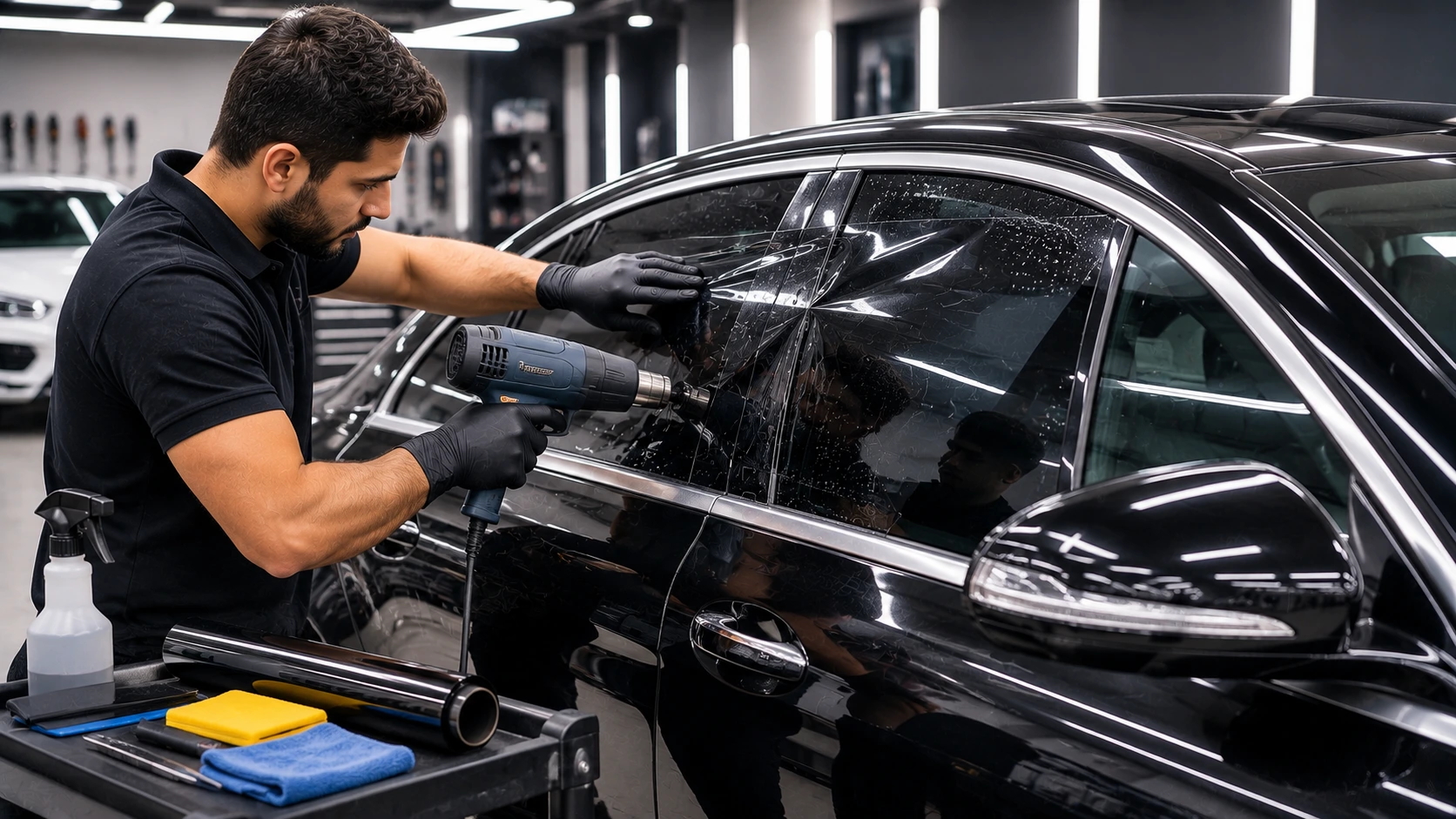
Car window tinting Dubai is one of the most practical modifications an owner can make to a vehicle in the UAE — not a cosmetic preference but a genuine functional upgrade that affects cabin temperature, UV exposure, driver comfort, and interior preservation.
Dubai’s UV index is among the highest globally, and the combination of direct sun exposure and high ambient temperatures creates cabin conditions that genuinely degrade interiors, increase AC load, and make driving uncomfortable in ways that window tinting directly addresses.
But car window tinting Dubai comes with specific legal requirements that every owner should understand before booking a tinting appointment — the wrong tint shade can result in a failed RTA inspection, a fine, and the cost of removing and replacing the film entirely.
Car Window Tinting Dubai — The Legal Framework
Window tinting in Dubai is governed by Dubai Police and RTA regulations that specify the minimum visible light transmission (VLT) percentage allowed on each window position.
VLT percentage refers to the amount of visible light that passes through the tinted film. A 50% VLT film allows 50% of visible light through. A 20% VLT film allows 20% — darker and more opaque.
Legal VLT Requirements by Window Position
Dubai’s tinting regulations apply differently to each window position on the vehicle. Understanding which windows are subject to which limits is the foundation of any legal car window tinting Dubai installation.
Windshield
No tinting is permitted on the main windshield glass below the top 10 cm strip. A sun strip of up to 10 cm along the top of the windshield is permitted in most cases — but the specific allowance varies, and professional advice before any windshield tinting is the correct approach.
Front Side Windows
Front side windows — driver and front passenger — must allow a minimum of 30% VLT. This means the film must allow at least 30% of visible light through. This is the most commonly misunderstood requirement because many owners assume the front windows can be tinted to the same level as the rear.
Rear Side Windows
No specific minimum VLT is mandated by Dubai’s regulations for rear side windows — darker tints are permitted. Owners wanting maximum privacy and heat rejection in the rear can use significantly darker film here than on front windows.
Rear Window
The same applies as for rear side windows — darker tints are legally permitted. Combined with quality film, this allows meaningful heat and UV rejection in the rear of the cabin without legal concerns.
Why Legal Compliance Matters Practically
A non-compliant car window tinting Dubai installation doesn’t just risk a fine. It means the cost of the original tinting job is lost when non-compliant film must be removed, plus the cost of compliant film to replace it.
A quality workshop fitting legal tints correctly from the start is always more economical than a budget installation that requires correction before the next RTA inspection.
Understanding Tint Film Options
Not all window tint films are equal. The film type significantly affects heat rejection, UV protection, visibility quality, and durability — and the correct film for Dubai’s conditions differs from what would be appropriate in a cooler climate.
There are four main film categories relevant to car window tinting Dubai — each with different performance characteristics, price points, and suitability for Dubai’s specific conditions.
Dyed Film
Dyed films are the entry-level option in car window tinting Dubai packages. They work by absorbing solar energy through the dyed layer in the film. In Dubai’s heat conditions, absorbed energy re-radiates into the cabin — limiting the film’s effectiveness as a heat barrier.
Over time, Dubai’s UV exposure causes dyed films to fade and develop a purple or brownish tint — particularly on rear windows that receive sustained direct sun. Dyed film has the lowest upfront cost but the shortest lifespan and lowest heat rejection performance in UAE conditions.
Metalised Film
Metalised films incorporate a thin metallic layer that reflects solar energy rather than absorbing it. This improves heat rejection compared to dyed film because reflected energy doesn’t enter the cabin or heat the film itself.
The practical limitation is signal interference. The metallic layer can disrupt mobile phone signals, GPS reception, and radio reception — a meaningful concern for most Dubai drivers where navigation and connectivity are daily requirements.
Carbon Film
Carbon films offer improved heat rejection over dyed film without the signal interference of metalised film. The carbon particles reflect infrared radiation — the heat-carrying component of solar energy — rather than visible light. This means the film can appear lighter while still rejecting significant heat.
Carbon film is more durable than dyed film in Dubai’s UV conditions — the carbon particles don’t degrade the way dyes do, so colour stability over time is significantly better. This makes carbon film the practical middle ground for car window tinting Dubai — better heat rejection than dyed, no signal interference, and a longer lifespan.
Ceramic Film
Ceramic film is the premium tier in car window tinting Dubai packages. Ceramic particles provide the highest heat rejection — blocking up to 80% of infrared radiation in high-quality formulations — without any metallic layer and therefore without signal interference.
Ceramic film can achieve high heat rejection with a lighter appearance. A 70% VLT ceramic film can reject more heat than a 50% VLT carbon film because the rejection targets infrared rather than visible light. This is particularly valuable on front windows where the legal 30% VLT minimum limits how dark the film can be. The upfront cost is higher, but the per-year cost over the film’s lifespan in Dubai’s conditions narrows the gap significantly.
What Car Window Tinting Actually Does for a Dubai Vehicle
The practical benefits of correct car window tinting Dubai installation address several genuine ownership concerns — not cosmetic preferences but measurable performance improvements.
Cabin Temperature Reduction
A parked car in Dubai’s summer reaches cabin temperatures exceeding 70°C. Quality window tinting — particularly ceramic film — significantly reduces the rate at which the cabin heats when parked. The practical benefit is a shorter cool-down period when the driver returns to the car and a lower starting temperature the AC system must overcome.
For the AC system specifically, a lower starting cabin temperature means less initial cooling load — the compressor reaches comfortable temperature faster with less sustained maximum-output operation.
UV Protection for the Interior
Even without visible fading, UV radiation progressively degrades dashboard plastics, seat leather, and fabric materials. The cracking and brittleness that Dubai interiors develop over years of exposure is substantially UV-driven.
Quality car window tinting Dubai film blocks 99% or more of UV radiation regardless of visible light transmission. A 70% VLT film — which appears nearly clear — still blocks 99% of UV. This means interior UV protection doesn’t require a dark tint — any quality film provides meaningful protection independently of how light or dark it appears.
Glare Reduction
Low-angle sun during morning and evening driving creates glare conditions that affect visibility and driver comfort. Window tinting reduces glare intensity — an important safety and comfort benefit on Dubai’s east-west oriented motorway network where drivers face directly into the rising or setting sun for significant portions of commutes.
Privacy
Rear window tinting provides privacy for rear passengers — relevant for families and professionally used vehicles. Darker rear tints are legally permitted and practically effective for privacy without affecting driver forward visibility.
Common Tinting Issues and How to Avoid Them
Certain car window tinting Dubai failures appear repeatedly in the market — most are avoidable through correct film selection and installation technique. Understanding them helps owners identify quality installations from budget ones before committing.
Bubbling and Delamination
The most common quality complaint in car window tinting Dubai installations is bubbling — air or moisture trapped between the film and glass creating visible bubble formations. Bubbling on new installations results from incorrect surface preparation — glass that wasn’t cleaned correctly before film application, allowing contaminants or moisture to prevent proper adhesion.
Bubbling on older installations results from film adhesive degradation — accelerated significantly by Dubai’s heat cycling. The correct response is film removal and replacement with quality material, not attempting to smooth existing bubbles.
Purple or Brown Discolouration
Colour shift from neutral grey or charcoal toward purple or brown is UV degradation of the dye compound in dyed films. This is almost exclusive to dyed film — carbon and ceramic films don’t exhibit this degradation pattern because their active components aren’t organic dyes.
For Dubai vehicle owners who want colour stability over the film’s lifespan, carbon or ceramic film is the correct choice. Dyed film discolouration in Dubai’s UV conditions is a matter of when, not if.
Peeling at Edges
Peeling at film edges — where the film separates from the glass at the trim line — results from either incorrect edge trimming during installation or adhesive failure from heat cycling at the glass edges where temperatures are highest. Quality film with heat-stable adhesive, correctly trimmed and pressed at the edges during installation, doesn’t peel in Dubai’s conditions.
A workshop with proper installation tools and experience with Dubai’s heat cycle requirements installs film that holds at the edges through multiple summers. A budget installation that cuts corners on edge preparation and pressing produces peeling within the first hot season.
Car Window Tinting Dubai Packages — What to Look For
A proper car window tinting Dubai package provides clear information on every component of the service before work begins.
The film brand and product series should be specified — not just “ceramic film” but the specific manufacturer and product line. Quality variation between premium ceramic brands and budget ceramic is significant despite sharing the same material category name. A workshop that can’t specify the film brand is typically using film they’d prefer the customer not to research independently.
VLT percentage for each window position should be confirmed in writing — particularly that front side windows are at or above 30% VLT. A compliant installation should have no hesitation documenting this.
Warranty terms should cover bubbling, peeling, and discolouration — and specify the duration and claim process clearly. A quality film backed by a meaningful warranty reflects the installer’s confidence in both the material and the installation.
Tinting New vs Used Vehicles
Car window tinting Dubai service applies differently to new and used vehicles. New vehicle tinting is straightforward — clean glass, no existing film, application proceeds directly.
Used vehicle tinting where existing film is present requires film removal first. Old film removal in Dubai’s heat conditions requires specific technique — the adhesive layer becomes more resistant after years of heat cycling, and incorrect removal scratches the glass. A proper car window tinting Dubai workshop has the tools and technique for clean old film removal without glass damage.
For vehicles with original factory solar control glass, additional film layers affect both the measured VLT (the combination of factory glass and added film) and heat management within the glass itself. A workshop experienced with car window tinting Dubai accounts for factory glass specifications when selecting the correct film for legal compliance.
Aftercare for Window Tinting in Dubai
Freshly applied car window tinting Dubai film requires a curing period before the adhesive reaches full bond with the glass. During this period — typically 48–72 hours in Dubai’s heat conditions — windows should not be lowered. Rolling the window into the door frame pulls the film from the glass edge before curing is complete.
Cleaning tinted windows after curing should use ammonia-free products only. Ammonia-based cleaners degrade tint film adhesive over time, accelerating edge peeling and delamination. Standard ammonia-free glass cleaners are appropriate and widely available.
For owners who need other vehicle services alongside window tinting, a car service can be scheduled in the same workshop visit. For paint or bodywork alongside window tinting, professional car painting is handled at the same workshop. A qualified car mechanic addresses any mechanical findings identified during the visit. A mobile car mechanic handles mechanical concerns at the vehicle’s location when needed. For owners in Al Quoz and surrounding areas looking for a garage near me that installs car window tinting Dubai correctly — legal VLT percentages, quality film appropriate for Dubai’s UV and heat conditions, and correct installation technique — the difference from a budget installation shows in how long the film lasts and whether it passes the next RTA inspection.
FAQ
What is the legal tint percentage for front windows in Dubai?
Front side windows must allow at least 30% visible light transmission — film darker than 30% VLT on driver and front passenger windows will fail the RTA roadworthiness inspection.
What is the best window tint film for Dubai's heat?
Ceramic film provides the highest heat rejection without signal interference and the longest lifespan in Dubai's UV conditions — the correct choice for front windows where legal VLT limits restrict how dark the film can be.
Does window tinting affect my car's RTA inspection in Dubai?
Yes — non-compliant tint darker than 30% VLT on front side windows will fail the RTA inspection and require removal and replacement before the vehicle can pass.
How long does car window tinting take in Dubai?
A full vehicle tinting installation typically takes two to four hours depending on vehicle size and the number of windows being tinted.
Can I roll my windows down immediately after tinting?
No — freshly applied film requires 48–72 hours of curing time before windows should be lowered to allow the adhesive to fully bond at the glass edges.
Conclusion
Car window tinting Dubai done correctly uses film that meets legal VLT requirements on front windows, provides genuine heat and UV rejection appropriate for Dubai’s conditions, and is installed with preparation and technique that prevents bubbling, peeling, and colour shift over the film’s lifespan. The choice of film type and the quality of the installation determines whether the tinting delivers years of value or becomes a re-tinting cost within months.
Car Garage Expert in Al Quoz handles car window tinting for all makes — legal compliance on all window positions, quality carbon and ceramic film options, and correct installation technique with warranty backing. Book your appointment on WhatsApp or find the workshop on Google Maps.