A scratch that appeared in a car park. A door edge that caught a bollard. A panel that needs respraying after an accident. Car body paint work in Dubai covers a range from minor cosmetic corrections to full panel resprays — and the quality of the result depends almost entirely on what happens before the paint goes on.
Dubai creates a specific set of challenges for car body paint work. UV intensity that fades paint and accelerates clear coat degradation faster than almost any other market. Fine sand from shamal events that creates surface abrasion. Temperature cycling between parked cabin heat and air-conditioned environments that stresses panel seals and bond lines. And a market where the gap between a budget repair and a quality one is immediately visible — particularly in the strong directional light of a Dubai afternoon.
Finding the right car body paint workshop in Al Quoz means finding one where colour matching is done with the vehicle’s actual paint code, where preparation is done in the correct sequence, and where UV-resistant clear coat is used as standard rather than as an upgrade.
Car Body Paint Dubai — Why Preparation Quality Determines Everything
The most common complaint about car body paint work in Dubai isn’t the colour match — it’s the repair that failed within months. Paint lifting at panel edges. Filler showing through the surface after one summer. Clear coat fading visibly against the surrounding original panels.
All of these are preparation failures. The surface that paint is applied to — how it was cleaned, profiled, primed, and dried — determines whether the repair holds correctly in Dubai’s conditions or fails progressively.
Surface contamination must be completely removed before any repair begins. Body oils, sunscreen residue, silicone from previous polish applications, and the fine oil film that accumulates on exterior surfaces in Dubai’s environment all prevent correct adhesion of primer and paint. A solvent wipe-down is a minimum step — thorough chemical cleaning of the repair area is correct practice.
Panel profile accuracy matters specifically in Dubai’s strong directional light. A panel that was straightened to approximately the right shape rather than precisely the right profile produces a repair that looks correct in the workshop and reveals subtle shape anomalies when low-angle sunlight crosses the panel surface.
A Toyota Camry came to Car Garage Expert after a budget workshop had resprayed the front left quarter following a parking impact. Under flat workshop lighting the repair looked acceptable. In direct afternoon Dubai sunlight, a clear profile deviation across the centre of the panel was visible — the panel had been roughed back to approximately the right shape but not precisely, and the filler had been applied to create the appearance of correct profile rather than to correct it. The panel had to be stripped and redone.
Types of Car Body Paint Work and the Correct Approach
Scratch Repair
Scratch depth determines the correct repair approach. This assessment is the first step of any car body paint consultation.
Clear Coat Scratches
A scratch that has damaged only the clear coat layer — not penetrated to the colour coat — can often be addressed through machine polishing alone. Polishing compounds remove a small amount of clear coat surface, blending out the scratch by eliminating the sharp edges of the damaged area.
This approach is only effective if the remaining clear coat is sufficient thickness after polishing. Dubai’s UV environment degrades clear coat over time — vehicles that have been polished repeatedly or that have UV-thinned clear coat may not have sufficient thickness remaining for polishing to work without breaking through to the colour coat.
Colour Coat Scratches
A scratch that has penetrated through the clear coat and into the colour coat requires localised respray. The scratch area is cleaned and prepared, primer is applied where bare metal is exposed, colour is applied and blended into the surrounding panel, and clear coat is applied over the repaired area and blended into the surrounding original clear coat.
The quality of this repair depends on the blend zone execution — the area where new paint transitions into original paint. A sharp transition is visible. A correctly graduated blend is invisible.
Deep Scratches to Metal
A scratch that has penetrated to bare metal on a steel panel is a rust entry point. In Dubai’s humidity cycling environment, the condensation that forms on a cold panel transferred from an air-conditioned garage to ambient exterior temperature is sufficient to initiate surface rust surprisingly quickly.
Correct car body paint repair for a scratch to metal involves cleaning the scratch, applying primer before any colour coat, and using the full preparation sequence rather than simply painting over the scratch. A brush touch-up that doesn’t apply primer seals the rust in rather than preventing it.
Dent and Stone Chip Repair
Stone chips on bonnets and front sections are among the most common car body paint repair requests in Dubai — highway conditions and construction zone traffic produce high-frequency chip damage on leading surfaces.
Micro-Repair Technique
Stone chips are correctly addressed through micro-repair technique — individual treatment of each chip rather than bulk coverage. Each chip is cleaned to bare metal, primed with the correct primer chemistry for the substrate, colour-matched, and sealed. The repair is virtually invisible at normal viewing distance and correctly protects the metal from rust development.
A brush touch-up from a pen applicator doesn’t achieve this. Pen applicators deposit paint over the chip without reaching the metal base, without applying primer, and with colour mixed to the original specification rather than adjusted for the vehicle’s actual UV-aged shade. The touch-up is visible immediately and seals rust potential in rather than preventing it.
Panel Respray
A full panel respray is the correct approach when damage is extensive, when a previous repair has failed, or when a panel has UV-degraded clear coat that polishing can’t adequately address.
Preparation Sequence for Panel Respray
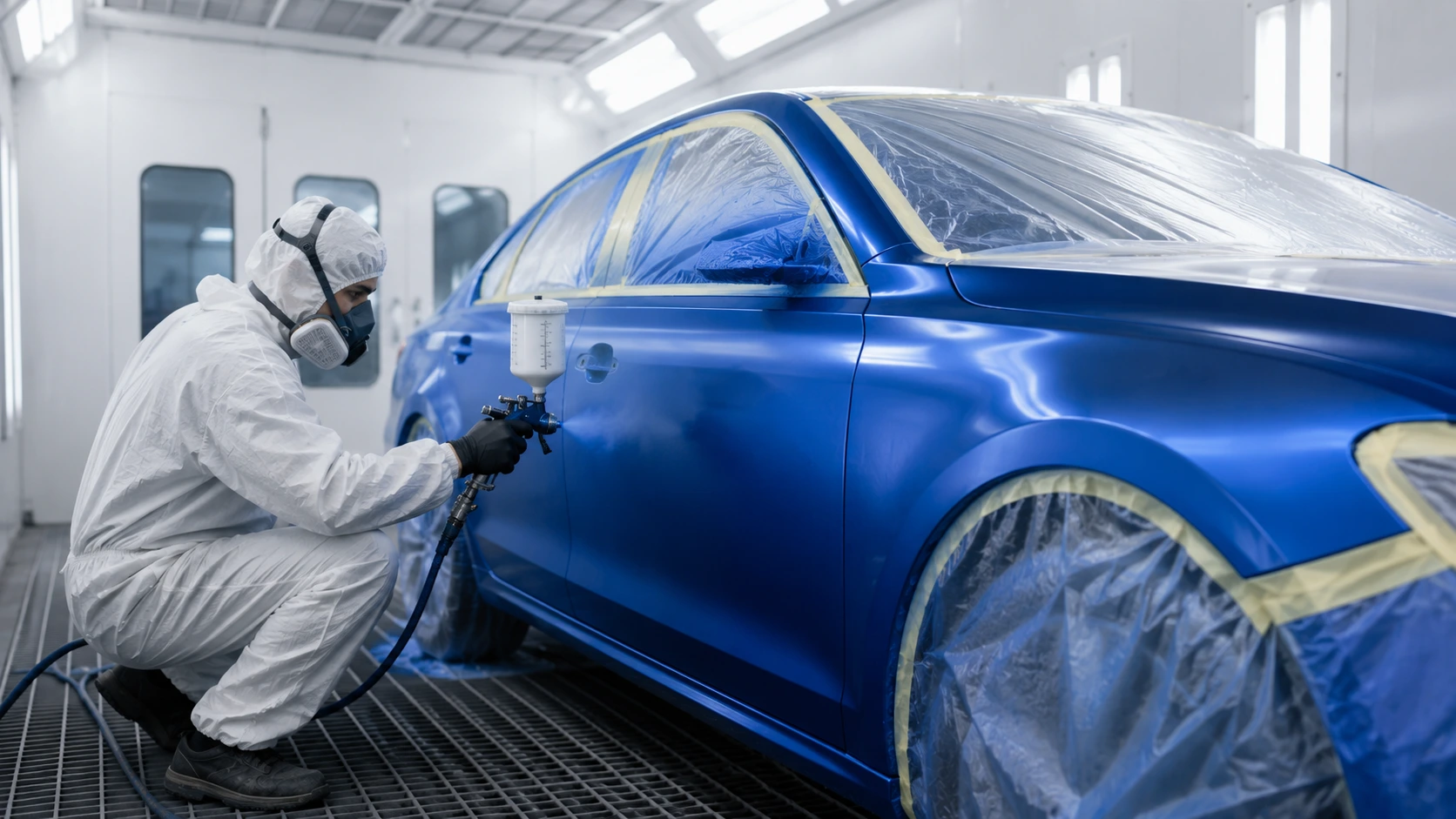
The preparation sequence for professional car body paint panel respray follows a specific order that can’t be shortcut without affecting the result.
Surface strip and cleaning — removing previous repair material, contamination, and loose paint. Panel straightening where needed — restoring the panel’s profile to the correct shape before any filling begins. Body filler application — sequential thin coats with correct cure time, sanded progressively to reveal remaining low areas. Primer application — correct primer type for the substrate at the correct film thickness. Primer sanding — wet sanding through progressively finer grits to create a smooth, texture-free surface. Tack cloth wipe — removing dust immediately before colour application.
Each step affects the quality of what follows. A respray that rushes any of these stages produces a result that looks adequate initially and reveals the shortcut within months.
Primer Chemistry for Each Substrate
The primer chemistry for steel differs from aluminium, which differs from plastic bumper material. A workshop that uses a single primer for every substrate is using incorrect chemistry for at least some of the materials it covers.
Steel requires an epoxy or etch primer that bonds to bare metal. Aluminium requires a primer with correct adhesion chemistry for aluminium’s surface oxide layer. Plastic bumpers require a flexible primer that moves with the panel rather than cracking under flexion.
Full Vehicle Respray
A full vehicle respray is appropriate when UV degradation has affected multiple panels consistently, when the vehicle is being restored, or when accident damage has affected multiple panels and repair is uneconomical compared to full respray.
The quality distinction in a full car body paint respray is most visible in the consistency of the finish across all panels — depth uniformity, texture consistency from panel to panel, and the fit of the finish at panel edges and shut lines.
Colour Matching — The Skill That Makes or Breaks a Repair
Colour matching is the element of car body paint work where the skill gap between workshops is most immediately visible.
Starting with the Paint Code
Every vehicle has a manufacturer paint code specifying the exact pigment formulation for its colour. This code is the correct starting point for any colour-matched repair — not a visual approximation from a colour chart.
The paint code is found in the vehicle’s documentation and on a plate or sticker in the engine bay or door jamb area. A car body paint workshop that mixes colour without the vehicle’s specific code is working from approximation from the start.
Accounting for Colour Age and Fade
The paint code specifies the factory colour — the colour the paint was when the vehicle left production. A vehicle that has spent two or three years in Dubai’s UV environment has experienced colour drift — the paint has faded slightly from factory specification, more on surfaces with greater direct sun exposure.
A repair mixed exactly to the original code on an aged vehicle will be slightly different from the surrounding original panels — usually slightly brighter or more saturated. Professional car body paint colour matching accounts for this drift by adjusting the mix based on the actual aged colour on the vehicle. The adjusted colour is test-sprayed and compared to the original panel under multiple lighting conditions before application.
Blend Zone Execution
The blend zone — where new paint transitions into surrounding original paint — is the technical skill that makes a car body paint repair invisible or visible.
A correctly executed blend involves feathering the colour coat into the adjacent panel through a gradual graduation, applying clear coat across the full blend zone, and polishing the entire affected area to eliminate texture variation between new and original clear coat. Done correctly, the repair is invisible even under direct inspection.
A blend zone executed by spraying to the panel edge produces a colour and texture step that’s visible under normal viewing conditions — particularly in Dubai’s strong directional light.
Metallic and Pearl Finishes
Metallic and pearl paint finishes require specific spray technique for correct colour matching.
Metallic Flake Orientation
The metallic flake in metallic paint is oriented during spraying by gun movement speed, air pressure, and distance from the panel surface. The flake orientation determines how the colour appears at different viewing angles — a colour that matches exactly when viewed head-on can show a variation when viewed at an angle if the flake orientation differs between new and original paint.
Correct metallic car body paint repair involves test-spraying the mixed colour, evaluating it at multiple viewing angles, and adjusting the application technique before committing to the actual repair.
Pearl Mid-Coat Application
Pearl finishes use a mid-coat layer containing the pearl pigment between the base coat and the clear coat. Matching a pearl finish requires replicating the mid-coat layer correctly — using the correct pearl pigment density and application thickness — not just matching the colour coat.
A car body paint workshop that repairs a pearl finish without applying the mid-coat layer produces a repair that’s visually different from the original in the depth and luminosity of the pearl effect.
Clear Coat Application in Dubai’s Conditions
Clear coat quality and application directly determines how long a car body paint repair holds its appearance in Dubai’s UV environment.
UV-Resistant Clear Coat
Dubai’s UV index is among the highest globally. Standard clear coat formulations designed for European or American climates degrade under Dubai’s solar intensity faster than the surrounding original panels — producing the fading at panel edges that is the most common long-term car body paint failure in the UAE market.
UV-resistant clear coat with the correct stabiliser package for Dubai’s conditions holds its gloss and protects the colour coat below it significantly longer than standard clear coat. A professional workshop in Dubai uses UV-resistant clear coat as standard — not as an optional upgrade.
Multiple Thin Coats vs Single Heavy Coat
Clear coat should be applied in multiple thin coats with flash-off time between each application. Multiple thin coats cross-link correctly through the full film thickness, build uniformly, and allow solvent escape between applications.
A single heavy coat traps solvent, which either causes blistering during cure or leaves trapped solvent that migrates to the surface over time, reducing adhesion and producing a finish that fails prematurely.
Post-Cure Polishing
After clear coat is fully cured, machine polishing removes orange peel texture from the spray application and blends the repaired area’s sheen into the surrounding original panels.
Polishing requires experience — too aggressive or too much heat from the polishing machine damages the clear coat. In Dubai’s heat, polishing immediately after a cure bake risks the clear coat being too warm for safe machine polishing. Correct cure time before polishing is part of professional car body paint finishing.
Dubai-Specific Car Body Paint Concerns
UV Clear Coat Failure
Clear coat that has UV-degraded to a chalky, dull appearance — particularly on roof panels, bonnets, and boot lids that receive the most direct sun — requires panel respray with correct UV-resistant clear coat rather than polishing.
Machine polishing cannot restore clear coat that has degraded through its full thickness. The chalky appearance is the colour coat becoming visible through failed clear coat — the clear coat must be reapplied at the correct thickness with the correct UV stabiliser package.
Sand Abrasion Damage
Shamal season deposits fine sand across every exterior surface. Cars washed improperly during high-dust periods — wiped without adequate water lubrication — develop fine scratching in the clear coat that reduces gloss and creates a haze visible in direct light.
Early-stage sand abrasion is addressable through machine polishing if sufficient clear coat thickness remains. Advanced sand abrasion that has reduced clear coat below safe polishing thickness requires full panel respray with correctly specified clear coat.
Parking Lot Contact Damage
Dubai’s multi-storey car parks produce the highest volume of car body paint repair work. Door dings, scrapes from tight bay exits, and bumper contact from parking misjudgements are the most common damage types.
Most car park damage where paint is intact is PDR territory — metal reshaped from behind without painting. Where paint has been broken — a scrape that cut through to primer or metal — conventional repair with primer and colour coat is required.
For owners who need mechanical assessment alongside bodywork, a qualified car mechanic handles any mechanical concerns from the same impact — suspension components, cooling system damage, or electrical concerns from physical intrusion.
A mobile car mechanic can attend the vehicle’s location for initial damage assessment and advise whether the car can be driven to the workshop safely. When a collision requires recovery, proper roadside assistance ensures the vehicle arrives without additional damage during transport.
A complete car service alongside body repair ensures mechanical condition is addressed in the same workshop visit — no separate appointments required.
For owners in Al Quoz and surrounding areas looking for a garage near me that handles car body paint work correctly — correct substrate primer, UV-resistant clear coat, proper blend zone technique, and colour matching adjusted for the vehicle’s actual aged colour — the difference from a budget workshop is visible within the first Dubai summer.
FAQ
How do I know if my car scratch needs polishing or repainting?
If the scratch is visible but can't be felt with a fingernail, polishing may address it. If it can be felt, or if bare metal or primer is visible, repainting with primer is the correct approach.
Will my car body paint repair match the original colour exactly?
On newer vehicles the match is very close. On UV-aged vehicles, correct blend zone technique and colour adjustment for fade minimises visible difference — a quality workshop executes this adjustment correctly.
How long does a car body paint repair take in Dubai?
Minor single-panel repairs typically take one to two days. Multiple panel repairs and accident damage work take three to seven days depending on damage extent and parts availability.
What causes car body paint to fade faster in Dubai?
Dubai's UV index is among the highest globally — clear coat without adequate UV stabiliser chemistry degrades faster here than in European markets, producing fading that's most visible at repaired panel edges against UV-aged original paint.
Is there a warranty on car body paint repairs?
A quality workshop stands behind its work — preparation failures like filler cracking or paint lifting should be covered. Ask about the repair warranty before authorising work.
Conclusion
Professional car body paint work in Dubai produces repairs that are invisible — panels that match the surrounding original paint in colour, depth, and surface texture, clear coat that holds against UV degradation, and preparation quality that doesn’t reveal itself under a Dubai summer sun. The difference between that outcome and one that fails within months is entirely in the preparation, the primer chemistry, the colour match technique, and the clear coat specification.
Car Garage Expert in Al Quoz handles the full range of car body paint work — scratch repair, stone chip micro-repair, panel respray, full vehicle respray, colour matching, and specialist finishes — for all makes. Book your appointment on WhatsApp or find the workshop on Google Maps.