A modern car has more in common with a networked computer system than with the mechanical machines that preceded it. The engine starts because a control unit authorises it. The gearbox shifts because a solenoid receives a signal from a transmission module. The brakes apply ABS because four sensors are feeding data to a control unit making calculations 25 times per second.
When any part of this electronic network develops a fault, the consequences range from a dashboard warning light to complete vehicle immobilisation — and the path from symptom to correct repair requires a qualified auto electrician with proper diagnostic tools and genuine circuit-level knowledge.
This matters more in Dubai than in most other markets. The sustained heat, the humidity cycling, the short-trip driving patterns, and the high vehicle density all create electrical fault conditions at rates that European design assumptions don’t fully anticipate. Finding the right auto electrician in Al Quoz is not a secondary concern — it’s often the primary factor that determines whether a fault is resolved correctly the first time or becomes a recurring expense.
Auto Electrician Dubai — What Modern Car Electronics Actually Involves
Understanding why an auto electrician is essential starts with understanding how much of a modern vehicle is governed by electronics.
The average premium vehicle in Dubai’s market — a Mercedes-Benz E-Class, a BMW X5, a Volkswagen Tiguan, a Toyota Land Cruiser — carries between 60 and 100 individual electronic control units. These units communicate across multiple bus networks — CAN (Controller Area Network), LIN (Local Interconnect Network), MOST (Media Oriented Systems Transport), and FlexRay — each designed for different communication speeds and data volumes.
A fault in one control unit can produce symptoms in a completely different system because these networks share data. A faulty wheel speed sensor on the left rear doesn’t just affect ABS — it can produce stability control warnings, traction control faults, and transmission shift behaviour changes simultaneously, because all these systems reference wheel speed data in their calculations.
An auto electrician who understands this architecture traces the fault correctly. One who doesn’t treats each warning light as an independent fault — replacing components and hoping the symptom disappears.
Why Dubai’s Conditions Make Auto Electrician Skills More Important
Dubai creates specific electrical fault conditions that accelerate component degradation and create fault patterns that aren’t well-documented in European service manuals.
Heat Accelerates Every Electrical Failure Mode
Sustained ambient temperatures above 40°C affect every electrical component in a vehicle. Battery chemistry degrades faster — an auto battery that lasts five years in Germany lasts three in Dubai. Wiring insulation that stays flexible for a decade in cooler climates hardens and cracks in four to five Dubai summers. Relay contacts oxidise faster. Solder joints in control units undergo more thermal cycling, increasing the probability of micro-crack development.
An experienced auto electrician in Dubai understands these heat-specific failure modes and knows where to look first on a vehicle that’s spent multiple summers in the UAE. A European-trained technician working from a standard fault manual often misses the UAE-specific failure locations that experience reveals.
Speed Bumps Create Wiring Harness Fatigue
Every speed bump impact transfers mechanical shock through the vehicle structure to every electrical connector, wiring harness support clip, and sensor mounting in the vehicle. Repeated thousands of times across Dubai’s omnipresent speed bump network, this creates fatigue cracks at wire stress points — connector entries, bend points in harness routing, and locations where harnesses contact body structure.
The resulting intermittent faults are among the most difficult electrical problems to diagnose. The fault appears during driving and disappears when the car is stationary — because the vibration that causes connector flex and signal dropout stops when the car stops. An auto electrician with experience on Dubai-operated vehicles knows to inspect harness routing, connector condition at stress points, and wiring at the locations that accumulate fatigue damage from repeated bump impacts.
Short-Trip Driving Prevents Battery Recovery
Most Dubai vehicles spend significant time on short trips — school run, supermarket, office commute in stop-start traffic. Each cold start draws a significant current from the battery, and short trips don’t give the alternator sufficient time to restore the full charge consumed by the cold start.
Over weeks and months, the battery spends increasing time in a partially discharged state, which accelerates sulphation and reduces capacity. An auto electrician who understands battery chemistry in Dubai’s specific short-trip context advises correctly on replacement intervals and on the supplemental charging that prevents premature battery failure.
What a Proper Auto Electrician Does That a General Mechanic Cannot
The distinction between an auto electrician and a general mechanic working on electrical issues is practical and consequential.
Circuit-Level Diagnosis vs Code-Level Diagnosis
A general mechanic with a generic code reader finds the fault code and identifies the component the code implicates. This approach resolves the fault approximately 40% of the time. The other 60% of the time, the fault is in the circuit feeding the component — the wiring, the connector, the power supply, the ground connection — rather than in the component itself.
An auto electrician with wiring diagram access and proper test equipment traces the circuit. Testing resistance and voltage at multiple points along the circuit identifies where the fault is — distinguishing between a failed sensor, a broken wire to the sensor, a corroded connector, a failed ground connection, or a power supply issue upstream of the sensor.
This distinction saves the cost of replacing correctly functioning components. A BMW 5 Series that came to Car Garage Expert had already had its MAF sensor and throttle body replaced by a general workshop chasing an idle fault. Both components were functioning correctly. Our circuit-level diagnosis found a vacuum line micro-crack causing an unmetered air leak — a AED 95 repair that the previous workshop’s code-based approach had no way of identifying.
Multi-System Fault Correlation
An experienced auto electrician recognises when multiple warning lights across apparently unrelated systems are symptoms of a single root cause. The ABS warning, the stability control warning, and the engine management light appearing together almost always trace to a single shared input that all three systems reference — typically a wheel speed sensor, a ground connection, or a power supply fault.
Treating each warning as an independent fault generates unnecessary diagnostic work and, worse, unnecessary parts replacement. Identifying the shared dependency between the fault patterns and testing for the common cause is the auto electrician approach that resolves multiple symptoms with a single correct repair.
Ground Fault Diagnosis
Ground faults are the most consistently misunderstood category of automotive electrical problems. Every circuit in a vehicle has a return path through the chassis — if that return path develops resistance (from a corroded ground strap, a loose connection, or a ground point that has developed surface oxidation), the circuit doesn’t function correctly even if the component itself and its supply wiring are perfect.
High-resistance ground connections cause voltage drops across the ground circuit that appear as component failures, intermittent faults, and seemingly inexplicable behaviour where multiple systems malfunction simultaneously.
An auto electrician tests for ground faults using voltage drop measurement under load — applying current to the circuit and measuring the voltage drop across the ground connection. A ground that passes visual inspection can still fail this test if corrosion has developed under the terminal surface.
Specific Areas Where Auto Electrician Expertise Is Essential
Battery System and Charging Circuit
Battery diagnosis, alternator output testing, and battery registration on European vehicles are foundational auto electrician work. But the nuance that separates capable work from average work is in the details.
Conductance testing rather than voltage testing for battery assessment. Alternator output testing under full electrical load rather than at idle with minimal consumers. Parasitic drain diagnosis using milliamp metering with individual fuse isolation. Battery registration using manufacturer-compatible diagnostic software on BMW, Mercedes-Benz, Volkswagen Group, and other platforms that require it.
Each of these is a skill that generic code-reader mechanics don’t have — and each is essential for correct battery system diagnosis in Dubai’s heat cycling environment.
ECU and Control Unit Diagnosis
Control unit faults generate the most expensive unnecessary parts replacement in automotive electrical work. Modules get replaced speculatively because fault codes point to them — without anyone verifying whether the fault is in the module itself or in the circuit the module monitors.
A qualified auto electrician follows the correct diagnostic sequence: verify the fault code and its freeze frame, check power and ground at the module connector, inspect the connector for pin corrosion, test all input signals to the module from sensors and switches on that circuit, and only after eliminating all external causes determine whether the module itself has an internal fault.
Software vs Hardware Faults
Many apparent control unit failures are software issues — corrupted calibration data, failed update processes, or manufacturer-known bugs that a revised software version addresses. A software fault requires reflashing, not hardware replacement. Distinguishing between the two requires diagnostic software that reads firmware version numbers and compares them against current release data — capability that an auto electrician with manufacturer-compatible tools has and a generic-scanner workshop doesn’t.
Wiring Repair and Harness Work
Physical wiring repair — splice repairs on damaged harnesses, connector replacement on corroded terminals, chafe repair where insulation has worn through against body structure — is a craft skill that a qualified auto electrician develops through practice.
Correct splice technique uses proper heat-shrink solder connectors or professional crimp connectors — not twist-and-tape repairs that fail from vibration and moisture within months. Correct connector repair uses the appropriate pin extraction tools and replacement pin terminals matched to the connector type — not generic terminals that don’t lock correctly in the connector housing.
Poor wiring repair is often worse than no repair — a joint that fails intermittently after six months generates a new diagnostic session and new parts replacement. A properly executed wiring repair lasts the life of the vehicle.
Sensor Diagnosis
Sensors generate more fault codes than any other category in automotive electrical work — and sensor codes are the most frequently misinterpreted. A code that names a specific sensor as faulty means that circuit has a problem. It doesn’t confirm the sensor has failed.
An auto electrician checks the sensor’s wiring condition before the sensor itself, tests the sensor’s output signal against specification, and checks the sensor’s operating conditions — confirming that what the sensor is supposed to measure is actually present and behaving correctly before concluding that the sensor itself is faulty.
This approach catches the intake boot split that produces a MAF sensor code. It catches the bearing wear that increases the gap to the ABS speed sensor. It catches the exhaust leak upstream of the oxygen sensor that makes the O2 reading incorrect. All of these produce sensor fault codes — and all of them are resolved by fixing the actual cause rather than the sensor the code implicates.
Lighting and Comfort Electrical Systems
Auto electrician work extends beyond powertrain and chassis systems to the lighting, comfort, and infotainment electronics that affect daily ownership experience.
Xenon ballast replacement and LED matrix module diagnosis. Parking sensor and camera system coding after component replacement. Climate control blend motor diagnosis and replacement. Power window regulator and motor assessment. Central locking system diagnosis. Infotainment screen and connectivity fault resolution.
All of these require a combination of diagnostic skill, circuit knowledge, and in many cases manufacturer-compatible coding capability to complete correctly.
What to Look for in an Auto Electrician in Dubai
Not every workshop that describes itself as having auto electrician capability delivers the same quality. Specific indicators separate genuinely capable workshops from average ones.
Manufacturer-Compatible Diagnostic Equipment
Ask specifically what diagnostic system the workshop uses for your vehicle. ISTA for BMW. XENTRY for Mercedes-Benz. VCDS for Volkswagen Group. IDS for Ford. SDD for Land Rover. Techstream for Toyota. Each communicates with the full control unit network of its platform. A workshop with only a generic scanner is delivering partial diagnostic coverage regardless of how experienced the technician.
Wiring Diagram Access
A proper auto electrician workshop has access to vehicle-specific wiring diagrams for the makes it services. Circuit tracing without the correct wiring diagram is guesswork — knowing the pin assignment, the circuit routing, and the resistance specifications for each circuit is what makes systematic diagnosis possible.
Circuit Testing Equipment
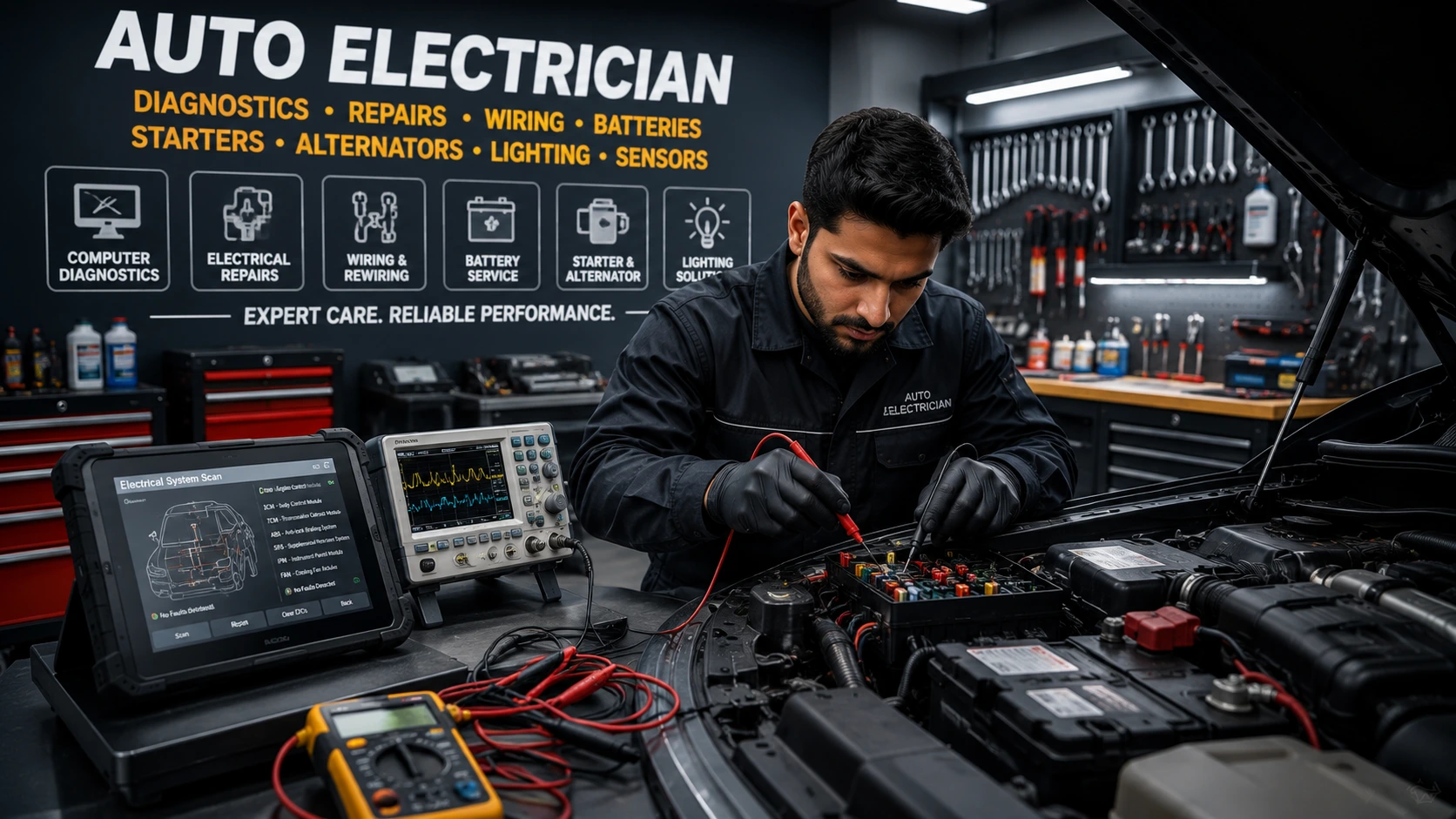
Beyond the diagnostic scanner, a proper auto electrician uses a digital multimeter, an oscilloscope for signal quality assessment, a current probe for parasitic drain diagnosis, and a brake pipe pressure gauge for ABS hydraulic circuit testing. The scanner identifies the circuit. The test equipment characterises the fault within that circuit.
For owners who need qualified on-site electrical support, a mobile car mechanic with proper diagnostic capability handles battery replacement with correct registration coding, minor fault resets, and initial circuit assessment at the vehicle’s location. For situations where the fault leaves the vehicle undriveable, proper roadside assistance ensures the car reaches a workshop with the diagnostic capability to actually resolve the fault rather than the nearest available one.
A complete car service visit is the correct time to request a full electrical system health assessment alongside the mechanical service — battery conductance, alternator output, ground strap condition, and a complete control unit scan. Catching developing electrical faults during a service costs nothing beyond the scan time — finding them after they strand the vehicle is considerably more expensive.
For owners in Al Quoz and surrounding areas looking for a garage near me with genuine auto electrician capability — manufacturer-compatible diagnostics, wiring diagram access, and circuit-level testing rather than code reading and component substitution — the difference is visible from the first diagnostic session.
A qualified car mechanic with genuine electrical diagnostic training handles the full scope of automotive electrical work correctly — from battery systems through control unit diagnosis to wiring repair and sensor assessment.
FAQ
What does an auto electrician do that a regular mechanic can’t?
An auto electrician performs circuit-level diagnosis using wiring diagrams and electrical test equipment — tracing faults to their actual cause rather than replacing components that fault codes implicate.
How do I know if my car needs an auto electrician or a mechanical repair?
Warning lights, components that work intermittently, multiple simultaneous faults, or electrical behaviour that doesn’t match any obvious mechanical cause all indicate auto electrician assessment is needed.
Why do multiple warning lights appear at the same time on my car?
Usually a single root cause — a ground fault, a shared sensor signal failure, or a power supply issue — creates fault codes across multiple systems simultaneously because they share a common circuit input.
Can a software update fix a control unit fault without replacing the module?
Yes — many apparent control unit failures are software calibration issues resolved by reflashing with the current manufacturer software version, without any hardware replacement.
How long does proper auto electrical diagnosis take in Dubai?
Battery and charging system checks take 30–45 minutes. Full multi-system scans with circuit tracing take 1–2 hours. Complex wiring fault diagnosis can take 3–5 hours depending on the fault location.
Conclusion
An auto electrician is essential for modern car electronics because modern cars are electronic systems first and mechanical systems second — and the diagnostic capability required to find electrical faults correctly is specifically different from the capability required for mechanical work. In Dubai’s heat, with its specific electrical degradation patterns and its high-consequence operating environment, getting electrical diagnosis right the first time isn’t just a convenience — it’s a financial and safety priority.
Car Garage Expert in Al Quoz provides qualified auto electrician services — battery diagnosis, wiring fault tracing, control unit diagnosis, sensor assessment, and complete electrical system health checks — with manufacturer-compatible diagnostic equipment for all makes. Book your appointment on WhatsApp or find the workshop on Google Maps.