Driving a BMW on the immaculate multi-lane highways of Dubai is an experience defined by elite precision, immediate power, and flawless German engineering. Whether you are navigating your sleek 3 Series through the dense rush-hour gridlock of Downtown Dubai or opening up an X5 on the long, sweeping tarmac towards Al Ain, these luxury machines are built to perform. Yet, beneath that sophisticated exterior lies a complex mechanical ecosystem that operates under tremendous pressure and immense thermal stress.
Among the various maintenance queries that luxury car owners search for, one issue stands out above the rest: dealing with an unexpected oil leak in BMW models. In the hyper-arid, scorching climate of the UAE, where summer ambient temperatures routinely exceed 45°C, what might have been a minor oil leak in colder climates quickly becomes a significant mechanical hazard.
This guide breaks down why BMW engines are uniquely susceptible to losing oil, how to identify the subtle warning signs early, the true financial realities of resolving these issues in Dubai, and how specialized maintenance keeps your ultimate driving machine running beautifully.
What Is the Most Common Problem with BMW Engines?
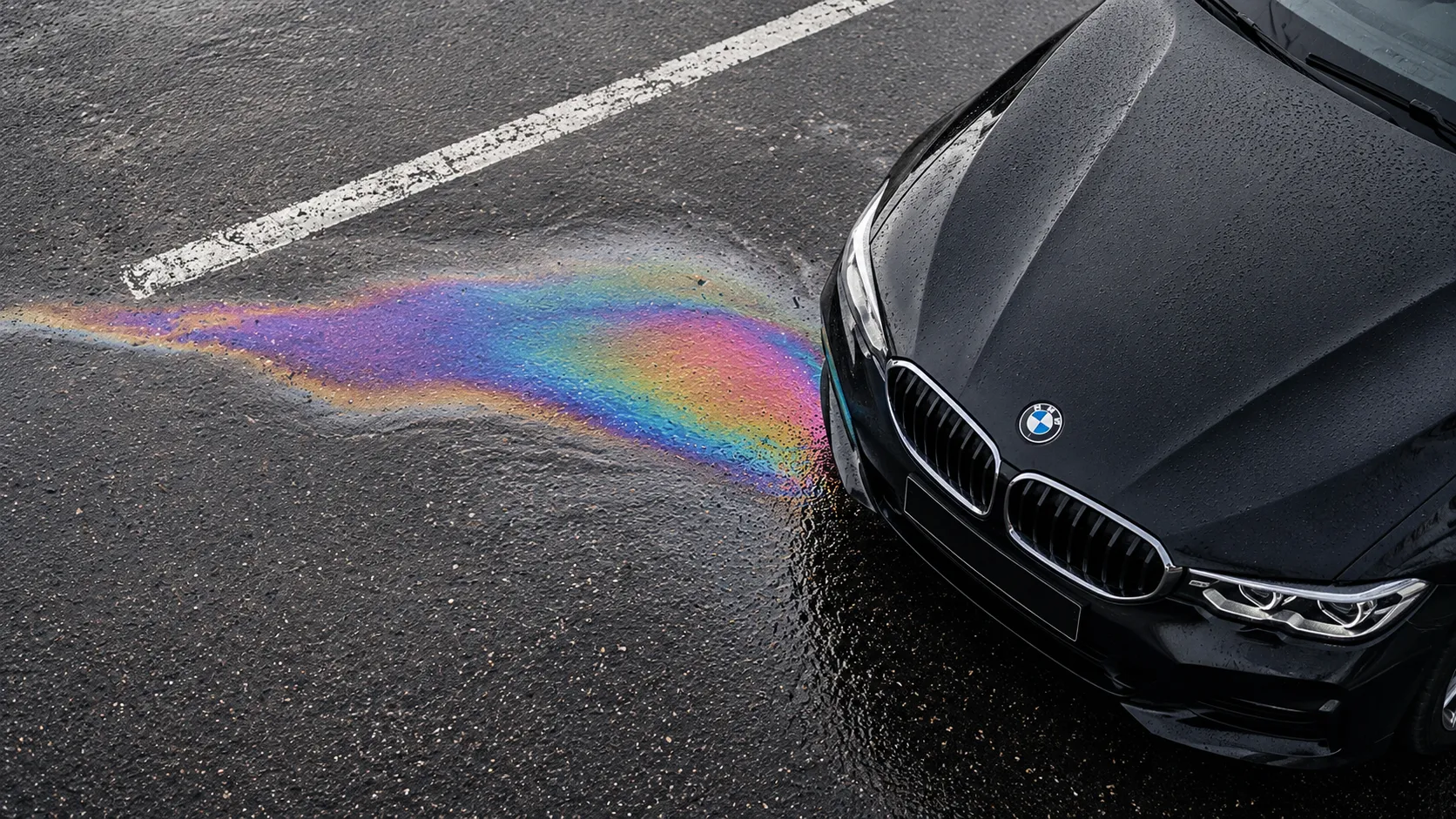
If you are noticing a dark, slick puddle forming on your garage floor or repeatedly viewing the low oil level indicator light BMW warns on your iDrive dashboard, you are experiencing a known hallmark of European performance engineering.
To answer the main question that thousands of luxury car owners ask:
Is it common for BMWs to leak oil?
Yes, it is remarkably common. BMW builds high-performance, high-compression engines that naturally run at significantly higher operating temperatures than standard economy vehicles. While this design optimizes thermal efficiency and power delivery, it subjects the engine’s internal rubber, plastic, and composite seals to brutal heat cycles. Over time, these gaskets bake, harden, shrink, and crack, allowing pressurized engine oil to escape.
When diagnosing an engine oil leak, our team almost always traces the origin back to three notorious, high-wear component zones:
1. The Valve Cover and Valve Cover Gasket
The valve cover sits at the absolute peak of the engine cylinder head, sealing the rapidly moving camshafts and valvetrain assembly. Because it sits directly on top of the engine block, the valve cover gasket bears the brunt of rising engine bay heat. When it hardens and loses elasticity, oil seeps past the seal and drips directly down onto the scorching metal surfaces of the exhaust manifold. This failure is the primary cause of a distinct, acrid burning oil smell through AC vents when your vehicle comes to a stop at a traffic light. In severe cases, you may even notice faint wisps of white or blue smoke rising from beneath the edges of your hood.
2. The Oil Filter Housing Gasket (OFHG)
Commonly found across BMW’s iconic inline-6 and inline-4 engine families (such as the N55, B48, and B58), the oil filter housing is bolted directly to the engine block. The BMW oil filter housing gasket leak symptoms usually begin with oil pooling quietly in the small crevices at the front and middle sections of the engine bay. If left unaddressed, this specific leak is highly dangerous. The escaping oil frequently drips directly down onto the main rubber accessory drive belt. When engine oil saturates a fast-spinning serpentine belt, it compromises the rubber, causing the belt to slip off its tracks or snap entirely, potentially wrapping around the crankshaft pulley and causing catastrophic internal engine failure.
3. The Oil Pan Gasket
Located at the very bottom of the vehicle, the oil pan serves as the primary reservoir for your engine’s oil supply. A BMW oil pan gasket repair is a labor-intensive procedure because the pan sits directly above the front subframe and steering rack assembly. Leaks here are usually identified by significant, dark puddles accumulating directly underneath the centerline of the front axle.
The Realities of Driving with an Oil Leak in the UAE
When a warning indicator lights up or you notice a fresh spot on your driveway, your first instinct might be to delay the repair, especially if your calendar is packed. However, driving conditions in the UAE require a more proactive approach.
Two of the most asked questions are:
- Can you drive a BMW with an oil leak?
- Can I still drive if I have an oil leak?
The answer is: You can technically drive a short distance to a service center if the leak is a very slow, minor weep and your engine oil level remains safely within the normal operating zone. However, you should never continue to drive or commute normally with an unresolved oil leak.
In Dubai’s intense environment, an oil leak escalates rapidly due to three distinct regional factors:
- Extreme Thermal Stress: When ambient outdoor temperatures reach 45°C to 50°C, the temperature inside your engine bay skyrockets. Oil dripping onto hot exhaust components is a significant fire risk.
- Abrasive Desert Sand: Escaping engine oil acts like a magnet for fine desert dust and airborne sand particles. This creates an abrasive, gritty sludge that clings to your engine components, degrades electrical wiring harnesses, accelerates belt wear, and traps excessive heat inside the engine block.
- Loss of Hydrostatic Pressure: BMW engines depend on precise, consistent oil pressure to actuate advanced variable valve timing systems like VANOS. A drop in oil pressure due to a severe leak will immediately result in rough idling, engine misfires, and reduced fuel efficiency.
Advanced Technical Diagnosis: How Specialists Find the Source
A common mistake made by general workshops is assuming that an oil leak visible at the bottom of the engine originates from the bottom. Because gravity forces oil downward, a leak at the top-tier valve cover will travel all the way down the block, making it look like a faulty oil pan or the dreaded BMW rear main seal leak.
To prevent misdiagnosis and avoid unnecessary component changes, a professional workshop utilizes specialized diagnostic protocols:
- Step 1: Engine Cleanse: The engine bay is carefully degreased and washed to remove all legacy oil stains, dirt, and built-up road grime.
- Step 2: UV Dye Oil Leak Test BMW Protocol: A specialized, highly concentrated fluorescent ultraviolet (UV) dye is injected directly into the engine’s fresh oil reservoir.
- Step 3: Controlled Thermal Cycle: The vehicle is run or test-driven for a specific period, allowing the dye to circulate under full operating pressure throughout the entire lubrication system.
- Step 4: Ultraviolet Scan: A technician inspects the engine compartment in a darkened bay using a specialized UV blacklight and yellow tracking glasses. The exact mechanical point where the oil first emerges will glow brilliantly, allowing the mechanic to accurately isolate the true source of the leak.
Why Choose Car Garage Expert in Dubai?
When your luxury vehicle begins showing signs of fluid loss, choosing a generic workshop can quickly lead to misdiagnosed faults, extended repair delays, and recurring leaks. Car Garage Expert is established as the premier BMW dealer alternative workshop in Dubai, delivering precise dealership-level diagnostics and meticulous mechanical repairs without the premium agency markup.
Our advanced facility is staffed by factory-trained, dedicated BMW specialist mechanic in Dubai who possess an intimate understanding of both classic naturally aspirated engines and modern twin-scroll turbocharged power units. We understand the precise torque specifications and complex bolt tightening sequences required to properly seal magnesium and aluminum engine blocks.
We protect your investment by strictly using Genuine OEM parts and premium quality seals that are engineered specifically to withstand extreme local driving conditions. We support our mechanical diagnostics with complete transparency, providing detailed digital health check sheets and upfront cost breakdowns. Whether you drop into our service bay for a routine inspection or require urgent roadside assistance after a low-pressure warning light illuminates, we ensure your vehicle receives world-class care.
How Much Does It Cost to Fix an Oil Leak in BMW?
The total cost varies widely, from AED 300 to over AED 3,500+. This variance is not driven by the cost of the rubber gaskets themselves, which are relatively inexpensive, but rather by the labor time and engineering complexity required to access the component.
| Specific Repair Service/Component | Estimated Cost Range (AED) | Average Labor Time | Complexity & Labor Insight |
| Comprehensive Diagnostic Scan & UV Dye Leak Test | AED 250 – AED 450 | 1 – 2 Hours | Includes a full engine bay wash and blacklight tracking trace. |
| BMW Valve Cover Gasket Replacement | AED 900 – AED 1,800 | 3 – 5 Hours | Requires removal of ignition coils, fuel lines, and upper cowling. |
| BMW Oil Filter Housing Gasket (OFHG) Repair | AED 800 – AED 1,600 | 3 – 4 Hours | Involves draining partial coolant and careful intake manifold clearance. |
| BMW Oil Pan Gasket Repair | AED 1,800 – AED 3,500+ | 6 – 10 Hours | Highly complex. Requires dropping the front subframe and steering rack. |
| BMW Rear Main Seal Leak Replacement | AED 2,500 – AED 4,500+ | 8 – 12 Hours | Requires full removal of the automatic/manual transmission assembly. |
| Oil Drain Plug & Crush Washer Replacement | AED 150 – AED 300 | 30 Minutes | Typically resolved during a standard, routine preventive oil change. |
Checklist: Proactive BMW Engine Longevity
To safeguard your vehicle against premature gasket dry-out and avoid unexpected visits to a garage, follow this specialized preventative maintenance routine:
- ✔️ Stick to Short Oil Change Intervals: Do not wait for the factory-programmed 15,000 km electronic alert. In the Gulf region, change your engine oil and oil filter every 7,000 km to 10,000 km maximum to keep internal engine detergents fresh and prevent sludge build-up that increases internal pressures.
- ✔️ Insist on Premium Synthetic Lubricants: Always verify that your service provider uses the correct, approved oils that meet BMW Longlife (LL-01 or LL-04) specifications to maintain nominal viscosity under high heat.
- ✔️ Monitor the Cooling System Status: A malfunctioning cooling fan or a leaking water pump causes localized engine overheating, which instantly bakes and hardens neighboring rubber oil gaskets.
- ✔️ Address Engine Misfires Immediately: Rough running and unburnt fuel can cause crankcase pressure variations that push oil past aging seals.
FAQs
Can I still drive if I have an oil leak?
Only for a brief, emergency trip to a nearby repair center, provided you have checked the dipstick or electronic iDrive monitor to confirm that your engine oil volume is not critically low. If the low oil pressure light is red, turn off the engine immediately and call for transport.
Where can I find a certified mechanic near me for accurate European car servicing?
If you are looking for an experienced mechanic nearby in Dubai, Car Garage Expert provides dealership-level computerized diagnostics, expert engine repair technicians, and a complete inventory of OEM components to resolve fluid leaks permanently.
Will using an “oil stop-leak” additive fix my BMW engine?
No, oil stop-leak additives are not a permanent solution and are highly discouraged for performance engines. While they may temporarily swell an old gasket to slow down minor seepage, they do not repair cracks, and they can contaminate your variable valve timing (VANOS) system or clog oil galleries.
How much does it cost to fix a BMW oil leak?
Minor drain plug or oil filter cap seals can cost between AED 150 and AED 400. Main structural gaskets like the valve cover, oil filter housing, or oil pan gaskets generally range from AED 800 to AED 3,500+ due to the extensive labor hours required to access those areas safely.
Why did my oil leak return shortly after replacing the gasket?
If a fresh gasket fails quickly, it is almost always due to an undiagnosed crankcase ventilation (PCV) valve failure. A clogged or faulty PCV valve builds excessive pressure inside the crankcase, which instantly forces engine oil past brand-new rubber seals.
Conclusion
An oil leak is your vehicle’s way of signaling that its internal components are under stress from intense thermal cycles. Ignoring a persistent burning smell or a collection of dark fluid on your driveway turns a straightforward gasket replacement into an expensive mechanical overhaul. If you are searching ‘garage near me‘ to fix these issues early, Car Garage Expert is the best option to accurately trace the leak, protect your engine, and restore your ultimate driving machine’s peak performance.
Keep your vehicle performing at its absolute best. Our team of skilled technicians is fully equipped with advanced diagnostic tools to trace and resolve your engine issues with complete accuracy. Contact us and get an advanced vehicle health checkup.
You can visit us at our Al Quoz, Dubai branch,
Car Garage Expert: https://maps.app.goo.gl/2TkrA5b3pRk8e3sQA