A Ford with a failing AC system in Dubai isn’t a comfort issue — it’s a safety issue from May through September. Cabin temperatures in a parked car under direct sun can exceed 70°C, and an AC system that’s losing performance doesn’t announce itself with a single obvious failure. It gets gradually worse until one afternoon in July it stops cooling entirely.
Ford AC repair in Dubai comes up more than owners expect. Not because Ford’s AC systems are poorly designed — they’re generally well-engineered for high-demand markets. But Dubai’s conditions push every AC system harder than it was built for, and specific Ford models have known AC fault patterns that a proper workshop identifies quickly once they know what to look for.
Getting the right Ford AC repair means more than a refrigerant top-up. It means finding the actual cause — whether that’s a slow condenser leak, a failing compressor clutch, a blend door actuator fault, or a software issue in the climate control module — and fixing it correctly the first time.
Ford AC Repair Dubai — Why These Systems Need Specific Attention
Ford vehicles in the UAE market — the Fusion, Explorer, Edge, F-150, Mustang, and EcoSport — use Ford’s proprietary HVAC control architecture. The automatic temperature control systems on higher-specification models communicate on the vehicle’s CAN network through a dedicated HVAC module.
A generic AC gauge set and refrigerant top-up approach doesn’t diagnose faults in this system. A blend door actuator that’s sticking reads as insufficient cooling to the driver but has nothing to do with refrigerant. A faulty evaporator temperature sensor causes the system to cut compressor operation early — reducing cooling efficiency without any refrigerant loss at all.
Proper Ford AC repair requires Ford IDS (Integrated Diagnostic System) or a high-grade Ford-compatible equivalent that reads the HVAC module’s fault codes, live data streams, and actuator positions. Without this, the actual cause of many Ford AC complaints remains invisible.
A Ford Explorer owner brought his car in after two refrigerant top-ups at different workshops over six months. The system would cool well for a few weeks then lose performance again. Our Ford-compatible diagnostic found a faulty HVAC blend door actuator allowing warm air to mix with cooled air at the plenum — the refrigerant circuit was fine throughout. Actuator replacement resolved the issue permanently. No refrigerant was involved.
Why Dubai’s Conditions Accelerate Ford AC Problems
Continuous Operation Through Summer
Dubai’s AC season runs roughly nine months of the year with genuine intensity from May through September. Ford AC compressors that might run 60% of the time in a European market run continuously here — the thermal load on every component in the refrigeration circuit is substantially higher than manufacturer durability testing assumes.
Compressor clutch wear accelerates from continuous engagement cycles. Refrigerant hose connections develop micro-leaks from constant pressure cycling. Condenser fins accumulate dust and road debris blockage faster in Dubai’s environment than in clean-air markets.
High Ambient Temperatures Create Pressure Spikes
When ambient temperature exceeds 42°C — common in Dubai from June through August — the high-side pressure in a Ford’s refrigeration circuit reaches levels that stress every connection point in the system. O-rings and seals that are years old and heat-cycled develop micro-permeability, releasing refrigerant slowly enough that the owner only notices reduced cooling over weeks rather than a sudden failure.
This is why a Ford AC repair for a system that’s losing performance gradually almost always starts with a UV dye leak test before any refrigerant is added. Finding the leak source first prevents paying for refrigerant twice.
Short-Trip Driving Affects Compressor Lubrication
The AC compressor relies on refrigerant oil circulation through the system to lubricate its internal bearings. On short trips where the system doesn’t run long enough to circulate oil fully, localised bearing wear develops over time. Dubai’s predominantly short-trip urban driving pattern creates compressor lubrication conditions worse than sustained highway use.
Common Ford AC Repair Problems by Model
Ford Fusion and Mondeo
The Fusion is the most common Ford sedan in Dubai’s market and its AC system has specific fault patterns that come up regularly.
Blend Door Actuator Failures
The Fusion’s dual-zone climate system uses multiple blend door actuators to control temperature distribution between driver and passenger sides. These actuators are plastic-geared electric motors that develop wear and stripped gears over time — particularly in Dubai’s temperature environment where the plastic gear material cycles through significant thermal expansion and contraction.
The symptom is temperature imbalance — one side of the cabin cools correctly while the other blows warm regardless of the temperature setting. Diagnosis requires Ford IDS actuator testing to confirm which specific door has failed. There are typically three or four actuators in the system and only one is usually at fault.
Evaporator Core Leaks
Higher-mileage Fusion models develop slow evaporator core leaks that present as a system that loses refrigerant without any visible external leak. The refrigerant escapes through a pinhole in the evaporator and exits through the condensate drain — often detected only by UV dye visible at the drain outlet. Evaporator replacement on the Fusion requires significant dashboard disassembly — it’s a labour-intensive Ford AC repair that benefits from an experienced workshop.
Ford Explorer
The Explorer is the most popular Ford SUV in Dubai and its AC system works particularly hard — a three-row cabin in sustained 45°C heat demands maximum cooling output for extended periods.
Rear AC System Faults
The Explorer’s rear AC evaporator and blower motor are separate from the front system and develop their own faults independently. A rear blower resistor failure is one of the most common Ford AC repair items on this model — the resistor controls rear fan speed and fails from the sustained high-current draw of continuous maximum-speed operation in Dubai’s heat.
Rear evaporator leaks are less common but occur on higher-mileage examples — detected by UV dye at the rear condensate drain or by the characteristic sweet smell in the rear cabin area.
Compressor Clutch Cycling Faults
The Explorer’s V6 engines — both the 2.3 EcoBoost four and the 3.5 V6 — develop compressor clutch cycling issues on higher-mileage examples. A clutch that engages and disengages rapidly rather than holding steady engagement indicates either low refrigerant triggering the pressure protection switch repeatedly, or a failing clutch coil that can’t maintain consistent electromagnetic engagement.
Proper diagnosis distinguishes between these causes before any part is ordered — refrigerant pressure testing confirms whether the system is correctly charged before the clutch itself is assessed.
Ford F-150
The F-150 is the pickup variant in Dubai’s Ford market and its AC system serves a large cabin volume that demands full output on hot days.
Condenser Damage from Road Debris
The F-150’s raised ride height and forward-facing condenser position make it particularly susceptible to stone impact damage that creates refrigerant leaks. A condenser puncture from road debris presents as a sudden or rapid refrigerant loss rather than the gradual loss of a slow leak. UV dye testing confirms the condenser as the source before replacement is authorised.
EcoBoost Compressor Oil Separation
The 2.7 and 3.5 EcoBoost V6 engines in the F-150 occasionally develop AC compressor oil separation issues on higher-mileage examples — compressor oil migrates into the refrigerant circuit and accumulates in the condenser and evaporator, reducing heat exchange efficiency. The symptom is reduced cooling performance despite correct refrigerant charge and a functioning compressor. A proper Ford AC repair for this condition involves flushing the refrigerant circuit before recharging.
Ford Mustang
The Mustang is the performance model in Dubai’s Ford market and its AC system faces specific thermal challenges from the engine bay heat generated by the 2.3 EcoBoost four-cylinder and the 5.0 Coyote V8.
High-Side Pressure Issues
The Mustang’s engine bay temperatures — particularly on V8 models — raise the ambient temperature around the AC compressor significantly above outdoor ambient. High-side pressure spikes in Dubai’s heat on a Mustang can push system limits that would be comfortable at European ambient temperatures. Condenser efficiency is critical on this model — a partially blocked condenser from road debris accumulation compounds the high ambient pressure problem significantly.
Refrigerant Hose Wear Near Exhaust Components
The Mustang’s engine bay layout routes some refrigerant lines in proximity to exhaust heat sources. Hose insulation degradation from sustained heat exposure creates micro-cracks that release refrigerant slowly. A proper Ford AC repair inspection on a Mustang should specifically check refrigerant hose condition in the rear of the engine bay near exhaust routing.
Ford EcoSport
The EcoSport is the compact SUV in Ford’s Dubai range and its smaller refrigeration circuit means any loss of refrigerant has a proportionally larger effect on cooling performance than on larger models.
Compressor Control Valve Faults
The EcoSport uses a variable displacement compressor whose control valve regulates output based on cooling demand. A failing control valve causes the compressor to either run at maximum displacement regardless of load — overcooling and icing the evaporator — or minimum displacement — providing insufficient cooling at any ambient temperature.
Control valve replacement is a Ford AC repair procedure that saves the cost of full compressor replacement when the compressor body itself is mechanically sound. Diagnosis requires live pressure data on both sides of the circuit simultaneously to confirm the control valve is the fault source.
What a Proper Ford AC Repair Service Covers
A complete Ford AC repair service starts with diagnosis — not refrigerant addition.
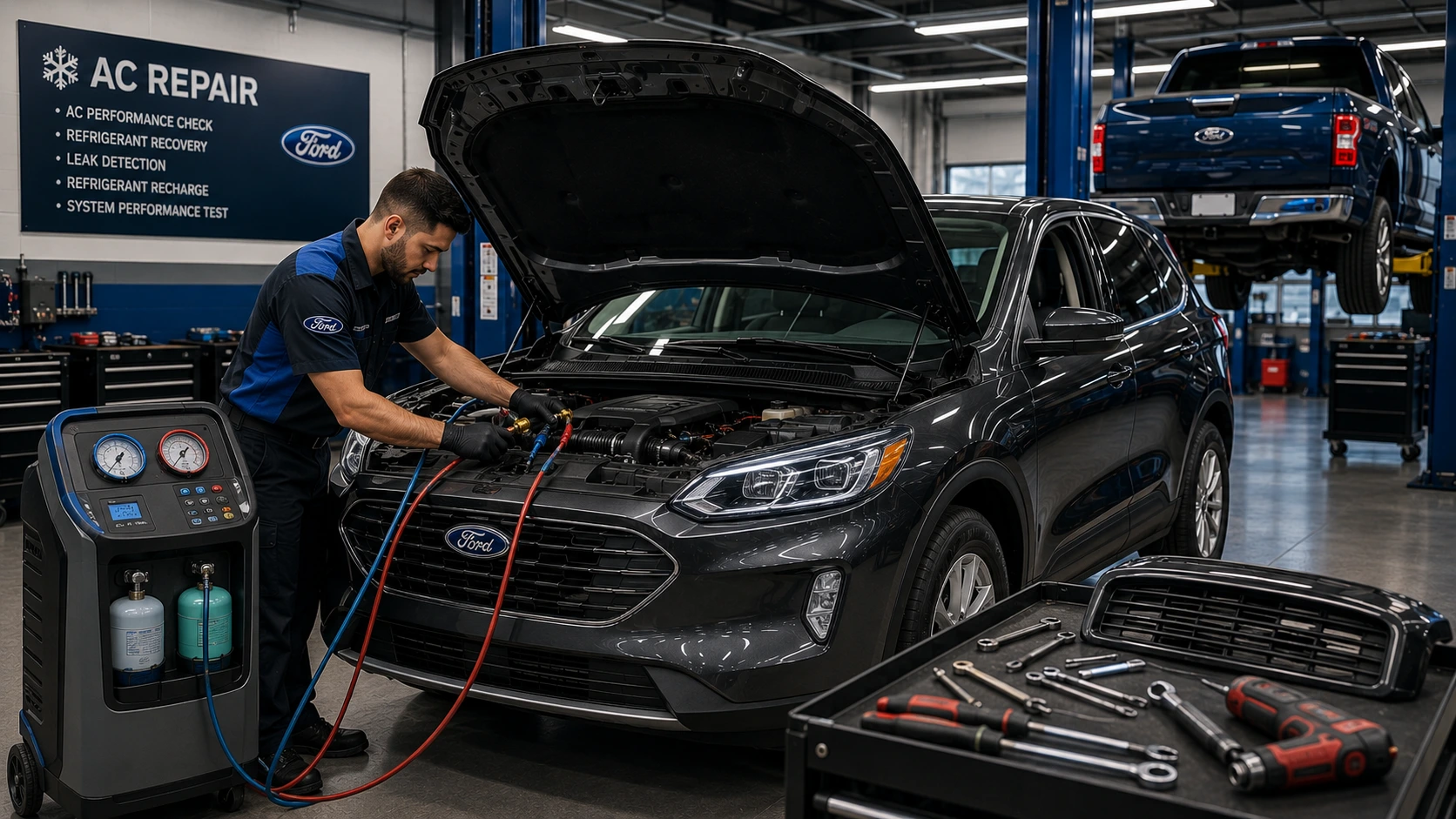
Ford IDS or equivalent diagnostic scan of the HVAC module — fault codes, live data for all temperature sensors, actuator position data, and compressor clutch engagement quality. Refrigerant pressure testing on both high and low sides under operating conditions and at rest. UV dye leak detection if the system is low on charge. Condenser physical condition assessment and cleanliness check. Compressor clutch engagement noise and cycling behaviour. Evaporator temperature sensor verification. Cabin temperature sensor accuracy check. Blend door actuator function test through the diagnostic system. Cabin blower operation at all speed settings.
After any repair, a post-repair performance check — vent temperature measurement at idle and under load, refrigerant pressure verification at operating temperature — confirms the repair resolved the actual fault.
For comprehensive vehicle maintenance alongside AC repairs, a proper car service covers the full inspection at the same visit. A qualified car mechanic with Ford platform knowledge handles both the AC system and any related electrical faults correctly.
For Ford owners needing urgent help before reaching the workshop, a mobile car mechanic handles basic AC assessments and fault code readings on-site. For front-end impact damage that affects the condenser alongside bodywork, professional car painting handles both repairs at the same visit.
Proper roadside assistance ensures the car reaches the workshop safely when an AC failure coincides with another fault. For owners in Al Quoz searching for a garage near me with genuine Ford diagnostic capability — proper Ford AC repair starts with finding the actual cause, not with adding refrigerant and hoping.
FAQ
Why does my Ford AC cool well in the morning but poorly in the afternoon?
Classic sign of a system marginally low on refrigerant — it manages at lower ambient temperatures but can't maintain performance when heat load peaks in afternoon Dubai heat.
How do I know if my Ford AC needs refrigerant or has a different fault?
Refrigerant pressure testing on both high and low sides identifies whether the system is correctly charged — many Ford AC complaints trace to blend door actuators or sensor faults unrelated to refrigerant.
What causes the musty smell from my Ford AC vents?
Usually a blocked evaporator condensate drain or mould growth on the evaporator surface — evaporator cleaning and drain clearing resolves both the smell and any associated airflow restriction.
Can a Ford AC compressor be repaired or does it need full replacement?
On Ford variable displacement compressors the control valve is often serviceable separately — replacing just the valve saves the cost of full compressor replacement when the mechanical body is sound.
How often should a Ford AC system be serviced in Dubai?
A refrigerant pressure check and condenser cleaning annually — before Dubai's peak summer heat in April — keeps the system performing correctly and catches slow leaks before they cause full system failure.
Conclusion
Ford AC repair in Dubai is rarely a simple refrigerant top-up — it’s a diagnostic process that finds the actual cause of the cooling problem before deciding on the repair. A blend door actuator fault, a failing compressor control valve, a slow condenser leak, or an evaporator temperature sensor issue all present as “AC not cooling well” to the driver. Only proper Ford-compatible diagnostics distinguishes between them.
Car Garage Expert in Al Quoz handles full Ford AC diagnosis and repair — HVAC module diagnostics, refrigerant circuit testing, compressor assessment, condenser inspection, and actuator testing — for all Ford models. Book your appointment on WhatsApp or find the workshop on Google Maps.