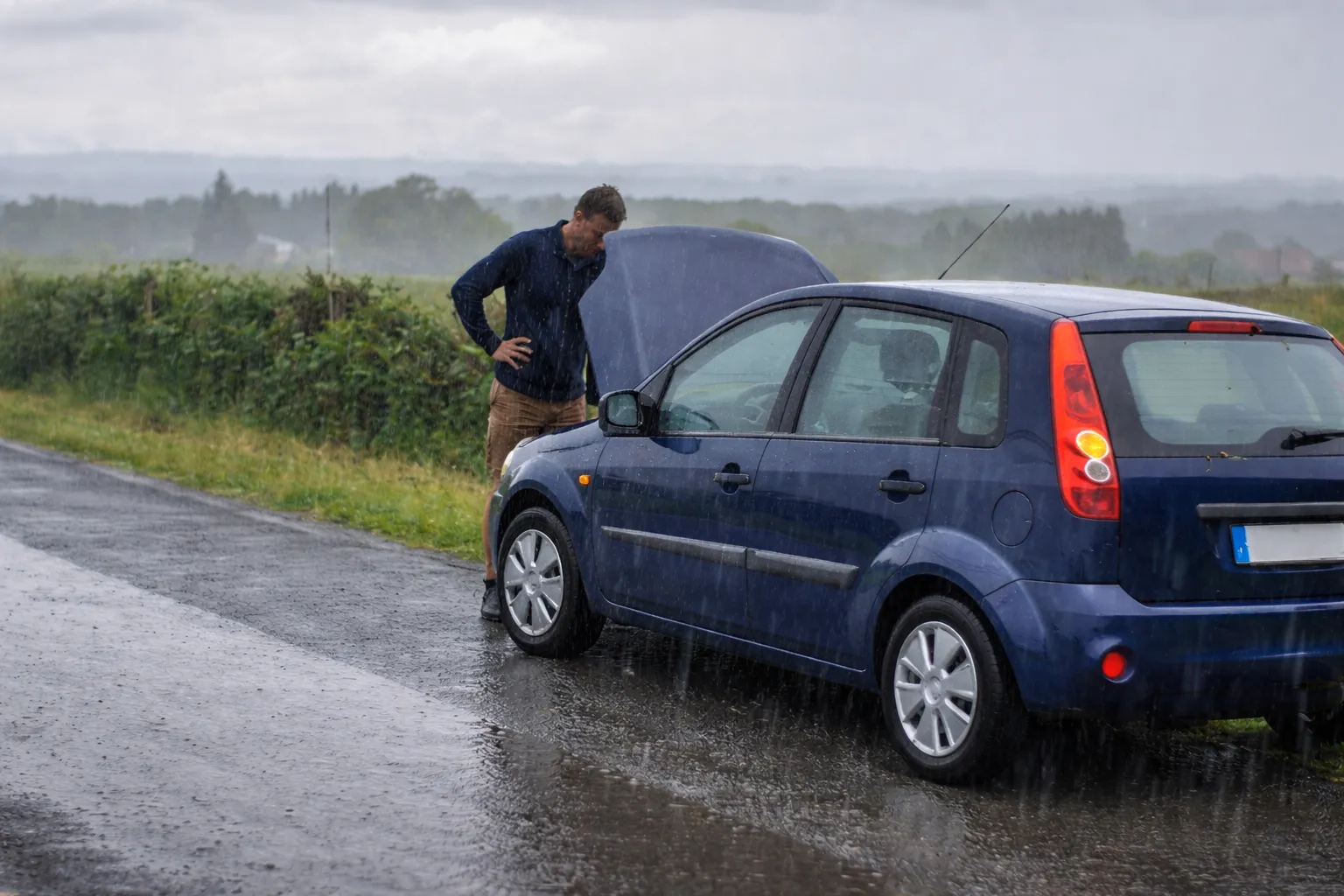
When your car not starting after rain, especially in a place like Dubai where sudden downpours can flood the roads quickly, it’s not just inconvenient, it can be risky for your engine and electronics.
Rainwater exposure can affect multiple systems at once: ignition, battery, air intake and even onboard sensors. The key is not to panic or force-start the car, but to follow a structured, safe approach.
Let’s walk through exactly what to do and what to avoid, specifically in UAE driving conditions.
1. First, Assess the Level of Water Exposure
Before touching the ignition, understand how much water your car has been exposed to.
| Water Level | Risk Level | What It Means |
|---|---|---|
| Below tires | Low | Usually safe, minor issues possible |
| Half tire height | Medium | Electrical and brake issues possible |
| Above bumper | High | Engine and intake risk |
| Above hood | Severe | High chance of engine damage |
If your car stopped in rain in Dubai streets where water pools quickly, assume a higher risk even if the damage looks minor.
Why this matters:
Water entering the engine (hydrolock) can cause permanent damage if you attempt to start the car.
2. The Most Important Rule: Do NOT Force Start
If your car has stopped in the rain, avoid repeatedly trying to start it.
Engines are built to compress air, not water.
If water gets into the engine cylinders, attempting to crank the engine can damage internal components like connecting rods. This kind of damage is costly and may require major engine repair or even full replacement.
Even a couple of repeated attempts can turn a minor issue into a serious one.
3. Observe How the Car Behaves When Starting
The way your car reacts when you try to start it can reveal a lot about the underlying issue.
- No dashboard lights and no response usually points toward a battery failure or a main power supply issue.
- Dashboard lights come on, but the engine doesn’t crank this could indicate a problem with the starter motor, relay, or an electrical fault.
- The engine cranks but doesn’t start a common situation after rain exposure, often linked to moisture in ignition components, sensor interference, or air intake issues.
- The engine cranks unusually fast or sounds different than usual stop immediately and avoid trying again, as this could signal a serious internal risk.
It’s a good idea to record a short video showing the dashboard and the engine sound. This can help technicians diagnose the problem more accurately later.
4. Battery Issues Are Very Common in UAE Conditions
High temperatures in the UAE can reduce battery lifespan and rain or moisture often exposes an already weakened battery.
Common signs of battery issues include:
- Slow engine cranking
- A clicking noise when turning the key
- Flickering dashboard lights
- Dim headlights
If the battery voltage drops too low, the car may fail to start completely. While jump-starting can help in some cases, it should always be done with caution.
Jump Starting
- Try jump starting the car only once or twice at most.
- Make sure the jumper cables are connected properly and securely.
- If the engine still doesn’t start, avoid repeated attempts and stop immediately.
Modern cars such as Audi and Porsche are equipped with highly sensitive electronic systems. Multiple or incorrect jump-start attempts can potentially damage the control modules. Even if the car starts successfully, it’s important to have the battery and charging system inspected afterward.
5. Check the Key & Immobilizer System
Heavy rain can also impact your car’s key system.
- You might see a “key not detected” message on the dashboard.
- The start button may stop responding properly.
- Lock and unlock functions can become inconsistent or delayed.
If possible, try using your spare key. In many cases, moisture can weaken or temporarily affect the key battery, causing these issues.
6. Do a Basic Visual Inspection Under the Hood
- Stick to basic and safe visual checks only avoid anything technical.
- Look around the engine bay for any visible pooled or standing water.
- Inspect the battery terminals to ensure they are dry, clean and securely connected.
Avoid disconnecting any wiring or connectors unnecessarily, as opening wet connections can trap moisture inside or lead to corrosion.
7. Check the Air Filter
If you’ve driven through water and the engine is cranking but not starting, carefully check the air filter housing (only if it’s easily accessible).
- If the air filter is dry, that’s a positive sign.
- If the air filter is damp, stop right away.
A wet air filter usually indicates that water may have entered the intake system and trying to start the engine again could lead to serious damage.
8. Don’t Ignore Interior Water Signs
Many drivers tend to concentrate only on the engine and overlook the interior.
Check:
- Front footwell carpets
- Under the seats
- Trunk area
- Spare wheel compartment
In modern cars like Land Rover and Volkswagen, important electronic control modules are often positioned low within the cabin.
If the carpets are damp, moisture can seep into the wiring and these modules. Even if the car starts without issues now, this hidden moisture can lead to corrosion and electrical problems over time, sometimes appearing weeks later.
9. Dashboard Warning Lights After Rain
After flood exposure, you may notice several warning lights appearing on the dashboard at once.
- ABS and traction control lights are showing together
- Steering and braking system warnings
- Airbag warning indicator turning on
- Multiple random system alerts appear simultaneously
In many cases, these warnings are triggered by low battery voltage or moisture interfering with sensors and electrical connections. It’s always a good idea to take a clear photo of the dashboard lights so a technician can diagnose the issue more accurately.
10. What You Should NEVER Do
- Avoid repeatedly cranking the engine if it doesn’t start.
- Never try to push-start an automatic transmission vehicle.
- Don’t spray random chemicals onto electrical components.
- Avoid disconnecting the battery unless you know the correct procedure.
Don’t assume the issue is resolved just because the car starts once.
11. When Towing Is the Best Option
Keep in mind that flood damage can show up later as electrical problems.
You should consider arranging a car towing service Dubai if:
- Your car stalled in standing or deep water
- Water has seeped into the cabin area
- There’s a possibility that the air filter is damp or soaked
- The engine makes unusual noises while trying to start
Towing might feel like a hassle at first, but it’s usually far more cost-effective than dealing with major engine repairs or replacing sensitive electronic components later.
How Car Garage Expert Handles Rain-Damaged Vehicles
At Car Garage Expert, we follow a thorough and methodical inspection approach.
- We first ensure the engine is safe before attempting any extended start.
- We run a full system diagnostic scan, not limited to just engine-related codes.
- We accurately test both the battery and the charging system.
- We check the air intake system for any signs of water entry.
- We carefully inspect fuse boxes, wiring and other sensitive electrical components.
- If needed, we perform proper interior drying to prevent future corrosion issues.
FAQs – Car Not Starting After Rain in UAE
Why is my car not starting after rain in Dubai?
Rainwater can affect electrical systems, battery performance, and air intake. In UAE conditions, dust mixed with water increases the risk of short circuits.
What should I do if my car stopped in rain?
First, avoid restarting immediately. Check water exposure level and look for visible damage. If unsure, call a professional or towing service.
Can rain damage a car battery?
Yes. Moisture can reduce battery efficiency and cause corrosion, especially in humid UAE weather.
Is it safe to jump start a car after rain?
Only if there’s no water in the engine bay and the issue appears battery-related. Otherwise, avoid it.
When should I call a car towing service Dubai?
If water reached the engine area, the car won’t start, or warning lights appear, towing is the safest option.
Can Car Garage Expert fix rain-damaged cars?
Yes. Car Garage Expert provides professional diagnostics, electrical repairs, and engine checks tailored for UAE rain conditions.
Final Advice for UAE Drivers
Our priority is ensuring long-term reliability, not just quick, temporary fixes.
- Avoid driving into water when the road surface isn’t clearly visible.
- Don’t assume SUVs or larger vehicles can safely handle deep water.
- If the water is flowing, it’s often deeper and more dangerous than it looks.
- Flood risks are never worth the potential repair costs.
If your car is not starting after rain or flooding in the UAE, it’s best not to take chances. Have your car checked by professionals,
Visit us at our Al Quoz, Dubai branch
Car Garage Expert: https://maps.app.goo.gl/2TkrA5b3pRk8e3sQA