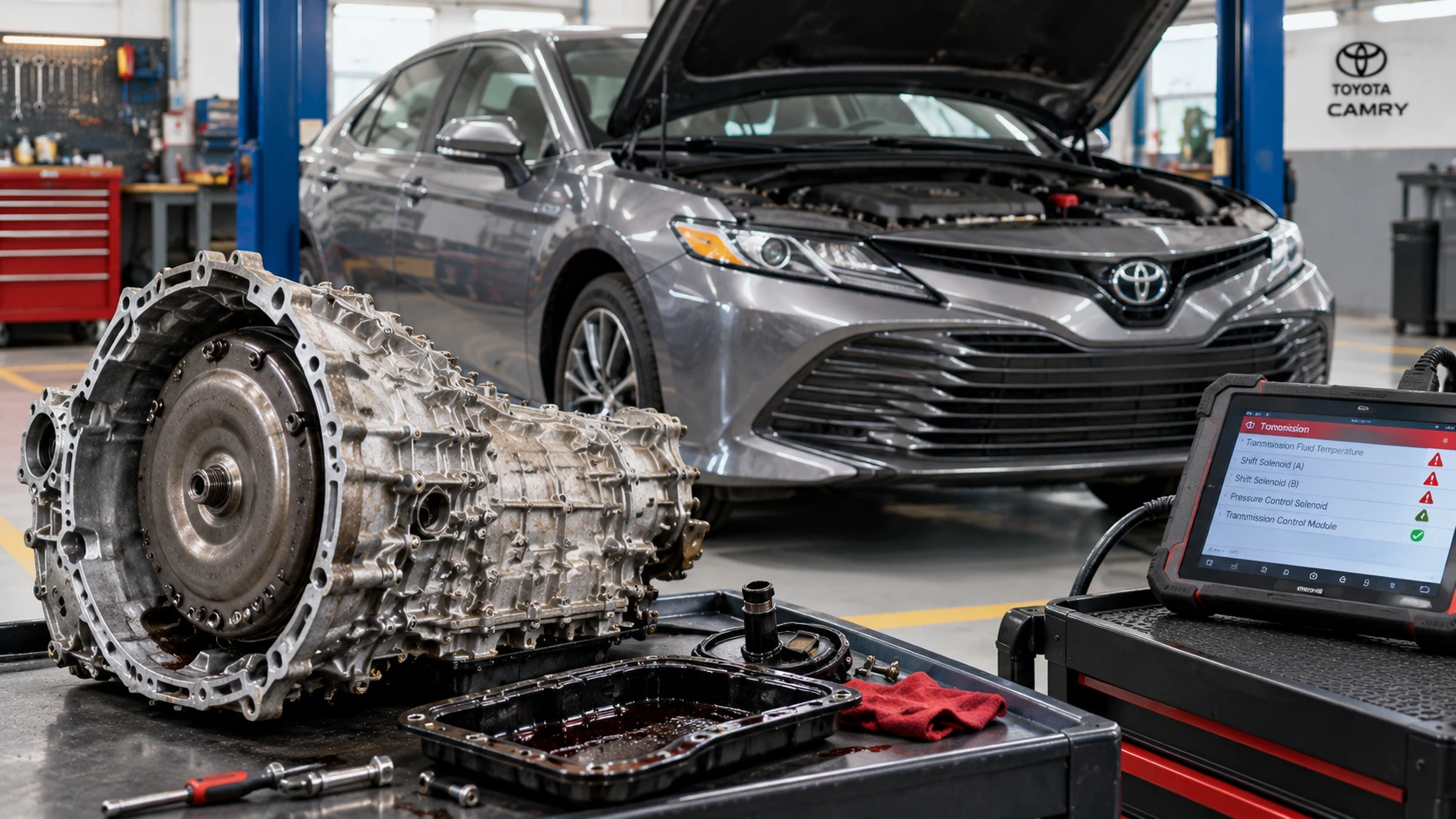
The Toyota Camry has been one of the best-selling sedans in the UAE for over two decades. It is the default choice for families in Mirdif, Al Nahda, and Deira, a staple of Dubai’s private hire fleet, and a common sight on every road from Al Khail to Emirates Road. Its reputation for reliability is well earned — but the automatic transmission is one area where neglect in Dubai conditions leads to expensive repairs.
The Camry uses a traditional torque converter automatic gearbox across most generations sold in the UAE. From the 2018 model onward, a new 8-speed automatic replaced the older 6-speed unit. Both gearboxes share similar failure points when subjected to Dubai’s stop-start traffic, summer heat, and the repeated deceleration from speed bumps across residential areas.
This guide covers the most common Toyota Camry transmission problems reported in Dubai, how each fault develops, how it is diagnosed at the workshop, and what the repair costs in AED.
Toyota Camry Transmission Problems — Quick Answer
Toyota Camry transmission problems most commonly show up as rough or jerky gear shifts, hesitation between 2nd and 3rd gear, shuddering at low speed, and a delay when selecting Drive from Park. In Dubai, the primary cause is degraded automatic transmission fluid (ATF) from heat cycling, followed by solenoid wear and torque converter faults. Diagnosis involves an OBD-II scan for stored fault codes, ATF condition check, and a road test under load. Repair costs in Dubai range from AED 300 for an ATF flush to AED 5,000 or more for a torque converter or solenoid pack replacement.
Table of Contents
- Which Camry Generations Have the Most Transmission Issues
- Rough and Jerky Gear Shifts
- Hesitation and Slipping Between Gears
- Torque Converter Shudder at Low Speed
- Delayed Engagement When Selecting Drive
- Transmission Warning Light and Fault Codes
- How Dubai Conditions Accelerate Camry Transmission Wear
- How Car Garage Expert Diagnoses Camry Transmission Faults
- Repair Options and Cost in AED
- FAQ
Which Camry Generations Have the Most Transmission Issues
Three Camry generations are most common on Dubai roads and each has its own transmission profile.
The seventh generation (2012 to 2017) uses a 6-speed automatic paired with the 2.5-litre 2AR-FE engine. This gearbox is generally robust, but develops solenoid faults and torque converter shudder beyond 120,000 km when ATF has not been changed on schedule.
The eighth generation (2018 to 2024) introduced Toyota’s Direct Shift 8-speed automatic. This unit is smoother and more fuel efficient but is more sensitive to fluid quality. Rough shifts and hesitation in the 2nd to 3rd gear range appear earlier — sometimes before 60,000 km — in vehicles where Toyota’s extended ATF interval has been followed without accounting for Dubai operating conditions.
The hybrid Camry variants use an electronically controlled continuously variable transmission (e-CVT) integrated with the hybrid system. That unit has a separate failure profile and is not covered in this guide.
Rough and Jerky Gear Shifts
Rough or jerky shifts are the most frequently reported Toyota Camry transmission problem at workshops across Dubai. The shift from 2nd to 3rd gear is where most drivers first notice it — a thud or lurch through the cabin when the gearbox changes up under moderate acceleration.
The cause in most cases is a shift solenoid that is not opening and closing at the correct speed, causing the hydraulic pressure to the clutch pack to spike instead of rising smoothly. On the 8-speed Direct Shift unit, a dirty valve body is also a common contributor — fine metal particles from normal clutch wear accumulate in the valve body passages over time and interrupt the smooth flow of ATF to each circuit.
The technician connects a scan tool and checks shift timing data against Toyota’s specification for each gear change. On a healthy gearbox, 2nd to 3rd shift time should be under 300 milliseconds. A shift taking 500 milliseconds or more with a pressure spike confirms a solenoid or valve body issue.
A car service in Dubai that includes an ATF drain, pan cleaning, and fresh fluid often resolves early-stage rough shifts before solenoid replacement is needed.
Hesitation and Slipping Between Gears
Hesitation feels like a half-second pause where the engine revs but the car does not accelerate. Slipping is more pronounced — the engine revs freely while the car barely moves. Both point to the transmission failing to transfer drive cleanly from the engine to the wheels.
On the Camry’s 6-speed and 8-speed units, this is most often caused by a worn torque converter clutch, a faulty pressure control solenoid, or ATF that has lost its viscosity. Low viscosity ATF cannot maintain the hydraulic pressure the clutch packs need to stay fully engaged under load.
Drivers on Al Quoz Industrial Area roads or merging onto Sheikh Zayed Road from the Business Bay interchange notice slipping most during hard acceleration from low speed — exactly the condition that demands peak hydraulic pressure from the transmission.
A hydraulic stall test measures peak torque converter pressure at stall speed. Stall RPM on a healthy 2.5-litre Camry automatic should be between 2,100 and 2,400 RPM. A stall reading below 1,800 RPM indicates torque converter clutch wear. A reading above 2,600 RPM with slipping suggests a fluid pressure problem.
Torque Converter Shudder at Low Speed
Torque converter shudder in the Camry is a distinct vibration that appears at 50 to 70 km/h during light throttle — the speed range where the torque converter lock-up clutch engages to improve fuel economy. When the lock-up clutch lining is worn or the ATF has lost its friction modifier, the clutch slips instead of locking cleanly, producing the shudder.
It is most noticeable on moderate-speed roads like Umm Suqeim Street or Al Wasl Road, where cruise-control-style driving at 60 to 70 km/h is common. On Sheikh Zayed Road at 110 km/h, the clutch stays fully locked and the shudder disappears — which is why some drivers mistake this for a tyre or road surface issue.
The workshop checks lock-up clutch engagement by monitoring torque converter slip speed on the scan tool during a road test. A slip reading above 50 RPM at light throttle in the 50 to 70 km/h range confirms the torque converter as the source.
If caught early, a transmission fluid change using Toyota WS (World Standard) ATF resolves the shudder in most cases. Toyota WS fluid contains friction modifier additives specifically formulated for the lock-up clutch surface. Using non-Toyota ATF in a Camry — even a fluid marketed as compatible — is one of the most common causes of premature torque converter wear seen at independent workshops in Dubai.
Delayed Engagement When Selecting Drive
A pause of 2 to 3 seconds between moving the selector from Park to Drive and feeling the transmission engage is called delayed engagement. On a Camry, this is most common on first startup after the car has sat overnight, particularly in winter when temperatures in Dubai drop to 14 to 16°C.
The cause is usually low ATF level from a slow leak at the transmission cooler lines or the selector shaft seal, a failing pressure control solenoid that takes longer to build pressure when cold, or old ATF that has thickened enough to slow hydraulic response.
The technician checks fluid level with the engine at operating temperature, inspects all external seals and cooler line connections for seepage, and scans for pressure solenoid fault codes. A leak trace using UV dye in the ATF confirms small leaks that are not visible in a dry inspection.
Getting a garage near me in Dubai to check delayed engagement early prevents the solenoid from failing completely — which turns a AED 400 repair into a AED 1,800 one.
Transmission Warning Light and Fault Codes
The Camry’s transmission warning light activates when the TCM stores a fault code it cannot recover from automatically. Common codes on Dubai Camrys include:
P0700 — Transmission Control System malfunction (generic trigger, requires code-specific diagnosis)
P0741 — Torque Converter Clutch circuit performance (lock-up clutch slipping)
P0750 — Shift Solenoid A malfunction
P0755 — Shift Solenoid B malfunction
P2714 — Pressure Control Solenoid D performance
P2716 — Pressure Control Solenoid E performance
The last two codes are specific to the 8-speed Direct Shift unit and are among the most commonly seen at workshops on 2018 to 2022 Camrys in the UAE.
Each code requires live data analysis to confirm the faulty component. A code scanner that only reads the code number without live data often leads to unnecessary part replacement. The workshop reads pressure solenoid response times, clutch engagement data, and fluid temperature under load before recommending any repair.
The roadside assistance team can recover your Camry if the transmission has entered limp mode — a condition where the TCM locks the gearbox in 3rd gear to prevent further damage.
How Dubai Conditions Accelerate Camry Transmission Wear
Toyota specifies ATF WS as a lifetime fill on the Camry — meaning no scheduled change in the owner’s manual for many markets. In the UAE, that recommendation does not reflect reality.
ATF WS has an effective service life of around 80,000 km under severe duty conditions. Dubai qualifies as severe duty by every criterion in Toyota’s own service classification: ambient temperatures above 32°C, frequent stop-start traffic, trailer towing equivalents from constant load cycling, and short trips under 8 km that prevent full fluid warm-up.
By 80,000 to 100,000 km, ATF WS that has never been changed will have lost 40 to 60% of its viscosity index improver and friction modifier concentration — data published in SAE International research on ATF degradation in high-temperature operating environments.
Speed bumps on Barsha, Jumeirah, and Mirdif residential streets, spaced every 200 to 400 metres, force the torque converter lock-up clutch to disengage and re-engage repeatedly on every trip. Each engagement cycle generates heat at the clutch lining. Across 50,000 km of Dubai residential driving, this adds up to a significant acceleration of lock-up clutch wear beyond what the manufacturer’s base wear model accounts for.
The workshop recommendation for Dubai Camry owners is an ATF change every 60,000 km using genuine Toyota WS fluid, regardless of what the owner’s manual says.
How Car Garage Expert Diagnoses Camry Transmission Faults
The diagnostic sequence at Car Garage Expert in Al Quoz starts with a full OBD-II scan across all modules — not just the engine. The TCM is read separately for current, pending, and history codes. Live data including ATF temperature, solenoid duty cycles, torque converter slip speed, and shift timing is recorded on a test drive route.
After the road test, ATF is drained and inspected. The colour of healthy Toyota WS ATF is a clear light red. Dark brown ATF with a burnt smell has exceeded its service life. Metal flakes on the drain plug magnet indicate internal wear. Fine black particles suggest clutch pack lining breakdown.
If the fluid is degraded but no mechanical wear is found, an ATF flush and refill resolves the fault. If solenoid data is outside specification, the relevant solenoid is replaced. Valve body cleaning or replacement is recommended when multiple solenoids are affected simultaneously.
All diagnosis findings are explained to the owner before any repair is authorised. Book your inspection via WhatsApp at wa.me/971555797960 or find the workshop on Google Maps.
A car mechanic at our Al Quoz workshop can also carry out a preliminary check if you are unsure whether the symptom you are experiencing is transmission-related or from another system.
Repair Options and Cost in AED
| Fault | Repair | Estimated Cost |
| Shudder / rough shifts (fluid-related) | ATF drain and refill (Toyota WS) | AED 300 to AED 450 |
| Torque converter shudder (early stage) | ATF flush with friction modifier treatment | AED 450 to AED 650 |
| Shift solenoid fault (P0750, P0755) | Single solenoid replacement | AED 500 to AED 900 |
| Pressure solenoid fault (P2714, P2716) | Pressure solenoid replacement | AED 700 to AED 1,200 |
| Valve body cleaning | Valve body removal and ultrasonic clean | AED 800 to AED 1,400 |
| Torque converter replacement | Torque converter replacement | AED 1,800 to AED 3,000 |
| Full transmission overhaul | Strip, inspect, rebuild with OEM parts | AED 4,500 to AED 8,000 |
A mobile car mechanic from our team can come to your location in Al Quoz, Business Bay, Jumeirah, or Barsha for a preliminary scan before you decide whether to bring the car in for a full inspection.
FAQ
Here are the questions Dubai drivers most often ask about Toyota Camry transmission problems.
How often should I change ATF in a Dubai Camry?
Every 60,000 km using genuine Toyota WS ATF. Toyota's lifetime fill specification was not designed for UAE operating conditions, which qualify as severe duty by the manufacturer's own service classifications.
Can rough Camry gear shifts be fixed without a rebuild?
In most cases, yes. Rough shifts caused by degraded ATF or a single solenoid fault are fixed without opening the transmission. Only cases with internal wear — clutch pack or valve body damage — require a rebuild.
Why does my Camry shudder at 60 km/h but not at high speed?
This is torque converter lock-up clutch shudder. It only occurs in the speed range where the lock-up clutch engages (typically 50 to 80 km/h). Above that speed, the clutch stays fully locked and the shudder stops.
How much does a Camry transmission rebuild cost in Dubai?
Between AED 4,500 and AED 8,000 depending on which components need replacing. A fluid service and solenoid replacement — which resolves most faults before they reach rebuild stage — costs AED 300 to AED 1,200.
Does driving in Dubai heat really damage the transmission faster?
Yes. SAE International research on ATF degradation confirms that fluid operating above 90°C loses its viscosity index and friction modifiers faster than mileage-based intervals account for. Dubai under-bonnet temperatures regularly exceed 100°C in summer, accelerating fluid breakdown.
What happens if I ignore a Camry transmission warning light?
The TCM may enter limp mode, locking the gearbox in 3rd gear. Continuing to drive in this state can cause internal clutch pack damage that turns a solenoid replacement into a full rebuild.
Conclusion
Toyota Camry transmission problems in Dubai are rarely sudden failures — they develop gradually through degraded ATF, solenoid wear, and torque converter stress from stop-start traffic and summer heat. The warning signs are consistent: rough shifts, shudder at 60 km/h, hesitation under acceleration, or a transmission warning light.
Car Garage Expert in Al Quoz diagnoses and repairs Camry transmissions across all generations sold in the UAE. We serve drivers from Jumeirah, Barsha, Mirdif, Business Bay, and the Sheikh Zayed Road corridor. Book your free inspection on WhatsApp at wa.me/971555797960 or find us on Google Maps. See the full range of services at cargarageexpert.com.
Car Garage Expert — Toyota Camry Transmission Problems | Al Quoz, Dubai